Contents
Download PDF
pdf Download XML
1707 Views
219 Downloads
Share this article
Research Article | Volume 5 Issue 1 (Jan-June, 2024) | Pages 1 - 6
Application of the Health Belief Model in Breast Self- Exam among Tikrit Nursing Student
 ,
 ,
 ,
 ,
1
IBMS/CM, Subspecialty of cancer screening, Salahdeen Health Directorate, Iraq
2
Tikrit College of Nursing, Iraq
Under a Creative Commons license
Open Access
Received
Nov. 8, 2023
Revised
Nov. 30, 2023
Accepted
Dec. 18, 2023
Published
Jan. 2, 2024
Abstract

Performing breast self-exammonthly help in early detection of breast cancer agreed by 73(72.3 %) of the students. Performing breast self-exammonthly help in detection of tumors before going to doctors agreed by 75(74.3 %) of the students. Performing breast self-exam monthly will decrease complications of BC if I got its agreed by 75(74.3 %) of the students. Performing breast self-examdecrease the chance of making operation if I got it agreed by 15(14.9 %) of the students. When I performed breast self-exam I became self-satisfied agreed by 17 (16.8 %) of the students. Performing breast self-exam decrease the anxiety about breast cancer agreed by 29(28.7 %) of the students.Monthly BSE practice among nursing students was poor. Confidence of breast self-exam was good. The performing breast self-exam was considered a trivial thing or unfavorable thing in half of the nursing students. Good percentage of the students considered that performing breast self-exammonthly help in early detection of breast cancer& were knowing how to perform breast self-examand could find a breast lump by performing breast self-exam

Keywords
INTRODUCTION

One of the most common malignancy that affects women worldwide, and Iraq is Breast cancer [1 2]. Breast cancer is accounting to one third of the cancerous female population according to the Iraqi Cancer Registry [3]. Breast cancer incidence in Iraqi females of all ages has been elevating, and the common vulnerable age group is 60–69 years [4]. In the previous thirty years, in Iraq, breast cancer was responsible for 19.4% of all newly diagnosed cancers, 34.7% of female’s cancers, and 22.5% of malignancy related deaths [5]. The reduction in breast cancer mortality rate can be achieved by screening and early detection of breast cancer with appropriate therapy [6 9]. BSE is one of the vital and easily performed techniques for the early detection of breast cancer which can be performed by females themselves. Some studies show that up to 90% of breast cancers can be detected by females themselves, although performing BSE regularly in women does not necessitate the discovery of the illness [10, 11]. In the developing countries, it was found that BSE is not adapted well by health system causing low awareness and low practice/irregular practice of BSE in public.The BSE regular practice was much low, 7.6% and 14% in two different settings in Iran [12, 13]. versus 24.9% of women recognized BSE as screening method in Qatar, and 18.7% of women practiced BSE [14]. In Saudi Arabia 43.4% identified BSE as a screening method but 67.6% never practiced BSE [15]. However, in Iraq, under the program, monthly practice of BSE has been recommended for women aged more than 20 years hence better observations were found 69.1% of participants aware about BSE and 42.6% had practiced BSE occasionally regular practice of BSE was not found [12,16,17]. The Health belief model (HBM) has been widely used to investigate women’s belief regarding practice of the BSE [18,19]. This model, women’s study various factors i.e., women’s perceived seriousness and susceptibility to the disease, women’s motivation and confidence towards health, perceived benefits and barriers of BSE and determine the women’s beliefs and attitude about BC and practice of the BC screening behaviors such as BSE [12,20]. The aim of this study is to identify the Knowledge, attitude and practices of female nursing students on breast self-examination in Tikrit nursing college. 

MATERIALS AND METHODS

Patient and methods

A cross sectional study was done in Tikrit university –College of Nursing, during the period of 1st October- 2022 to 1st April 2023. Randomly selected 101 student from the college of nursing 3rd and 4th class at nursing college Tikrit University. Data collected through designed questionnaire by the researchers, to test the knowledge, attitude and practice of the students. The questionnaire was originally designed in English and then translated into Arabic language and was validated in a pilot study before finally utilized. The questionnaire is composed of: (1) demographic characteristics of students, (2) knowledge of students about breast self-examination, (3) practice of breast self-examination questions. (4) the health belief model (HBM) to collect data about women’s perception to BSE. It consists of 6 concepts: perceived susceptibility to illness (5 items), perceived seriousness of illness (7 items), perceived benefits for the presumed action (6 items), perceived barriers for the presumed action (7 items), confidence in one’s ability (11 items) and health motivation (7 items). All the items have 5 response choices ranging from strong disagreement (1 point) to strong agreement (5 points). All scales are positively related to screening behavior, except for barriers which are negatively associated.


RESULTS

About 88(87.1%) of the student were single and 13(12.9%) were married. Positive family history found among Near relatives (Mother/Sister/Daughter) 10(9.9%), and Far relatives 6(5.9%). Monthly BSE to be done   per   year   was  reported  among  30(29.7%)  of  the 
female students. Once per year mammography to be done answered by 15(14.9%). When BSE should be performed with regular menses, 50(49.5%) of the student answered 5th  days after menses. About 39(38.6%) of the students performed BSE. The common place of performing BSE was home 60(59.4%), followed hospital 19(18.8%). The last time performed BSE was more than 1 year 37 (21.8%), followed by less than 1 year 23(22.8%), and the less than 1 month 19(18.8%), as shown in Table 1.


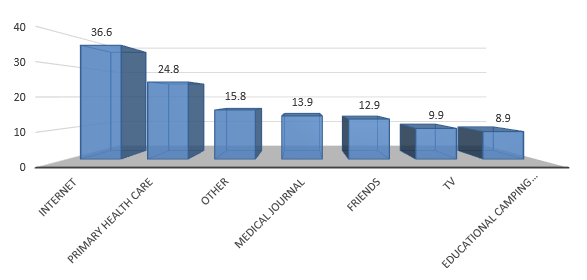
The commonest source of information was internet 37(36.6%), followed by 1ry health care 25(24.8%), Medical journal 14(13.9%) friends 13 (12.9%), TV10 (9.9%) and educational camping public 9(8.9%),  other  sources 16915.8%), as shown in Figure 1.


About 57(56.7%) thought that BC is a hopeless disease. I think I will not live more than 5 years with BC found among 14(13.9%), When I think about BC my heart beat faster found among 49(48.5%). I am afraid even to think about BC 57(56.4%). If I got BC this will threaten my marital life found among 41(40.6%), All my life will be changed if I got BC was agreed by 58(57.4%), I think the problem about BC will persist long agreed among 60(59.4%) of the students, The thought of BC scare me found among 62(61.4%) of the students, as shown in Table 2.


Table 1: The general characteristics

ParametersFrequencyPercent
Marital state
Single8887.1
Married1312.9
Family history of BC
Negative8584.2
Near relatives (Mother/Sister/Daughter)109.9
Far relatives65.9
How often could BSE be done per year
Daily2221.8
Weekly4948.5
Monthly3029.7
How often could mammography be done per year
Daily33.0
Weekly33.0
Monthly3231.7
Once per year4847.5
Don’t know1514.9
When BSE should be performed with regular menses
Regular day of each month1514.9
5th  days after menses5049.5
Do not know3635.6
Have you done BSE before
Yes3938.6
No6261.4
Where do you perform BSE  
Home6059.4
Early detection programs1211.9
Private hospital109.9
Governmental hospital1918.8
The last time performed BSE
Less than 1 month1918.8
Less than 1 year2322.8
More than 1 year3736.6
I don’t Know2221.8


Figure 1: The sources of information


Table 2: The seriousness of breast cancer

SeriousnessStrongly  Disagree/ DısagreeNeutralAgree/ Strongly Agree
FrequencyPercentFrequencyPercentFrequencyPercent
BC is a hopeless disease2221.82221.85756.4
I think I will not live more than 5 years with BC5554.53231.71413.9
When I think about BC my heart beat faster3130.72120.84948.5
I am afraid even to think about BC2625.71817.85756.4
If I got BC this will threaten my marital life3332.72726.74140.6
All my life will be changed if I got BC2524.81817.85857.4
I think the problem about BC will persist long1615.82524.86059.4
The thought of BC scare me1918.82019.86261.4


Table 3: The susceptibility of breast cancer

SusceptibilityStrongly  Disagree/ DısagreeNeutralAgree/ Strongly Agree
FrequencyPercentFrequencyPercentFrequencyPercent
I am susceptible to breast cancer in the future5857.42524.81817.8
I feel that I am susceptible to breast cancer6968.32524.876.9
I think I am susceptible to breast cancer more than anyone7473.31918.887.9
My personal chance of getting breast cancer is big6362.42928.798.9
I am highly susceptible to breast cancer next 10 years1615.81615.86968.3


Table 4: The confidence of breast self-examination

ConfidenceStrongly  Disagree/ DısagreeNeutralAgree/ Strongly Agree
FrequencyPercentFrequencyPercentFrequencyPercent
I know how to perform BSE1110.93332.75756.4
I am confident in performing BSE correctly1514.91514.97170.3
I am sure of the steps of BSE2524.82423.85251.5
I can use the correct parts of my fingers when performing BSE2120.82524.85554.5
I am confident I can discover breast tumors by performing BSE2726.72322.85150.5
I can discover breast tumor at size of big spot3635.62928.77069.3
I can discover breast tumor at size of small peas2928.72928.74342.6
I am able to discover breast tumors alone through performing BSE3534.72423.84241.6
I can discover breast tumor at size of small spot1110.92019.83635.6
I am able to differentiate between normal and abnormal breast tissue through BSE87.965.98786.1
When I look at mirror I can identify abnormal changes in my breast87.91312.98079.2


Regarding the susceptibility of breast cancer: I am susceptible to breast cancer in the future agreed by 18(17.8%) of the students. I feel that I am susceptible to breast cancer agreed by 7(6.9%) of the students. I think I am susceptible to breast cancer more than anyone agreed by 8(9.7%) of the students. My personal chance of getting breast cancer is big agreed by 9 (8.9%) of the students. I am highly susceptible to breast cancer next 10 years agreed by 69 (68.3%) of the students.


Table 5: The benefits of breast self-examination

Benefits1Strongly  Disagree/ DısagreeNeutralAgree/ Strongly Agree
FrequencyPercentFrequencyPercentFrequencyPercent
Performing BSE monthly help in early detection of BC1211.91615.87372.3
Performing BSE monthly help in detection of tumors before going to doctors87.91817.87574.3
Performing BSE monthly will decrease complications of BC if I got it98.91716.87574.3
Performing BSE decrease the chance of making operation if I got it8079.265.91514.9
When I performed BSE I became self-satisfied6968.31514.91716.8
Performing BSE decrease the anxiety about BC5857.41413.92928.7


Table 6: The barriers of breast self-examination

BarriersStrongly  Disagree/ DısagreeNeutralAgree/ Strongly Agree
FrequencyPercentFrequencyPercentFrequencyPercent
Performing BSE is a trivial thing5554.52827.71817.8
Performing BSE is unfavorable thing3736.62423.84039.6
No private place at home to perform BSE5049.51817.83332.7
Feeling of shame and embarrassment when performing BSE76.965.98887.1


Table 7: The bse self-efficacy of breast self-examination

BSE self-efficacy (confidenceStrongly  Disagree/ DısagreeNeutralAgree/ Strongly Agree
FrequencyPercentFrequencyPercentFrequencyPercent
(1) I know how to perform BSE.1211.91716.87271.3
2) I can perform BSE correctly.2019.82120.86059.4
(3) I could find a breast lump by performing BSE.65.92221.87372.3
(4) I am able to find a breast lump that is the size of rather greater filbert.2019.82726.76665.3
(5) I am able to find a breast lump that is the size of a filbert.1312.92221.85453.5
(6) I am able to find a breast lump that is the size of a pea.1211.91716.87271.3
(7) I am sure of the steps to follow for doing BSE.2019.82120.86059.4
(8) I am able to tell something is wrong with my breast when doing breast self-examination.65.92221.87372.3


Regarding the Confidence of Breast Self-examination: I know how to perform BSE agreed by 57(56.4 %) of the students. I am confident in performing BSE correctly agreed by 71(70.3 %) of the students. I am sure of the steps of BSE agreed by 52(51.5 %) of the students. I can use the correct parts of my fingers when performing BSE agreed by 55(54.5 %) of the students. I am confident I can discover breast tumors by performing BSE agreed by 51(50.5 %) of the students.  I can discover breast tumor at size of big spot agreed by 70(69.3 %) of the students. I can discover breast tumor at size of small peas agreed by 43(42.6 %) of the students. I am able to discover breast tumors alone through performing BSE agreed by 42(41.6 %) of the students. I can discover breast tumor at size of small spot agreed by 36(35.6 %) of the students. I am able to differentiate between normal and abnormal breast tissue through BSE agreed by 87(86.1 %) of the students. When I look at mirror I can identify abnormal changes in my breast agreed by 80(79.2 %) of the students, as shown in Table 4. 


Regarding the Benefits of Breast self-examination: Performing BSE monthly help in early detection of BC agreed by 73(72.3 %) of the students. Performing BSE monthly help in detection of tumors before going to doctors agreed by 75(74.3 %) of the students. Performing BSE monthly will decrease complications of BC if I got its agreed by 75(74.3 %) of the students. Performing BSE decrease the chance of making operation if I got it agreed by 15(14.9 %) of the students. When I performed BSE I became self-satisfied agreed by 17(16.8 %) of the students. Performing BSE decrease the anxiety about BC agreed by 29(28.7 %) of the students, as shown in Table 5. 


Regarding the Barriers of Breast self-examination: Performing BSE is a trivial thing disagreed by 55(54.5 %) of the students. Performing BSE is unfavorable thing disagreed by 37(36.6 %) of the students. No private place at home to perform BSE disagreed by 50(49.5 %) of the students. Feeling of shame and embarrassment when performing BSE disagreed by 7(6.9 %) of the students, as shown in Table 6.


Regarding the BSE self-efficacy of Breast self-examination: I know how to perform BSE agreed by 72(71.3 %) of the students. I can perform BSE correctly agreed by 60(59.4 %) of the students. I could find a breast lump by performing BSE agreed by 73(72.3 %) of the students. I am able to find a breast lump that is the size of rather greater filbert agreed by 66(65.3 %) of the students. I am able to find a breast lump that is the size of filbert agreed by 54(53.5 %) of the students. I am able to find a breast lump that is the size of a pea agreed by 72(71.3 %) of the students. I am sure of the steps to follow for doing BSE agreed by 60(59.4 %) of the students. I am able to tell something is wrong with my breast when doing breast self-examination agreed by 73 (72.3 %) of the students, as shown in Table 7.

DISCUSSION

The BSE is an effective and cost-free technique to detect breast anomalies, which occasionally result in breast cancer [21]. In low resourced and destructed health infrastructure areas such as Tikrit in Iraq, access to advanced imaging technologies is a challenge. The BSE serves as an essential alternative and is critical in the early detection of breast tumors. Tikrit University in Iraq, as nursing staff is the first of attachment point with women in the community. Correct information regarding mammography found among 15(14.9%) of the females, this goes with Shkur Azeez in Iraq found that 43.2% of women had information about mammography [22]. In the current study correct knowledge of breast cancer regarding: Monthly BSE to be done per year was reported among 30(29.7%) of the female students, and preferred to done during the 5th day of regular menses by 50(49.5%) of the student answered 5th days after menses. This results goes with Ansari S et al.. [23] only 18.9% of nurses said that it should be done monthly. In contrast a study conducted by Jemebere [24] concluded that 87.7% of the nurses opined that BSE should be performed monthly preferably on 5th or seventh day after menstruation.


About 39(38.6%) of the students performed BSE. This  lower than Baloushah et al. in Palestine 2020  (60%) confirmed they performed BSE before The common place of performing BSE was home 60(59.4%), followed hospital 19(18.8%). The last time performed BSE was less than 1 month in 19(18.8%) [25]. The commonest source of information was internet 37(36.6%), followed by 1ry health care 25(24.8%), Medical journal 14(13.9%) friends 13 (12.9%), TV10 (9.9%) and educational camping public 9(8.9%), other sources 16915.8%). In this study (68.3%) of the students feel they are highly susceptible to breast cancer next 10 years. Regarding the Confidence of Breast Self-examination: knowing how to perform BSE agreed by 57(56.4 %) of the students. confident in performing BSE correctly agreed by 71(70.3 %) of the students. sureness of the steps of BSE agreed by 52(51.5 %) of the students. This in contrast to Akhtari-Zavare M 2014 only 19.6% of the students in Malaysia have been reported to perform BSE. [26]. Regarding the Benefits of Breast self-examination: Performing BSE monthly help in early detection of BC agreed by 73(72.3 %) of the students. Performing BSE monthly help in detection of tumors   before   going to  doctors    agreed  by        75(74.3 %)    of   the   students.


Regarding the Barriers of Breast self-examination: Performing BSE is a trivial thing 18 (17.8 %), unfavorable thing 40 (39.6 %) of the students. No private place at home to perform BSE 33 (32.7%), feeling of shame and embarrassment when performing BSE 88(87.1 %) of the students. While in a study in Palestine done by Baloushah S et al.. 2020 found the barriers were 94 (40%) had the perception that they had no disease and therefore did not need a BSE. Other barriers included the lack of knowledge, 89 (37.9%); the fear of detecting cancer, 23 (9.8%); not thinking it is necessary, 15 (6.4%); the perception that it is time consuming, 6 (2.5%); the feeling that it deviates privacy, 6 (2.5%); and the feeling of embarrassment, 2 (0.9%) [27]. Regarding the BSE self-efficacy: knowing how to perform BSE agreed by 72(71.3 %), can perform BSE correctly agreed by 60(59.4 %) , I could find a breast lump by performing BSE agreed by 73(72.3 %). This results goes with Ansari S et al.. found that 43.3% of the nurses used finger tips to palpate [28].

CONCLUSION

Monthly BSE practice among nursing students was poor. Confidence of Breast Self-examination was good. The performing BSE was considered a trivial thing or unfavorable thing in half of the nursing students. Good percentage of the students considered that performing BSE monthly help in early detection of BC & were knowing how to perform BSE and could find a breast lump by performing BSE.

REFERENCE
  1. Alwan, N.A, et al.. "Knowledge, Attitude & Practice towards Breast Cancer & Breast Self-Examination in Kirkuk University." Asian Pacific Journal of Reproduction, vol. 1, 2012, pp. 308–311.

  2. Othman, A., et al.. "Knowledge, Attitudes, and Practices of Breast Cancer Screening Among Women in Jordan." Health Care for Women International, vol. 36, 2015, pp. 578–592.

  3. Alwan, N.A. "Breast Cancer Among Iraqi Women: Preliminary Findings from a Regional Comparative Breast Cancer Research Project." Journal of Global Oncology, vol. 2, 2016, pp. 255–258.

  4. Al Hashimi, M.M., and X.J. Wang. "Breast Cancer in Iraq: Incidence Trends from 2000–2009." Asian Pacific Journal of Cancer Prevention, vol. 15, 2014, pp. 281–286.

  5. Nada, A.S, et al.. "Comparative Study on the Clinic pathological Profiles of Breast Cancer among Iraqi and British Patients." Open Public Health Journal, vol. 11, 2018, pp. 177–191.

  6. Al Suroj, H.R., et al.. "Awareness and Attitude Among Saudi Females Toward Breast Cancer Screening in Al Ahsa, KSA." Egyptian Journal of Hospital Medicine, vol. 71, 2018, pp. 2516–2522.

  7. Khalili, A.F., and M. Shahnazi. "Breast Cancer Screening (Breast Self-Examination, Clinical Breast Exam, and Mammography) in Women Referred to Health Centers in Tabriz, Iran." Indian Journal of Medical Sciences, vol. 64, 2010, pp. 149–162.

  8. Coleman, C. "Early Detection and Screening for Breast Cancer." Seminars in Oncology Nursing, vol. 33, 2017, pp. 141–155.

  9. Aljohani, S., I. Saib, and M. Noorelahi. "Women’s Performance of Breast Cancer Screening (Breast Self-Examination, Clinical Breast Exam, and Mammography)." Advances in Breast Cancer Research, vol. 6, 2017, pp. 16–27.

  10. Segni, M., et al.. "Breast Self-Examination: Knowledge, Attitude, and Practice Among Female Health Science Students at Adama Science and Technology University, Ethiopia." Gynecology & Obstetrics (Sunnyvale), vol. 6, 2016, p. 368.

  11. Alharbi, N.A., et al.. "Knowledge Awareness and Practices Concerning Breast Cancer Among Kuwaiti Female School Teachers." Alexandria Journal of Medicine, vol. 48, 2012, pp. 75–82.

  12. Noroozi, Azita, Tayyebh Jomand, and Rahim Tahmasebi. "Determinants of Breast Self-Examination Performance Among Iranian Women: An Application of the Health Belief Model." Journal of Cancer Education, vol. 26, no. 2, 2011, pp. 365–374.

  13. Shiryazdi, Seyed Mostafa, et al.. "Health Beliefs and Breast Cancer Screening Behaviors Among Iranian Female Health Workers." Asian Pacific Journal of Cancer Prevention, vol. 15, no. 22, 2014, pp. 9817–9822.

  14. Bener, Abdulbari, et al.. "Do We Need to Maximize the Breast Cancer Screening Awareness? Experience with an Endogamous Society with High Fertility." Asian Pacific Journal of Cancer Prevention, vol. 10, no. 4, 2009, pp. 599–604.

  15. Dandash, Khadiga F., and Abdurrahman Al-Mohaimeed. "Knowledge, Attitudes, and Practices Surrounding Breast Cancer and Screening in Female Teachers of Buraidah, Saudi Arabia." International Journal of Health Sciences, vol. 1, no. 1, 2007, pp. 61–69.

  16. American Cancer Society. American Cancer Society Recommendations for the Early Detection of Breast Cancer. www.cancer.org.

  17. Alwan, Nada A.S., et al.. "Knowledge, Attitude and Practice Towards Breast Cancer and Breast Self-Examination in Kirkuk University, Iraq." Asian Pacific Journal of Reproduction, vol. 1, no. 4, 2012, pp. 308–311.

  18. Gürsoy, Ayla Akkaş, et al.. "The Effect of Peer Education on University Students’ Knowledge of Breast Self-Examination and Health Beliefs." Journal of Breast Health, vol. 5, no. 3, 2009.

  19. Wu, Tsu-Yin, et al.. "Health Beliefs and Practices Related to Breast Cancer Screening in Filipino, Chinese, and Asian-Indian Women." Cancer Detection and Prevention, vol. 30, no. 1, 2006, pp. 58–66.

  20. Shiryazdi, Seyed Mostafa, et al. "Health Beliefs and Breast Cancer Screening Behaviors Among Iranian Female Health Workers." Asian Pacific Journal of Cancer Prevention, vol. 15, no. 22, 2014, pp. 9817–9822.

  21. Mohammadi, E., et al.. "Real-Time Evaluation of Breast Self-Examination Using Computer Vision." Journal of Biomedical Imaging, 2014, pp. 16–20.

  22. Shkur, Azeez S. Knowledge, Attitude, and Practice Towards Breast Cancer, Risk Factors, and Screening Among Iraqi Women. Doctoral dissertation, Karabuk University, 2021.

  23. Ansari, S, et al. "Knowledge and Practice of Breast Self-Examination Among Nursing Staff in Bangalore." Indian Journal of Forensic and Community Medicine, vol. 7, no. 4, 2020, pp. 176–182.


  24. Jemebere, W. "Practice of Breast Self-Examination and Associated Factors Among Female Nurses of Hawassa University Comprehensive Specialized Hospital, South Ethiopia in 2018." 2018.

  25. Baloushah, S., et al.. "Practice and Barriers Toward Breast Self-Examination Among Palestinian Women in Gaza City, Palestine." The Scientific World Journal, 2020, Oct. 2020.

  26. Akhtari-Zavare, M., et al.. "Knowledge of Breast Cancer and Breast Self-Examination Practice Among Iranian Women in Hamedan, Iran." Asian Pacific Journal of Cancer Prevention, vol. 15, no. 16, 2014, pp. 6531–6534.

  27. Baloushah, S., et al.. "Practice and Barriers Toward Breast Self-Examination Among Palestinian Women in Gaza City, Palestine." The Scientific World Journal, 2020, Oct. 2020.

  28. Ansari, S., et al. "Knowledge and Practice of Breast Self-Examination Among Nursing Staff in Bangalore." Indian Journal of Forensic and Community Medicine, vol. 7, no. 4, 2020, pp. 176–182.

License
CC BY-NC-ND
Creative Commons Attribution-NonCommercial-NoDerivatives 4.0 International License
Application of the Health Belief Model in Breast Self- Exam among Tikrit Nursing Student © 2026 by Sarab K. Abedalrahman, Rana J. Shakir, Ashoor R Sarhat, Aseel Q Ali4 and Hiba Sultan, Hiba Sultan licensed under CC BY-NC-ND 4.0
All papers should be submitted electronically. All submitted manuscripts must be original work that is not under submission at another journal or under consideration for publication in another form, such as a monograph or chapter of a book. Authors of submitted papers are obligated not to submit their paper for publication elsewhere until an editorial decision is rendered on their submission. Further, authors of accepted papers are prohibited from publishing the results in other publications that appear before the paper is published in the Journal unless they receive approval for doing so from the Editor-In-Chief.
Himalayan Journal of Applied Medical Sciences and Research open access articles are licensed under a Creative Commons Attribution-Share A like 4.0 International License. This license lets the audience to give appropriate credit, provide a link to the license, and indicate if changes were made and if they remix, transform, or build upon the material, they must distribute contributions under the same license as the original.
Recommended Articles
Research Article
Intellident – Identification System
...
Published: 30/06/2026
Download PDF
Research Article
Dento-Vault: A Universal Cloud-Based Dental Record System for Lifelong, Interoperable Patient Care
...
Published: 23/08/2026
Download PDF
Research Article
Ethnomedicinal Plants for Obesity Management - Phytochemicals, Molecular Targets and Prospects of Green Nanotechnology
Published: 25/03/2026
Download PDF
Research Article
Digital Implantology: Current Concepts, Clinical Applications, Limitations and Future Directions - A Narrative Review
Published: 30/07/2026
Download PDF
Flowbite Logo
Najmal Complex,
Opposite Farwaniya,
Kuwait.
Email: support@himjournals.com

Useful Links
Order Hard Copy
Privacy policy
Terms and Conditions
Refund Policy
Others
About Us
Team Members
Contact Us
Online Payments
Join as Editor
Join as Reviewer
Subscribe to our Newsletter
Follow us
MOST SEARCHED KEYWORDS
scientific journal
 | 
business journal
 | 
medical journals
 | 
Scientific Journals
 | 
Academic Publisher
 | 
Peer-reviewed Journals
 | 
Open Access Journals
 | 
Impact Factor
 | 
Indexing Services
 | 
Journal Citation Reports
 | 
Publication Process
 | 
Impact factor of journals
 | 
Finding reputable journals for publication
 | 
Submitting a manuscript for publication
 | 
Copyright and licensing of published papers
 | 
Writing an abstract for a research paper
 | 
Manuscript formatting guidelines
 | 
Promoting published research
 | 
Publication in high-impact journals
Copyright © Himalayan Journals . All Rights Reserved.