Contents
Download PDF
pdf Download XML
1006 Views
244 Downloads
Share this article
Research Article | Volume 4 Issue 2 (July-Dec, 2023) | Pages 1 - 4
Plate Perspectives: Exploring Dietary Habits among general public of District Shimla Himachal Pradesh
 ,
1
MD Physiology, India
Under a Creative Commons license
Open Access
Received
July 18, 2023
Revised
Aug. 5, 2023
Accepted
Aug. 28, 2023
Published
Sept. 8, 2023
Abstract

Background: Dietary habits significantly impact human health, influencing chronic disease development, energy levels, and mental well-being. The unique landscape of Himachal Pradesh's District Shimla, with its diverse population and cultural influences, provides an ideal setting to investigate dietary patterns and habits. Understanding the dietary landscape in this region is crucial for effective public health interventions and policies. Materials and Methods: A cross-sectional survey was conducted between April and June 2023 in District Shimla, Himachal Pradesh. A sample of 400 adults, residing in both urban (66.75%) and rural (33.25%) areas, participated. Data was collected through a Google Forms questionnaire covering socio-demographics and dietary knowledge. Scoring categorized knowledge levels as very good (25.25%), good (35.75%), fair (21.75%), and poor (17.25%). Statistical analysis employed Epi Info V7 Software. Results: Participants exhibited good knowledge levels in various aspects, with 53.25% familiar with balanced diets, 62% aware of health risks from excessive sugar or salt, and 57.75% understanding elements of a healthy and sustainable diet. However, 70.5% frequently consumed processed or fast food, indicating potential health risks. Only 30% regularly read food labels, emphasizing the need for nutritional education. Furthermore, 24.5% had sought guidance from nutritionists, indicating an untapped resource for dietary improvement. Conclusion: District Shimla residents demonstrated a commendable understanding of dietary aspects, with notable room for improvement in certain areas. Public health initiatives should target reducing processed food consumption, promoting label reading, and encouraging nutritionist consultations. These findings provide a foundation for evidence-based interventions tailored to the region's specific needs, contributing to enhanced overall well-being.

Keywords
INTRODUCTION

Dietary habits play a pivotal role in shaping our health and well-being. The food we consume not only provides us with essential nutrients but also influences the development of chronic diseases, overall energy levels, and even our mental and emotional states. Understanding the dietary habits of a population is fundamental for public health initiatives and policies aimed at promoting healthier lifestyles and preventing nutrition-related health issues [1-3].


Previous research has highlighted the profound impact of dietary habits on health outcomes. Studies have shown that poor dietary choices can lead to a range of health issues, including cardiovascular diseases, obesity, diabetes, and various types of cancer. Furthermore, dietary habits can influence mental health and well-being, with emerging research demonstrating the connection between diet and conditions such as depression and anxiety [4-6].


The dietary landscape is not static; it evolves over time due to various factors like globalization, urbanization, and changing socio-cultural norms. Traditional dietary patterns can blend with modern food choices, creating a dynamic tapestry of eating habits. Therefore, it is imperative to periodically assess the dietary habits of populations to understand the shifts and their potential consequences [5-8].


In the serene and picturesque landscapes of Himachal Pradesh lies District Shimla, a region renowned for its natural beauty and cultural diversity. With a population representing various backgrounds, lifestyles, and traditions, District Shimla provides a unique canvas for exploring the dietary patterns and habits of its residents. The dietary choices made by individuals in this region can be influenced by factors such as local cuisine, climate, and socio-economic conditions.


The objective of this study is to delve into the dietary habits of the general population of District Shimla, Himachal Pradesh. By gauging the levels of awareness and knowledge about dietary habits among its residents, this research endeavors to provide valuable insights that can inform public health interventions tailored to the specific needs of the community.


The findings of this study aim to serve as a foundation for designing evidence-based public health campaigns, nutritional education programs, and dietary interventions tailored to the unique needs of District Shimla's population. By shedding light on the dietary perspectives of this region, we aspire to contribute to the promotion of healthier eating habits and improved overall well-being among its residents.


Objectives of the Study

The objective of this study is to gauge the levels of awareness and knowledge about Dietary Habits among the general population of District Shimla Himachal Pradesh.

MATERIALS AND METHODS

Research Methodology

  • Research Approach: Descriptive

  • Research Design: Cross-sectional survey design

  • Study area: District Shimla, Himachal Pradesh

  • Study duration: between April 2023 to June 2023

  • Study population: The study's target population encompassed all adults aged 18 and above who had been residents of District Shimla for a minimum of 12 months

  • Sample size: A robust sample size of 400 adults was determined using a 95% confidence level, an estimated knowledge level of 50% regarding Dietary Habits, a precise 5% absolute error margin, and a conservative 5% non-response rate 

  • Study tool: A google form questionnaire consisting of questions regarding socio-demography and knowledge regarding Dietary Habits was created. The questionnaire was initially pre-tested on a small number of participants to identify any difficulty in understanding by the respondents

  • Description of Tool:

  • Demographic data survey instrument: The demographic form elicited information on participants’ background: age, marital status, religion, employment, education and many more

  • Questionnaire: The questionnaire contains 20 structured knowledge related questions regarding Dietary Habits. One mark was given for each correct answer and zero for incorrect answer. The maximum score was 20 and minimum score was zero. Scoring was done on the basis of marks as >80% (16-20) = very good,60-79% (12-15) =Good,41-59% (8-11) = Fair, <40% (< 8) = poor

  • Validity of tool: by the experts in this field

  • Data collection: Data was collected under the guidance of supervisors. The google form questionnaire was circulated among the residents of District Shimla, Himachal Pradesh for responses using online modes like e-mail and social media platforms like WhatsApp groups, Facebook, Instagram and LinkedIn till the 400 responses were collected

  • Data analysis: Data was collected and entered in Microsoft excel spread sheet, cleaned for errors and analyzed with Epi Info V7 Software with appropriate statistical test in terms of frequencies and percentage. 

  • Ethical Considerations: Participants confidentiality and anonymity were maintained

RESULTS

The primary objective of this study was to gauge the understanding of Dietary Habits among the general population of Shimla through a non-experimental descriptive survey. A total of 400 participants took part in the study, with 267 (66.75%) residing in urban areas and 133 (33.25%) in rural areas (Table 1).


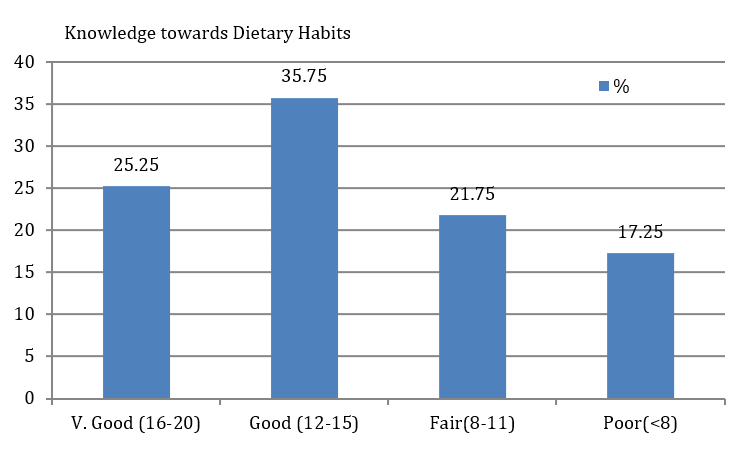
In the present study 25.25% (101) participants had very good knowledge (16-20 marks) towards Dietary Habits, 35.75% (143) had good knowledge (12-15 marks), 21.75% (87) had fair knowledge (8-11 marks) and 17.25% (69) having poor knowledge (<8 marks) (Figure 1).


Figure 1: Knowledge scores towards Dietary Habits among study participants


Table 1: Knowledge regarding Dietary Habits among study participants

S.No.StatementsFrequency of Correct ResponsesPercentage
  1. 1

How would you describe your typical daily diet? Please include the types of foods you commonly consume.

246

61.5

  1. 2

Are you familiar with the concept of a balanced diet? If so, can you briefly explain what it entails?

213

53.25

  1. 3

How often do you consume fruits and vegetables in your daily meals?

173

43.25

  1. 4

Do you have any dietary restrictions based on cultural, religious, or personal reasons?

187

46.75

  1. 5

Are you aware of the recommended daily intake of calories for an average adult?

172

43

  1. 6

What is your understanding of macronutrients like carbohydrates, proteins, and fats and their role in the diet?

149

37.25

  1. 7

Do you frequently consume processed or fast food, and how often?

282

70.5

  1. 8

Are you aware of the potential health risks associated with excessive sugar or salt consumption?

248

62

  1. 9

Have you heard about food allergies or intolerances? If so, can you name some common ones?

182

45.5

  1. 10

What is your knowledge of portion control and its importance in maintaining a healthy diet?

179

44.75

  1. 11

How often do you read food labels and nutritional information when shopping for groceries?

120

30

  1. 12

Are you aware of the significance of staying hydrated and the recommended daily water intake?

181

45.25

  1. 13

Do you think dietary habits play a role in preventing chronic diseases like diabetes, hypertension, or heart disease?

229

57.25

  1. 14

Have you ever sought guidance from a nutritionist or dietitian to improve your dietary habits?

98

24.5

  1. 15

Are you familiar with traditional Himachali dishes and their nutritional value?

228

57

  1. 16

Do you believe that cultural or regional factors influence dietary choices in Himachal Pradesh?

187

46.75

  1. 17

What do you consider to be the most important dietary practices for promoting overall health?

144

36

  1. 18

Are you aware of any local or traditional superfoods or herbs that are commonly used for health benefits?

113

28.25

  1. 19

How does your dietary pattern change with the seasons in Himachal Pradesh?

216

54

  1. 20

In your opinion, what are the key elements of a healthy and sustainable diet?

231

57.75


DISCUSSION

Dietary habits are intrinsic to human life and have profound implications for health and well-being. This study aimed to gauge the understanding of dietary habits among the general population of District Shimla, Himachal Pradesh. The findings provide insights into the knowledge and awareness levels regarding dietary choices and their implications for health within this unique region.


The majority of participants (61.5%) were able to describe their typical daily diets, including common food types. This suggests a reasonable level of awareness regarding personal dietary choices. Given the rich culinary traditions in Himachal Pradesh, it is unsurprising that individuals can articulate their dietary patterns. Moreover, participants acknowledged the influence of cultural and regional factors on their dietary choices, with 46.75% citing dietary restrictions based on cultural, religious, or personal reasons. This highlights the significance of local customs and traditions in shaping dietary habits.


Approximately 53.25% of respondents were familiar with the concept of a balanced diet. Understanding the principles of a balanced diet is crucial for ensuring that individuals receive adequate nutrition. This awareness can serve as a foundation for making healthier food choices and preventing dietary-related health issues. A notable 43.25% reported consuming fruits and vegetables in their daily meals. While this percentage is positive, there is room for improvement, as a diet rich in fruits and vegetables is associated with numerous health benefits. Encouraging increased consumption of these food groups could contribute to better overall health.


About 37.25% of participants demonstrated knowledge of macronutrients like carbohydrates, proteins, and fats and their roles in the diet. Understanding macronutrients is essential for making informed dietary choices. This result suggests that there is potential for enhancing nutritional education in the region.


Alarmingly, 70.5% of participants reported frequent consumption of processed or fast food. Excessive consumption of these foods is associated with various health risks, including obesity and cardiovascular diseases. This finding underscores the need for public health campaigns aimed at promoting healthier eating alternatives. A substantial 62% were aware of the potential health risks associated with excessive sugar or salt consumption. This knowledge is crucial, as it can empower individuals to make informed choices when it comes to their diets.


A significant portion (45.5%) of respondents had heard about food allergies or intolerances. Recognizing these conditions is vital for those affected, as it can help prevent adverse reactions and promote safer food practices. Nearly 44.75% of participants understood the importance of portion control in maintaining a healthy diet. Controlling portion sizes can aid in preventing overeating and weight gain, contributing to better health outcomes.


Only 30% reported regularly reading food labels and nutritional information when shopping for groceries. Increasing awareness of the value of reading labels can empower consumers to make healthier choices and avoid products high in sugar, salt, or unhealthy fats. A relatively low percentage (24.5%) had sought guidance from a nutritionist or dietitian to improve their dietary habits. Encouraging more individuals to consult with nutrition professionals could lead to better dietary practices and health outcomes.


A noteworthy 57% were familiar with traditional Himachali dishes and their nutritional value. Local cuisine can provide valuable nutrition, and this awareness can promote the preservation and promotion of indigenous dietary practices. A significant 54% reported that their dietary patterns change with the seasons in Himachal Pradesh. Adapting diets to seasonal variations can enhance nutrient intake and align with local food availability. An impressive 57.75% recognized the key elements of a healthy and sustainable diet. This awareness bodes well for the promotion of environmentally conscious and nutritious eating habits.


Compared to similar studies conducted in other regions, the levels of knowledge and awareness about dietary habits among the residents of District Shimla appear promising [7-12]. However, certain areas, such as the consumption of processed or fast food, indicate areas for improvement. This study provides valuable insights into the dietary landscape of the region, which can inform targeted interventions.


CONCLUSION

In conclusion, this study sheds light on the dietary knowledge and awareness of the general population of District Shimla, Himachal Pradesh. While there is commendable awareness in some areas, such as dietary restrictions and the potential health risks of excessive sugar and salt consumption, there are opportunities for improvement in other aspects, such as reducing the consumption of processed foods and promoting the reading of food labels.


These findings serve as a foundation for designing evidence-based public health campaigns, nutritional education programs, and dietary interventions tailored to the unique needs of District Shimla's population. By addressing specific areas of knowledge gaps and promoting healthier dietary practices, public health initiatives can contribute to improved overall well-being among its residents.

REFERENCE
  1. Popkin, B.M., Adair, L.S., and S.W. Ng. “Global Nutrition Transition and the Pandemic of Obesity in Developing Countries.” Nutrition Reviews, vol. 70, no. 1, 2012, pp. 3–21.

  2. Mozaffarian, D., and E.B. Rimm. “Fish Intake, Contaminants, and Human Health: Evaluating the Risks and the Benefits.” JAMA, vol. 296, no. 15, 2006, pp. 1885–1899.

  3. Schwingshackl, L., and G. Hoffmann. “Diet Quality as Assessed by the Healthy Eating Index, the Alternate Healthy Eating Index, the Dietary Approaches to Stop Hypertension Score, and Health Outcomes: A Systematic Review and Meta-Analysis of Cohort Studies.” Journal of the Academy of Nutrition and Dietetics, vol. 114, no. 6, 2014, pp. 932–949.

  4. Popkin, B.M. “Relationship Between Shifts in Food System Dynamics and Acceleration of the Global Nutrition Transition.” Nutrition Reviews, vol. 75, no. 2, 2017, pp. 73–82.

  5. Micha, R., Peñalvo, J.L., Cudhea, F., Imamura, F., Rehm, C.D., and D. Mozaffarian. “Association Between Dietary Factors and Mortality from Heart Disease, Stroke, and Type 2 Diabetes.” JAMA, vol. 317, no. 9, 2017, pp. 912–924.

  6. Sarris, J., Logan, A.C., Akbaraly, T.N., Amminger, G.P., Balanzá-Martínez, V., Freeman, M.P., et al. “Nutritional Medicine as Mainstream in Psychiatry.” The Lancet Psychiatry, vol. 2, no. 3, 2015, pp. 271–274.

  7. Ezzati, M., Riboli, E., and O. Canziani. “Climate Change and Chronic Diseases: Action Needs for Public Health.” The Lancet, vol. 379, no. 9838, 2012, pp. 2163–2164.

  8. World Health Organization. Diet, Nutrition, and the Prevention of Chronic Diseases: Report of a Joint WHO/FAO Expert Consultation, 2003.

  9. Lachat, C., Otchere, S., Roberfroid, D., Abdulai, A., Seret, F.M., Milesevic, J., et al. “Diet and Physical Activity for the Prevention of Noncommunicable Diseases in Low-and Middle-Income Countries: A Systematic Policy Review.” PLoS Medicine, vol. 10, no. 6, 2013, e1001465.

  10. Ofori-Asenso, R., and A.A. Agyeman. “Dietary Patterns and the Risk of Obesity, Type 2 Diabetes Mellitus, Cardiovascular Diseases, Asthma, and neurodegenerative diseases.” Critical Reviews in Food Science and Nutrition, vol. 57, no. 16, 2016, pp. 3569–3586.

  11. Afshin, A., Sur, P.J., Fay, K.A., Cornaby, L., Ferrara, G., Salama, J.S., et al. “Health Effects of Dietary Risks in 195 Countries, 1990–2017: A Systematic Analysis for the Global Burden of Disease Study 2017.” The Lancet, vol. 393, no. 10184, 2019, pp. 1958–1972.

License
CC BY-NC-ND
Creative Commons Attribution-NonCommercial-NoDerivatives 4.0 International License
Plate Perspectives: Exploring Dietary Habits among general public of District Shimla Himachal Pradesh © 2026 by Shruti Sharma, Anjana Kaushal licensed under CC BY-NC-ND 4.0
All papers should be submitted electronically. All submitted manuscripts must be original work that is not under submission at another journal or under consideration for publication in another form, such as a monograph or chapter of a book. Authors of submitted papers are obligated not to submit their paper for publication elsewhere until an editorial decision is rendered on their submission. Further, authors of accepted papers are prohibited from publishing the results in other publications that appear before the paper is published in the Journal unless they receive approval for doing so from the Editor-In-Chief.
Himalayan Journal of Applied Medical Sciences and Research open access articles are licensed under a Creative Commons Attribution-Share A like 4.0 International License. This license lets the audience to give appropriate credit, provide a link to the license, and indicate if changes were made and if they remix, transform, or build upon the material, they must distribute contributions under the same license as the original.
Advertisement
Recommended Articles
Research Article
Study of the Role of Serum Interleukin-6 in Inflammation among Pregnant Women with COVID-19
Published: 27/07/2021
Download PDF
Research Article
Evaluation of Serum Heat Shock Protein 70 as a Diagnostic Biomarker for Ectopic Pregnancy: A Comparative Case-Control Study
Published: 28/02/2026
Download PDF
Research Article
Assessing First Trimester Maternal Serum Pentraxin-3 Levels in Primary Unexplained Recurrent Pregnancy Loss: A Case-Control Study
Published: 28/02/2026
Download PDF
Research Article
Bones in Balance: Awareness of Rickets and Nutritional Deficiencies Among the Hamirpur Community
Published: 10/12/2024
Download PDF
Chat on WhatsApp
Flowbite Logo
Najmal Complex,
Opposite Farwaniya,
Kuwait.
Email: kuwait@iarcon.org

Editorial Office:
J.L Bhavan, Near Radison Blu Hotel,
Jalukbari, Guwahati-India
Useful Links
Order Hard Copy
Privacy policy
Terms and Conditions
Refund Policy
Others
About Us
Team Members
Contact Us
Online Payments
Join as Editor
Join as Reviewer
Subscribe to our Newsletter
Follow us
MOST SEARCHED KEYWORDS
scientific journal
 | 
business journal
 | 
medical journals
 | 
Scientific Journals
 | 
Academic Publisher
 | 
Peer-reviewed Journals
 | 
Open Access Journals
 | 
Impact Factor
 | 
Indexing Services
 | 
Journal Citation Reports
 | 
Publication Process
 | 
Impact factor of journals
 | 
Finding reputable journals for publication
 | 
Submitting a manuscript for publication
 | 
Copyright and licensing of published papers
 | 
Writing an abstract for a research paper
 | 
Manuscript formatting guidelines
 | 
Promoting published research
 | 
Publication in high-impact journals
Copyright © iARCON Internaltional LLP . All Rights Reserved.