Background: Reproductive health is integral to overall well-being, emphasizing the significance of proper antenatal and postnatal care for maternal and child health. In the endeavor to enhance maternal and child health outcomes, understanding the knowledge levels of reproductive-age women concerning antenatal and postnatal care becomes crucial. Material and Methods: This cross-sectional study focused on reproductive-age women in District Sirmaur, Himachal Pradesh. Antenatal care, essential for healthy pregnancies, and postnatal care, vital for maternal recovery and neonatal well-being, were the key areas of investigation. A structured questionnaire containing socio-demographic details and 20 knowledge-related questions on antenatal and postnatal care was used for data collection. The study involved 400 participants, drawn from both urban (32.25%) and rural (67.75%) areas of the district. Data analysis utilized Epi Info V7 Software for statistical evaluation. Results: The study revealed that while 36.5% of participants demonstrated very good knowledge (16-20 marks), 41.25% exhibited good knowledge (12-15 marks), 14.5% had fair knowledge (8-11 marks), and 7.75% displayed poor knowledge (<8 marks) regarding antenatal and postnatal care. Key knowledge gaps were identified in specific areas such as the components of antenatal and postnatal care and recognition of warning signs during pregnancy. Conclusion: The study underscores the importance of enhancing women's knowledge about antenatal and postnatal care, addressing the existing gaps through targeted educational interventions. Findings also highlight the influence of demographic factors on knowledge levels. By empowering women with accurate information, healthcare-seeking behaviors can be improved, potential complications detected early, and maternal and child health outcomes elevated.
Reproductive health is a vital component of overall well-being, and ensuring proper antenatal and postnatal care is essential for both maternal and child health. In the pursuit of improving maternal and child health outcomes, it is imperative to assess the knowledge levels of reproductive-age women regarding antenatal and postnatal care [1,2].
Antenatal care encompasses healthcare interventions that are provided to pregnant women to ensure a healthy pregnancy and safe delivery. Adequate antenatal care not only safeguards the well-being of the mother but also significantly contributes to the optimal development of the fetus. On the other hand, postnatal care is crucial for the mother's recovery after childbirth and the early care and support needed for the newborn. This period is critical for detecting and addressing potential complications, as well as promoting exclusive breastfeeding and proper neonatal care [3,4].
Himachal Pradesh, with its unique geographical and demographic characteristics, presents an intriguing context for examining women's knowledge of antenatal and postnatal care. District Sirmaur, nestled in the picturesque landscapes of the state, offers an opportunity to study a semi-urban population where healthcare access and awareness may differ from urban centers. This study seeks to assess the awareness levels, sources of information, and potential gaps in understanding among reproductive-age women in this district.
The findings of this study have the potential to inform policy decisions and guide interventions aimed at enhancing maternal and child health in District Sirmaur.
By identifying gaps in knowledge, healthcare providers, policymakers, and community health workers can develop targeted educational programs that empower women with accurate information about antenatal and postnatal care. Strengthening women's awareness can lead to improved healthcare-seeking behaviors, early detection of potential issues, and overall better health outcomes for both mothers and infants.
Objectives of the Study
To evaluate the knowledge of antenatal and postnatal care among reproductive-age women in District Sirmaur, Himachal Pradesh
Research Methodology
Research Approach: Descriptive
Research Design: Cross-sectional survey design
Study area: District Sirmaur, Himachal Pradesh
Study duration- between April 2023 to June 2023
Study population: All reproductive age group females who were staying in the District Sirmaur, Himachal Pradesh for 12 months or more
Sample size: 400 reproductive age group females, assuming 50% have adequate knowledge regarding antenatal and postnatal care, 5% absolute error, 95% confidence level, and 5% non-response rate.
Study tool: A google form questionnaire consisting of questions regarding socio-demography and knowledge regarding antenatal and postnatal care was created. The questionnaire was initially pre-tested on a small number of females to identify any difficulty in understanding by the respondents.
Description of Tool:
Demographic data survey instrument: The demographic form elicited information on participants’ background: age, marital status, religion, employment, education and many more.
Questionnaire: The questionnaire contains 20 structured knowledge related questions regarding antenatal and postnatal care. One mark was given for each correct answer and zero for incorrect answer. The maximum score was 20 and minimum score was zero. Scoring was done on the basis of marks as >80% (16-20) = very good,60-79% (12-15) = Good,41-59% (8-11) = Fair, <40% (< 8) = poor
Validity of tool: by the experts in this field
Data collection: Data was collected under the guidance of supervisors. The google form questionnaire was circulated among reproductive age group female residents of District Sirmaur, Himachal Pradesh for responses using online modes like e-mail and social media platforms like Whatsapp groups, Facebook, Instagram and Linkedin till the 400 responses were collected
Data analysis: Data was collected and entered in Microsoft excel spread sheet, cleaned for errors and analyzed with Epi Info V7 Software with appropriate statistical test in terms of frequencies and percentage.
Ethical Considerations: Participants confidentiality and anonymity were maintained
The goal of the current study was to evaluate the level of knowledge about antenatal and postnatal care among women of reproductive age in District Sirmaur, Himachal Pradesh. A total of 400 respondents including 109 (32.25%) were from urban area and 291(67.75%) were from rural area were participated in the study.
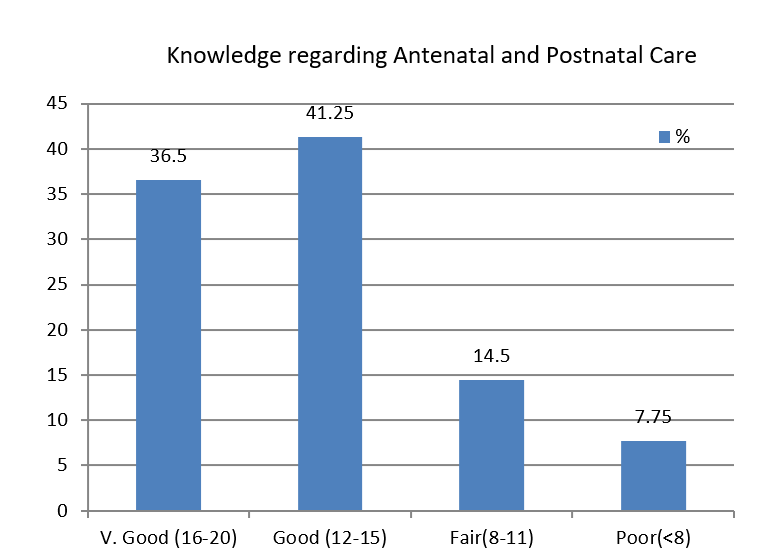
In the present study 36.5% (146) participants had very good knowledge (16-20 marks) towards antenatal and postnatal care, 41.25% (165) had good knowledge (12-15 marks), 14.5% (58) had fair knowledge (8-11 marks) and 7.75% (31) having poor knowledge (<8 marks).
Table-1: Knowledge regarding antenatal and postnatal care among study participants
| S.No. | Statements | Frequency of Correct Responses | Percentage |
What is antenatal care, and why is it important during pregnancy? | 296 | 74 | |
When should a woman start receiving antenatal care? | 289 | 72.25 | |
How often should antenatal check-ups be scheduled during pregnancy? | 293 | 73.25 | |
What are the common tests and screenings conducted during antenatal care? | 264 | 66 | |
How can a healthy diet and lifestyle contribute to a healthy pregnancy? | 272 | 68 | |
What are the key components of antenatal care, such as physical examinations and fetal monitoring? | 209 | 52.25 | |
Can you explain the purpose and benefits of prenatal vitamins and supplements? | 226 | 56.5 | |
What are the warning signs or symptoms during pregnancy that should prompt immediate medical attention? | 247 | 61.75 | |
How can antenatal care help in identifying and managing any potential pregnancy complications? | 253 | 63.25 | |
What is the importance of attending childbirth education classes during pregnancy? | 249 | 62.25 | |
Can you explain the concept of birth plans and their role in antenatal care? | 219 | 54.75 | |
What is postnatal care, and why is it important after giving birth? | 259 | 64.75 | |
How long does the postnatal period typically last? | 197 | 49.25 | |
What are the common physical and emotional changes experienced during the postnatal period? | 221 | 55.25 | |
What are the key components of postnatal care, such as breastfeeding support and postpartum check-ups? | 202 | 50.5 | |
Can you explain the importance of newborn care and vaccinations during the postnatal period? | 275 | 68.75 | |
What are the signs of postpartum depression, and how can it be addressed? | 254 | 63.5 | |
Can you explain the benefits of skin-to-skin contact and bonding with the newborn during the postnatal period? | 249 | 62.25 | |
How can postnatal care support the recovery and well-being of the mother? | 233 | 58.25 | |
What resources and support services are available for antenatal and postnatal care? | 246 | 61.5 |

Figure 1: Knowledge score regarding antenatal and postnatal care among study participants
The findings of this cross-sectional study provide valuable insights into the knowledge levels of reproductive-age women in District Sirmaur, Himachal Pradesh, regarding antenatal and postnatal care. The assessment of knowledge regarding these crucial aspects of reproductive health is essential to tailor interventions that can improve maternal and child health outcomes.
The study's results reveal a diverse range of knowledge levels among the participants. While 36.5% of respondents demonstrated very good knowledge, indicating a robust understanding of antenatal and postnatal care concepts, there remains room for improvement, with 14.5% exhibiting fair knowledge and 7.75% having poor knowledge. This variation suggests the need for targeted educational initiatives to bridge existing gaps and enhance overall awareness.
The study's results align with previous research conducted in diverse geographical settings, emphasizing that antenatal and postnatal care knowledge is influenced by factors such as education, socio-economic status, and access to healthcare resources [5,6]. Comparable studies have reported similar proportions of participants with inadequate knowledge about antenatal and postnatal care, highlighting the persistence of knowledge gaps that must be addressed [7,8].
It is encouraging that the majority of participants were able to correctly identify the importance of antenatal care during pregnancy, indicating a foundational understanding of its significance. Similarly, a substantial number of respondents recognized the value of postnatal care in ensuring the well-being of both mother and newborn. However, certain specific aspects of antenatal and postnatal care, such as the components of physical examinations, the purpose of prenatal vitamins, and signs of postpartum depression, demonstrated lower levels of comprehension.
The study's findings underscore the need for focused efforts to enhance knowledge regarding these specific areas. Community-based educational programs that emphasize the importance of regular antenatal check-ups, proper nutrition, and early recognition of potential complications could significantly contribute to improving overall maternal and child health outcomes. Moreover, highlighting the benefits of postnatal care for both the physical and emotional well-being of mothers can encourage women to seek timely and appropriate care during the postpartum period.
The results of this study also emphasize the potential influence of various demographic factors on knowledge levels. Previous research has shown that education and socio-economic status play a pivotal role in determining health-related knowledge among women [9]. Designing interventions that consider these factors, along with cultural and contextual nuances, is imperative for creating effective strategies that empower women with accurate information.
In conclusion, this cross-sectional study sheds light on the knowledge levels of reproductive-age women in District Sirmaur, Himachal Pradesh, regarding antenatal and postnatal care. The findings indicate a mixed range of understanding, highlighting the importance of tailored educational interventions to address existing knowledge gaps. By bolstering women's knowledge of antenatal and postnatal care, stakeholders can contribute to improved healthcare-seeking behaviors, early identification of complications, and ultimately better maternal and child health outcomes.
World Health Organization. WHO Recommendations on Antenatal Care for a Positive Pregnancy Experience. Retrieved from https://www.who.int/publications/i/item/9789241549912. Accessed 15 July 2023.
World Health Organization. Postnatal Care for Mothers and Newborns. Retrieved from https://www.who.int/maternal_child_adolescent/documents/postnatal-care-recommendations/en/. Accessed 15 July 2023.
Directorate of Economics and Statistics, Government of Himachal Pradesh. Himachal Pradesh Socio-Economic Indicators 2020. Retrieved from http://des.hp.gov.in/content/area-profile. Accessed 16 July 2023.
Jat, R.L., and N. Ng. “Factors Affecting the Use of Maternal Health Services in Madhya Pradesh State of India: A Multilevel Analysis.” International Journal for Equity in Health, vol. 10, no. 1, 2011, pp. 59.
Chalise, B., Chalise, M., Bista, B., Pandey, A.R., and P. Thapa. “Knowledge and Perception of Antenatal Care Services among Pregnant Women in Kathmandu, Nepal.” Open Journal of Epidemiology, vol. 9, no. 4, 2019, pp. 180–189.
Abebe, F., Birhanu, D., and T. Awoke. “Assessment of Antenatal Care Utilization and Associated Factors among Pregnant Women in Gondar Town, Northwest Ethiopia.” Hindawi Publishing Corporation Journal of Pregnancy, vol. 2015, 2015, pp. 1–7.
Idowu, O.A., Mafiana, C.F., and S. Dapo. “Knowledge and Practices of Antenatal Care among Pregnant Women at the Lagos University Teaching Hospital, Nigeria.” African Journal of Primary Health Care & Family Medicine, vol. 2, no. 1, 2010, pp. 1–6.
Mekonnen, F.A., Ambaw, Y.A., and T.S. Nigussie. “Quality of Antenatal Care Services and Completion of Four or More Antenatal Care Visits in Ethiopia: A Finding Based on a Demographic and Health Survey.” PLoS ONE, vol. 13, no. 2, 2018, e0197149.
Abate, K.H., and T. Belachew. “Women’s Autonomy and Men’s Involvement in Child Care and Feeding as Predictors of Infant and Young Child Anthropometric Indices in Coffee Farming Households of Jimma Zone, South West of Ethiopia.” PLoS ONE, vol. 12, no. 1, 2017, e0168562.