The use of heritage-led urban development to promote sustainable urban regeneration through place making, preservation of urban identity, promoting tourism and nurturing creative economic development is growing. Street naming is considered to be heritage preservation in South African urban development. Whilst most studies have investigated name origins and driving forces behind street renaming, what is missing is an academic account of the citizens’ narratives and interpretations behind these names. The aim of the study was to assess people’s urban memory and investigate whether they share the same perceptions with the government of preserving heritage through street names. This study assessed how people interpret street names in Newtown, Johannesburg. The study adopted a qualitative approach and a case study research design. Data collection was conducted through face-to-face interviews, observations and archival research (social media and newspaper archives). Convenient and purposive sampling methods were used to recruit participants. Thematic analysis was used to present findings of the study. Finding from the study revealed that street renaming coupled with selective criteria for preserving heritage and limited awareness programs may not be the best way to preserve heritage. The study suggested several recommendations to enhance heritage preservation through street naming.
Keywords
Heritage Preservation
Street Naming
Renaming
Urban Landscapes
INTRODUCTION
Place or locality naming or renaming foreground is gaining significant attention in contemporary urban development [1]. Historically, place names were a subfield of linguistics, but emerging literature now examines place naming as part of spatial planning affairs [2]. Place names can be used in urban planning to chronicle the history and heritage of a place thereby reinforcing heritage-led urban development [3].
The toponyms (place names) and odonyms (street names) of some countries were customised by colonisers, where they would get rid of the indigenous names to replace them with names that represented their identities, culture and ideologies [4]. This implies that the colonial names enabled colonisers to develop an aggregate settler memory and instilled a sense of collective identity. It presented a quest to shape geographic connectedness of the colonisers’ missions, origins and philosophies. The demise of colonisation in some countries led to various socio-political changes and amongst these changes has been the renaming of entities or toponymy adjustment [5]. This suggests that political elites within states may use toponymic processes like Commemorative Street naming, to wipe away traces of previous political regimes and advance new notions of identity and memory. Thus, place and street renaming can be an affirmation of African political regime dominance and ownership of the newly liberated urban spaces [6]. For instance, the name ‘Zimbabwe’, replaced ‘Southern Rhodesia’ [7] which symbolises the historical greatness of the Shona homeland and its archaeological site called ‘Great Zimbabwe’. Other postcolonial societies outside Africa also changed names: In Vietnam, Saigon changed to Ho Chi Minh City; in Indonesia, Batavia changed to Jakarta and in India Bombay changed to Mumbai [8].
South Africa’s names were influenced to some extent by the ruling parties of both the apartheid and post-apartheid governments [8]. This also suggests that South Africa might have drawn its inspiration from other post-colonial states. One significant element of the apartheid era in South Africa was the use of colonial names on streets, towns, cities, dams, rivers, game reserves, roads and [9]. For example, many roads, buildings, airports and dams were named after the Nationalist Party leaders such as J. Smuts, B. Schoeman, J. Strijdom, D. Malan, L. Botha, P. Sauer and H. Verwoerd [10]. After gaining independence in 1994, the South African government embarked on a program to rename places and streets in honour of its political activists and artists [11]. It followed the reconstitution of the National Place Names Committee (NPNC), in 1998 into the South Africa Geographical Names Council (SAGNC) (Department of Arts and Culture 1998) and the issuing of new guidelines: Handbook on Geographical Names [12]. According to the Handbook, the aims of renaming were to eliminate duplication; rectify orthographic errors; accord official recognition to place names commonly used by residents; and to sensitise toponyms to South Africa’s democratic values and diverse history.
In Johannesburg and in particular Newtown, a lot of places, organisations, businesses and spaces have been branded using African names (afro-branding) in order to attract customers [13]. Places like Newtown and companies like Cell C have Afro-branded themselves by using celebrities like Miriam Makeba, Ntemi Piliso, Kippies Moeketsi and artists in streets and adverts. It is also noted that in the post-1994 South Africa, Afro-branding is used as part of rhetoric to inform comp. anies’ brand identity while other entities use it “as part of their poignant illustration of their sympathies and association with the new political class” [13].
Ever since place and street renaming was actively pursued in South Africa some cities are still dealing with tensions and debates regarding the goals of renaming [14]. Due to tensions and debates on street renaming opposition groups surfaced opposing the renaming process [15]. Opposing parties suspect that the goal is to perpetuate the propaganda of ANC cadres and hold the perception that the renaming process aims to discriminate and disregard certain races in South Africa [16]. The study examines the urban memory of citizens to assess whether street names preserve heritage in Newtown. The study assesses how the general public interprets these street names. The assessment is conducted through the lenses of heritage preservation, specifically intangible heritage which encompasses folklore, urban memory, oral history, traditions, language and indigenous knowledge. The study assesses how street naming captures heritage preservation in an area which was designated as a cultural precinct in early 2000.
MATERIALS AND METHODS
Methodologically, the study followed a qualitative research approach. [17] states that qualitative research method sought to gain a deeper insight and/or more information about the problem studied. In this study, the case study was Newtown. The researcher utilized the case study design to obtain in-depth information about heritage preservation through street naming in Newtown. In this case study of Newtown, more specifically the existing cultural and recent street renaming settings are very important elements of the context. Data collection was conducted through face-to-face interviews, observations and archival research (social media and newspaper archives). The people who participated in the interviews can be divided into three groups. The first group consists of a purposively sampled group of participants who participated in the “Naming Jozi” walking tour on the 25th of August 2019 in which the researcher participated too. The second group consists of people who were in Newtown streets at that specific time whether vending, walking, relaxing and any other activities. Convenience sampling was employed to select this second group of participants. The third group consisted of business owners in Newtown. The researcher recruited those who voluntarily agreed to be part of my study. Open ended and closed questions were utilised in the study.
Thirty-eight participants were recruited in the study and thirty-eight face to face interviews were conducted in Newtown. An interview schedule was used as a tool to collect data. Most participants were between the age ranges of 20 to 44 years. Only 3 participants were over the age of 60 years. There were 17 whites’ participants and 21 black participants, 24 were females and 14 were males. For the purposes of this study only, the term ‘Newtown citizens’ is used to refer to all these participants of my study. Observations were conducted before, during and after conducting the interviews. During the walks, the researcher would observe and take pictures of any streets, buildings and public places which might be of interest. Social media was also used to collect data, through retrieving online Facebook responses that speak to street renaming. Social media platforms were consulted because these are platforms where people are allowed to express their opinions and perceptions publicly. Newspaper articles sought from the Johannesburg Heritage Foundation, Parktown were consulted during data collection. I consulted all the articles about Newtown streets renaming that I found there.
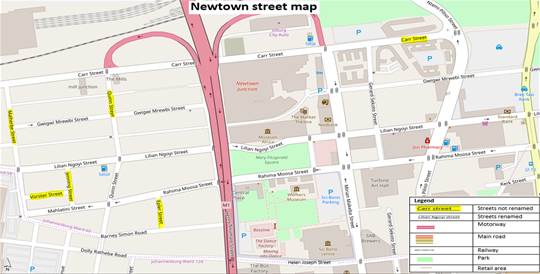
Newtown is located to the western side of Johannesburg inner city. The Newtown Cultural Precinct extends from the railway lines and Kazerne yards to the northern direction, towards Dolly Rathebe Street in the south, Quinn Street to the west and Ntemi Piliso Street to the eastern direction. The northbound M1 freeway is the division between Newtown and Fordsburg in the west, whilst the railway lines to the north divide Newtown and Braamfontein. Both Albertina Sisulu Street and the Johannesburg Central Police Station form the border with Ferreira’s Town in the southern boundary [18]. The Nelson Mandela Bridge is often referred to as the gateway to Newtown from the northern direction. Newtown cultural precinct also houses a number of activities for dance, music, art, photography and crafts. It houses tourist attractions, heritage landmarks, entertainment centres, restaurants, cultural organisations, residential areas and shopping malls [19]. Some of Newtown’s key attractions include the Market Theatre, SAB World of Beer, Dance Factory and the Bassline [20]. According to the 2011 Census, Newtown has a population of 2505 [21]. Data analysis and presentation involve bringing order, structure and meaning to the collected data [22]. Responses from the interviews were recorded using a tape recorder and taking down notes. Thematic Content Analysis (TCA) was used to analyse data. TCA helps to cluster and distil raw data into a list of common themes [23]. In addition to the interview data analysis, I also analysed some perceptions from social media (Facebook) regarding street renaming in Newtown.
RESULTS AND DISCUSSION
Data Analysis, Findings and Results
This section presents the data analysis, findings and results from the data collection process conducted in Newtown to address the research objectives. Hereunder follows a discussion of the emerging themes from the collected data.
Understanding the Street Renaming Process Conducted in Newtown
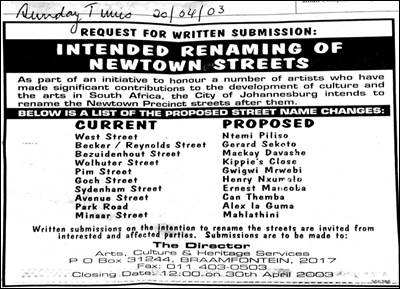
To address this theme, the researcher reviewed some articles which discussed how the street naming process was conducted in Newtown. In addition, the researcher interviewed participants on streets on how they were engaged in the street renaming process. From my newspaper archival research, I discovered that there were 2 phases of renaming streets in Newtown. The first phase started in 2003 [24]. The second one started in 2013 a period where South Africa was preparing to celebrate its 20th anniversary of obtaining democracy [25]. In 2003, the City of Johannesburg issued out a notice requesting interested and affected parties to forward written submissions on its proposal to rename 10 streets in Newtown. Figure 1 shows the City of Johannesburg’s request for written submissions from affected parties in 2003 which was published in the Sunday Times on 20 April 2003.
Figure 1: City of Johannesburg’s request for written submission [26]
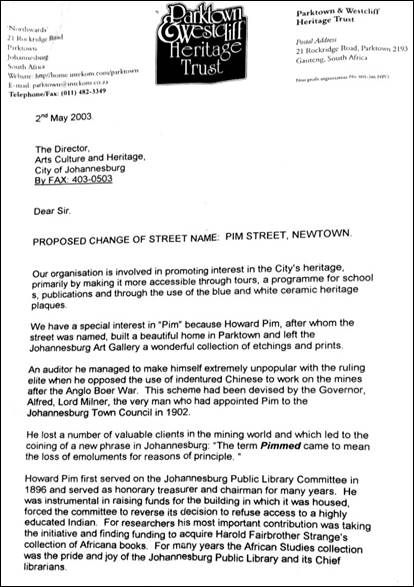
However, there were some objections towards some of the proposed names. For instance, from Figure 2 the Parktown & Westcliff Heritage Trust (PWHT) felt that it was important to retain Pim Street. The image below shows an extract of their written submission to the Director of Arts and Culture in 2003 which highlighted Howard Pim’s significant work in Johannesburg.
Figure 2: Extract of a letter to retain Pim Street [27]
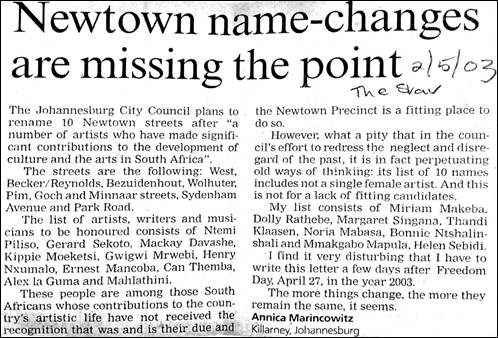
In this letter dated 2 May 2003 the Parktown & Westcliff Heritage Trust (PWHT) articulated how Pim had improved the Johannesburg Art gallery and how he raised funds for the city’s library. In addition to that, several articles were also published in the press raising concerns on the proposed street names. For instance, a letter to the Star Newspaper on 02 May 2003 written by Annica Marincowitz (a member of the public) entitled “Newtown name-changes are missing the point” raising gender-based concerns on the street renaming process. A copy of the letter is presented in Figure 2.
The article shown in Figure 3 was voicing the absence of gender representation in the proposed street names because the proposed names consisted of male artists [28]. The streets names which were eventually selected reflect that the City of Johannesburg later on considered some of the concerns which were raised by the public. There are two issues that I observed or that emerged from the articles shown above. I observed that the City of Johannesburg (CoJ) was responsive to some concerns raised by the public after its notice to rename. For instance, initially Bezuidenhout Street was supposed to be renamed to Mackay Davashe, but it was eventually renamed to Miriam Makeba Street. Sydenham Street was supposed to be renamed to Ernest Mancoba Street, but after concerns raised, it was renamed to Noria Mabasa Street. Secondly what also emerges from the newspaper archives is that some concerns were not considered. For instance, PWHT requested Pim Street to be retained, their proposal was rejected. This shows that only concerns which were supporting street renaming were the ones being recognised rather than those who were appealing to retain names.
Figure 3: A newspaper article raising gender inconsideration on street renaming in Newtown [28]
According to Samuels [29], street naming can be a contested space based on who has the power to determine whose history should be commemorated. In this case, City of Johannesburg had the ultimate power to make the final decision. Furthermore, the responsive public participation process by CoJ is contrary to what some participants articulated. For instance, respondent 11 felt that the public participation process was not robust enough because she was not involved. I think the CoJ should have multiple public participation platforms to try and involve most people. In addition, commemorative street renaming is also controversial because, “the commemoration of one’s past can often cause the de-commemoration of another,” [29]. In this case, although Howard Pim conducted substantial work as indicated by PWHT, Gwigwi Mrebwi had also carried out significant work that CoJ could not ignore. Therefore, in relation to Alderman’s observation the commemoration of Gwigwi Mrebwi caused the de-commemoration of Howard Pim, implying that the process is highly contested and not always even.
To initiate the second phase of the renaming process, in July 2013 a report was compiled by the City of Johannesburg (CoJ) outlining the suggested street name changes in honour of women icons namely Lilian Ngoyi, Helen Joseph and Rahima Moosa respectively [25]. These street names in honour of female icons were responding to some concerns about gender issues. Four streets namely Bree Street, President Street, Jeppe Street and Pritchard Street were identified for renaming [30] After identification of streets, a notice of intention to rename was then published in The Star, Sowetan and Beeld newspapers in 2014. Responding to CoJ’s notice of intention the Johannesburg Heritage Foundation requested that Pritchard Street be retained and here is an extract of their response:
“PRITCHARD, we believe should be retained as he was a land-surveyor and we have so little appreciation for the enormous contribution made by land-surveyors in defining exact details of the land since it is described by survey, [31].”
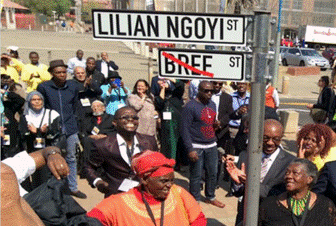
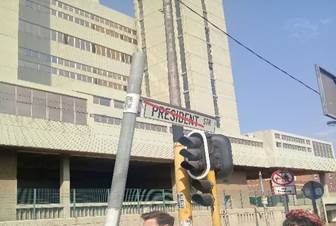
Currently Pritchard Street still exists in Newtown, implying that this request to retain Pritchard Street was accepted. So, in 2015 three more streets were renamed in Newtown namely: Bree Street to Lilian Ngoyi Street, President Street to Helen Joseph Street and Jeppe Street to Rahima Moosa Street [25]. Some of the streets which were renamed are shown in Figures 4,5 and 6. Table 1 is also showing the name changes of the streets of Newtown.
Table 1: A chronicle of the street names of Newtown
Old street name
Current street name
Becker street
Thorpe Becker was a director of gold mining companies in apartheid South Africa
Gerard Sekoto street
Sekoto was one of the pioneers of modern South African art. The Johannesburg Art Gallery honored him in 1989 with a retrospective that covered 50 years of his work. South Africa remained alive in his paintings throughout his life. Sekoto died in 1993.
Minaar street
Johannes Christofel Minaar was the Registrar of Deeds (1849-1914) in Johannesburg
Mahlathini street
Joseph Nkabinde, better known as Mahlathini, was one of the best musicians to emerge from South Africa. He single-handedly branded mbaqanga as the formidable music genre it is today.
Bezuidenhout street
The Bezuidenhout family-owned farms in Johannesburg. For instance, F.J. Bezuidenhout Sen was the owner of the then Doornfontein farm and FJ Bezuidenhout Jun owned the Turffontein farm
Miriam Makeba street
Makeba a musician, nicknamed “Mama Africa" has long been identified as the voice of South Africa's anti-apartheid movement and spent decades in exile before white rule finally ended in the country in 1994. She added to "the overall struggle and effort to achieve change.
Goch street
George Henry Goch was the mayor of Johannesburg
(1904-1905)
Henry Nxumalo
Henry Nxumalo nicknamed ‘Mr Drum” was a South African journalist from the drum magazine. He was arrested for writing about apartheid prisoners’ life. He also wrote a regular column for the Pitsburg Courier, educating US readers about the realities of the South African apartheid era.
Wolhuter street
Presumably named after FM Wolhuter who played an important role in the mining affairs of Witwatersrand and as a member of Diggers committee
Margaret Mcingana
Mcingana was a musician. The music of Margaret Mcingana filled the gaping hole left by the banning of the music of Miriam Makeba, Hugh Masekela and a number of other activist musicians during the 1970s. Also, well-known her haunting voice in the South African television series Shaka Zulu. Mcingana died in 2000.
West Street
The street was located on the western boundary of Johannesburg Central
Ntemi Piliso street
Ntemi was a musician in the early 1950 known as Bra Ntemi with his Alexandra All Star Band blending African American music with the sounds and ethos of township life. Ntemi’s African Jazz Pioneers survived the apartheid era and, after 1990, started to headline jazz venues and festivals all over Africa and Europe.
Pim street
James Howard Pim (1862-1934) was a Johannesburg Councillor between 1903 and 1907, more or less the time Newtown was established
Gwigwi Mrebwi street
Mrebwi was a fiery alto saxophonist of the 1950s who achieved international acclaim. Affectionately known as 'Bra Gwigwi', he played for The Jazz Maniacs and in the African opera King Kong. The saxophone legend died in the 1970s.
Sydenham street
Presumably named either after the Rand Pioneer Easton Southwell Cox Sydenham who arrived in 1888 or commemorating the London district of Sydenham.
Noria Mabasa street
Noria Mabasa is an internationally renowned sculptress. The only sculptress from the Venda area in Limpopo province where she was born in 1938. Her sculptures mainly focused on traditional issues pertaining to women. Her works are displayed in museums across South Africa and in Netherlands, Belgium and USA.
Avenue Road
Based on a historic avenue of trees which was in Fordsburg
Dolly Rathebe road
Dolly Rathebe was a South African activist musician, actress and investigative journalist who tragically passed away in 2004. Dolly Rathebe helped popularize the Sophia town jazz scene around Johannesburg in the 1950s.
Park Road
Based on the character of Fordsburg in its early days, where the road starts from. It was in the form of a park.
Barney Simon road
Barney Simon was a South African writer, playwright and director. In 1976, he co-founded The Market Theatre in Johannesburg and it soon became the first multiracial cultural center in South Africa.
Bree Street
The translation of this common Dutch street name is “Broad Street”. Although Bree Street is not wider than the other streets which were measured up at the time and does not serve as a descriptive name
Lilian Ngoyi street (1911-1980)
Lilian Ngoyi was an anti-apartheid activist who was under house arrest for 16 years, Ngoyi was banned from attending and participating in any social or political gatherings, becoming the person who spent the longest period under house arrest. She was part of the heroines who led the 20 000 strong Women’s’ Freedom March to the Union Buildings in Pretoria in 1956.
Jeppe Street
Jeppe Street was named in honour of the prominent pioneering family of Julius Jeppe Snr. and his sons. Sir Julius Jeppe (1859-1929) was a mining and property magnate, knighted in 1922 for his pioneering role in the development of Johannesburg
Rahima Moosa Street
Rahima Moosa lived together with her husband and fellow-activist, Dr. “Ike” H.M. Moosa and her family still lives at this address. Together with Sophie de Bruyn, Rahima Moosa, Helen Joseph and Lilian Ngoyi, these heroines led the 20 000 strong Women’s’ Freedom March to the Union Buildings in Pretoria in 1956.
President street
This street is known to have been named in honor of President S.J.P. Kruger and it has also been suggested that this was expected to be the most important street in Johannesburg.
Helen Joseph Street
The late Helen Joseph was under house arrest for many years. She was part of the heroines who led the 20 000 strong Women’s’ Freedom March to the Union Buildings in Pretoria in 1956.
Source: [20,34,35]
Figure 4: Bree Street to Lilian Ngoyi Street
Figure 5: President to Helen Joseph Street
Figure 6: Newtown street map showing streets renamed and streets not renamed
Participants’ Knowledge on the Icons Behind the Street Names and Newtown as A Cultural Precinct
Knowledge on Icons behind Street Names: All the 38 participants confirmed that they had noticed the street name changes in Newtown. However, no one was able to specifically indicate the old name and new name of a specific street. Instead, they were able to highlight collectively the old street names and the new street names, for instance, I quote one respondent saying:
“I cannot remember the old name for Lilian Ngoyi Street, but I can tell you that we were used to Pim Street, Jeppe Street, Bree Street, but now its Lilian Ngoyi Street, Helen Joseph Street and Miriam Makeba Street. Even in other towns the general pattern is now Lilian Ngoyi Street, Helen Joseph Street and Albertina Sisulu Street,” (Respondent 19, 2019).”
When asked about which history they know about the icons behind the street names, most participants indicated the artistic side of the icons. For instance, 27 of the participants indicated they knew Miriam Makeba as a musician. Hopwever, 3 participants over the age of 60 explained how Miriam Makeba. Lilian Ngoyi and Helen Joseph had contributed to the anti-apartheid activism. Two participants indicated that Noria Mabasa was a sculptress and 3 indicated that Dolly Rathebe was a musician. However, 20 participants further indicated that they felt that the selection criteria of icons honoured was biased towards ruling party politics. I quote one respondent, aged 63, who said:
“These names are African National Congress (ANC) political agendas to honour their cadres. What if the Democratic Alliance (DA) comes into power and start renaming the streets for the second time? (Participant 10, 2019)”
This response shows that some participants felt that the selection criteria of icons honoured was biased towards ANC affiliated people. In my own opinion, I agree that the selection criteria maybe biased, but I still think the icons’ contributions to the country still deserve to be honoured. This is because street naming depends on who has the power to determine whose history should be commemorated [29]. Even if a new political party comes into power and starts renaming based on its own party-affiliated activists, I believe the contributions of those icons will still be valuable. Even when [36], states that the commemoration of one icon can result in the abandonment of another, I believe this is based on who has the power to rename and that moment and time.
Most young participants indicated that they knew that the streets were named after the anti-apartheid activists, however they did not know exactly how these icons had contributed to the anti-apartheid activism and I quote one respondent who said:
“My grandmother only told me that ‘these streets were named after anti-apartheid activists’. Personally; I do not really know what exactly these so-called activists did to deserve to be on our streets. Maybe we should be told what they did so that we appreciate too, (Participants 22, 2019)”
Besides indicating that the old street names were shorter, all participants did not have any knowledge about the icons behind the old street names. I think this is because in most cases the old streets names were coined in honour of people who held government positions before 1994 in South Africa rather than those who had outstanding contributions in different fields. For instance, Goch Street, had been named after George Henry Goch who was the Mayor of Johannesburg from 1904 to 1905 [34]. Unlike in the current street names, where some of the icons were outstanding journalists, musicians, sculptors and anti-apartheid activists which gives the names more exposure to diverse populations. For instance, Miriam Makeba was both a musician and anti-apartheid activist; Noria Mabasa was an internationally renowned sculptress; Henry Nxumalo was an international journalist who kept countries like United States well-informed on the realities of the South African apartheid era [35]. This means that it is not easy for citizens to remember icons based on their former government positions but rather after their significant artistic contributions in different fields. This also explains why the born-frees would not have been aware of the apartheid contributions, but at least were aware of the artistic side of these icons. For instance, some were able to indicate that Miriam Makeba, Ntemi Piliso and Mahlathini were musicians. It also speaks to the scale of iconic contributions being recognised by the street renaming processes. If I compare the scales of iconic contributions that I mentioned above, the renaming process pre-1994 recognised icons with lower scale of contributions as compared to post-1994. It suggests that the lower the scale of contribution, the lower the levels of being remembered by the public.
Knowledge of Newtown as a Cultural Precinct
In-terms of perceiving the whole of Newtown as a cultural precinct, there were mixed feelings. Twenty-four participants indicated that they felt that Newtown was a cultural precinct because of the existence of a number of elements like: a collection of old buildings which offer services like music, dancing, theatre and the existence of art in the town. I quote one respondent aged 23 who said:
“What attracts me to Newtown is art. I think Newtown is a cultural precinct because art reflects our culture. For me there should be art to every activity that one can do; Be it dancing, acting, singing, painting or even accounting, there should be art on how it is done. That is why the Dance Factory and the Market theatre attract me to Newtown more often, (Participants 24, 2019)”
I also quote another one who said:
“I visit Newtown because I love the Jazz that is played at Niki’s Oasis Restaurant Jazz Lounge. They have maintained playing deep and real jazz there, unlike the jazz that is played at the Orbit in Braamfontein which is not really ‘cool’ for oldies like us, (Participants 30, 2019)”
On the other hand, some participants felt that the cultural infrastructure is there, but what lacks is the connection among the citizens, infrastructure and the cultural spaces. I quote one respondent who said:
“Of course, as I am walking now, I see Museum Africa, I see the Market theatre, I see these wooden carved heads and paintings on walls but still Newtown is just cold for me. I do not feel that energy and buzz of what they call the cultural precinct (Participants 13, 2019)”
Most of the above responses reflect that that people perceive the elements of a cultural precinct as tangible heritage like music, cultural buildings and art in Newtown although some may not connect to it. In most instances, part of the identity of a cultural precinct is normally around tangible heritage and historic buildings as suggested by [37]. In addition, a study conducted by [38] in Newcastle listed the cultural strengths of a town as exceptional projects; established institutions; structurally sound buildings and arts organisations deciding to locate there.
No one mentioned that they perceive street names as elements of a cultural precinct. Some responses to support this include responses like:
“……. It is just a street name that I will use to reach my destination! (Participant 3, 2019)
I cannot say these street names give me memories besides reminding me that we are now in a democratic South Africa… (Participant 28, 2019)
The time that I spend in the streets is too little to immerse myself…. (Participant 16, 2019)”
From the above extracts, it means some people perceive street names as location markers only, perceive new street names as indicators of change in ruling power and do not have enough time to interact with street spaces to such an extent that they can relate with them. Based on the above extracts, although the implementers of street renaming intended to preserve heritage, the public does not share the same sentiments. I think this suggests that the heritage behind the street names might be there, but it is too passive or rather inactive to elicit responses from people.
Participants’ Memories Incited by the Previous and Current Street Names
Three participants older than 60 years had memories of the street names whilst the other 27 indicated that they did not have any memories incited by the street names. However, from the three participants aged 60 and above one lady indicated that she did not have any specific connection with any street in Newtown but rather Pretoria and I quote:
“The only street I connect with is not in Newtown but Sophia Williams-De Bruyn Street in Pretoria. I felt this connection when we marched along Sophia Williams-De Bruyn as women in 2016. When I saw all those women and listened to the emotional speeches, I started imagining all the work that she did at a young age and this pushed me to even research more about her afterwards. The march left some kind of heaviness in my heart, (Participant 30, 2019)”
The street the respondent was referring to, is named after Sophia Theresa Williams de Bruyn who was the youngest (18 years old) amongst women who led the march of 20 000 women on the Union Buildings to protest against the requirement that women carry pass books. The respondent participated in the 2016 Women’s Day march which honoured women who led the 1956 march. The 2016 march was a joyous and emotional occasion especially during the unveiling of the Living Women’s monument. The monument was composed of statues of Lilian Ngoyi; Helen Joseph; Rahima Moosa; with Sophia Williams de Bruyn unveiling her own statue in an emotional gesture. One of the aims of the statues was to take people through apartheid, patriarchy and segregation thereby cutting across racial lines and urban-rural divisions.
One significant element from this response, is that commemorative celebrations drive evocations between people and spaces. For instance, Sophie de Bruyn Street was renamed in 2012, yet this woman only felt a connection 4 years later due to the women’s march. This relates to how [39] iterates that events can be used as a means of augmenting the image of cultural infrastructure. This also speaks to six participants who indicated that Newtown had cultural infrastructure, but they did not feel any connection with it. This therefore means that there might be a need to timeously conduct occasions or functions which remind people on the cultural infrastructure surrounding them.
One significant issue that emerged is that street names act as reminders of change to the elderly rather than evoking memories. I quote one respondent who said:
“I cannot say these street names give me memories besides reminding me that we are now in a democratic South Africa. My memory normally gets refreshed when I watch something that I can relate to on television about the apartheid or when my grandchildren bring their homework about apartheid to me. (Participant 28, 2019)”
By just seeing the local names on the streets, this respondent is reminded of the transition from the apartheid period to a democratic South Africa. This means that she is being reminded of how political power has shifted to Africans. This is in line with what [6] emphasize when they describe that street renaming in Africa is an affirmation of the Africans' political dominance and ownership of newly liberated urban space.
From this response street names are perceived as time-period markers. Further than that, they do not really evoke any memories. The response also indicates that media and people can actually evoke memories better than street names. The majority of participants (27) indicated that although they saw the new street name changes, they did not really have any memories incited by the street names and I quote one respondent who said:
“When I drive down Albertina Sisulu Street, it is not like I am going to have a history lesson about Albertina Sisulu. It is just a street name that I will use to reach my destination! (Participant 3, 2019)”
This respondent feels that street names are just place markers rather than memory evokers. This response concurs with [40] who indicates that the primary function of street names is for easy manoeuvring around localities. This means that the respondent appreciates the primary function of street names. A large number of ‘born-frees’ felt that the street names are just names, which do not evoke memories. I think this is also influenced by the absence or inadequacy of occasions and infrastructure that brings memories.
I quote another one who said:
“The time that I spend in the streets is too little to immerse myself in memories because I will be moving from one point to the other. You see, it is easy for me to relate to spaces or buildings where I spend more time rather than streets I just pass by. I remember how I got so much interest in knowing more about Gandhi the day I saw people taking pictures next to his statue at Gandhi square (Participant 16, 2019).”
This response is indicating that even if people would be interested in reflecting more on the street names, the time spent on streets is too little. In fact, there is nothing about the street name that can attract people to stay longer in that street. In my own opinion, heritage which does not initiate any form of interaction with the people is dormant. This means that heritage preservation should not only end after setting up heritage structures or resources. Instead, planners should move a step further to activate the heritage resources so that they do not remain passive.
Overall Perceptions regarding the Street Renaming Process in Newtown
Responses from the Interviews: From the interviews, three main issues were raised about the general perceptions regarding the renaming process that is most business owners felt that they were not adequately consulted; lack of knowledge regarding the icons behind the street names; and lack of knowledge on the criteria used to select the people behind the street names. I quote one respondent who said:
“It is hard to judge whether these icons deserve to be commemorated or not, because I do not know these people’s stories. Maybe if given a chance to learn their history and engage I could also appreciate, (Participant 15, 2019)”
The above response shows that the respondent admits that she does not know the history of the honoured icons, but she is willing to learn and engage or participate if given the opportunity.
Some business owners interviewed in 2019 said:
“Aren’t we supposed to get personal communications as people who work up and come here to our properties every day, what does the law say? (Participant 34, 2019)
I saw the newspaper advert but I was out of Newtown. I still remember how I complained why they didn’t provide an email address rather than only providing a postal address. (Participant 33, 2019)
…. How about we do it vice versa. We propose names first then we ask the municipality for inputs. Now that’s real engagement. (Participant 35, 2019)”
The above responses from business owners indicate different concerns on how they were consulted. The concerns include request to receive personal communications, request to open up for more engagement modes and lastly restructuring the engagement process.
Furthermore, 20 participants added that they felt that the renaming process was not really necessary because the country should focus on pressing problems rather than street naming. I quote one passionate participant who said:
“I embrace change gladly especially when it improves the quality of life for those who need it most. Trying to eliminate the whites' part in the history of this country will not change anything. These new street names have not improved our lives. We are hungry and we have no jobs, yet no one asked us whether we need new street names or food. Why waste money for those long names instead of improving livelihoods. (Participant 18, 2019).”
The above response was from a 28-year-old young woman who was very bitter because of being unemployed. She felt that South Africa has bigger problems to tackle rather than naming streets. The element of inadequate citizen participation in the renaming process is reflected when she said, “no one asked us.” She also touched on the issue that the current names are very long as compared to the old names.
Overall Perceptions regarding the Street Renaming Process in Newtown from Social Media
Although the Facebook threads selected fall under “street renaming Joburg/Jozi CBD,” there are some streets which span through both Johannesburg CBD and Newtown. For instance, Lilian Ngoyi Street and Rahima Moosa Street pass through both Newtown and Johannesburg CBD.
Therefore, it is correct to indicate that the extracts presented below also represent views for street renaming Newtown. However, the views might not represent or be generalised for everyone because:
Not everyone uses Facebook
They are not specific to Newtown but combine both Newtown and Johannesburg CBD
These Facebook discussions emerged in March and October 2015 after the two phases of renaming streets from 2003 to 2013 in Newtown were complete. From the two threads, one Facebook user would update a status to inform others or to express how he/she feels about the renaming process. The other Facebook friends would then comment below the first status update to express how they feel about the renaming process. The extracts are presented in Figure 7.
From the above thread a Facebook user updated a Facebook status as follows:
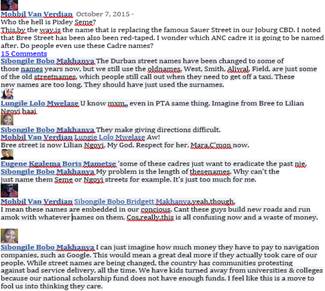
Figure 7: A Facebook thread (07/10/15) on street renaming in Johannesburg CBD (identities hidden for ethical reasons)
“Who the hell is Pixley Seme? This, by the way is the name that is replacing the famous Sauer Street in our Joburg CBD. I noted that Bree Street has also been red-taped. I wonder which ANC cadre it is going to be named after. Do people even use these cadre names?”
Both Pixley Seme and Bree streets pass through Newtown and Johannesburg CBD. From the above Facebook status update, I sense an irritated voice. Although the person did not know the history of the Pixley Seme, he/she felt that street renaming was biased towards political parties and wondered if people even used the new street names. The second Facebook thread is presented in Figure 8.
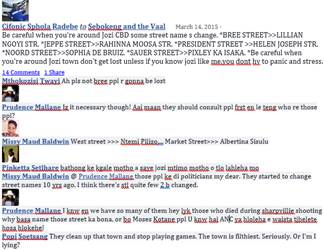
From the thread in Figure 8, a Facebook status was updated as follows:
Figure 8: A Facebook thread (14/03/15) on street renaming in Johannesburg CBD (identities hidden for ethical reasons)
“Be careful when you are around Jozi CBD of some street name changes. Bree street to Lilian Ngoyi; Jeppe street to Raheem Moosa; President Street to Helen Joseph Street……. Be careful when you are around Jozi Town. Don’t get lost unless you know Jozi like me……….”
From the above Facebook status update, the person was informing other people about the changes in street names in Johannesburg CBD. The person raised a concern about getting lost easily due to the new street names.
Looking at the responses that followed from both Facebook, extracts the main issues raised were that:
The new names are too long e.g. from Sauer Street to Pixley Seme Street
The new names make giving directions very difficult.
Renaming streets is wasting money, the government should focus on pressing problems like improving basic service delivery
People felt that they were not consulted
You can get lost easily due to the new street names
People felt that there are better people who can be honoured instead of the current ones
In short, most of the participants on the social media extract shared negative sentiments towards street renaming. Some of the sentiments are similar to those which were raised in face-to-face interviews. For instance; the renaming of streets is considered biased towards political parties and wasting resources on renaming. This indicates that most people were not happy with the renaming process. From my own view, the issues raised above are linked to concerns on how public participation was conducted. For instance, if the majority of people were aware, they would have indicated that the government should focus on basic service delivery rather than new street names. In addition, I also share the same sentiments of the names being too long. I still think using the surnames and initials would shorten them.
CONCLUSION
Considering the dynamics of contemporary urban planning, one cannot ignore how heritage preservation is being used as an urban regeneration and place making strategy. The focus was on assessing whether street naming is a good way to preserve heritage towards urban regeneration and place making in Newtown. The study found out that the citizens’ urban memory did not show that street names are preserving heritage in Newtown. Participants indicated that the current names do not serve any other purpose besides being detectors of change of new government coming into power.
Participants indicated that they were not involved in the process and they well not well-informed about the history of the icons being honoured. Instead, participants indicated music, cultural buildings and art in Newtown as part of heritage preservers rather than the street names. As I explained earlier, I think the main issue here is that the street renaming process conducted was lacking interms of its citizen engagement and heritage awareness methods.
Therefore, the study recommended that any renaming proposals in the pipeline should be paused for now and an immediate heritage evaluation process should be conducted. In addition, recommendations were also suggested to keep the public well-informed about heritage especially the youth to achieve heritage preservation through street naming. These include installation of QR coded blue plaques; online documentation of the history of icons behind the new street names; conducting public awareness programs; as well as reviewing the current ratio of old street names to new street names in future. Communication of issues should be published on multiple platforms so as to reach the public and thereby increasing public participation. Public awareness programs should be put in place and conduct follow-up awareness programs to inform citizens. Future studies can also focus on how all these suggestions can be implemented to improve the preservation of heritage.
REFERENCE
Madden, D.J. “Pushed off the map: Toponymy and the politics of place in New York City.” Urban Studies, 2017. ISSN 0042-0980.
Rose-Redwood, R. et al. “Geographies of toponymic inscription: New directions in critical place-name studies.” Progress in Human Geography, vol. 34, no. 4, 2010, pp. 453–470.
Abramowicz, Z. and L. Dacewicz. “Changes in urbanonymy of north-eastern Poland in the context of statehood transformation.” Acta Onomastica, vol. 51, no. 2, 2010, pp. 417–429.
Manatsha, B.T. “The politics of renaming ‘colonial’ streets in Francistown, Botswana.” Historia, vol. 59, no. 2, 2014, pp. 269–288.
Alderman, D.H. and J. Inwood. “Street naming and the politics of belonging: Spatial injustices in the toponymic commemoration of Martin Luther King Jr.” Social & Cultural Geography, vol. 14, no. 2, 2013, pp. 211–233.
Raento, P. and C.J. Watson. “Gernika, Guernica, Guernica?: Contested meanings of a Basque place.” Political Geography, vol. 19, no. 6, 2000, pp. 707–736.
Bopda, A. “De l’usage de fonds mythiques dans les remaniements territoriaux en Afrique et au Cameroun.” Cahiers de géographie du Québec, vol. 45, no. 126, 2001, pp. 451–478.
Guyot, S. and C. Seethal. “Identity of place, places of identities: Change of place names in post-apartheid South Africa.” South African Geographical Journal, vol. 89, no. 1, 2007, pp. 55–63.
Chauke, M.T. Mavito ni nkoka wa wona eka xiTsonga. Unpublished honours dissertation, xiTsonga Department, University of the North, Pietersburg, 2015.
Jenkins, E.R. et al. Changing Place Names. Durban: Indicator Press, 1996.
Duminy, J. “Street renaming, symbolic capital and resistance in Durban, South Africa.” Environment and Planning D: Society and Space, vol. 32, no. 2, 2014, pp. 310–328.
Republic of South Africa. Handbook on Geographical Names. Department of Arts and Culture, 2002.
Sihlongonyane, F. Cultural turn. Lecture, Philosophies, Theories and Methodologies of Development Planning Module, University of Witwatersrand, Faculty of Architecture and Planning, Room A4, 24 Apr. 2019.
Forrest, C. “What’s in a name? A feminist reflection on street name changes in Durban.” Agenda, Routledge, 2019.
Ndletyana, M. “Changing place names in post-apartheid South Africa: Accounting for the unevenness.” Social Dynamics: A Journal of African Studies, vol. 38, no. 1, 2012, pp. 87–103.
Areff, A. “Street names should recognise all heroes. Concourt hears.” 2016.
Bless, C. and C. Higson-Smith. Fundamentals of Social Research Methods. Cape Town: Juta, 2006.
Shand, K. Newtown: A cultural precinct—real or imagined. Doctoral dissertation, 2010.
Newtown Management District (NMD). AGM Report 2009–2010. Johannesburg, 2010.
Newtown Heritage Trail (NHT). The History of Newtown. 2019, www.newtown.co.za/heritage/history. Accessed 18 Mar. 2019.
Statistics South Africa (Stats SA). Census 2011: Statistical Release (revised). 2011, www.statssa.gov.za/publications/ P03014/P030142011.pdf. Accessed 20 Jun. 2019.
De Vos, A.S. et al. Research at Grassroots. 4th ed., Pretoria: Van Schaik Publishers, 2015.
Braun, V. and V. Clarke. “Using thematic analysis in psychology.” Qualitative Research in Psychology, vol. 3, no. 2, 2006, pp. 77–101.
Gaule, S. “Alternating currents of power: From colonial to post-apartheid spatial patterns in Newtown, Johannesburg.” Urban Studies, vol. 42, no. 13, 2005, pp. 2335–2361.
Maluleke, T. “‘Goodbye Bree Street.’” The Mail and Guardian, 20 Aug. 2019, https://mg.co.za/article/2015-11-27-00-goodbye-bree-street.
Johannesburg Heritage Foundation (JHF). The History of Newtown Archival Records. 2019.
Marincowitz, A. “Newtown name-changes are missing the point.” The Star, 2 May 2003.
Alderman, D.H. “Street names as memorial arenas: The reputational politics of commemorating Martin Luther King in a Georgia county.” Historical Geography, vol. 30, 2002, pp. 99–120.
Samuels, S. “‘New street names set for Joburg.’” The Sandton Chronicle, 31 July 2018, https://sandtonchronicle. co.za/102221/new-street-names-set-for-joburg/.
Olawale, L.O. Urban cultural tourism in the city of Johannesburg Metropolitan Municipality and its potential benefits to economic growth. Doctoral dissertation, University of Pretoria, 2016.
Nyamwanza, S. Assessing heritage preservation in post-apartheid urban landscapes: Insights from the street names of Newtown. Master’s dissertation, 2019.
Smith, A.H. Johannesburg Street Names: A Dictionary of Street, Suburb and Other Place Names Compiled to the End of 1968. Juta, 1971.
Buitendach, J. Naming Jozi Walking Tour. Past Experiences Private Limited, 25 Aug. 2019.
Azaryahu, M. “German reunification and the politics of street names: The case of East Berlin.” Political Geography, vol. 16, no. 6, 1997, pp. 479–493.
Sack, S.J. The Director of Johannesburg Directorate of Art, Culture and Heritage Services. Interview by Magic H. Mbhiza, 2011.
Bailey, C. et al. “Culture-led urban regeneration and the revitalisation of identities in Newcastle, Gateshead and the North East of England.” International Journal of Cultural Policy, vol. 10, no. 1, 2004, pp. 47–65.
Hannigan, T.R. et al. “A new tool for policymakers: Mapping cultural possibilities in an emerging AI entrepreneurial ecosystem.” Research Policy, vol. 51, no. 9, 2022, p. 104315.
Haggett, P. Geography: A Modern Synthesis. London: Harper and Row Publishers, 1979.
License
Creative Commons Attribution-NonCommercial-NoDerivatives 4.0 International License
All papers should be submitted electronically. All submitted manuscripts must be original work that is not under submission at another journal or under consideration for publication in another form, such as a monograph or chapter of a book. Authors of submitted papers are obligated not to submit their paper for publication elsewhere until an editorial decision is rendered on their submission. Further, authors of accepted papers are prohibited from publishing the results in other publications that appear before the paper is published in the Journal unless they receive approval for doing so from the Editor-In-Chief.
Himalayan Journal of Humanities and Cultural Studies open access articles are licensed under a Creative Commons Attribution-Share A like 4.0 International License. This license lets the audience to give appropriate credit, provide a link to the license, and indicate if changes were made and if they remix, transform, or build upon the material, they must distribute contributions under the same license as the original.
Recommended Articles
Research Article
Development of a Blended Learning Model to Increase Learning Effectiveness at University
Hairul ,
...
Darman Manda
Published: 10/12/2022
Download PDF
Cite
x
APA
None, H., Tolla, I. & Manda, D. (2022). Development of a Blended Learning Model to Increase Learning Effectiveness at University. Himalayan Journal of Humanities and Cultural Studies, 3(2), None-None.
MLA
None, Hairul, Ismail Tolla and Darman Manda. "Development of a Blended Learning Model to Increase Learning Effectiveness at University." Himalayan Journal of Humanities and Cultural Studies 3.2 (2022): None-None.
Chicago
None, Hairul, Ismail Tolla and Darman Manda. "Development of a Blended Learning Model to Increase Learning Effectiveness at University." Himalayan Journal of Humanities and Cultural Studies 3, no. 2 (2022): None-None.
Harvard
None, H., Tolla, I. and Manda, D. (2022) 'Development of a Blended Learning Model to Increase Learning Effectiveness at University' Himalayan Journal of Humanities and Cultural Studies 3(2), pp. None-None.
Vancouver
Hairul H, Tolla I, Manda D. Development of a Blended Learning Model to Increase Learning Effectiveness at University. Himalayan Journal of Humanities and Cultural Studies. 2022 Jul;3(2):None-None.
Download PDF
Research Article
A Study on the Current Situation and Innovation Strategies of Museum Cultural and Creative Product Development: taking Shanghai Museum as an Example
Shuyou Shi
Published: 30/04/2024
Download PDF
Cite
x
APA
Shi, S. (2024). A Study on the Current Situation and Innovation Strategies of Museum Cultural and Creative Product Development: taking Shanghai Museum as an Example. Himalayan Journal of Humanities and Cultural Studies, 5(1), 1-8.
MLA
Shi, Shuyou. "A Study on the Current Situation and Innovation Strategies of Museum Cultural and Creative Product Development: taking Shanghai Museum as an Example." Himalayan Journal of Humanities and Cultural Studies 5.1 (2024): 1-8.
Chicago
Shi, Shuyou. "A Study on the Current Situation and Innovation Strategies of Museum Cultural and Creative Product Development: taking Shanghai Museum as an Example." Himalayan Journal of Humanities and Cultural Studies 5, no. 1 (2024): 1-8.
Harvard
Shi, S. (2024) 'A Study on the Current Situation and Innovation Strategies of Museum Cultural and Creative Product Development: taking Shanghai Museum as an Example' Himalayan Journal of Humanities and Cultural Studies 5(1), pp. 1-8.
Vancouver
Shi S. A Study on the Current Situation and Innovation Strategies of Museum Cultural and Creative Product Development: taking Shanghai Museum as an Example. Himalayan Journal of Humanities and Cultural Studies. 2024 Jan;5(1):1-8.
Download PDF
Research Article
The Role of SEAMEO CECCEP in Creating Accessibility to Early Childhood Education in Indonesia
Ratna Wulan,
Elisabeth A. Satya Dewi
Published: 01/08/2024
Download PDF
Cite
x
APA
Wulan, R. & Dewi, E. A. S. (2024). The Role of SEAMEO CECCEP in Creating Accessibility to Early Childhood Education in Indonesia. Himalayan Journal of Humanities and Cultural Studies, 5(2), 1-8.
MLA
Wulan, Ratna and Elisabeth A. S. Dewi. "The Role of SEAMEO CECCEP in Creating Accessibility to Early Childhood Education in Indonesia." Himalayan Journal of Humanities and Cultural Studies 5.2 (2024): 1-8.
Chicago
Wulan, Ratna and Elisabeth A. S. Dewi. "The Role of SEAMEO CECCEP in Creating Accessibility to Early Childhood Education in Indonesia." Himalayan Journal of Humanities and Cultural Studies 5, no. 2 (2024): 1-8.
Harvard
Wulan, R. and Dewi, E. A. S. (2024) 'The Role of SEAMEO CECCEP in Creating Accessibility to Early Childhood Education in Indonesia' Himalayan Journal of Humanities and Cultural Studies 5(2), pp. 1-8.
Vancouver
Wulan R, Dewi EAS. The Role of SEAMEO CECCEP in Creating Accessibility to Early Childhood Education in Indonesia. Himalayan Journal of Humanities and Cultural Studies. 2024 Apr;5(2):1-8.
Download PDF
Research Article
Stamp Game Intervention to Overcome Numeracy Difficulties in Slow Learner Children
Florentina Nining Hastiani,
Adnani Budi Utami
Published: 30/05/2024
Download PDF
Cite
x
APA
Hastiani, F. N. & Utami, A. B. (2024). Stamp Game Intervention to Overcome Numeracy Difficulties in Slow Learner Children. Himalayan Journal of Humanities and Cultural Studies, 5(1), 1-4.
MLA
Hastiani, Florentina N. and Adnani B. Utami. "Stamp Game Intervention to Overcome Numeracy Difficulties in Slow Learner Children." Himalayan Journal of Humanities and Cultural Studies 5.1 (2024): 1-4.
Chicago
Hastiani, Florentina N. and Adnani B. Utami. "Stamp Game Intervention to Overcome Numeracy Difficulties in Slow Learner Children." Himalayan Journal of Humanities and Cultural Studies 5, no. 1 (2024): 1-4.
Harvard
Hastiani, F. N. and Utami, A. B. (2024) 'Stamp Game Intervention to Overcome Numeracy Difficulties in Slow Learner Children' Himalayan Journal of Humanities and Cultural Studies 5(1), pp. 1-4.
Vancouver
Hastiani FN, Utami AB. Stamp Game Intervention to Overcome Numeracy Difficulties in Slow Learner Children. Himalayan Journal of Humanities and Cultural Studies. 2024 Jan;5(1):1-4.
Nyamwanza, S. (2023). Perceptions of Commemorative Street Renaming: A Case Study of Newtown Cultural Precinct, South Africa. Himalayan Journal of Humanities and Cultural Studies, 4(1), 1-12.
MLA
Nyamwanza, Shylet. "Perceptions of Commemorative Street Renaming: A Case Study of Newtown Cultural Precinct, South Africa." Himalayan Journal of Humanities and Cultural Studies 4.1 (2023): 1-12.
Chicago
Nyamwanza, Shylet. "Perceptions of Commemorative Street Renaming: A Case Study of Newtown Cultural Precinct, South Africa." Himalayan Journal of Humanities and Cultural Studies 4, no. 1 (2023): 1-12.
Harvard
Nyamwanza, S. (2023) 'Perceptions of Commemorative Street Renaming: A Case Study of Newtown Cultural Precinct, South Africa' Himalayan Journal of Humanities and Cultural Studies 4(1), pp. 1-12.
Vancouver
Nyamwanza S. Perceptions of Commemorative Street Renaming: A Case Study of Newtown Cultural Precinct, South Africa. Himalayan Journal of Humanities and Cultural Studies. 2023 Jan;4(1):1-12.


 Download PDF
 Download XML