The onboarding program has been acknowledged as beneficial to help new employees reach the onboarding levers. The onboarding levers consist of Self-efficacy, Role Clarity, Social Integration, and Knowledge of the Culture (Bauer, 2010). It helps new employees have an emotional connection with the organization, so it could decrease leavers under three months. But after almost a year after its grand launch, the completeness rate of the onboarding program has remained at less than 40%. It might be because the organization is not ready to implement the program yet. This research uses using descriptive analysis method. The data was collected by taking a survey to 741 participants, using Likert Scale with a scale 1 (Strongly Disagree) to 6 (Strongly Agree) and open-ended questions. And interviewed 6 participants to get a deeper understanding of why the onboarding program did not implement as expected. The result of the research is 75% ready to implement the onboarding program. they have awareness, desire, knowledge, and ability to implement the program. But there are some other factors not mentioned in the ADKAR concept that makes the program did not go as expected. Not prioritizing to complete the program is one factor that makes the implementation rate remain low. It could be aligned with the managers who didn’t pay enough attention to their team to complete the tasks. Besides, technical issues of the program such as duration, administration process, competencies of the buddy, out-of-date material, and application issues can also make the employee not do it properly.
Keywords
Onboarding program
Readiness to change
New employee
Onboarding effectiveness
Onboarding
ADKAR
INTRODUCTION
Organizations have recognized that onboarding, as the first stage of the employee cycle, plays an important role in creating success for both the organization and the employee itself. The Onboarding Program has been shown to socialize newcomers and increase their knowledge, skills, and abilities (KSA) upon completion [2]. This program is an attempt by the organization to introduce a new employee to what working for the organization will be like [3]. For the organization, recruiting, selecting, and training new employees is a significant expense. Hence, the onboarding program is a crucial process that, if executed effectively, leads to positive outcomes, such as higher job performance and organizational renewal [1]. Some research studies show that new hires leave the organization early during the first three months of employment [2]. Employees leave an organization for various reasons, with poor onboarding being a primary driver, as the new employees miss the emotional connection with the organization [1]. Onboarding is the element that helps employees transition from being an outsider to an insider by gaining the knowledge, skills, and abilities to be successful [5]. According to the Society of Human Resource Management (SHRM) data from surveys and exit interviews, most employees state they leave within the first two years because of poor onboarding, lack of training, and few advancement opportunities in the organization. These three elements create a psychological contract between the employee and the organization and are part of the employee lifecycle.
The banking industry is special; they must run their business based on prudential principles. The function of banks in Indonesia is basically as financial intermediaries that take deposits from surplus units and channel financing to deficit units (www.ojk.go.id). In terms of operational definition, banks in Indonesia are classified into non-Sharia and Sharia-based commercial banks. Banking is a highly regulated industry. In Indonesia, they are supervised by Bank Indonesia and Otoritas Jasa Keuangan.
One of the Sharia-based banks in Indonesia is Bank Syariah National. Unlike other banks, they have a unique core business, which focuses on women's empowerment and financial inclusivity. But just like other banks, they are also being supervised by Bank Indonesia, OJK, and the Sharia Supervisory Board. As a highly regulated organization, employees in the banking industry must be equipped with basic skills and knowledge in Sharia banking. Bank Syariah National is a Sharia-based bank with a unique core business. For financing businesses, they focus on women's empowerment, especially for those who are categorized as unbanked or from pre-prosperous economic backgrounds. They provide venture capital financing for women who have small businesses or are just about to start their small businesses. With this kind of business, Bank Syariah National is spread mostly in rural areas across Indonesia. Bank Syariah National’s financing customers don't need to go to the bank; customers are collected and gathered in one group. Every financial transaction is done in their surroundings. To serve the customers, Bank Syariah National now has more than 10,000 employees who have been placed in their branches across Indonesia. Just like the customers, the employees who serve financing customers are also women aged between 18 and 30 years old. They are assigned to maintain relationships with customers, starting from the acquisition process to the maintenance process, including receiving installments and conducting financing transactions with customers. Their work hours are mostly spent mobile, moving from one village to another. This type of job requires requirements close to those of a salesperson.
In the workforce of financing business, 78% of employees is range between 18-29 years old, mostly classified as Generation Z. Generation Z is the cohort group born after 1995 [6]. Generation Z wants to start working as soon as they are board, as they are career-ambitious, and prefer real-time feedback. The findings from the study are in line with Fratricova and Kirchmayer. In their research on Generation Z’s motivation observed that the uninteresting nature of work, work overload, and working with no sense of purpose are the barriers to motivation. Similarly, they identified that career advancement, career growth, and continuous learning act as motivating factors. Generation Z wants to have a clear understanding of the organization’s values, vision and strategic goals. Therefore, the initial onboarding has to set the stage in helping the new hires understand the values and objectives of the organizations and need to reinforce the values, so they are aligned to organization values. Generation Z believes that it is a mandate for the organizations to provide flexibility as it only increases productivity and efficiency [7], and such a flexible work arrangement should be open and unreserved for all levels of employees. Frequent discussions with the managers build a strong foundation of trust, enabling them to operate flexible working arrangements. Lanier defines Generation Z as more pragmatic, in a way that if work is not affected, there should be no reason to reject flexibility. A participant responded, stating that she would not like to spend her time on office work. Generation Z is a lot more ambitious than the other cohorts and generally does not settle for the status quo [7]. They like to take up challenging work, as they are self-confident, self-directed, and reliant on self-learning. To meet the learning styles of Generation Z, organizations need to adapt to technology, provide hands-on experience, offer self-learning courses, and be comfortable with this tech-savvy and on-the-go group. Generation Z would not like to do a job for which they are not hired. Such employees tend to leave the organization during the initial months of joining the organization. There are certain expectations that both the organization and the employees need to fulfill; therefore, they should engage in a psychological contract, and the violation of such an arrangement leads to poor performance and high turnover. Organizations that know how to engage this group are bound to be successful.
In Bank Syariah national, the Onboarding Program has been developed to fulfill new employee needs. It has proven that the program can decrease turnover rate, especially for those under 6 months of service. Unfortunately, the fulfillment rate of the onboarding program is below 50%. From an initial and informal survey by the author, since it is a new program, it is happening because employees didn't know the benefit of the onboarding program and its importance.
Organizational readiness for change is considered a critical precursor to the successful implementation of complex changes [7]. To implement something new in the organization, they will need organizational readiness to change. Organizational readiness to change has three components: Individual readiness to change, Communication of Change, and Change-Efficacy [7]. Consequently, the definition of readiness to change as "the beliefs, feelings, and intentions of individuals regarding the extent to which change is needed and the capacity of organizations to successfully implement change" was more suitable with the multidimensional concept in [8].
Research shows that organizations that engage in formal onboarding by implementing step-by-step programs for new employees to teach them what their roles are, what the norms of the company are, and how they are to behave are more effective than those that do not [1]. The Onboarding Program in Bank Syariah National had been piloted since August 2022 and was fully established in January 2023. This program is designed for new community officers, where they can learn about their job in 4 phases within 3 weeks. The first week is for phases 1 and 2: introduction and observation, where the new employee is welcomed by their superior and introduced to their buddy, who is their senior in the office. Their buddy will assist them in doing their daily job properly by observing their senior in doing their job. The second week is for the accompanying phase, where the new employee starts to try doing their job and is supervised by their buddy or other seniors. In the last week, the new employee will have to do their job independently, but their buddy still must evaluate it at the end of the day. This program involves a minimum of three parties: the New Employee, the Business Manager, and the Buddy. As a basic knowledge, the new employee must complete each stage in the learning system, where they can access the theoretical aspects of their job, fill out a daily questionnaire, get daily evaluations from their buddy, and weekly evaluations from their Business Manager. So, every party involved in the onboarding process must do their role to evaluate and accompany newcomers on a daily and weekly basis. Somehow this administrative process is troublesome to them. They thought that it adds up to their daily job and only gives them difficulty.
Beyond the short-term issues related to employees’ initial adjustments, many long-term outcomes of onboarding affect a firm’s bottom line. When surveyed, organizations perceive effective onboarding as improving retention rates (52 percent), time to productivity (60 percent), and overall customer satisfaction (53 percent) [1]. Prior research shows that new hires leave the organization early during the first three months of employment [2]. In Bank Syariah National, the highest turnover rate is among those who have worked for under three months. The purpose of the onboarding program, besides helping new employees adapt to their jobs, is also to decrease turnover, especially for those with a month of service under three months. Data shows that of the new employees who fully completed the Onboarding Program, 69% of them will stay, while for those who didn’t participate in onboarding at all only 18% stay.
There are four levels that the organization needs to reach for successful onboarding: self-efficacy, role clarity, social integration, and knowledge of culture [1]. If the onboarding design meets these variables, then the probability of success will be higher. From the initial interview with the Learning Manager of Bank Syariah National, The Onboarding Program in Bank Syariah National is designed in 5 stages of learning, so the new employee can receive a learning experience from the basic to the advanced. They taught the basic theory of each activity and allowed them to observe their buddy, they tried to do the activity under the buddy’s supervision until they were asked to do the job alone with an unexpected visit from the buddy to check whether the activity was correct. They even have a daily evaluation with their buddy to evaluate whole-day activities, and a weekly evaluation with their manager to evaluate whole-stage activities.
A good design of the program is nothing if it can’t be implemented. Since the Onboarding Program is a new thing, many employees didn’t see it as a good program that can be done and have a positive impact. Superiors thought that this program is a stopper for new employees to jump into their daily jobs, and it also adds up to their daily tasks as in the image below:
This research objective is to find out about Organizational readiness to implement the onboarding program at Bank National Syariah. The Onboarding program has already been implemented in Bank Syariah National since January 2023. Based on evaluation and analysis of the program, new employees who finish the program most likely stay longer than those who didn’t complete the program. This program is also designed to reach the highest level of the onboarding program, which is the proactive level, where new employee fully contributes to the program. They have a chance to practice the task on their own and are supervised by their senior and their manager. This program also has been monitored by human capital, and they reported it monthly to the user.
The Onboarding program for new employees, especially for Community Officers in Bank Syariah National is designed to be completed in 21 (twenty-one) days. The learning process is gradual, starting from observation phase to independent practice. During the onboarding program, new employees will have a buddy to help them learn their role as community officers and evaluate the process. The entire learning process in the onboarding program is expected to make new employees have self-efficacy, understand their roles clearly, can adapt well and have social integration, and become familiar with the company culture. Unfortunately, the completeness rate of the onboarding program is still low. Only 35% of new employees do the program completely.
The implementation of a new program in the organization needs a whole organization member to make it successful. For the onboarding program, there are some stakeholders involved in the program. Besides the Buddy, the managers also have a big role in welcoming new employees, evaluating the whole program, and making new employees feel comfortable at work. To be ready to implement changes, every organization must be aware they need changes, have a desire to change, know how to change, have the ability to change, and have reinforcement from the management.
Conceptual Framework
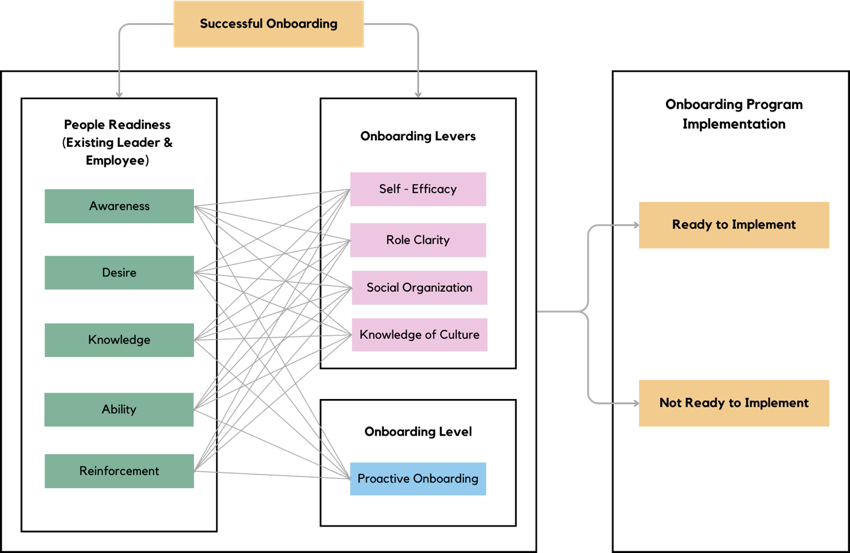
The onboarding program will involve two parties in charge, they are a new employee and an existing employee. The onboarding program itself will be given to new employees to help them adapt to their jobs and the culture of the organization. To reach a successful program, we must know whether the program is adequate and has fulfilled all the levers of the onboarding program. Besides that, we also must analyze from the side of strategic onboarding. It has reached the highest level of onboarding, which is the proactive level. Bauer, 2010 explains that the highest level is reached, the higher the probability the program will be successful.
On the other hand, new employees can’t do the onboarding program by themselves. They’ll need assistance from their seniors and superiors. In this case, if existing employees didn’t help new employees, then new employees probably couldn’t get enough knowledge, skill, and ability to do their jobs properly. In the Onboarding Program, the Business Manager has the main role of welcoming, monitoring, and giving final evaluations for new employees. They’ll be seen as figurehead by new employees, they also must monitor the program and demand to be spokespersons on behalf of the organizations, at a time they also demanded to be the agents of change. So, they need to understand their roles as business managers.
Since the onboarding program is new, all existing employees as stakeholder also must be ready to change. When they are ready to change and switch to a new form of new employee orientation, they will not be resistant to the change, and lead the program voluntarily. Thus, the program will not last if there is no support and reinforcement from the management. So, the organization is also involved in the success of the onboarding program.
Figure 1: Conceptual Framework
MATERIALS AND METHODS
Data Collection Method(s)
Data collection in this research will be using surveys to the sample participants. According to Mertens, the descriptive survey approach is a one-shot survey to simply describe the characteristics of a sample at one point in time. In research on students' reading attitudes and behaviors, a descriptive survey study might be structured as follows: The researcher would randomly select participants, and survey them to describe their attitudes toward reading as well as their reading behaviors [9].
In terms of the onboarding program, there are two parties will be involved: new employees, and existing employees to help them adapt quicker to their job and organization. This research will measure the readiness of the organization to implement the onboarding program. So, the survey will be distributed to existing employees to measure whether they’re ready to implement the program or not. To determine the sample and collect the data, the author takes the following steps:
Determine participant criteria
Determine the population of the sample
Determine sample size
Construct the survey
Distribute the survey and collect data.
Participant criteria are:
Business Manager, or
Community Officer with a minimum of 6 (six) months of work
The sample size of this research is a minimum 368 respondents. The population of employees that meet the criteria of the participants in Bank Syariah National is 8591. To determine sample size, the author using the formula:
n = Z2p(1-p) = 1.962 x 0.5 (1-0.5) = 368
m2N0.052 x 8591
Equation 1. Sample Size
Table 1: Reseach Dimension
Dimension and Sub Dimension
Description
Awareness
How individuals aware of the need to change
Desire
How individuals have desire to participate and support the change
Knowledge
How individual know how to change
Ability
Is the individual having ability to implement desired skills and behaviour.
Reinforcement
Organization’s reinforcement to sustain the change
Self-Efficacy
It is when new employee feels confident in doing the job well, that they feel more motivated than those who are less confident.
Role Clarity
It is how well a new employee understands their role and expectations. Role clarity is a good indication of how well- adjusted a new employee is.
Social Integration
It is when new employees feel comfortable and accepted by their peers and superiors. Useful tactics can be:
Making time to engage in small talk.
Arranging informal social interaction like lunches or coffee breaks
Participating in voluntary company function
Trying to build relationship with superior by taking on new responsibilities and successfully completing assignment
Knowledge of and fit within an or within an organizational culture
Understanding an organizations politics, goal, and values, and learning the organization “unique” language.
Proactive Onboarding
The Onboarding level whereas the program has been systematically organizes with a strategic human resource approach
Table 2: Variable and Sub Variable of the Research
Variable
Variable Code
Sub Variable
Sub Variable Code
Kode Item
No Item
Awareness
A
Self-Efficacy
SE
AWSE1
1
AWSE2
2
Role Clarity
R
AWR1
3
AWR1
4
Social Integration
SI
AWSI1
5*
AWSI2
6
Knowledge of Culture
C
AWC1
7
AWC2
8
Proactive OBP
P
AWP1
9
AWP2
10
AWP3
11
AWP4
12
AWP5
13
AWP6
14*
Desire
D
Self-Efficacy
SE
DSE1
15
DSE2
16
Role Clarity
R
DR1
17
DR2
18*
Social Integration
SI
DSI1
19
DSI2
20
Knowledge of Culture
C
DC1
21
DC2
22*
Proactive OBP
P
DP1
23
DP2
24
DP3
25
DP4
26
Knowledge
K
Self-Efficacy
SE
KSE1
27
KSE2
28*
Role Clarity
R
KR1
29
KR2
30
Social Integration
SI
KSI1
31
KSI2
32
Knowledge of Culture
C
KC1
33
KC2
34*
Proactive OBP
P
KP1
35
KP2
36
KP3
37
KP4
38
KP5
39
Ability
A
Self-Efficacy
SE
ABSE1
40
ABSE2
41
Role Clarity
R
ABR1
42
ABR2
43*
Social Integration
SI
ABSI1
44
ABSI2
45
Knowledge of Culture
C
ABC1
46
ABC2
47
Proactive OBP
P
ABP1
48
ABP2
49
ABP3
50*
ABP4
51
ABP5
52
Reinforcement
R
Proactive OBP
P
RP1
53
RP2
54
RP3
55
RP4
56
RP5
57*
RP6
58
Reinforcement
R1
59
R2
60
R3
61
R4
62
R5
63*
R6
64
R7
65
Self-Efficacy
SE
RSE
66
Role Clarity
R
RR
67
Social Integration
SI
RSI
68
Knowledge of Culture
C
RC
69
Where:
N : sample size
Z : z-value (confidence level 95%; z-value = 1, 96)
p : proportion of population (50%)
m : margin of error (5%)
The sampling technique is using simple random sampling. Simple random sampling is a basic sampling technique where every individual in the population has an equal chance of being selected. This method ensures that every possible sample of the desired size has the same probability of being chosen [10] Babbie [11]. The Practice of Social Research. 12th ed. Belmont: CA: Wadsworth Cengage.
The business manager, as the agent of change, has a big role in how the onboarding program will be successful and meaningful. Their willingness to change the habit on how they are welcoming new employees will matter to reach organizational purposes. In this research, participants will be asked about their readiness to change, regarding to ADKAR Model and Onboarding Levers:
From the research dimensions mentioned above, the Author then derived these dimensions into survey items. The primary focus of this study is related to the organization's readiness for the implementation of an onboarding program. On the other hand, an ideal onboarding program meets the criteria of onboarding levers and onboarding level proactive [1]. Therefore, the arrangement of items in the survey is as follows:
Total of the item on questionnaire is 69 items, which 10 of them are negative item. Since the location of the population is in Indonesia, then the survey will be distributed to participants in Bahasa Indonesia. This survey uses using Likert scale from 1-6 to measure whether the participants agree to the item stated. The participant will be asked to express their agreement by choosing between a scales of 1-6:
1 : Strongly Disagree
2 : Disagree
3 : Somewhat Disagree
4 : Somewhat Agree
5 : Agree
6 : Strongly Agree
Besides the question on the survey, the author also gives participants an open question about the onboarding program in Bank Syariah National, to get direct feedback from the participants to the program.
These open questions cover the onboarding construct and design in Bank Syariah National including stages, duration, process, and feedback of the onboarding program as follows:
Research Design
The research design is using quantitative approach. Quantitative methods emphasize objective measurements and the statistical, mathematical, or numerical analysis of data collected through polls, questionnaires, and surveys, or by manipulating pre-existing statistical data using computational techniques. Quantitative research focuses on gathering numerical data and generalizing it across groups of people or explaining a particular phenomenon [10-11]. Quantitative research relies on the collection and analysis of numerical data to describe, explain, predict, or control variables and phenomena of interest.
Quantitative research commonly falls into two categories of approaches: Experimental and Non-experimental research design. Non-experimental research designs embody a group of techniques used to conduct quantitative research where there is no manipulation done to any variable in the study. In other words, variables are measured as they occur naturally, without interference of any kind by the researcher. This lack of manipulation may exist because the variable was naturally "manipulated" before the study began or because it is not possible, or feasible, for the researcher to manipulate a particular variable [9].
The research purpose is to know whether the organization has been ready to implement the onboarding program. So, this research will be using descriptive studies to answer the research questions. The purpose of descriptive studies is to describe, and interpret, the current status of individuals, settings, conditions, or events [9]. In descriptive research, the researcher is simply studying the phenomenon of interest as it exists naturally; no attempt is made to manipulate the individuals, conditions, or events. Since the population of the sample is big, the author will use a survey as an approach to collect data.
This research purpose is to find out why the onboarding program hasn’t been implemented yet, even though the organization knows the benefit of it. By measuring whether the organization is ready to implement the program. The author uses a quantitative-descriptive method to find the root cause regarding to readiness to change theory and give recommendations to the organization so that the onboarding program can be fully implemented by all stakeholder.
Table 3: List of Open Questions
Open Question
Alternatives Answers
What Aspect should be preserved from the Onboarding Program
Choose maximum 3 statements:
Content related to the Community Officer’s job
Onboarding Stages especially on 3 main stages (Observing, Active Assistant, Self-Practice)
Total Duration of Onboarding Program (21 days)
Daily Evaluation session with Buddy
Weekly Evaluation session with Buddy
Whole program evaluation with Business Managers
Administration process of each activity
What Aspect should be developed from the Onboarding Program
What positive outcomes are gained from the onboarding program?
Open question
Feedback to Onboarding Program
RESULTS AND DISCUSSION
Analysis
After collecting the questionnaire, the author analyzes the data by descriptive statistical analysis. Samples required for this research are 368 respondents. Total number of questionnaires collected is 821 questionnaires, but only 741 data valid as follows:
Validity and Reliability
Validity testing is evaluating the extent to which a test or assessment measures what it is intended to measure. It is important because it ensures that the results of a test are accurate and reliable and that the inferences made from the results are valid. The technique used is using Pearson product-moment correlation. The item is valid if the R count is larger than the R table. As the sample test is more than 700 samples, the R table is 0,074 for a level of significance of 5%.
A reliability test in research is the process of assessing the consistency of a measurement tool or test over time. The Objective of a reliability test is to ensure that a measurement instrument in research, has consistent and stable results across different occasions, different conditions, or different evaluators. Using Cronbach Alpha as a statistical method, the dimension that has a score >0,6 is considered reliable. The author used Statistical Package for Social Science (SPSS) to analyze the data. First validity and reliability tests show that some item, especially negative items are not reliable and the validity is low.
So, all negative items is deleted from the research, and the author did a second reliability score >0,9 and all items are valid.
Table 4: Total Data Collected
Total Respondent
821
Data Valid
741
90%
Data Invalid
80
10%
Double Data
6
Not Meet Respondent Requirement
74
Table 5: Demographic Data of the Participants
Gender
Total
%
Male
8
1%
Female
733
99%
Grand Total
741
Position
Total
%
BM
135
18%
CO
606
82%
Grand Total
741
Education
Total
%
SMA / SMK / MA
339
46%
D1 / D2 / D3
56
8%
S1
344
46%
S2
2
0%
Grand Total
741
Area
Total
%
DISTRIBUTION 1
158
21%
DISTRIBUTION 2
82
11%
DISTRIBUTION 3
353
48%
DISTRIBUTION 4
148
20%
Grand Total
741
Age
Total
%
18-23
145
20%
23-26
308
42%
27-30
146
20%
31-35
124
17%
35-42
18
2%
Grand Total
741
After running a second reliability test, all the remaining items are valid. There are 69 question items in the first run of the validity and reliability test, and 10 items were deleted because the reliability is less than the Cronbach Alpha standard. The item that continues to be analyzed remains 59 items.
Demographic Data
There are 741 collected that meet the respondent requirement, dominated by Community Officers. It is equal to the research population of 11.000 Community Officers and 1000 Business Managers. Overall, all the participants have represented the user of the Onboarding Program, which is the Business Manager and Community Officer at the Financing Business Directorate.
Table 5 shows that the participants mostly are between the ages of 23-26 years old, or we can say that they came from the Z generation. Furthermore, we can see the comparison between position and generation as we can see in the diagram below:
From the diagram above, CO is dominated by Generation Z meanwhile BM is dominated by millennial. The generation gap could affect how the Business Managers lead and on how the Community Officer wants to be treated.
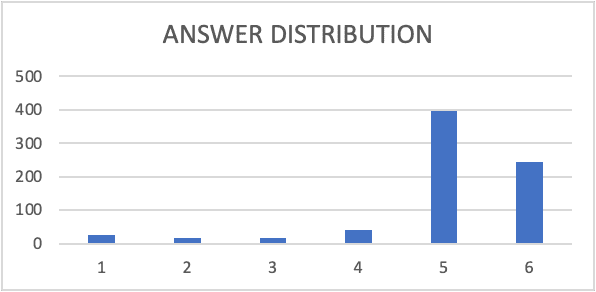
Figure 4 shows that most participants agree with the item on the questionnaire. The overall average score for readiness to change is 4.74 out of 6, or we can say that the organization is more than 75% ready to implement the onboarding program.
The readiness to implement the Onboarding program is consist of five dimensions. The variable is referred to ADKAR model by Jeff Hyatt, it measures Awareness, Desire, Knowledge, Ability, and Reinforcement to implement the changes. Based on the model, we get the result below:
Table 6 shows that in every dimension of ADKAR, Bank Syariah National is ready to implement the onboarding program. Jeff Hyatt, ADKAR model has five outcomes an individual needs to achieve for a change to be successful. The dimension is:
Figure 4: Average Answer Distribution
Table 6: ADKAR Variable Score
Variable
Dimension Score
Conclusion
Awareness
4.90
Ready to implement
Desire
4.80
Ready to implement
Knowledge
4.70
Ready to implement
Ability
4.68
Ready to implement
Reinforcement
4.66
Ready to implement
Awareness is how the organization members are aware of the need to change. In the context of readiness to implement the onboarding program, it measures how individuals are aware that the onboarding program will benefit the new employee such as increasing self-efficacy, role clarity, social integration, and knowledge of the culture of Bank Syariah National
Desire measures how individuals in the organization are willing to implement the onboarding program
Knowledge measures whether the organization member has sufficient knowledge on how to implement the onboarding program, so the program will be successful for the organization
Ability, it measures if the organization member has enough ability to do the onboarding program and help a new employee
Reinforcement, measures if the organization member thinks the organization has given enough reinforcement so the onboarding program can be well implemented
Table 6 shows the ADKAR Dimension Score of readiness in Bank Syariah National to implement the onboarding program. The graphic shows that the highest score on readiness in Bank Syariah National is the Awareness factor with an average of 4.9 out of 6, followed by Desire of 4.8, Knowledge at 4.7, Ability at 4.68, and Reinforcement at 4.6. The interpretation is:
The employee of Bank Syariah National (score 4.9 out of 6) is 81% aware that the onboarding program will help a new employee to be ready to work by increasing their self-efficacy. The Onboarding program is also seen to give role clarity to a new employee, help them to adapt faster to their work environment and team members, and introduce them to the culture of Bank Syariah National
80% of the employees of Bank Syariah National have the willingness (score 4,8) to help new employees increase self-efficacy, role clarity, social integration, and knowledge of the culture of Bank Syariah national through the onboarding program
78% of employees of Bank Syariah National have sufficient knowledge (score 4.70) to help new employees have self-efficacy, self-efficacy, role clarity, social integration, and knowledge of the culture of Bank Syariah National through the onboarding program
78% of employees of Bank Syariah national have the ability (score 4.68) to help new employees have self-efficacy, self-efficacy, role clarity, social integration, and knowledge of the culture of Bank Syariah national through the onboarding program
Lastly, 76% of employees of Bank Syariah national think (score 4.6) that the management of Bank Syariah national has enough reinforcement to help them implement the onboarding program
Table 7 shows that there is no big difference in readiness scores in various circumstances. Distribution 2 shows the highest value on awareness, but it gradually decreases in knowledge, ability, and reinforcement. Meanwhile, in the other area, the score is also gradually decreasing, but it is slighter than Distribution 2. Readiness scores for the position of Business Manager and Community Officer show no differences. On the other hand, different scores occur in different age ranges.
Generation Z is a cohort for they are born after 1997, so their range of ages is between 18-26 years old. Millennial is a cohort for those who were born in 1981-1996. In Generation Z categories lower scores occur in age range 23-26. Meanwhile, Millennial show that the older they are, the higher the score. In Bank Syariah national, the workforce, especially those who stay for more than six months is dominated by gen z with age range 23-26. With a service period of over 6 months, the Community Officer is required to take full responsibility for more complex tasks such as handling problematic customers, being a specific Person in Charge (PIC) in the work area and acting as a buddy for new Community Officers.
In conclusion, data from the questionnaire shows that Bank Syariah national is ready to implement the onboarding program. The implementation of the onboarding program is still not optimum because of another variable that is not mentioned in ADKAR variable. To answer these questions, the author also asks several open-ended questions on the questionnaire.
Descriptive Analysis on Open Question Questionnaire
Based on The Onboarding Module of Bank Syariah National, The Onboarding program is designed to be completed in three weeks. The journey is divided into four phases. Bauer [1] has mentioned that The Onboarding Program has four distinct levels: Compliance, Clarification, Culture, and Connection. The combination of these four distinct levels will develop different onboarding strategies. Based on analysis of the onboarding module, and on interviews with learning managers of Bank Syariah National shows onboarding strategies as follow:
The highest strategy in the onboarding program is the Proactive level. The pro-active level is reached when the onboarding program fulfills the four levels of the onboarding [1]. In the proactive level of onboarding, the program also must be monitored by human capital. In Bank Syariah National, every activity input in the Learning Application will be generated by Human Capital and will be reported monthly to the stakeholders. It makes the onboarding program in Bank Syariah National meet the requirement to be on a Proactive Onboarding Strategy.
In the research, the author also asked an open-ended question to the participants to get feedback on the onboarding program they already knew. The question is about what things should be considered for maintaining its effectiveness, identifying areas for development, understanding its positive impacts, and gathering feedback for improvements.
Table 10 shows that participants said that the phase of the Onboarding program is a good thing to be maintained. Its phase includes a gradual learning process to be assisted by a buddy and prepare new employees to
Table 7: Onboarding Level in Bank Syariah National
Distinct Level
Onboarding Program in Bank Syariah National
Compliance
The material in the onboarding program includes basic rules of employees, both as employees of Bank Syariah National and basic rules of their role as Community Officers. It uses learning material such as videos and quizzes that are compiled in the Learning Management System Application.
Clarification
The learning material in the onboarding program shows detailed checklist items for every activity so that no detailed activities are missing.
Culture
The Onboarding Program at Bank Syariah National also makes new employees know the culture of the company. With the unique business model, the culture itself has started in the smallest part of the company, which is MMS. They will be involved in every morning and afternoon briefing and share their learning experiences to other team member, as the others give an update on their daily task and activities.
Connection
The Onboarding Program at Bank Syariah National is designed to pair new employees with a buddy. Their buddy is responsible for all over learning process of new employees, including mapping them to learn with another team member. So, with this design, new employees can easily connect with another team member.
Table 8: Good dimensions and needs improvement dimension
Dimension
Good Point
To be improved
Gap
Administration process
7
38
-31
Duration of the program
20
83
-63
Detailed Material
189
149
40
Daily Evaluation Process
35
101
-66
Weekly Evaluation Process
15
33
-18
Final Evaluation Process
35
61
-26
Program Phase
438
272
166
others
2
4
2
Total
741
741
Table 9: Positive Feedback to the Onboarding Program
Positive Feedback
Frequency
Role clarity
323
Social Integration
77
Self-Efficacy
58
Simplicity
29
Practical learning
24
Refreshment for existing employee
23
Culture Knowledge
13
Standardize process
13
Fun learning
10
Leadership
8
Table 10: Negative Feedback of the Onboarding Program
Things to Develop
Frequency
Buddy Competencies
48
Detailed Material
48
Shorter Program Duration
34
New Employee Competencies
24
Lack of Evaluation Process in MMS
22
Length of Theory vs Practical learning
17
Reward System
16
Application Update
14
Gamification
11
Involvement of Business Manager
9
work on their own. But some dimensions need to be improved shown on the big four dimensions with the biggest minus score on the gap. These big four are:
Daily evaluation processes. In the onboarding program, ideally, new employee gets daily feedback from their buddy during afternoon meetings. The objective is to evaluate the daily learning process, knowing if something is missing. But this process seems hard to fulfill or there is an ineffective process of daily evaluation
Duration of the Program. The onboarding Program at Bank Syariah National needs to be completed in three weeks. In the former practices, a new employee usually wasn’t given that much time to learn, and they probably asked to work like another team member as soon as they came to the workplace
Administration Process. The onboarding program at Bank Syariah National still requires reporting their daily activities in the learning application. It must be done daily and step by step, or they can’t access the next phase if the current phase is still unfinished
Final Evaluation Process. There are at least two processes that must be done by the Business Managers: first briefing when the new employee comes, and final evaluation. The final evaluation objective is to measure motivation level of new employees and to make sure that new employees are ready to work on their own. In this moment, the Business Managers can also give feedback and hear aspirations from the new employee
Despite the positive things, the author also gathers feedback to be developed in future onboarding programs. The most frequent things to be developed are Buddy Competencies and Detailed Material. The onboarding program is designed to prepare new employees to do their jobs properly, but in the practical, the buddy competencies are not considered yet. There is no requirement for the buddy unless their Business Manager feels that they are good enough to teach new employees. In the feedback, many participants said that the buddy needs to be trained first to know what to do and not to do in teaching others, and also to help them manage their regular workload. There are some detailed materials that no longer relate current situation, they need to be updated so the new employee can get all the material.
The duration of the program is also negative feedback. The participants suggested a shorter duration because they think that three weeks is too long, and a new employee is already bored while the existing employee’s workload is much higher. They proposed to reconsider the length of duration for theory and practical learning. From the new employee side, the participants hope for improvements in new employee selection. They prefer the more active and serious new employee so the learning process can be done in two-way. The evaluation process is still quite hard to do when workload of the buddy is high. It also shows that the participants hope for the involvement of the Business Manager. There is also some trouble with the learning application, which is not updated and sometimes difficult to access.
Table 12: The Interview Result
Dimensions
Conclusion
The Onboarding Program
Onboarding done but the duration not ideal because of lack of team member. They also rarely input their progress in learning apps
Onboarding Lever
The program is beneficiary to new employees. It helps them have a better understanding of their role, environment, and company culture.
Onboarding Level
New CO involved to practice and try on their own but still supervised by Buddy or BM
Readiness to Change
They are Ready to implement the program but do not prioritize it.
Evaluation Process
Casual or direct feedback. No more feedback in afternoon meeting
Feedback
duration should be shorter
improvement of application
detail material need to be updated
put the onboarding program as a KPI for CO / BM
CO and BM still need to be remained to complete all the tasks
Interview Findings
The contrast between readiness to implement and feedback given on open-ended questions made the author deepen the cause of why the onboarding program wasn’t completed as expected in Bank Syariah National by doing interviews with five Business Manager with a completeness rate are o%, but the new employee remains still stay at the area. The interview objective is to deepen understanding of why the organization seems ready to implement the program, but the number is not as good as expected. There are five dimensions to be asked of the interviewee:
The Onboarding Program. Is to measure whether the interviewee knows about the program, and how they run the program
Onboarding Lever is to know whether the onboarding program is beneficiary for new employees
The onboarding Level is to know the participation rate of the new employee
Readiness to Change to know if the interviewee is ready to implement the program,
How the Evaluation Process is done by the Business Manager
Feedback
From the interview, the author gets the conclusion as follow:
The interview result shows that several factors made the onboarding program didn't go as expected. The onboarding program is mostly implemented but with standards that each area can accept. They mostly run the program but don’t report the progress on the apps because they are too busy or because the application is not supported. They also still need to remain with their team to input the progress as well as they also need to be reminded.
One of the functions of the manager is to control the [22]. In the context of the onboarding program, the managers didn’t do their function completely. The interview shows consistently that they are not prioritizing the onboarding program because it is not mentioned in their Key Performance Indicator, so for Business Managers, it will not give any added value to them.
Solution and Proposed Implementation Plan
The onboarding program has been acknowledged as beneficial to help new employees reach the onboarding levers. The onboarding levers consist of Self-efficacy, Role Clarity, Social Integration, and Knowledge of the Culture [1]. It helps new employees have an emotional connection with the organization, so it could decrease leavers under three months.
In Bank Syariah National, the onboarding program is monitored and evaluated by the completeness status of the onboarding program in the Learning Management System Application. But after almost a year from its grand launch, the completeness rate of the onboarding program has remained at less than 40%. It might be because the organization is not ready to implement the program yet since it is a new program to them.
The research results from a measurement of ADKAR as the dimension of readiness to change, show that the organization ready by more than 75% to implement the program. But still, it is not the perfect number to get the onboarding program 100% implemented. An effort to increase the completeness rate of the onboarding program still must be made.
The results show that the number of readiness gradually decreases from awareness to reinforcement. Thus, the author proposed an Implementation plan:
Make the onboarding program a KPI for the Business Manager: The Business manager has a big role in running the onboarding program properly. In the interview, they said that they do the program but do not prioritize it. As a leader, they have the power to do or not to do the program completely. To make the onboarding program run completely, the business manager needs a booster to make it a priority to them. Thus, it must be written in the KPI. The onboarding KPI doesn’t have to be in the main KPI, but it can be booming factors that can decrease the KPI score or even the Bonus point that can add to the KPI score. It can be implemented in the next KPI arrangement in early 2024
Evaluate the Duration of the Onboarding Program: Almost all participants agree that the duration of the onboarding program is too long. It can be evaluated whether the introduction and observation phase can be done in a week, then followed with active assistance and self-practice in another week. So, the total duration will be two weeks. It can be done by doing a piloting project in some area and evaluating the effectiveness by comparing the results
Evaluate the learning Materia: In the onboarding program in Bank Syariah National, the program is to introduce the new employee, the customer acquisition process from scratch as if there are no sentra available in the area. The business process also has developed in many years. Evaluating the learning material can make the learning process more related to the current business needed. It can be done in early 2024
Evaluating the Learning Application: As the main infrastructure to be reported to Human Capital, the learning application must be excellent all the time. Considering the workload of existing employees, they might have a little time to input the report and will forget to input it because there so many priorities to them. Evaluating the application can be started by counting how many errors occurred and fixing them. Application that can be open when the signal is low is also beneficiary
Training for Buddy: The Buddy is someone who will teach the new employee, so they need to know how to assist the new employee but still manage to do their daily jobs. It can be done by cascading the material to their SBM and let their SBM be a facilitator for the buddy. It can be implemented in mid-2024
Program Reward: To boost the program, we can also make a program reward. The reward can be a souvenir or maybe some money for best team. Besides that, reward is also can be a recognition for those who achieve to teach new employee and success to make them stay for next six months. It can be started immediately
CONCLUSION
The completeness rate of the onboarding program remains not as good as expected. Although the organization is aware of the beneficiaries of the onboarding program, it still has a low completeness rate. The Onboarding Program is a new program that was launched in January 2023. Until August 2023, the completeness rate is less than 40%, although it has been proven that those who learn through the onboarding program most likely will stay longer. This research purpose is to find out whether the organization has been ready to implement the onboarding program. Based on the research done by the author, here is the conclusion of the research:
Bank Syariah National is 75% ready to implement the onboarding program. They have awareness, desire, knowledge, and ability to implement the program. But there is some other factors not mentioned in the ADKAR being a factor on why the onboarding program didn’t go as expected
Not prioritizing to complete the program is one factor that makes the onboarding program's implementation rate remain low. It could be aligned with the managers who didn’t pay enough attention to their team to complete the tasks
Besides, technical issues of the program such as duration, administration process, competencies of the buddy, and application issues can also make the employee not do it properly
The implementation plan is to put the completeness of the onboarding program as a boom factor or bonus point on KPI, evaluate the duration of the program, evaluate the application and learning material, hold training for the buddy, and make program rewards
Recommendation
For further research, the author recommends the next author measure the correlation of the leadership of the Business Manager and the Implementation of the program. This research hopefully can give a deeper understanding on why the program didn’t go as expected.
REFERENCE
Bauer, Talya N. Onboarding new employees: Maximizing success. SHRM Foundation, 2010.
Avecedo, J. M. and G. B. Yancey. "Asessing new employee orientation program." Journal of Workplace Learning, vol. 23, no. 5, 2011, pp. 349–354.
Goldstein, L. and J. Ford. Training in organization. 4th ed., Wadsworth, 2002.
Talya, B. and Berrin, E. "Organizational socialization: The effective onboarding of new employees." 2011. https:// doi.org/10.1037/12171-002.
Sunder, S. K. "Why do salespeople quit? An empirical examination of own and peer effects on salesperson turnover behavior." Journal of Marketing Research, vol. 54, no. 3, 2017, pp. 381–397. https://doi.org/10.1509/jmr. 15. 0485.
Chillakuri, B. "Understanding Generation Z expectations for effective onboarding." Journal of Organizational Change Management, vol. 33, no. 7, 2020, pp. 1277–1296. https:// doi.org/10.1108/JOCM-02-2020-0058.
Haqq, Z. N. and M. Natsir. "Three components of readiness to change: Communication of change and change-efficacy as antecedents." Islamic Banking and Finance Journal, vol. 3, no. 1, 2019. https://doi.org/10.21070/perisai.v3i1.20 11.
Mertler, Craig A. Introduction to educational research. 3rd ed., SAGE Publications, 2021.
Triola, Mario F. Elementary statistics. 13th ed., Pearson, 2018.
Babbie, Earl R. The practice of social research. 12th ed., Wadsworth Cengage, 2010.
Mujis, Daniel. Doing quantitative research in education with SPSS. 2nd ed., SAGE Publications, 2010.
Bielińska-Dusza, Elżbieta. "The motivation of generations – What drives Generation X, Y, Z?" Journal of Human Resources Management Research, vol. 2022, article ID 637177, 2022. https://doi.org/10.5171/2022.637177.
Fadli, Muhammad Rafi. "Memahami desain metode penelitian kualitatif." Humanika: Kajian Ilmiah Mata Kuliah Umum, vol. 21, no. 1, 2021, pp. 33–54. https://doi.org/10.21831/hum.v21i1.38075.
Hyatt, J. ADKAR methodology. 2023. https://www.prosci. com/methodology/adkar.
Mahendrati, H. A. and W. Mangundjaya. "Individual readiness for change and affective commitment to change: The mediation effect of technology readiness on public sector." 3rd FIRST Conference, 2019. https://doi.org/10.2 991/assehr.k.200407.010.
Nagendra, D. A. Paradigm shift in HR practices on employee life cycle due to influence of social media, 2014.
Nguyen, T et al. "The use of theory in qualitative research: Challenges, development of a framework exemplar." Wiley, 2021. https://doi.org/10.1111/jan.15053.
Rahadi, D. R. and E. Susilowati. Perilaku organisasi: Konsep dan implementasi. Filda Fikrindo, 2019.
Schermerhorn, John R. Management. Wiley, 2012.
De Vaus, David. Research design in social research. SAGE, 2001.
Walker-Schmidt, W. K. "Onboarding effects on engagement and retention in the IT sector." Impacting Education: Journal on Transforming Professional Practice, vol. 7, no. 4, 2022, pp. 8–15. https://doi.org/10.5195/ie.2022.220
Wibisono, R. A. Preparing the workforce for digital transformation, 2020.
Advertisement
Recommended Articles
Research Article
Influence of Leadership on Poverty Reduction in the Devolved Government in Trans-Nzoia County, Kenya
Kinisu Sifuna,
...
Peter Simotwo
Published: 30/06/2021
Download PDF
Cite
x
APA
Sifuna, K., Lwangale, D. W., Simotwo, P., Sifuna, K., Lwangale, D. W. & Simotwo, P. (2021). Influence of Leadership on Poverty Reduction in the Devolved Government in Trans-Nzoia County, Kenya. Himalayan Journal of Economics and Business Management, 2(1), None-None.
MLA
Sifuna, Kinisu, et al. "Influence of Leadership on Poverty Reduction in the Devolved Government in Trans-Nzoia County, Kenya." Himalayan Journal of Economics and Business Management 2.1 (2021): None-None.
Chicago
Sifuna, Kinisu, David W. Lwangale, Peter Simotwo, Kinisu Sifuna, David W. Lwangale and Peter Simotwo. "Influence of Leadership on Poverty Reduction in the Devolved Government in Trans-Nzoia County, Kenya." Himalayan Journal of Economics and Business Management 2, no. 1 (2021): None-None.
Harvard
Sifuna, K., Lwangale, D. W., Simotwo, P., Sifuna, K., Lwangale, D. W. and Simotwo, P. (2021) 'Influence of Leadership on Poverty Reduction in the Devolved Government in Trans-Nzoia County, Kenya' Himalayan Journal of Economics and Business Management 2(1), pp. None-None.
Vancouver
Sifuna K, Lwangale DW, Simotwo P, Sifuna K, Lwangale DW, Simotwo P. Influence of Leadership on Poverty Reduction in the Devolved Government in Trans-Nzoia County, Kenya. Himalayan Journal of Economics and Business Management. 2021 Jan;2(1):None-None.
Download PDF
Research Article
Modelling Structure Job Quality, Job Design and Job Satisfaction
Moch Nurhadi,
...
Avi Sunani
Published: 30/08/2022
Download PDF
Cite
x
APA
Nurhadi, M., Bisyri Effendi, M., Saiful Ulum, A. & Sunani, A. (2022). Modelling Structure Job Quality, Job Design and Job Satisfaction. Himalayan Journal of Economics and Business Management, 3(2), 1-4.
MLA
Nurhadi, Moch, et al. "Modelling Structure Job Quality, Job Design and Job Satisfaction." Himalayan Journal of Economics and Business Management 3.2 (2022): 1-4.
Chicago
Nurhadi, Moch, Moch Bisyri Effendi, Achmad Saiful Ulum and Avi Sunani. "Modelling Structure Job Quality, Job Design and Job Satisfaction." Himalayan Journal of Economics and Business Management 3, no. 2 (2022): 1-4.
Harvard
Nurhadi, M., Bisyri Effendi, M., Saiful Ulum, A. and Sunani, A. (2022) 'Modelling Structure Job Quality, Job Design and Job Satisfaction' Himalayan Journal of Economics and Business Management 3(2), pp. 1-4.
Vancouver
Nurhadi M, Bisyri Effendi M, Saiful Ulum A, Sunani A. Modelling Structure Job Quality, Job Design and Job Satisfaction. Himalayan Journal of Economics and Business Management. 2022 Jul;3(2):1-4.
Download PDF
Research Article
Accountability and Transparency of Village Fund Management in Lumajang District
Nurina Ayuningtiyas,
...
Muhammad Miqdad
Published: 28/12/2023
Download PDF
Cite
x
APA
Ayuningtiyas, N., Santosa Putra, H. & Miqdad, M. (2023). Accountability and Transparency of Village Fund Management in Lumajang District. Himalayan Journal of Economics and Business Management, 4(2), 1-4.
MLA
Ayuningtiyas, Nurina, Hendrawan Santosa Putra and Muhammad Miqdad. "Accountability and Transparency of Village Fund Management in Lumajang District." Himalayan Journal of Economics and Business Management 4.2 (2023): 1-4.
Chicago
Ayuningtiyas, Nurina, Hendrawan Santosa Putra and Muhammad Miqdad. "Accountability and Transparency of Village Fund Management in Lumajang District." Himalayan Journal of Economics and Business Management 4, no. 2 (2023): 1-4.
Harvard
Ayuningtiyas, N., Santosa Putra, H. and Miqdad, M. (2023) 'Accountability and Transparency of Village Fund Management in Lumajang District' Himalayan Journal of Economics and Business Management 4(2), pp. 1-4.
Vancouver
Ayuningtiyas N, Santosa Putra H, Miqdad M. Accountability and Transparency of Village Fund Management in Lumajang District. Himalayan Journal of Economics and Business Management. 2023 Jul;4(2):1-4.
Download PDF
Research Article
The Quality of Information Systems and their Impact on Improving Digital Management: An Exploratory Study of the Opinions of a Sample of Administrative Staff at Tikrit University
Anwar Ghazi Noaman
Published: 10/10/2025
Download PDF
Cite
x
APA
Ghazi Noaman, A. (2025). The Quality of Information Systems and their Impact on Improving Digital Management: An Exploratory Study of the Opinions of a Sample of Administrative Staff at Tikrit University. Himalayan Journal of Economics and Business Management, 6(2), 1-8.
MLA
Ghazi Noaman, Anwar. "The Quality of Information Systems and their Impact on Improving Digital Management: An Exploratory Study of the Opinions of a Sample of Administrative Staff at Tikrit University." Himalayan Journal of Economics and Business Management 6.2 (2025): 1-8.
Chicago
Ghazi Noaman, Anwar. "The Quality of Information Systems and their Impact on Improving Digital Management: An Exploratory Study of the Opinions of a Sample of Administrative Staff at Tikrit University." Himalayan Journal of Economics and Business Management 6, no. 2 (2025): 1-8.
Harvard
Ghazi Noaman, A. (2025) 'The Quality of Information Systems and their Impact on Improving Digital Management: An Exploratory Study of the Opinions of a Sample of Administrative Staff at Tikrit University' Himalayan Journal of Economics and Business Management 6(2), pp. 1-8.
Vancouver
Ghazi Noaman A. The Quality of Information Systems and their Impact on Improving Digital Management: An Exploratory Study of the Opinions of a Sample of Administrative Staff at Tikrit University. Himalayan Journal of Economics and Business Management. 2025 Jul;6(2):1-8.
Hilmi, F. & Ghazali, A. (2023). Onboarding Program and Organization Readiness to Change in Bank Syariah National. Himalayan Journal of Economics and Business Management, 4(2), 1-12.
MLA
Hilmi, Fadillah and Achmad Ghazali. "Onboarding Program and Organization Readiness to Change in Bank Syariah National." Himalayan Journal of Economics and Business Management 4.2 (2023): 1-12.
Chicago
Hilmi, Fadillah and Achmad Ghazali. "Onboarding Program and Organization Readiness to Change in Bank Syariah National." Himalayan Journal of Economics and Business Management 4, no. 2 (2023): 1-12.
Harvard
Hilmi, F. and Ghazali, A. (2023) 'Onboarding Program and Organization Readiness to Change in Bank Syariah National' Himalayan Journal of Economics and Business Management 4(2), pp. 1-12.
Vancouver
Hilmi F, Ghazali A. Onboarding Program and Organization Readiness to Change in Bank Syariah National. Himalayan Journal of Economics and Business Management. 2023 Jul;4(2):1-12.



 Download PDF
 Download XML