Contents
Download PDF
pdf Download XML
1951 Views
264 Downloads
Share this article
Research Article | Volume 3 Issue 1 (Jan-June, 2022) | Pages 1 - 5
The Therapeutic Role of Almitrine and Inhaled Nitric Oxide (INO) As Rescue Therapy in Patients of Acute Respiratory Distress Syndrome (ARDS) Due To Covid-19-A Narrative Review
 ,
 ,
 ,
 ,
 ,
 ,
 ,
1
Medical Graduates of Rawalpindi Medical University, Rawalpindi, Pakistan
2
Resident Medical officer Sandeman Provincual Hospital Quetta Pakistan
3
Medical Undergraduate of King Edward Medical University, Lahore, Pakistan
Under a Creative Commons license
Open Access
Received
Feb. 5, 2022
Revised
March 22, 2022
Accepted
April 10, 2022
Published
May 30, 2022
Abstract

COVID-19 is a disease caused by severe acute respiratory syndrome coronavirus 2 (SARS CoV-2), leading to acute respiratory distress syndrome among suffered patients manifested through severe hypoxemia and ventilation-perfusion VA/Q mismatch. This study aims to evaluate the effectiveness of INO, Almitrine and INO + Almitrine combined in terms of improvement in PaO2/FiO2 (mmHg) ratios and arterial or venous blood gases profile were analyzed before and after rescue therapy. Various databases were searched for collection studies and only 18 studies of interest were included in this review. Initially, baseline parameters (PaO2/FiO2 ratios, pH, PaCO2, PaO2, SpO2 and echocardiographic parameters like velocity-time integral of the left ventricular outflow tract (VTI LVOT), Cardiac index, Tricuspid Regurgitation (TR) peak velocity, Left Ventricular (LV) eccentricity index and finally RV/LV surface ratio) were assessed. They were compared after INO (10 ppm), Almitrine alone (2,4,8 and 12 µg/kg/min) and INO (10 ppm) + Almitrine (8 µg/kg/min) combined. After rescue therapy significant rise of PaO2/FiO2 (mmHg) ratios from 146 mmHg to 255 mmHg in one study and 79 mmHg to 117 mmHg in another was observed and arterial or venous blood gases profile was also improved from baseline of value (pH = 7.30, PaCO= 48 mmHg, PaO2 = 102 mmHg, bicarbonate = 28 mmoL/L and So2 = 97%) to (pH= 7.32, PaCO2 = 46 mmHg, PaO2= 180 mmHg, bicarbonate = 28 mmol/L and So2 = 99%) after INO and Almitrine combined therapy. Similarly, the cardiac parameters on echocardiography were also under normal reference values after rescue therapy validating the effectiveness of rescue therapy (INO + Almitrine) in treating COVID-19 induced ARDS.

Keywords
INTRODUCTION

Coronavirus disease (COVID-19) is a viral pneumonitis associated with droplets-born severe respiratory dysfunction in the infected patients. Epidemiological studies have reported that over the world, 9 million people are affected, with about half of the million deaths in 2020 [1-2]. This, pandemic impacted the social, economic parameters of the world and affected the health systems and health-related outcomes throughout the globe. The most commonly reported respiratory dysfunction of COVID-19 is disproportionate hypoxemia [3]. However, to our surprise, studies also highlighted that most of the patients with COVID-19 showed good thoraco-pulmonary compliance and excellent lungs mechanics. 


The severe acute respiratory syndrome coronavirus-2 (SARS-CoV-2), currently known as COVID-19, is recognized as the primary causative factor for acute respiratory distress syndrome (ARDS) in patients with the severe form of COVID-19 [4]. According to Berlin criteria, ARDS is defined as a life-threatening respiratory condition that leads to severe Hypoxemia [when the ratio of arterial partial pressure of oxygen to the fraction of inspired oxygen (PaO2/FiO2) is >150 mmHg], specific pulmonary vascular dysfunction with the possible hemodynamic mechanism of ventilation-perfusion (VA/Q) mismatch as hypoxic vasoconstriction alteration [5]. The overall mortality due to COVID-19 induced ARDS is reported as more than 1% [5]. 


Since the hypoxic induced pulmonary vasoconstriction is considered the potent factor in the development of ARDS in COVID-19 patients [6], the role of selective pulmonary arterial vasodilators is considered of paramount significance in patients of COVID-19 induced ARDS. This study evaluates the comparative effectiveness of both Almitrine and Inhaled Nitric Oxide (INO) in patients with acute respiratory distress syndrome (ARDS) due to COVID-19. This study will also highlight the role of both Almitrine and INO in reducing ventilator requirement with reduced FiO2 in patients with severe ARDS and requiring ventilator support.

MATERIALS AND METHODS

Methods and Protocol

This narrative review was conducted from June 2021 to August 2021. Various databases such as PubMed/Medline, Google scholar, web of science, Scopus were searched to retrieve all possible studies to validate our point of interest. After searching the Mesh words of Almitrine, Inhaled Nitric Oxide (INO), ARDS, COVID-19, we extracted 20 articles in total, out of which we selected 16 full-text articles to be included in our study. All the patients Studied in the selected articles were COVID positive on PCR. They were on ventilatory support and completely sedated and relaxed with neuromuscular blocking agents to keep the patients on volume-control ventilation with target tidal volume (VT exp) of 6-7mL/hr according to predicted body weight (PBW) and PEEP for plateau pressure ≤30 cmH2O. Similarly, patients' arterial blood gases were analyzed at regular intervals of 2-4 hours and pH, PCO2, PO2, HCO3 and SAO2 levels were evaluated with a PCOtarget of less than 50 mmHg. The role of patient positioning was also of paramount significance, with the prone position being most effective in reducing oxygen requirement and ventilatory support with maintained blood oxygen saturation levels. In the same vein, soon after putting the patients from prone to supine a dose of 10ppm of INO alone followed by a combination of INO (10ppm) and 4, 8 and 10mcg/ml/min of Almitrine was administered and outcome parameters were tested.


Outcome Parameters of Given Therapy

Before the initiation of rescue therapy, the baseline parameters were assessed in terms of arterial blood gas analysis (pH, pCo2, pO2, HCO3 and Spo2), arterial partial pressure of oxygen/fraction of inspired oxygen (PaO2/FiO2), echocardiographic parameters like VTI LVOT (cm), Cardiac index (L/min/m2), TR velocity peak (m/s), LV eccentricity index and finally RV/LV surface ratio were also assessed before and after rescue therapy. Following the therapy administration, as mentioned above, the outcome measures were evaluated in supine baseline position, with alone INO and with both INO and Almitrine. Similarly, arterial blood gases were measured in supine baseline, INO alone and INO and Almitrine combined. Because of the effects of Almitrine on right ventricular afterload, echocardiography was also performed to assess any negative impact on the heart in terms of the following parameters (velocity–time integral of the left ventricular outflow tract, cardiac index). Finally, the effectiveness of the given therapy was assessed in terms of the paO2/Fio2 ratio. The increase in paO2/Fio2 ratio of 20% or 20mmHg was considered the actual response to the above-given therapy as observed in a study [7].


Mechanism Of Covid-19 Induced Ards

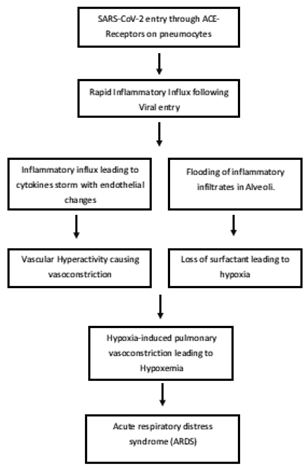
Coronavirus 2019, also known as SARS-CoV-2, entered the host through respiratory droplets and the host cells through ACE-2 receptors expressed on pneumocytes [8]. Soon after entry into the endothelial cells, the host response is activated, leading to a rapid influx of inflammatory cells and activation of various cytokines leading to cytokine storm. Accumulation of various cytokines and inflammatory infiltrates causes alteration in endothelial lining leading to endotheliitis and vascular Hyperactivity [9]. Under the influence of the inflammation, the flooding of alveoli with inflammatory infiltrates occurs, which ultimately causes loss of surfactant with intrapulmonary shunting of blood and hypoxemic alveoli. In response to alveolar hypoxia, hypoxia-induced pulmonary vasoconstriction occurs, leading to ARDS [10]. The Flow diagram of COVID-19 induced ARDS is given in Figure 1.


Baseline Parameters Befor e Initiation of Rescue Therapy

According to a study by Laghlam et al., the baseline means the value of PaO2/FiO2 in patients without rescue therapy was 146±48. Similarly, the mean value of partial pressure of CO2 in arterial blood without therapy was 52±8.9 [11]. In the same fashion, a study by François Bagate et al. has also reported the baseline characteristics in terms of pH = 7.30, PaCO2 = 48 mmHg, PaO2 = 102 mmHg, bicarbonate = 28 mmol/L and So2 = 97% in patients arterial blood analysis before initiation of rescue therapy. The baseline value of PaO2/FiO2 was about 77 without given therapy. Other observed parameters were also discussed as the echocardiographic findings with the velocity-time integral of left ventricular outflow tract (VTI LVOT) was 17cm, Cardiac index = 3.2 L/min/m2, Tricuspid regurgitation (TR) peak velocity = 2.8 m/s, Left Ventricular (LV) eccentricity index = 0.95 and finally, RV/LV surface ratio was observed that comes out to be 0.5 without rescue therapy [12].


Role of Inhaled Nitric Oxide (INO) Alone in Covid-19 Induced ARDS

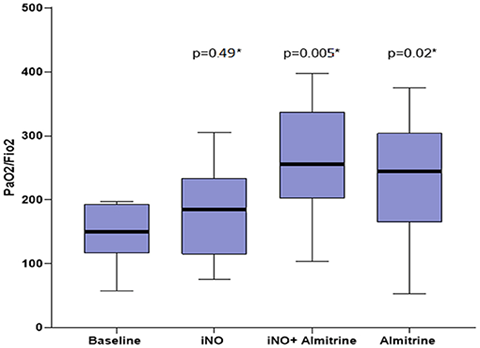
The role of Inhaled Nitric Oxide (INO) has been well documented since 1993 when it was first introduced as a wonder drug in reducing ventilatory requirements and improving arterial oxygen saturation in patients of ARDS [13]. It helps improve arterial oxygen concentration by its vasodilator activity and reducing hypoxia-induced pulmonary vasoconstriction through cGMP-dependent protein kinase pathway, thus improving ventilatory-perfusion (V/Q) mismatch [14]. The effectiveness of INO is validated by a study conducted by Laghlam et al., in which the authors have demonstrated the effects of INO in improving PaO2/FiO2 (mmHg) ratio from baseline value of 146±48 mmHg to 185±73 mmHg following INO as shown in Figure 2 [11]. Similarly, the arterial blood gas profile also showed marked improvement following INO administration where pH = 7.32, pCo2 = 45, pO2 = 124, bicarbonate = 26, SpO2 = 98% compared to baseline by a study from François Bagate et al. [12]. In the same vein, the echocardiographic findings were as follows: velocity-time integral of left ventricular outflow tract (VTI LVOT) = 16cm, Cardiac index = 2.8 L/min/m2, Tricuspid Regurgitation (TR) peak velocity = 2.2 m/s, Left Ventricular (LV) eccentricity index = 0.97 and finally RV/LV surface ratio was observed that comes out to be 0.44 with INO therapy [12].


Role Of Almitrine (DUXIL) Alone in Covid-19 Induced ARDS

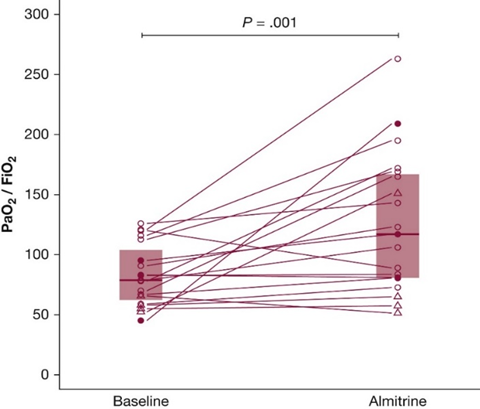
Almitrine (DUXIL) is an agonist on peripheral chemoreceptors expressed on carotid bodies and helps to improve ventilation in hypoxemic patients [2]. In the same vein, Almitrine also helps improve VA/Q mismatch by potentiating HPV at its lowest dose [15]. Various studies have tested the different doses of Almitrine (8 µg/kg/min, 4 µg/kg/min and 10 µg/kg/min) to elaborate the dose-dependent effects of Almitrine; to surprise all the administered doses were showing significant responses in terms of rising in PaO2/FiO2 (mmHg) ratio from baseline values [11,12,16]. Similarly, a study by Romain Barthélémy et al. on the effectiveness of Almitrine in improving the PaO2/FiO2 (mmHg) ratio was showing a significant rise in this ratio from the baseline value of 79 mmHg to 117 mmHg following administration of low dose (2 µg/kg/min) of Almitrine as shown in Figure 1 [17]. The effectiveness of Almitrine is also validated by a study conducted by Laghlam D et al., in which the authors have demonstrated the effects of Almitrine in improving the PaO2/FiO2 (mmHg) ratio from the baseline value of 146±48 mmHg to 238±98 at the dose of 8 µg/kg/min [11]. According to blood gas analysis the baseline values of were pH = 7.38, PaCO2 = 42, paO2 = 135, bicarbonate = 25.1 and central venous O2 saturation was 73%, similarly following the administration of Almitrine (12 µg/kg/min) the blood gas profile improved pH = 7.41, PaCO2 = 43, PaO2 = 215, bicarbonate = 24.8 and central venous oxygen saturation of 85 as compared to baseline values [18]. Similarly, on 2D Transesophageal Echocardiographic (TEE), findings showed improvement of the cardiac index from the baseline value of 2.6 to 3.0 l/min–1/m–2 following 12hrs after Almitrine infusion [16]. The effectiveness of Almitrine alone is represented in Figure 2.


Role of INO and Almitrine Combined in COVID-19 Induced ARDS

The therapeutic effectiveness of both INO and Almitrine combined has been validated by recent studies in patients with COVID-19 induced ARDS. Studies have also depicted the significant role of combined INO and Almitrine in improving patients' PaO2/FiO2 (mmHg) ratio and blood gas profile compared to baseline, INO alone and Almitrine alone. A study by Laghlam D et al. had reported the significant rise in PaO2/FiO2 (mmHg) ratio from the baseline value of 146±48 mmHg to 255±90 followed by INO and Almitrine combination when INO was continuously given at the dose of 10 ppm through the inspiratory limb of the ventilator. Similarly, Almitrine was delivered intravenously via a central venous catheter at a concentration of 8 µg/kg/min, as shown in Figure 2 [11]. In the same vein, the arterial blood gas analysis reports as reported by François Bagate et al. are also depicting the significant improvement in blood gas analysis profile from baseline values of pH = 7.30, PaCO= 48 mmHg, PaO2 = 102 mmHg, bicarbonate = 28 mmol/L and So2 = 97% to pH = 7.32, PaCO2 = 46 mmHg, PaO2 = 180 mmHg, bicarbonate = 28 mmol/L and So2 = 99% after the combined dose of INO and Almitrine [12]. The echocardiographic parameters were also noted and they were as follows: velocity-time integral of left ventricular outflow tract (VTI LVOT) = 20cm, Cardiac index = 2.9 L/min/m2, Tricuspid Regurgitation (TR) peak velocity = 2.7 m/s, Left Ventricular (LV) eccentricity index = 0.97 and finally RV/LV surface ratio was observed that comes out to be 0.49 with both INO and Almitrine therapy [12]. The effectiveness of both Almitrine and INO is represented in Figure 3.


RESULTS

The purpose of conducting this study was to get an insight into the old therapeutic techniques of treating ARDS and implementing the same in COVID-19 induced ARDS. In this study, we concluded that all the therapies, either INO alone, Almitrine alone and both INO and Almitrine combined were showing significant improvement in PaO2/FiO2 (mmHg) ratio and improvement in arterial or venous blood gases profile (pH, PaCO2, PaO2, HCO3 and SpO2).


Figure 1: Flow Diagram of COVID-19 Induced ARDS


Figure 2: Showing the Significant Rise in PAO2/FIO2 (mmHg) Ratio from Baseline (pre-treatment) value of 79 mmHg to post-treatment (with almitrine) value of 117 mmHg. Circles (o) Represent Individual PaO2/FiO2 ratio at fio2 1 of Patients Under Mechanical Ventilation and (▲) Represent the Patients Who Are Breathing Spontaneously and Red Solid Circles (●) Represent the Patients Treated with Both Inhaled Nitric Ino Started Along with Almitrine Combined [17].


Figure 3: Showing the Effectiveness of INO Alone, Almitrine alone and INO + Almitrine Combined in Terms of Increasing PaO2/FiO2 (mmHg) ratio From the Baseline value of 146±48 mmHg to 185±73 mmHg after alone INO treatment and the Effectiveness Was Significant When Both Ino and Almitrine Was Used in Combination Showing the Rise in PaO2/FiO2 (mmHg) Ratio from the Baseline Value of 146±48 to 255±90 mmHg [11].


However, improvement was much more significant when both INO and Almitrine were given in combined form compared to INO alone and Almitrine alone. Similarly, the studies also showed the impact of the rescue therapy on cardiovascular systems and echocardiographic parameters were also observed in patients receiving rescue therapy; however, to our surprise, no cardiac abnormalities of paramount significance were detected in these patients.

CONCLUSION

The purpose of conducting this study was to get an insight into the old therapeutic techniques of treating ARDS and implementing the same in COVID-19 induced ARDS. In this study, we concluded that all the therapies, either INO alone, Almitrine alone and both INO and Almitrine combined were showing significant improvement in PaO2/FiO2 (mmHg) ratio and improvement in arterial or venous blood gases profile (pH, PaCO2, PaO2, HCOand SpO2). However, improvement was much more significant when both INO and Almitrine were given in combined form compared to INO alone and Almitrine alone. Similarly, the studies also showed the impact of the rescue therapy on cardiovascular systems and echocardiographic parameters were also observed in patients receiving rescue therapy; however, to our surprise, no cardiac abnormalities of paramount significance were detected in these patients.


Recommendations

We recommend that more scholars and researchers evaluate the effectiveness of combined INO and Almitrine in patients who have undergone ARDS due to COVID-19 while keeping a close eye on the cardiovascular parameters of the patients in order to outweigh the risk related to this rescue therapy.


Acknowledgement 

None


Disclaimer

None


Conflict of Interest

All authors have declared that they have no conflict of interest to disclose.


Funding

No funding or grant was utilized at any level during the conduction of this particular study.


REFERENCES
  1. 'ARDS' Patients with Almitrine: The Earlier the Better?" Anaesthesia, Critical Care and Pain Medicine, vol. 39, no. 4, 2020, pp. 451–452. https://doi.org/10.1016/j.accpm.2020.07.003.

  2. Bendjelid, Karim and Raphaël Giraud. "Treating Hypoxemic Patients with SARS-CoV-2 Pneumonia: Back to Applied Physiology." Anaesthesia, Critical Care and Pain Medicine, vol. 39, no. 3, 2020, pp. 389–390. https://doi.org/10.1016/j.accpm.2020.04.003.

  3. J. Tobin, Martin "Basing Respiratory Management of COVID-19 on Physiological Principles." American Journal of Respiratory and Critical Care Medicine, vol. 201, no. 11, 2020, pp. 1319–1320. https://doi.org/10.1164/ rccm.202004-1076ED.

  4. L. Archer, Stephen et al. "Differentiating COVID-19 Pneumonia from Acute Respiratory Distress Syndrome and High-Altitude Pulmonary Edema: Therapeutic Implications." Circulation, vol. 142, no. 2, 2020, pp. 101–104. https://doi.org/10.1161/CIRCULATIONAHA.120.047915.

  5. ARDS Definition Task Force et al. "An acute respiratory distress syndrome: The Berlin Definition." JAMA, vol. 307, no. 23, 2012, pp. 2526–2533. https://doi.org /10.1001/jama.2012.5669.

  6. A. Jolin and L. Bjertnaes. "Hypoxic Pulmonary Vasoconstriction in the Adult Respiratory Distress Syndrome." Acta Anaesthesiologica Scandinavica. Supplementum, no. 95, 1991, pp. 40–54. https://doi.org/10.1111/j.1399-6576.1991.tb03399.x.

  7. Koulouras, Vasileios et al. "Efficacy of Prone Position in Acute Respiratory Distress Syndrome Patients: A Pathophysiology-Based Review." World Journal of Critical Care Medicine, vol. 5, no. 2, 2016, pp. 121–136. https://doi.org/10.5492/wjccm.v5.i2.121.

  8. Scialo, Francesco et al. "ACE2: The Major Cell Entry Receptor for SARS-CoV-2." Lung, vol. 198, no. 6, 2020, pp. 867–877. https://doi.org/10.1007/s00408-020-00408-4.

  9. C. Evans, Paul et al. "Endothelial Dysfunction in COVID-19: A Position paper of the esc working group for atherosclerosis and vascular biology and the esc council of basic cardiovascular science." Cardiovascular Research, vol. 116, no. 14, 2020, pp. 2177–2184. https://doi.org/10.1093/cvr/cvaa230.

  10. A. Jolin and L. Bjertnaes. "Hypoxic pulmonary vasoconstriction in the adult respiratory distress syndrome." Acta Anaesthesiologica Scandinavica. Supplementum, no. 95, 1991, pp. 40–54. https://doi.org/10.1111/j.1399-6576.1991.tb03399.x.

  11. Laghlam, Djamila et al. "Use of almitrine and inhaled nitric oxide in ards due to COVID-19." Frontiers in Medicine, vol. 8, 2021, article 655763. https://doi.org/10.3389/fmed.2021.655763.


  12. Bagate, Florent et al. "Rescue therapy with inhaled nitric oxide and almitrine in covid-19 patients with severe acute respiratory distress syndrome." Annals of Intensive Care, vol. 10, no. 1, 2020, article 151. https://doi.org/10.1186/s13613-020-00769-2.

  13. Rossaint, Rolf et al. "Inhaled nitric oxide for the adult respiratory distress syndrome." The New England Journal of Medicine, vol. 328, no. 6, 1993, pp. 399–405. https://doi.org/10.1056/NEJM199302113280605.

  14. Frostell, Claes et al. "Inhaled nitric oxide. a selective pulmonary vasodilator reversing hypoxic pulmonary vasoconstriction." Circulation, vol. 83, no. 6, 1991, pp. 2038–2047. https://doi.org/10.1161/01.cir.83.6.2038.

  15. T. Sylvester, James et al. "Hypoxic pulmonary vasoconstriction." Physiological Reviews, vol. 92, no. 1, 2012, pp. 367–520. https://doi.org/10.1152/physrev.00041.2010.

  16. Huette, Philippe et al. "Almitrine for COVID-19 critically ill patients–a vascular therapy for a pulmonary vascular disease: Three case reports." World Journal of Clinical Cases, vol. 9, no. 14, 2021, pp. 3385–3393. https://doi.org/10.12998/wjcc.v9.i14.3385.

  17. Barthélémy, Romain et al. "Efficacy of almitrine in the treatment of hypoxemia in sars-cov-2 acute respiratory distress syndrome." Chest, vol. 158, no. 5, 2020, pp. 2003–2006. https://doi.org/10.1016/j.chest.2020.05.573.

  18. R. Losser, Marc et al. "Almitrine as a non-ventilatory strategy to improve intrapulmonary shunt in covid-19 patients." Anaesthesia, Critical Care and Pain Medicine, vol. 39, no. 4, 2020, pp. 467–469. https://doi.org/10.1016/j.accpm.2020.05.013.

License
CC BY-NC-ND
Creative Commons Attribution-NonCommercial-NoDerivatives 4.0 International License
The Therapeutic Role of Almitrine and Inhaled Nitric Oxide (INO) As Rescue Therapy in Patients of Acute Respiratory Distress Syndrome (ARDS) Due To Covid-19-A Narrative Review © 2026 by Shahzaib Maqbool, Hassaan Tahir1, Imran khan, Muhammad Nadeem, Ahmad Talha Mustafa, Waleed Inayat Mohamed, Javed Iqbal, Ather Iqbal licensed under CC BY-NC-ND 4.0
All papers should be submitted electronically. All submitted manuscripts must be original work that is not under submission at another journal or under consideration for publication in another form, such as a monograph or chapter of a book. Authors of submitted papers are obligated not to submit their paper for publication elsewhere until an editorial decision is rendered on their submission. Further, authors of accepted papers are prohibited from publishing the results in other publications that appear before the paper is published in the Journal unless they receive approval for doing so from the Editor-In-Chief.
Himalayan Journal of Medicine and Surgery open access articles are licensed under a Creative Commons Attribution-Share A like 4.0 International License. This license lets the audience to give appropriate credit, provide a link to the license, and indicate if changes were made and if they remix, transform, or build upon the material, they must distribute contributions under the same license as the original.
Advertisement
Recommended Articles
Research Article
Impact of Gut-Liver Axis: Hepatic Biochemical and Metabolic Changes Associated with Chronic Gastritis in Iraqi Patients with Helicobacter Pylori
Published: 20/02/2026
Download PDF
Research Article
Effect of Land Degradation on Livelihood
Published: 04/01/2024
Download PDF
Research Article
Gastric Cancer: A Comprehensive Review
...
Published: 20/01/2026
Download PDF
Research Article
Mean Platelet Volume, Systemic Immune-Inflammation Index and Procalcitonin as Biomarkers in Streptococcal Acute Tonsillitis and Peritonsillar Abscess
...
Published: 31/12/2025
Download PDF
Flowbite Logo
Najmal Complex,
Opposite Farwaniya,
Kuwait.
Email: support@himjournals.com

Useful Links
Order Hard Copy
Privacy policy
Terms and Conditions
Refund Policy
Others
About Us
Team Members
Contact Us
Online Payments
Join as Editor
Join as Reviewer
Subscribe to our Newsletter
Follow us
MOST SEARCHED KEYWORDS
scientific journal
 | 
business journal
 | 
medical journals
 | 
Scientific Journals
 | 
Academic Publisher
 | 
Peer-reviewed Journals
 | 
Open Access Journals
 | 
Impact Factor
 | 
Indexing Services
 | 
Journal Citation Reports
 | 
Publication Process
 | 
Impact factor of journals
 | 
Finding reputable journals for publication
 | 
Submitting a manuscript for publication
 | 
Copyright and licensing of published papers
 | 
Writing an abstract for a research paper
 | 
Manuscript formatting guidelines
 | 
Promoting published research
 | 
Publication in high-impact journals
Copyright © Himalayan Journals . All Rights Reserved.