Evaluation of the Incidence and Severity of Post Dural Puncture Headache (Pdph) in the Obstetrics and Non-Obstetrics Patients in a Tertiary Care Hospital
C.M. Negi
1
,
Poonam
2
,
Mast Ram
3
1
Department of Anaesthesiology, Regional hospital, Reckong Peo, Kinnaur (H.P.), India
2
Department of Anaesthesiology, Civil Hospital, Tauni Devi, Hamirpur (H.P.), India
3
Department of General Surgery, Civil Hospital, Rajgarh, Sirmour (H.P), India
Background: The present observational study was carried out to evaluate the incidence and severity of PDPH in the obstetrics and non-obstetrics patients. Material and Methods: This was a observational Prospective study carried out at Department of Anaesthesia, Dr Rajendra Prasad Medical College, Tanda conducted on consecutive patients ASA I and II, aged 20-60 years, obstetric/ non obstetric patients scheduled for surgery under subarachnoid block, over a period of 18 months including data collection, data organization, presentation, analysis and interpretation.After recruitment, the patients were divided into two groups comprising of obstetric and non-obstetric group. Results: The total patients included were 302, being 115 in obstetric group and 187 in non-obstetric group. Mean age of patients in group obstetric and non-obstetric group was 30.66± 6.27 years and 52.88±12.72 years respectively (P=0.045). The patients were comparable with regards to body mass index in two groups. With regards to gender distribution in the non-obstetric group, 76 were female patients while 111 were male (P Value=0.001). In our study, out of 302 patients only 17 patients had post dural puncture headache, the total incidence being 5.6%. There were eight (7%) patients in obstetric and nine (4.8%) patients in non-obstetric group, however the difference was not statistically significant (P=0.597). Majority of the patients had mild PDPH (47.05%) followed by moderate (41.17%), and only one patient had severe (11.76%) PDPH. Conclusion: Therefore, we concluded that in the present study with the use of 26G quincke spinal needle, obstetric population had higher incidence of PDPH in comparison to non-obstetric population.
Keywords
Evaluation
Incidence
Severity
Post Dural Puncture Headache
Obstetrics and Non-Obstetrics Patients
INTRODUCTION
Post dural puncture headache causes considerable morbidity and is a complication that should not to be treated lightly. The relatively high incidence of post dural puncture headache in the obstetric patients is a major disadvantage of subarachnoid block [1].
According to the Headache Classification Committee of the International Headache Society, headache after lumbar puncture is defined as “bilateral headaches that develop within 7 days after a lumbar puncture and disappears within 14 days. The headache worsens within 15 min of resuming the upright position, disappears or improves within 30 min of resuming the recumbent position [2].”
The incidence of PDPH in non-obstetric patients after spinal anaesthesia, epidural anaesthesia and combined spinal epidural anaesthesia was 0.16%, 0.13% and 0.23% and in obstetric patients 1.16%, 0.99% and 1.05% respectively.The important risk factors for patients whose dura is intentionally violated i.e., spinal anaesthesia, combined spinal epidural (CSE), anddural puncture epidural (DPE) are related to the needle selection. The reported incidence of PDPH varies from 10 to 40% depending on age, [3] gender, [4] and needle size [5] after subarachnoid block.
Recently, in the national inpatient database study [6] the authors observed the incidence and risk factors for post dural puncture headache after neuraxial anaesthesia in obstetric vs non obstetric patients, retrospectively by collecting the data from nationwide inpatient administrative claims and discharge database. This study has been planned to observe the incidence and severity of PDPH in obstetric and non-obstetric patients undergoing surgeries under subarachnoid block.
Aim and Objectives
To study the incidence and severity of post dural puncture headache in obstetric/non-obstetricpatients following spinal anaesthesia
MATERIALS AND METHODS
Study Design: An Observational Prospective study
Study area: The study was carried out at Department of Anaesthesia, Dr Rajendra Prasad Medical College, Tanda.
Study population: After obtaining approval from Institution Ethics Committee, this observational study was conducted on consecutive ASA I and II, aged 20-60 years, obstetric/ non obstetric patients scheduled for surgery under subarachnoid block, over a period of 18 months.
Study duration: This study was conducted over a period of 18 months including data collection, data organization, presentation, analysis and interpretation.
Inclusion Criteria
Non obstetric patients /parturients belonging to age group of 20 to 60 yrs, ASA physical status I, II scheduled for surgery under spinal anaesthesia were included.
Exclusion Criteria:Patients presenting with fetal distress, toxemia of pregnancy, CVS/CNS disorders, neuromuscular diseases (eg, myopathies and neuropathies), hypovolemia, acid base disturbances and electrolyte imbalance, obese, infection on the back, on anticoagulant therapy and vertebral anomaly were excluded from the study
Study Tools: Semi structured Performa containing demographic profile of study population and preoperative parameters in relation to objectives of the study
Methodology
Preoperative evaluation included detailed history, general and spine examination, routine laboratory investigations. All patients received gastric aspiration prophylaxis. In the operating room, 3-lead ECG, noninvasive blood pressure and pulse oximetry were attached and parameters recorded.
A good intravenous access was established. After recording baseline vital parameters parturients/patients were preloaded with 500-1000mL of crystalloid solution. Standardized anaesthetic technique was employed for every patient.The attending anaesthetist was free to choose the type of spinal needle (however in our institution we used 26 G quincke spinal needle because of availability), approach (median/ paramedian), dose of intrathecal drug, position for spinal.
After about five minutes, level of block (sensory, motor) was assessed. Surgeons were asked to proceed for surgery after adequate block to T5 is confirmed using pin prick for sensory and bromage scale for assessment of motor blockade. Demographic details of each patient were filled in the study questionnaire during the procedure.
The patients were assessed for hemodynamic variables ie heart rate, systolic, diastolic and mean blood pressure and percentile of oxygen saturation every three minutes till the end of the procedure. The patient was then followed up by another anaesthetist who was blinded to the patient and the size of the needle and the number of punctures. The patient was followed up in the day one and upto three days with regards to PDPH (incidence, onset, duration, and severity, associated symptoms like neck spasm and vomiting, methods of treatment).
Each patient was visited 6, 24, 36, 48 and 72 hours postoperatively to check for the presence or absence of PDPH, its onset and severity. Severity of headache was graded as per Lybecker classification [7].
Any patient with dural puncture was included even if she/he experienced a surgical complications (bleeding, injury, hysterectomy), failed spinal, total spinal, or even request to have general anaesthesia after the spinal.
Patients diagnosed as having PDPH were not discharged till they became symptom free. Patients were advised to take bed-rest, avoid straining and were given additional fluids and analgesics in the form of NSAIDS, paracetamol as required.
Statistical Analysis
The results in the study are presented in a tabulated manner as mean ± Standard Deviation (SD). Data was statistically analysed using SPSS (Version 23.0). For categorical data, Chi-Square test, for numerical data for inter group comparison, one way analysis of variance (ANOVA) test and Z test was applied for comparison of proportion between two groups. P-value ofless 0.05 was considered statistically significant.
Observations and Results
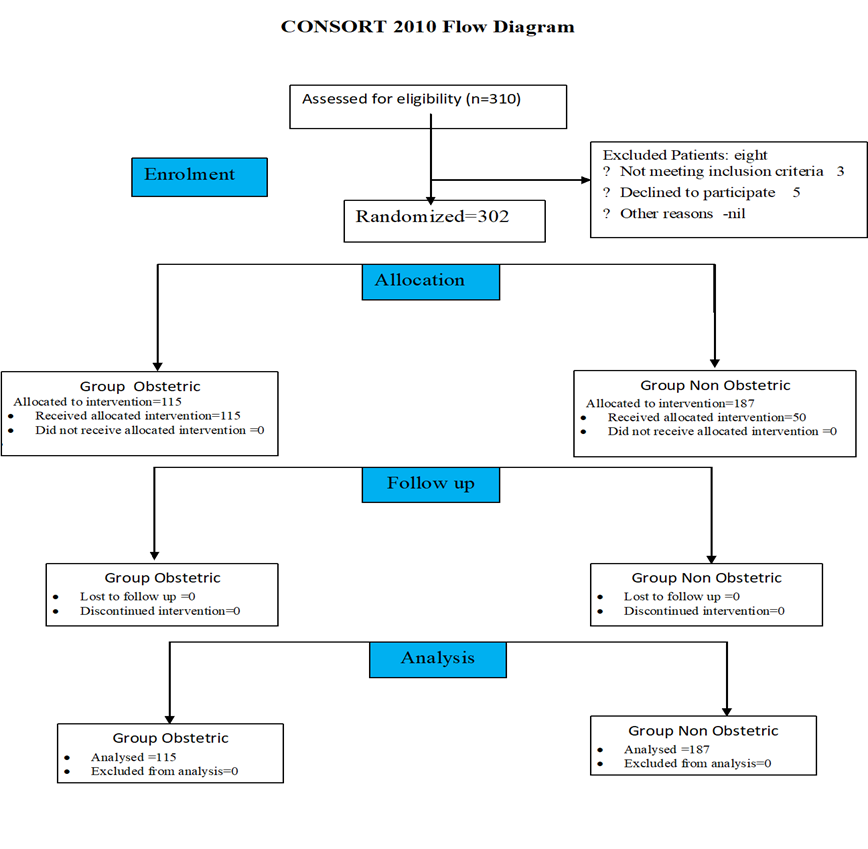
The present observational study was carried out to evaluate the incidence and severity of PDPH in the obstetrics and non-obstetrics patients. A total of 310 patients aged 20-60 years belonging to ASA I, II having BMI less than 30 kg/m2 and undergoing surgeries under subarachnoid block were enrolled comprising of parturients as well, over a period of 18 months at the Department of Anaesthesia, Dr RPGMC Kangra at Tanda. The five patients were excluded due to unwillingness to participate in the study and three patients couldn’t meet inclusion criteria. Thereby 302 patients were randomized into 2 groups.
The total patients included were 302, being 115 in obstetric group and 187 in non-obstetricgroup Figure 1.
Mean age of patients in group obstetric and group non obstetric was 30.66± 6.27 years and 52.88±12.72 years respectively (P=0.045). In our study, majority of obstetric population aged between 20-30 years, while 54% of non-obstetric populationwas aged above 40 years (p-Value=0.0001) (Table 1).
Mean BMI of patients in group obstetric and group non obstetric was 23.01±1.4 kg/m2 and 22.90±1.3 kg/m2 respectively (P=0.529). With regards to gender distribution in the non-obstetric group, 76 were female patients, while
Figure 1: Flow Chart of Patients Recruited and Analysedin Two Groups
Table 1: Demographic Profile of The Patients in Two Groups
Parameters
Group Obstetric (n= 115)
Group Non-Obstetric (n=187)
P -value
Age(yrs)*
20-30
92 (80%)
55 (29.3%)
0.0001
31-40
23 (20.0%)
31 (16.6%)
>40
0 (0.0%)
101 (54.0%)
Mean±SD
30.66± 6.27
52.88±12.72
0.045
BMI (Kg /m2)
Mean±SD
23.01 ±1.4
22.90 ±1.3
0.529
Gender
(Female/male)†
(Number )
115/0
76/111
0.001
ASA Status
(Number/%)
I
0(0.0%)
142(75.9%)
0.001
II
115(100.0%)
45(24.1%)
Note: Data expressed as* mean±SD and †number as appropriate. BMI: Body Mass Index, ASA: American Society ofAnaesthesiologist’s physical status
Table 2: Comorbidities in Patients in Two Groups
Co morbidities
Obstetric
Non-Obstetric
p-value
No
112(97.4%)
143(76.5%)
0.001
Yes
Hypertension
Hypertension with T2DM
Hypothyroidism
Overt DM
T2 DM
3 (2.6%)
0
0
2
1
0
44 (23.5%)
34
3
1
0
6
Note: DM: Diabetes Mellitus
111 were male (P Value=0.001). In relation to ASA grading 145 patients belonged to ASA I in non-obstetric group, whereas 42 patients belonged to ASA II in non-obstetric group and 115 in obstetric group (p-Value=0.001) (Table 2).
There were significantly higher proportion of subjects with co-morbidities among non-obstetrics in comparison to obstetrics population (23.5% vs. 2.6% P=0.001) (Table 3, Figure 5).
Table 3: Patients Positioning, Approach, Number of Attempts, Presence of Blood in the Spinal Needle During Spinal Block in Two Groups
Obstetric n=115
Non-Obstetric n=187
p-value
Patient position for spinal block
Sitting(n)
94(81.7%)
135(72.2%)
0.0813
Lateral
21(18.3%)
52(27.8%)
Approach for spinal block
Median
112(97.4%)
179(95.7%)
0.663
Para Median
3(2.6)
8(4.3%)
Number of attempts
1
104(90.4%)
164(87.7%)
0.587
2
11(9.6%)
23(12.3%)
Presence of blood in the spinal needle during SAB
Yes
0(0%)
0(0%)
NA
No
115(100%)
187(100%)
Table 4: Sensory Blockade Level, Motor Blockade Expressed as Modified Bromage Score, Intraoperative, Post-Operative Fluid Administered (Ml) and Ambulation Timings in the Two Groups Intra Operatively
Obstetric
Non-Obstetric
P value
Sensory blockade level
T4
54(47.0%)
108(57.8%)
0.0876
T6
61(53.0%)
79(42.4%)
Modified Bromage score
Complete block
(Grade 3)
115(100.0%)
187(100.0%)
NA
Intraoperative fluid (ml)
Mean±SD
1382.6±212.8
1398.4±238.4
0.814
Postoperative fluid over a period of 24 hrs (mL)
Mean±SD
2238.26±88.4
2193.0±210.2
0.0292
Ambulation timings
10 Hours
18(15.7%)
2(1.1%)
0.0001
12 Hours
97(84.3%)
78(41.7%)
16 Hours
0(0.0%)
1(0.5%)
48 Hours
0(0.0%)
106(56.7%)
Table -5: Patients Having Post Dural Puncture Headache (Pdph) in Two Groups
PDPH
Group Obstetric (n=115)
Group Non-Obstetric (n=187)
P value
Yes
(7.0%)
(4.8%)
0.5977
No
107(93%)
178(95.2%)
Table 6: Severity of Pdph in Two Groups
Variables
Frequency
Percentage
Mild
9
47.05
Moderate
7
41.17
Severe
1
11.76
In the obstetric group 94 parturients (81.7%) were positioned in sitting, whereas in the non-obstetric group 135(72.2%) patients were placed in the sitting position. Lateral position was used in 21(18.3%) parturients and 52(27.8%) in the non-obstetric group(P-Value=0.0813) In obstetric group the spinal block was instituted utilizing median approach in 112 parturients (97.4%), while in non-obstetric group 179(95.7%)patients were given spinal using median approach. The paramedian approach was used in 3(2.6%) parturients and 8(4.3%) patients in non-obstetric group (P Value=0.663). Single attempt was required in 104(90.4%) parturients and 164 (87.7%) in non-obstetric patients for instituting subarachnoid block, whereas 11(9.6%) and 23(12.3%) required two attempts in obstetric and non-obstetric patients respectively (0.587). Single attempt was required in 104(90.4%) parturients and 164 (87.7%) in non-obstetric patients for instituting subarachnoid block, whereas 11(9.6%) and 23(12.3%) required two attempts in obstetric and non-obstetric patients respectively (0.587) (Table 3).
In obstetrics and non-obstetrics patients, sensory blockade level was T4 in 47% and 57.8% respectively. Whereas, T6 level was obtained in 53% and 42.4% in obstetric and non-obstetric patients respectively (P Value=0.087) On the basis of modified bromage score, all the patients had complete motor block ie, grade 3 in all patients in both groups. The mean intraoperative fluid administered to the patients was 1382.6±212.8 mL and1398.4±238.4mL in obstetric and non-obstetric groups respectively (P Value=0.814).The postoperative fluid administration was 2238.26±88.4 mL in obstetric group as compared to non-obstetric group 2193.0±210.2 mL(P=0.0292). In obstetric group84.3% parturients were allowed to ambulatewithin 12 Hrs as compared to 41.7% patients in non-obstetric group. (p=0.0001) (Table 4).
In our study, out of 302 patients only 17 patients had post dural puncture headache, the total incidence being 5.6%. There were eight (7%) patients in obstetric and nine (4.8%) patients in non-obstetric group, however the difference was not statistically significant(p=0.597) (Table 5).
Majority of the patients had mild PDPH (47.05%) followed by moderate (41.17%), and only one patient had severe (11.76%) PDPH.
DISCUSSION
Spinal block is a reliable and easy technique frequently used in the anaesthetic practice. The post dural puncture headache (PDPH) is a well-known complication of spinal block [7]. The PDPH, which cause significant morbidity in obstetric patients, has higher incidence because of the increased cerebrospinal fluid (CSF) pressure related to pregnancy, dehydration, blood loss, postpartum diuresis, hormonal imbalance, high serum estrogen levels, and increased peridural pressure [8-9].
A total of 302 patientsaged 20-60 years belonging to ASA I, II having BMI less than 30 kg/m2 and undergoing surgeries under subarachnoid blocks were includedcomprising of parturients as well, over a period of 18 months at Department of Anaesthesia, Dr RPGMC Kangra at Tanda. After recruitment, the patients were divided into two groups comprising of obstetric and non-obstetric group. The total patients included were 302, being 115 in obstetric group and 187 in non-obstetric group.Mean age of patients in group obstetric and non-obstetric group was 30.66± 6.27 years and 52.88±12.72 years respectively (p=0.045). The patients were comparable with regards to body mass index in two groups. With regards to gender distribution in the non-obstetric group, 76 were female patients while 111 were male (p-Value=0.001). Three patients in obstetric group and 44 patients in non-obstetric group were having comorbidities, but were controlled on medications.
In our study, out of 302 patients only 17 patients had post dural puncture headache, the total incidence being 5.6%. There were eight (7%) patients in obstetric and nine (4.8%) patients in non-obstetric group (P=0.597). In all the patients the subarachnoid block was instituted using 26 G quincke spinal needle. The incidence is observed to range between 2 to 12% with 26-G needle.7 Our results are well within range. Comparable results were observed with Abdullayev et al. [10]Akdemir MS. [11] Whereas in Srivastava et al. [12] the incidence was 4% in obstetric patients, but authors used 27 G quincke spinal needle. In Jost U et al. [13] the incidence in non-obstetric patients were 1.83% with 26 G quincke needle, but the patients were more than 60 years of age.
In our study, the incidence of post dural puncture headache was 7% in parturients and 4.8% in non-obstetric patients (p=0.597). Whereas in the study by Srivastava et al. [12] the incidence was 4% in the obstetric group as compared to none in non-obstetric group(p=0.045) with 27 G quincke spinal needle. The lesser incidence in this study could be attributed to 27 G needle. Whereas in the study by Makito et al. [6] the incidence was 0.16% and 1.16% in the obstetric and non-obstetric patients respectively.Moreover, on the contrary the study by Weinrich J et al. [14] observed that the incidence of PDPH was less in obstetric patients (1.8%) as compared to orthopaedic patients(5.9%). The more incidence in orthopaedic patients may be because of delayed ambulation in such patients as compared to obstetric patients.In study by DelPizzo K et al. [15] 3.4% of patients for ambulatory lower limb surgery developed PDPH after subarachnoid block with 27 G pencil point spinal needle.
Majority of the patients had mild PDPH (47.05%) followed by moderate (41.17%), and only one patient had severe(11.76%) PDPH.Similarly Uluer et al. [16]Abdullayev et al. [10] and Montasser et al. [17]observed that majority of patients had mild and moderate PDPH and resolved within 3 to 5 days.
CONCLUSION
Therefore, we concluded that in the present study with the use of 26G quincke spinal needle, obstetric population had higher incidence of PDPH in comparison to non-obstetric population.
REFERENCE
Cesur, M. et al. "Decreased incidence of headache after unintentional dural puncture in patients with caesarean delivery administered with postoperative epidural analgesia." J Anesth, vol. 23, no. 1, 2009, pp. 31–35.
Arnold, M. "Headache classification committee of the international headache society the international classification of headache disorders." Cephalalgia, vol. 38, no. 1, 2018, pp. 1–21.
Oedit, R. et al. "Efficacy of the epidural blood patch for the treatment of post lumbar puncture headache BLOPP: a randomised, observer-blind, controlled clinical trial." BMC Neurol, vol. 5, no. 1, 2005, pp. 12–17.
Kiki, I. et al. "A simple, safe and effective approach to prevent postdural puncture headache: epidural saline injection." European J Med, vol. 41, no. 1, 2009, pp. 175–179.
Kwak, K.H. "Postdural puncture headache." Korean J Anesthesiol, vol. 70, no. 1, 2017, pp. 136–140.
Makito, K. et al. "Incidences and risk factors for post-dural puncture headache after neuraxial anaesthesia: a national inpatient database study in Japan." Anesth Intensive Care, vol. 48, no. 1, 2020, pp. 381–388.
Castrillo, A. et al. "Postdural puncture headache: impact of needle type. A randomized trial." Spine J, vol. 15, no. 1, 2015, pp. 1571–1576.
Choi, P.T. et al. "PDPH is a common complication of neuraxial blockade in parturients: a meta-analysis of obstetrical studies." Can J Anaesth, vol. 50, no. 1, 2003, pp. 460–469.
Lybecker, H. et al. "Incidence and prediction of postdural puncture headache. A prospective study of 1021 spinal anesthesias." Anesth Analg, vol. 70, no. 1, 1990, pp. 389–394.
Abdullayev, R. et al. "Incidence of postdural puncture headache: two different fine gauge spinal needles of the same diameter." J Obstet Anaesth Crit Care, vol. 4, no. 1, 2014, pp. 64–68.
Akdemir, M.S. et al. "The postdural puncture headache and back pain: the comparison of 26-gauge atraucan and 26-gauge quincke spinal needles in obstetric patients." Anesth Essays Res, vol. 11, no. 1, 2017, pp. 458–462.
Srivastava, V. et al. "Study of post dural puncture headache with 27G quincke & whitacre needles in obstetrics / non obstetrics patients." MEJ Anesth, vol. 20, no. 1, 2010, pp. 711–717.
Jost, U. et al. "Experience with G27 Whitacre needle in in-patient and 26G outpatient settings: incidence of post dural puncture headaches and other side effects." Anasthesiol Intensive Med, vol. 35, no. 1, 2000, pp. 381–387.
Weinrich, J. et al. "Postdural puncture headache after neuraxial anesthesia: incidence and the risk factors." Der Anaesthesist, vol. 69, no. 1, 2020, pp. 878–885.
DelPizzo, K. et al. "Risk of postdural puncture headache in adolescents and adults." Anesth Analg, vol. 131, no. 1, 2020, pp. 273–279.
Uluer, M.S. et al. "A randomized study to evaluate post-dural puncture headache after caesarean section: comparison with median and paramedian approaches." Niger J Clin Pract, vol. 22, no. 1, 2019, pp. 1564–1569.
Montasser, M.G. "Post dural puncture headache after spinal anesthesia for caesarean section: a comparison of 27G quincke and whitacre spinal needles in midline and paramedian approaches." J Med Sci, vol. 15, no. 1, 2015, pp. 44–49.
License
Creative Commons Attribution-NonCommercial-NoDerivatives 4.0 International License
All papers should be submitted electronically. All submitted manuscripts must be original work that is not under submission at another journal or under consideration for publication in another form, such as a monograph or chapter of a book. Authors of submitted papers are obligated not to submit their paper for publication elsewhere until an editorial decision is rendered on their submission. Further, authors of accepted papers are prohibited from publishing the results in other publications that appear before the paper is published in the Journal unless they receive approval for doing so from the Editor-In-Chief.
Himalayan Journal of Medicine and Surgery open access articles are licensed under a Creative Commons Attribution-Share A like 4.0 International License. This license lets the audience to give appropriate credit, provide a link to the license, and indicate if changes were made and if they remix, transform, or build upon the material, they must distribute contributions under the same license as the original.
Recommended Articles
Research Article
Primordial Prevention of Coronary Artery Diseases
Ahmed Adil Ali,
...
Hassan Ali Noori
Published: 26/07/2026
Download PDF
Cite
x
APA
Ali, A. A., Hussien, H. A., Kareem, H. B., Sarhan, S. R. & Noori, H. A. (2026). Primordial Prevention of Coronary Artery Diseases. Himalayan Journal of Medicine and Surgery, 7(2), 1-6.
MLA
Ali, Ahmed Adil, et al. "Primordial Prevention of Coronary Artery Diseases." Himalayan Journal of Medicine and Surgery 7.2 (2026): 1-6.
Chicago
Ali, Ahmed Adil, Hamza Ali Hussien, Hassan Baqer Kareem, Sarhan Raad Sarhan and Hassan Ali Noori. "Primordial Prevention of Coronary Artery Diseases." Himalayan Journal of Medicine and Surgery 7, no. 2 (2026): 1-6.
Harvard
Ali, A. A., Hussien, H. A., Kareem, H. B., Sarhan, S. R. and Noori, H. A. (2026) 'Primordial Prevention of Coronary Artery Diseases' Himalayan Journal of Medicine and Surgery 7(2), pp. 1-6.
Vancouver
Ali AA, Hussien HA, Kareem HB, Sarhan SR, Noori HA. Primordial Prevention of Coronary Artery Diseases. Himalayan Journal of Medicine and Surgery. 2026 Jul;7(2):1-6.
Download PDF
Research Article
Impact of Gut-Liver Axis: Hepatic Biochemical and Metabolic Changes Associated with Chronic Gastritis in Iraqi Patients with Helicobacter Pylori
Noor Zuhair Bakheet N. Z.
Published: 20/02/2026
Download PDF
Cite
x
APA
N. Z., N. Z. B. (2026). Impact of Gut-Liver Axis: Hepatic Biochemical and Metabolic Changes Associated with Chronic Gastritis in Iraqi Patients with Helicobacter Pylori. Himalayan Journal of Medicine and Surgery, 7(1), 1-4.
MLA
N. Z., Noor Z. B.. "Impact of Gut-Liver Axis: Hepatic Biochemical and Metabolic Changes Associated with Chronic Gastritis in Iraqi Patients with Helicobacter Pylori." Himalayan Journal of Medicine and Surgery 7.1 (2026): 1-4.
Chicago
N. Z., Noor Z. B.. "Impact of Gut-Liver Axis: Hepatic Biochemical and Metabolic Changes Associated with Chronic Gastritis in Iraqi Patients with Helicobacter Pylori." Himalayan Journal of Medicine and Surgery 7, no. 1 (2026): 1-4.
Harvard
N. Z., N. Z. B. (2026) 'Impact of Gut-Liver Axis: Hepatic Biochemical and Metabolic Changes Associated with Chronic Gastritis in Iraqi Patients with Helicobacter Pylori' Himalayan Journal of Medicine and Surgery 7(1), pp. 1-4.
Vancouver
N. Z. NZB. Impact of Gut-Liver Axis: Hepatic Biochemical and Metabolic Changes Associated with Chronic Gastritis in Iraqi Patients with Helicobacter Pylori. Himalayan Journal of Medicine and Surgery. 2026 Jan;7(1):1-4.
Download PDF
Research Article
Effect of Land Degradation on Livelihood
Kemalo Abdulmalik,
Isreal Zewide
Published: 04/01/2024
Download PDF
Cite
x
APA
Abdulmalik, K. & Zewide, I. (2024). Effect of Land Degradation on Livelihood. Himalayan Journal of Medicine and Surgery, 5(1), 1-4.
MLA
Abdulmalik, Kemalo and Isreal Zewide. "Effect of Land Degradation on Livelihood." Himalayan Journal of Medicine and Surgery 5.1 (2024): 1-4.
Chicago
Abdulmalik, Kemalo and Isreal Zewide. "Effect of Land Degradation on Livelihood." Himalayan Journal of Medicine and Surgery 5, no. 1 (2024): 1-4.
Harvard
Abdulmalik, K. and Zewide, I. (2024) 'Effect of Land Degradation on Livelihood' Himalayan Journal of Medicine and Surgery 5(1), pp. 1-4.
Vancouver
Abdulmalik K, Zewide I. Effect of Land Degradation on Livelihood. Himalayan Journal of Medicine and Surgery. 2024 Jan;5(1):1-4.
Download PDF
Research Article
Awareness and Practices among Professional Healthcare Workers towards COVID-19 in Iraq
Yasir H Motlaq,
...
Zainab T. N M. Almuhannah
Published: 30/03/2024
Download PDF
Cite
x
APA
H Motlaq, Y., A Aqebian, E. & N M. Almuhannah, Z. T. (2024). Awareness and Practices among Professional Healthcare Workers towards COVID-19 in Iraq. Himalayan Journal of Medicine and Surgery, 5(1), 1-9.
MLA
H Motlaq, Yasir, Esraa A Aqebian and Zainab T. N M. Almuhannah. "Awareness and Practices among Professional Healthcare Workers towards COVID-19 in Iraq." Himalayan Journal of Medicine and Surgery 5.1 (2024): 1-9.
Chicago
H Motlaq, Yasir, Esraa A Aqebian and Zainab T. N M. Almuhannah. "Awareness and Practices among Professional Healthcare Workers towards COVID-19 in Iraq." Himalayan Journal of Medicine and Surgery 5, no. 1 (2024): 1-9.
Harvard
H Motlaq, Y., A Aqebian, E. and N M. Almuhannah, Z. T. (2024) 'Awareness and Practices among Professional Healthcare Workers towards COVID-19 in Iraq' Himalayan Journal of Medicine and Surgery 5(1), pp. 1-9.
Vancouver
H Motlaq Y, A Aqebian E, N M. Almuhannah ZT. Awareness and Practices among Professional Healthcare Workers towards COVID-19 in Iraq. Himalayan Journal of Medicine and Surgery. 2024 Jan;5(1):1-9.
Negi, C., None, P. & Ram, M. (2022). Evaluation of the Incidence and Severity of Post Dural Puncture Headache (Pdph) in the Obstetrics and Non-Obstetrics Patients in a Tertiary Care Hospital. Himalayan Journal of Medicine and Surgery, 3(2), 1-5.
MLA
Negi, C.M., Poonam and Mast Ram. "Evaluation of the Incidence and Severity of Post Dural Puncture Headache (Pdph) in the Obstetrics and Non-Obstetrics Patients in a Tertiary Care Hospital." Himalayan Journal of Medicine and Surgery 3.2 (2022): 1-5.
Chicago
Negi, C.M., Poonam and Mast Ram. "Evaluation of the Incidence and Severity of Post Dural Puncture Headache (Pdph) in the Obstetrics and Non-Obstetrics Patients in a Tertiary Care Hospital." Himalayan Journal of Medicine and Surgery 3, no. 2 (2022): 1-5.
Harvard
Negi, C., None, P. and Ram, M. (2022) 'Evaluation of the Incidence and Severity of Post Dural Puncture Headache (Pdph) in the Obstetrics and Non-Obstetrics Patients in a Tertiary Care Hospital' Himalayan Journal of Medicine and Surgery 3(2), pp. 1-5.
Vancouver
Negi C, Poonam P, Ram M. Evaluation of the Incidence and Severity of Post Dural Puncture Headache (Pdph) in the Obstetrics and Non-Obstetrics Patients in a Tertiary Care Hospital. Himalayan Journal of Medicine and Surgery. 2022 Jul;3(2):1-5.



 Download PDF
 Download XML