Background: Family planning is essential for reproductive health and enables individuals to make informed decisions about pregnancy timing and spacing. Despite efforts to improve knowledge, gaps exist in understanding family planning methods among women. This study aims to assess the level of knowledge about family planning methods among women attending Civil Hospital Theog, Himachal Pradesh. Methods: A descriptive cross-sectional survey was conducted at the outpatient department of Civil Hospital Theog between March and June 2023. A convenience sampling technique was used, and 400 women above 18 years participated. Data were collected using a questionnaire assessing knowledge related to family planning methods. Validity of the tool was ensured, and data analysis was performed using Epi Info V7 Software. Results: The study found that 32% of participants had very good knowledge, 41.25% had good knowledge, 17.75% had fair knowledge, and 9.0% had poor knowledge about family planning methods. Notably, 80.75% correctly identified the purpose of family planning, and 72% named three common contraceptive methods. However, knowledge regarding hormonal contraception and its types was relatively lower, with 38% and 39% of participants providing correct responses, respectively. Conclusion: The study highlights the need for targeted educational interventions to improve knowledge about family planning methods among women in the region. Enhancing understanding of contraceptive methods, including hormonal contraception, and addressing gaps in knowledge will empower individuals to make informed decisions and improve reproductive health outcomes.
Family planning is a crucial aspect of reproductive health that empowers individuals and couples to make informed decisions about the timing and spacing of pregnancies. It encompasses a range of methods that enable individuals to prevent or delay pregnancy and choose the number of children they want to have [1]. Access to comprehensive information and services related to family planning is essential to ensure individuals can make choices aligned with their reproductive goals and improve overall maternal and child health outcomes [2-3].
In India, family planning is a key component of the national health policy, aiming to provide individuals with the necessary knowledge and access to a wide range of contraceptive methods. However, despite ongoing efforts, there are still gaps in awareness and understanding about family planning methods among women in various communities [4]. Limited knowledge about available contraceptive methods, their effectiveness, and potential side effects can hinder women's ability to make informed decisions regarding their reproductive health [5-6].
Himachal Pradesh, a northern state of India, faces unique challenges in terms of access to healthcare services, including family planning. The outpatient department of Civil Hospital Theog plays a vital role in delivering healthcare services to women in the region. Understanding the level of knowledge and awareness about family planning methods among women attending this specific healthcare setting is crucial for identifying gaps and developing targeted interventions to improve reproductive health outcomes [7-8].
Assessing the understanding of family planning methods among women can help identify barriers, misconceptions, and gaps in knowledge that hinder informed decision-making. It can also inform the development of educational programs, interventions, and policies to promote the use of appropriate family planning methods and improve overall reproductive health outcomes [9-12].
Therefore, this study aims to explore the understanding about family planning methods among women attending the outpatient department of Civil Hospital Theog, Himachal Pradesh. By assessing the awareness, knowledge, and perceptions related to various contraceptive methods, this study intends to provide valuable insights into the educational needs of women in the region and contribute to improved reproductive health outcomes.
Objectives of the Study
To assess the level of various Family planning methods knowledge among women attending the outpatient department of Civil Hospital Theog, Himachal Pradesh, with the objective of identifying gaps and potential areas for targeted educational interventions.
Research Approach: Descriptive
Research Design: Hospital based cross-sectional survey design
Setting of the study: OPD in Civil hospital Theog, Himachal Pradesh
Study Duration: Between March 2023- June 2023
Study Population: Women aged above 18 years came to OPD
Sample Size: 400 women, assuming 50% have adequate knowledge regarding Family planning methods, 5% absolute error, 95% confidence level, and 5% non-response rate
Sampling Technique: Convenience Sampling technique
Sampling Criteri: Irst five female patients who came to OPD were selected everyday till the completion of
sample size after explaining the purpose of the study Informed consent was taken from them and confidentiality of the selected participants was also maintained
Inclusive Criteria: Female patients who were willing to participate in the study
Exclusion Criteria: female patients who were not willing to participate in the study
Description of Tool
Demographic Data Survey Instrument: The demographic form elicited information on
Articipants’ Background: age, marital status, religion, employment, education, family’s monthly income etc
Questionnaire: The questionnaire contains 20 structured knowledge related questions. One mark was given for each correct answer and zero for incorrect answer. The maximum score was 20 and minimum score was zero. Scoring was done on the basis of marks as >80%(16-20)=very good,60-79%(12-15) =Good,41-59% ( 8-11)=Fair,<40% (< 8)=poor
Validity of Tool: By the experts in this field
Data Collection: By under the guidance of supervisors and patients were given 30 minutes time to complete that questionnaire and collected at the end of the prescribed time
Data Analysis: with Epi Info V7 Software with appropriate statistical test in terms of frequencies, percentage
The goal of the current study was to assess the level of knowledge about Family planning methods among women attending the outpatient department of Civil Hospital Theog, Himachal Pradesh. A total of 400 respondents including 137 (34.25%) from urban area and 263 (65.75%) from rural area were participated in the study.
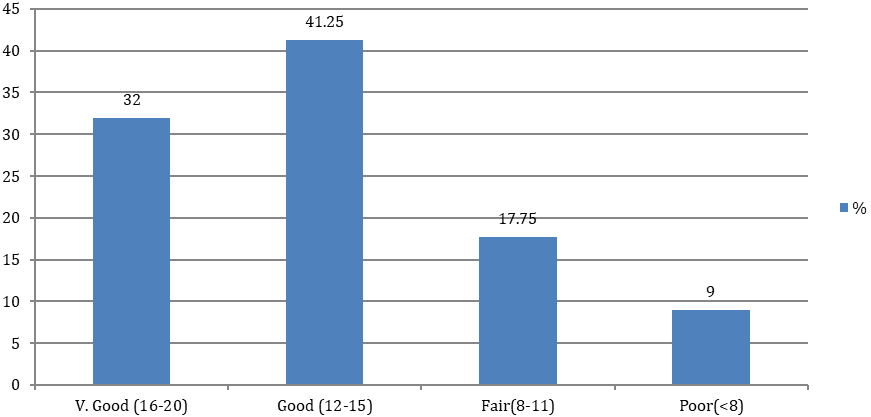
In the present study 32% (128) participants had very good knowledge (16-20 marks) towards contraceptives, 41.25% (165) had good knowledge (12-15 marks), 17.75% (71) had fair knowledg (8-11 marks) and 9.0% (36) having poor knowledge (<8 marks).
Table-1: Knowledge regarding Family Planning Methods among study participants
| S.No. | Statements | Frequency of Correct Responses | Percent |
| 1 | What is the purpose of family planning? | 323 | 80.75 |
| 2 | Name three common contraceptive methods. | 288 | 72 |
| 3 | What is the effectiveness of male condoms in preventing pregnancy? | 276 | 69 |
| 4 | How does hormonal contraception work? | 152 | 38 |
| 5 | What are the different types of hormonal contraception? | 156 | 39 |
| 6 | Can emergency contraception be used as a regular form of contraception? | 166 | 41.5 |
| 7 | What is the effectiveness of intrauterine devices (IUDs) in preventing pregnancy? | 154 | 38.5 |
| 8 | What are the advantages and disadvantages of oral contraceptive pills? | 187 | 46.75 |
| 9 | How does the contraceptive patch work? | 102 | 25.5 |
| 10 | What are the permanent methods of family planning? | 299 | 74.75 |
| 11 | Can breastfeeding be used as a form of contraception? | 110 | 27.5 |
| 12 | What is the effectiveness of natural family planning methods? | 99 | 24.75 |
| 13 | How does sterilization work for males and females? | 179 | 44.75 |
| 14 | What are the side effects or potential risks of using hormonal contraception? | 206 | 51.5 |
| 15 | How soon after giving birth can a woman start using contraception? | 158 | 39.5 |
| 16 | Can teenagers access contraceptive methods without parental consent? | 187 | 46.75 |
| 17 | What should a woman do if she misses taking her oral contraceptive pill? | 276 | 69 |
| 18 | Can family planning methods protect against sexually transmitted infections (STIs)? | 189 | 47.25 |
| 19 | Are there any religious or cultural beliefs that influence the use of family planning methods? | 264 | 66 |
| 20 | Where can women access family planning services and information in our community? | 302 | 75.5 |

Figure 1: Knowledge score regarding Family Planning Methods among study participants
The aim of this study was to assess the level of knowledge about family planning methods among women attending the outpatient department of Civil Hospital Theog, Himachal Pradesh. The findings provide valuable insights into the understanding and awareness of family planning methods among women in the region.
The study included 400 participants, with 34.25% from urban areas and 65.75% from rural areas. The results indicated varying levels of knowledge regarding family planning methods among the participants. Overall, 32% of the participant’s demonstrated very good knowledge, 41.25% had good knowledge, 17.75% had fair knowledge, and 9.0% had poor knowledge about family planning methods.
The results showed that a significant proportion of women had a good level of knowledge regarding family planning methods. For instance, 80.75% of participants correctly identified the purpose of family planning. This indicates a relatively high level of awareness about the fundamental concept of family planning among the respondents. Similarly, a considerable number of participants correctly identified common contraceptive methods (72%) and understood the effectiveness of male condoms in preventing pregnancy (69%). This indicates a relatively high level of awareness about the overall concept and basic methods of family planning among the respondents.
However, there were areas where participants showed relatively lower levels of knowledge. For instance, only 38% of participants understood how hormonal contraception works, and a similar proportion (39%) knew about the different types of hormonal contraception. These findings suggest a need for targeted educational interventions to improve understanding in these specific areas.
It is encouraging to note that a majority of participants recognized the advantages and disadvantages of oral contraceptive pills (46.75%) and the effectiveness of male condoms in preventing pregnancy (69%). Additionally, a significant proportion of participants were aware of permanent methods of family planning (74.75%) and the need to use contraception to prevent sexually transmitted infections (STIs) (47.25%).
The findings of this study align with previous research on knowledge about family planning methods among women in different settings. A study conducted in a rural area of Nepal reported similar levels of knowledge, with 30% of women demonstrating very good knowledge and 41% having good knowledge [12].
These findings revealed that participants had moderate knowledge about various family planning methods, including emergency contraception, intrauterine devices (IUDs), natural family planning methods, sterilization, and postpartum contraception. However, there is still room for improvement in terms of understanding the effectiveness and appropriate use of these methods.
The results of this study indicate the need for targeted educational interventions to improve awareness and knowledge about family planning methods among women in the region. Enhancing understanding of different contraceptive methods, their mechanism of action, effectiveness, and potential side effects could empower individuals to make informed decisions and choose the most suitable method for their reproductive goals.
Furthermore, the findings can serve as a baseline for future studies and help evaluate the effectiveness of awareness campaigns and educational programs focused on family planning. By addressing the gaps in knowledge identified in this study, healthcare providers and policymakers can work towards improving access to comprehensive family planning services and reducing unintended pregnancies in the region.
Limitations
It is important to note that this study has some limitations. The use of convenience sampling may introduce selection bias, and the reliance on self-reported data could be subject to recall bias. Future research could utilize larger sample sizes, employ more diverse sampling techniques, and include qualitative methods to gain a deeper understanding of the factors influencing knowledge and perceptions of family planning methods among women.
In conclusion, this study highlights the importance of assessing the understanding about family planning methods among women attending healthcare facilities. The findings provide valuable insights into the knowledge gaps and areas for improvement in reproductive health education. By addressing these gaps, healthcare providers and policymakers can enhance awareness and knowledge about family planning methods, promote informed decision-making, and contribute to improved reproductive health outcomes in the region.
"Family planning/contraception." World Health Organization. Available at: https://www.who.int/news-room/fact-sheets/detail/family-planning-contraception (Accessed on 18 June 2023).
Pazol, K., et al. "Impact of contraceptive education on contraceptive knowledge and decision making: a systematic review." American Journal of Preventive Medicine, vol. 49, no. 2 Suppl 1, pp. S46–S56, 2015.
Silumbwe, A., et al. "Community and health systems barriers and enablers to family planning and contraceptive services provision and use in Kabwe District, Zambia." BMC Health Services Research, vol. , no. , pp. 390, 2018.
"National Family Health Survey (NFHS-5), 2019–20." Ministry of Health and Family Welfare, Government of India. Available at: https://rchiips.org/nfhs/ (Accessed on 18 June 2023).
Muttreja, P. and Singh, S. "Family planning in India: the way forward." Indian Journal of Medical Research, vol. 148, no. Suppl, pp. S1–S9, 2018.
"NHM." Ministry of Health and Family Welfare. Available at: https://nhm.gov.in/index1.php?lang=1&level=2&sublinkid=821&lid=222 (Accessed on 15 June 2023).
Mwaisaka, J., et al. "Exploring contraception myths and misconceptions among young men and women in Kwale County, Kenya." BMC Public Health, vol., no. , pp. 1694, 2020.
"Family planning." Gates Foundation. Available at: https://www.gatesfoundation.org/our-work/programs/gender-equality/family-planning (Accessed on 18 June 2023).
Ghule, M., et al. "Barriers to use contraceptive methods among rural young married couples in Maharashtra, India: qualitative findings." Asian Journal of Research in Social Sciences and Humanities, vol. 5, no. 6, pp. 18–33, 2015.
Ochako, R., et al "Barriers to modern contraceptive methods uptake among young women in Kenya: a qualitative study." BMC Public Health, vol., no. , pp. 118, 2015.
Moreira, L. R., et al. "Reasons for nonuse of contraceptive methods by women with demand for contraception not satisfied: an assessment of low and middle-income countries using demographic and health surveys." Reproductive Health, vol. 16, no. , pp. 148, 2019.
Thapa, S., et al. "Knowledge on family planning methods and its use among married women of reproductive age in a rural municipality of Nepal." Journal of Kathmandu Medical College, vol. 7, no. 3, pp. 122–127, 2018.