The study examined the impact of international trade on poverty reduction in Nigeria. The specific objectives are to: Determine the impact of total import value on the poverty reduction in Nigeria; ascertain the impact of total export value on the poverty reduction in Nigeria and evaluate the impact of foreign direct investment on the poverty reduction in Nigeria. This study made use of ex post-facto research design, which enables us to measure the impact or relation between dependent variable and explanatory variables using time-series secondary data. These variables consist of Poverty Rate (POVERTY), Total Export Value (TEV), Total Import Value (TIV), Foreign Direct Investment (FDI), TRADE OPENNESS (TRAOPEN) and Trade Tariff (TRADE) for a period of 1980 to 2019. Poverty rate (POVERTY) was sourced from World Bank Data Indicators. Total Export Value (TEV), Total Import Value (TIV), Foreign Direct Investment (FDI) and Trade Tariff (TRADE) were sourced from Central Bank of Nigeria’s (CBN) Statistical Bulletin 2019. The method of data analysis was Error Correction Model while Augmented Dickey-Fuller Unit Root test statistic, Johansen co-integration test, Heteroscedasticity White Test, Ramsey Reset, Jarque Bera, Breuch-Godfrey Serial Correlation LM Test were test used in the study. The results of the study reveal that: Total Export Value (TEV) has positive significant impact on poverty reduction since (t-statistics (6.0593) > critical value (1.684); Total Import Value (TIV) has negative significant impact on poverty reduction since (t-statistics (-3.3968) > critical value (1.684); total import value has 79% positive significant impact on poverty reduction in Nigeria and Foreign Direct Investment (FDI) has positive insignificant impact on poverty reduction since (t-statistics (0.2781) < critical value (1.684). The study recommends that the Nigeria government should sustain export diversification. Non-oil exports, especially agricultural sector, should be encouraged and concentration on oil sector export should be minimized.
The first of the Millennium Development Goals (MDGs) is to eradicate poverty and hunger. This shows the severity of the challenge worldwide and its importance for development. Economists have long been concerned with the factors which cause diverse countries to grow at different rates and accomplish various levels of wealth. One of such factors is trade. However, while international trade between nations may engender growth generally, there are no guarantees that its cumulative benefits are distributed evenly among trading partners [1]. This has been the experience of Nigeria since the independence even though the composition of trade has changed over the years. Thus, international trade is the existence of absolute independence of countries in terms of goods and services produced and consumed [2].
International trade, through the medium of import and export of goods and services, has become an increasingly important and prominent economic activity amongst countries particularly in this volatile economy. The exchange of goods and services across borders is an avenue through which countries may be able to achieve and promote economic self-sustainability as well as a platform for transforming a country’s natural resources such as crude oil, gold, diamond and so on into economic wealth. The wealth acquired in this regard is used by the government to provide basic infrastructural facilities, which off-course enhances the living standards of the populace and consequently leading to economic growth and development [3].
Another positive spillover effect that international trade has on the economy of developing countries especially in Africa is that it presents opportunities for local industries to internationally broaden their market reach. This results to the potential increase of market size and increased profit turnover which in turn results to the encouragement and growth of the local industries and creation of employment opportunities for the teaming populace [3].
In Nigeria, international trade could be found to be paramount to the growth of the economy because it generates a significant amount of revenue particularly from the agricultural and oil sectors. Prior to the discovery of crude oil, a significant portion of Nigeria’s revenue emanated from the exportation of agricultural products such as palm oil, groundnut, rubber and cocoa. However, the discovery of crude oil resulted to the neglect of the agricultural sector as Nigeria’s major export sector. From the import perspective, due to Nigeria’s status quo of being underdeveloped, it highly depends on technologically advanced countries such as Germany, the United States and the United Kingdom for the importation of products which it lacks the capacity and technical know-how to produce for instance, automobiles, equipment and machinery. The importation of these commodities helps to stimulate technical efficiencies and meet the productive needs of the local industries as well as that of the large population [4].
The importance of international trade to economic improvement cannot be over emphasized. This is because both the classical and neoclassical financial analysts are of the opinion that international trade serves as the life wire of any developed nation. Over the past three centuries, the world economy has become greatly connected through globalization. International trade plays a central role in the development of a modern global economy. The impact of international trade on a country’s economy is reflected in the structural change in the economy. International Trade could enhance the efficient production of goods and services through allocation of resources to countries that have comparative advantage in their production [5].
International trade has become an inevitable activity in today’s world. A country such as Nigeria generates a substantial portion of its revenue through the exportation of oil and agricultural produce. Likewise, through importation, the country is able to satisfy the domestic needs for mechanized and technological products which it lacks the capacity and technical know-how to produce. It is based on this premise that this study conducts an investigation into the impact of international trade on poverty reduction in Nigeria.
Statement of the Problem
Trade has been recognized as an engine for inclusive economic growth and poverty reduction in the 2030 Agenda for Sustainable Development. The 2015 joint WTO-World Bank publication, The Role of Trade in Ending Poverty strengthened the evidence that trade has played a critical role in poverty reduction and that the further integration of developing countries into an open global economy will be essential for achieving the goal of ending extreme poverty by 2030.
The Nigerian case in the benefits of international trade is a different thing altogether. One of the serious issues that has obstructed the accomplishment of poverty reduction in Nigeria have been credited to external aggregates such as; low FDI inflow, exchange rate instability and negative net export [6]. For instance, fluctuations in Nigeria’s currency (Naira) exchange rate, which is a good determinant of external trade, caused economic instability in the country and corrupt practices in government offices.
Nigeria is rich but its people are poor [7]. This irony has made it imperative to assess the poverty implications of the government’s activities. A greater urgency should be brought into this issue as the population of poor people is almost steadily growing: between 1980 and 1996 the population of poor people (living below the poverty line) doubled from 33% [18 million] to 66% [66 million] of the population (DFID). Recent United Nations and Federal Government estimates for the year 2000 that poverty level will change but unfortunate trend of rapidly growing population of poor people is further exacerbated by double i.e. the poor are becoming poorer than they used to be. Poverty is caused by microeconomic and macroeconomic as well as sociocultural factors in Nigeria.
Nigeria is an oil-endowed state and an example of a petro-dependent economy. Oil wealth and petroleum resources account for about 75% of Nigeria’s foreign exchange earnings. The petroleum sector is thus, justifiably, the mainstay of the economy. Between 2010 and 2019, total of 2,787 crude oil pipelines vandalisation were reported on pipelines belonging to the Nigerian National Petroleum Corporation (NNPC) resulting in a loss of 157.81mt of petroleum products, worth about ₦12.53billion revenue from export crude oil sales in international trade. According to the Nigerian Bureau of Statistics [8] reports that incidence of poverty in the Niger Delta increased from 15.4% in 1980 to 52.2% in 2014 and is connected to the constant incidence of oil spillage which has destroyed sources of income and productive activities in the region. Furthermore, Akpokodje and Sheu [9], Nnabuenyi [10] observed the negative effects of oil spillage on agriculture and lamented that most of the destroyed farmlands and polluted river have contributed to the frustration and lack of livelihoods for farmers and fishermen in Niger Delta region thereby reduced the level of farm produce for export in international trade. Therefore, it is in the light of these backdrops that this study examines the impact of international trade on poverty reduction in Nigeria.
Objectives of the Study
The aim of the study is to examine the impact of international trade on poverty reduction in Nigeria. The specific objectives are to:
Determine the impact of total import value on the poverty reduction in Nigeria
Ascertain the impact of total export value on the poverty reduction in Nigeria
Evaluate the impact of foreign direct investment on the poverty reduction in Nigeria
Conceptual Literature
International Trade: International trade is also known as foreign trade. It is different from inter-regional trade or internal-local or domestic or internal trade. The inter-regional trade or internal-local or domestic or internal trade refers to trade between regions within a country. But international trade, on the other hand, is a trade between two nations or countries [11]. It may be defined as the exchange of goods and services between one country and another. The trade is bilateral if it involves only two nations. Example, a trade between Nigeria and USA. The trade is multilateral if it involves more than two countries. Example, a trade between Nigeria, Japan and USA. Commodities produced at home country and sold to other countries are called exports and commodities purchased from other countries are called imports. International trade is the exchange of capital, goods and services across the international borders or territories [12].
Poverty Reduction
Poverty reduction, poverty relief, or poverty alleviation, is a set of measures, both economic and humanitarian, that are intended to permanently lift people out of poverty. [13]. Poverty can be seen from two different perspectives: (i) “moneylessness” which means both an insufficiency of cash and chronic inadequacy of resources of all types to satisfy basic human needs, such as, nutrition, rest, warmth and body care; and (ii) “powerlessness” meaning those who lack the opportunities and choices open to them and whose lives seem to them to be governed by forces and persons outside their control. That is, in positions of authority or by perceived “evil forces” or “hard luck”
Gafar et al. [13] saw poverty from five dimensions of deprivation: (i) personal and physical deprivation experienced from health, nutritional, literacy, educational disability and lack of self-confidence; (ii) economic deprivation drawn from lack of access to property, income, assets, factors of production and finance; (iii) social deprivation as a result of denial from full participation in social, political and economic activities; (iv) cultural deprivation in terms of lack of access to values, beliefs, knowledge, information and attitudes which deprives the people the control of their own destines; and (v) political deprivation in term of lack of political voice to partake in decision making that affects their lives. Related to the definition of poverty is the measurement of poverty.
Theoretical Literature
Heckscher-Ohlin International Trade Theory: The Heckscher-Ohlin international trade theory was developed by the Swedish economist Bertil Ohlin (1899-1979) on the basis of work by his teacher the Swedish economist Eli Filip Heckscher (1879-1952). For his work on the theory, Ohlin was awarded the Nobel Prize for Economics (the Sveriges Riksbank Prize in Economic Sciences in Memory of Alfred Nobel) in 1977. Heckscher-Ohlin international trade theory, in economics, developed the General Equilibrium or factor Endowment or factor proportions theory of international or theory of comparative advantage in international trade the H.O. theory states that the main determinant of the pattern of production, specialization and trade among regions is the relative availability of factor endowments and factor prices. Regions or countries have different factor endowments and factor prices. Countries in which capital is relatively plentiful and labour relatively scarce will tend to export capital-intensive products and import labour-intensive products, while countries in which labour is relatively plentiful and capital relatively scarce will tend to export labour-intensive products and import capital-intensive products. To Ohlin, the immediate cause of international trade always is that some commodities can be bought more cheaply from other regions whereas in the same region their production is possible at high prices. Thus, the main cause of trade between regions is the difference in prices of commodities based on relative factor endowments and factor prices.
Some countries are relatively well-endowed with capital: the typical worker has plenty of machinery and equipment to assist with the work. In such countries, wage rates generally are high; as a result, the costs of producing labour-intensive goods-such as textiles, sporting goods and simple consumer electronics-tend to be more expensive than in countries with plentiful labour and low wage rates. On the other hand, goods requiring much capital and only a little labour (automobiles and chemicals, for example) tend to be relatively inexpensive in countries with plentiful and cheap capital. Thus, countries with abundant capital should generally be able to produce capital-intensive goods relatively inexpensively, exporting them in order to pay for imports of labour-intensive goods. In the Heckscher-Ohlin theory, it is not the absolute amount of capital that is important; rather, it is the amount of capital per worker. A small country like Luxembourg has much less capital in total than India, but Luxembourg has more capital per worker. Accordingly, the Heckscher-Ohlin theory predicts that Luxembourg will export capital-intensive products to India and import labour-intensive products in return.
Despite its plausibility, the Heckscher-Ohlin theory is frequently at variance with the actual patterns of international trade. One early study of the Heckscher-Ohlin theory was carried out by Wassily Leontief, a Russian-born U.S. economist. Leontief observed that the United States was relatively well-endowed with capital. According to the theory, therefore, the United States should export capital-intensive goods and import labour-intensive ones. He found that the opposite was in fact the case: U.S. exports are generally more labour-intensive than the types of products that the United States imports. Because his findings were the opposite of those predicted by the theory, they are known as the Leontief Paradox.
Keynesian Theory of Income Determination in an Open Economy
The theory of income determination in an open economy was propounded by John Maynard Keynes in 1936. It involved the remove of assumption that there are no exports or imports and government expenditure in national income analysis. This means that imports and exports and government expenditure and taxation are added in the theory of open economy national income analysis. Government expenditures are like investment because they raise the demand for goods. They are injections in that national income. On the other hand, taxes are leakages in the national income like savings because they tend to reduce the demand for consumer goods. The impact of exports and imports is similar to that of the government expenditure. Exports are injections because they increase the demand for goods in the same economy. Imports, on the other hand, are leakages in the national income because they represent the supply of goods to the given economy.
The analysis of the determination of income in an open economy is based on the following assumptions. (A) The domestic economy international trade is small relative to total trade (b) There is less than full employment in the economy (c) The general price level is constant up to the full employment level (d) Exchange rate area fixed (e) There are no tariffs, trade and exchange restrictions (f) Gross exports are determined by external factors (g) Export (X), investment (I) and government expenditure (G) are autonomous (g) Consumption (C), imports (M), savings (S) and taxes (T) are each a fixed proportion of income (Y) and their relationship with income are linear.
Functional equation of an open economy theory is represented as:
Y = C+I+G+(X-M)
Where:
Y = National Income
C = Consumption Expenditure
I= Investment Expenditure
G= Government Expenditure
Nd = net trade (Jhingan, 2008)
This theory has been criticized for its unrealistic assumptions, first constant consumption is not realistic, second price is not constant in reality and thirdly total output of a nation does not dependent on consumption, investment and government expenditure and net export only. Regardless of these criticisms this theory has been instrumental in research studies concerning economic growth and government expenditure and net export. In spite of these criticisms, the theory of economic growth determination in an open economy will be adopted in this work with modification where the TOT will be factored-in as the independent variable.
Empirical Literature
The link between international trade and poverty reduction has attracted the attention of the researchers and scholars. The empirical review of literature was written as follows.
Komal and Madan [14] conducted a study to examine the impact of India’s exports intensity on poverty outcomes. With poverty as a focal point, the international trade in India is examined together with a wide range of macro variables in order to trace down the poverty-reducing impact of trade. Using a case study approach, time series data on India is taken for the post-globalization period of 1990–2012. The key dependent variable is poverty, which is measured as poverty headcount as wells as poverty gap. The model is regressed using classical Ordinary Least Squares (OLS) as well as system Generalized Method of Moments (GMM) estimator in order to control endogeneity and reverse causality in the model. The results using basic OLS regression state that poverty reduces as exports increases. When the model is tested using the GMM approach, the empirical results do not show any significant relationship between poverty and exports for the basic model. However, when interaction terms of control variables are brought in the model, the results change. The results thus suggest that globalized trade of goods may be an engine for poverty reduction in India, when it is complemented with the right domestic policies.
Sheereen [15] conducted a study to investigate the impact of trade on poverty reduction in a small island of Mauritius over the time period of 1990-2017. Specially, the study examined the impact of trade openness, value of export and value of import on poverty reduction in small island of Mauritius. The study adopted ex post facto research design. The methods of data analysis were unit root test, Johansen co-integration test and granger causality analysis and vector error correction model. The study found that trade reduces poverty in the long, rather than the short run. Moreover, the study also shows that economic growth as well as education are important to alleviate poverty in the country. Hence, it is recommended that the government should an export-led poverty Reduction Programme, which will integrate poor communities into trade. Other social protections and social policies like the provision of welfare benefits are recommended to reduce poverty level in the country.
Adegbemi et al. [16] investigate the possible nexus between trade liberalization and poverty in 21 African countries covering the period 2005–2014. The study deployed the following econometric tests: Descriptive statistics; the correlation matrix and variance inflator; the panel unit root test; the pooled OLS technique; and the panel co-integration test (Johansen co-integration test). In order to confirm the robustness and validity of the regression model result, Ramsey RESET, cross dependence, autocorrelation and heteroscedasticity tests were conducted. The findings reveal that foreign direct investment and inflation rate had a positive relationship with the human development index while exchange rates and trade openness were negatively related to poverty level at the 5% level. The study recommended urgent policy measures aimed at revamping the poverty alleviation programmes. The study recommended that in a bid to diversify export market, developing countries should target other developing countries in the spirit of South-South cooperation.
Komal and Madan [17] conducted a study to identify the role of trade in growth and poverty reduction: A review of literature with special reference to India. The study intends to achieve the following objectives: (a) to examine the literature outlining the theories supporting poverty and trade linkages; (b) to examine the literature implying that economic growth impacts poverty and (c) to examine the literature implying that exports impacts poverty. This paper tries to assess the relevance of trade in reducing poverty in India and promoting pro-poor growth through a survey of the existing literature and concludes that a strong performance on the international market can help reduce domestic poverty in developing countries. The method of data was literature content analysis. The findings revealed that there is strong empirical evidence in favour of the growth enhancing effects of exports and trade in general. Furthermore, a number of detailed microeconomic studies using firm-level and household data show that exporting can lead to productivity, growth and directly reduce poverty through wage and employment effects.
Gap in Literature
After literature review, it is verify that there is no clear consensus till date in the literature as to whether international trade stimulate poverty reduction or promote poverty as empirical result varies from region to region and country to country. The study will provide explanation to the direction effect of international trade on poverty reduction thereby bridge existing gap.
This study made use of expost-facto research design which enables us to measure the effect or relationship between dependence variable and explanatory variables using time-series secondary data. The data analytical techniques were Augmented Dickey-Fuller Unit Root test statistic Johansen Co-integration test were pre-estimation test carried out in the study. Heteroscedasticity White Test, Ramsey Reset, Jarque Bera, Breuch-Godfrey Serial Correlation LM Test and Error Correction Model.
Theoretical Framework
The study adopts the work of Keynesian framework. In a simple Keynesian framework, the desired aggregate demand relationship in the goods market in the Keynesian framework is expressed as follows:
Y = C + I+G+ (X-M)
(1)
Model Specification
This study specifically adopts the model of Sheereen [15] to study the impact of international trade on poverty reduction. Thus, the model is represented in a functional form as shown below:
POVERTY=f (TEV, TIV, FDI, EXR, TRAOPEN, TRADE)
(2)
where, POVERTY is poverty head count ratio representing Percentage of population below $1.25 a day poverty line (%) as a proxy for poverty reduction, TEV is total export value, TIV is total import value, FDI is foreign direct investment, EXR is exchange rate, TRAOPEN is trade openness (Trade openness calculated as the ratio of import plus export to GDP (%) and TRADE is trade tariff. In a linear function, it is represented as follows:
POVERTYt = β0 + β1TEVt- β2TIVt + β3FDIt + β4EXRt
+ β5 TRAOPENt + β6 TRADEt+ µt
(3)
Where:
β0 = Constant term
β1 to β6 = Regression coefficient
µt = Error Term, t = the period
Presentation of Data and Results
The descriptive statistics of data show nature and common statistics of the variables namely mean, median, maximum, minimum, standard deviation and sum of the variable (Table 1).
Table 1: Result of Descriptive Statistics
| POVERTY | TEV | TIV | FDI | TRAOPEN | EXR | TRADE |
Mean | 1776.072 | 381062.7 | 418420.3 | 428567.0 | 82430.95 | 70054.95 | 608998.6 |
Median | 2588.105 | 140106.8 | 128929.1 | 113623.6 | 23211.80 | 97.39930 | 162181.3 |
Maximum | 4188.890 | 1945723.0 | 1920900. | 1488922. | 1399400.0 | 1399400.0 | 1874638.0 |
Minimum | 0.380000 | 7502.500 | 7201.200 | 264.3000 | 0.000000 | 0.546400 | 2880.200 |
Std. Dev. | 1485.289 | 550428.3 | 569468.1 | 527873.8 | 221151.3 | 308834.7 | 745344.5 |
Skewness | -0.131613 | 1.711784 | 1.415656 | 0.993379 | 5.462560 | 4.129483 | 0.869145 |
Kurtosis | 1.379794 | 4.719607 | 3.819595 | 2.497168 | 33.08371 | 18.05263 | 2.028158 |
Jarque-Bera | 4.490590 | 24.46312 | 14.48010 | 7.000076 | 1707.313 | 491.3202 | 6.610211 |
Probability | 0.105896 | 0.000005 | 0.000717 | 0.030196 | 0.000000 | 0.000000 | 0.036695 |
Sum | 71042.88 | 15242509 | 16736810 | 17142679 | 3297238.0 | 2802198.0 | 24359945 |
Sum Sq. Dev. | 86037294 | 1.18E+13 | 1.26E+13 | 1.09E+13 | 1.91E+12 | 3.72E+12 | 2.17E+13 |
Observations | 40 | 40 | 40 | 40 | 40 | 40 | 40 |
Source: E-view’s Result
Unit Root Test using Augmented Dickey-Fuller Test
It has been shown in econometric studies that most macroeconomic time series are not stationary at levels. Giving this knowledge, testing for stationarity of variables to obtain a more reliable result becomes very essential. Stationarity test was therefore carried out using Augmented Dickey-Fuller (ADF) approaches for unit root testing which are reported in Table 2. In order to examine the unit root status of the variables.
In the Table 2, the variables that were tested with unit root are shown, the values for Augmented Dickey-Fuller (ADF) statistic is presented, the lag level of each variable is identified. The Mackinnon critical values at 5% level of significant were pointed out. The order of integration of each variable was enumerated and finally the stationarity position of each variable was also stated. When Augmented Dickey-Fuller statistic is greater than Mackinnon 5% critical value in absolute term, it is concluded that the variable is stationary. These variables Poverty rate (POVERTY), Foreign trade exchange rate (EXR), Total Export Value (TEV), Total Import Value (TIV), Foreign Direct Investment (FDI), trade openness (TRAOPEN) and Trade Tariff (TRADE) are stationary at first difference, that is they are I(1) process. Therefore, they contain unit root. The existence of unit root in most variables paves way for further investigation on the nature of the long run relationship among the variables.
Table 2: Results of Stationarity (Unit Root) Test
Variables | ADF- Statistic | Critical Value | Remark |
POVERTY | -5.057598 | 1% level = -3.615588 5% level = -2.941145 10% level = -2.609068 | 1(1) |
TEV | -5.484595 | 1% level = -3.615588 5% level = -2.941145 10% level = -2.609068 | 1(1) |
TIV | -5.535829 | 1% level = -3.615588 5% level = -2.941145 10% level = -2.609068 | 1(1) |
FDI | -4.651514 | 1% level = -3.615588 5% level = -2.941145 10% level = -2.609068 | 1(1) |
TRAOPEN | -7.374461 | 1% level = -3.615588 5% level = -2.941145 10% level = -2.609068 | 1(1) |
EXR | -6.163554 | 1% level = -3.615588 5% level = -2.941145 10% level = -2.609068 | 1(1) |
TRADE | -5.945844 | 1% level = -3.615588 5% level = -2.941145 10% level = -2.609068 | 1(1) |
Source: Author’s computation from E-view 9
Johansen Co-Integration Test Results
Since all the variables are integrated of order, 1 (1). It is necessary to determine the existence of long run equilibrium relationship between the variables. Separate co-integration tests were carried out on poverty rate (POVERTY), Total Export Value (TEV), total import value (TIV), Foreign Direct Investment (FDI), trade openness (TRAOPEN), Foreign Exchange Rate (EXR) and trade tariff (TRADE). Non-stationary time-series can be co-integrated if there are linear combinations of them that are stationary, that is, the linear combination does not have a stochastic trend. In other words, if two or more I(1) variables are co-integrated, they must obey an equilibrium relationship in the long-run, although they may diverge substantially from that equilibrium in the short run. The co-integration tests are based on the Johansen and Juselius (1989) test. Table 3 one present the co-integration test results.
Table 3: Johansen Co-Integration Test Results
Hypothesized No. of CE(s) | Eigenvaue | Trace Statistic | 0.05 Critical Value | Prob.** |
None * | 0.847474 | 220.5428 | 125.6154 | 0.0000 |
At most 1 * | 0.729872 | 149.0867 | 95.75366 | 0.0000 |
At most 2 * | 0.658692 | 99.35002 | 69.81889 | 0.0000 |
At most 3 * | 0.478618 | 58.50114 | 47.85613 | 0.0037 |
At most 4 * | 0.404942 | 33.75281 | 29.79707 | 0.0166 |
At most 5 | 0.225355 | 14.02716 | 15.49471 | 0.0822 |
At most 6 * | 0.107550 | 4.323833 | 3.841466 | 0.0376 |
Date: 08/01/21 Time: 16:34, Sample (adjusted): 1982 2019, Included observations: 38 after adjustments, Trend assumption: Linear deterministic trend, Series: POVERTY TEV TIV FDI TRAOPEN EXR TRADE, Lags interval (in first differences): 1 to 1, Unrestricted Cointegration Rank Test (Trace)Trace Test Indicates 5 cointegrating eqn(s) at the 0.05 Level, *Denotes Rejection of the Hypothesis at the 0.05 Level, **MacKinnon-Haug-Michelis (1999) p-values
Source: Author’s Computation from E-view 9
Ho = There is no Co-Integration (no Long Run Relationship among Variable)
The co-integration results in Table 3 for the model (POVERTY, TEV, TIV, FDI, TRAOPEN, EXR and TRADE) reveals that trace test statistics indicates 5 co-integrating equation(s) at the 5% level of significance.
Thus, there is a long-run relationship among the variables (POVERTY, TEV, TIV, FDI, TRAOPEN, EXR and TRADE). We therefore reject the null hypothesis of no co-integration amongst the variables and accept the alternative hypothesis.
Estimation of Regression Model
The result of the regression analysis represents the model for the impact of international trade on poverty reduction in Nigeria. The empirical result shows that the coefficient of Total Export Value (TEV) has positive and significant impact on poverty rate (proxy for poverty reduction) because probability value of 0.0005 which is less than 0.05. The empirical result shows that the coefficient of Total Import Value (TIV) has negative and significant impact on poverty rate (proxy for poverty reduction) because probability value of 0.0005 which is less than 0.05. The empirical result shows that the coefficient of Foreign Direct Investment (FDI) has positive and insignificant impact on poverty rate (proxy for poverty reduction) because probability value of 0.8596 which is greater than 0.05. The Trade Openness (TRAOPEN) has positive and significant impact on poverty rate (proxy for poverty reduction) probability value of 0.0003 which is less than 0.05. The foreign Exchange Rate (EXR) has negative and significant impact on poverty rate (proxy for poverty reduction) because probability value of 0.0004 which is less than 0.05.
The Trade Tariff (TRADE) has negative and significant impact on poverty rate (proxy for poverty reduction) because probability value of 0.0004 which is less than 0.05. The result of the F-statistical test shows that the overall regression of the variables is statistically significance. This is because observed values of the F-statistics (15.3963) is greater than its critical value (1.864251). Again, our empirical result shows that the R-squared (R2) is 0.803124. The coefficient of ECM statistic is (-0.18725). The ECM result indicates that 18% of errors have been corrected from short run adjustment to the long run. In other words, ECM statistic shows that the model has 18% degree of adjustment from short-run to long-run equilibrium. This is a low speed of adjustment to equilibrium after a shock (Table 4).
Table 4: Empirical Results of the Error Correction Model (ECM)
Variable | Coefficient | Std. Error | t-Statistic | Prob. |
C | 0.848661 | 0.442711 | 1.916964 | 0.0645 |
D(TEV,1) | 0.558706 | 0.092206 | 6.059323 | 0.0005 |
D(TIV,1) | -0.796786 | 0.234566 | -3.396860 | 0.0005 |
D(FDI,1) | 0.303407 | 1.090706 | 0.278174 | 0.8596 |
D(EXR,1) | -0.618907 | 0.201176 | -3.076445 | 0.0004 |
D(TRAOPEN,1) | 0.676356 | 0.090621 | 7.463568 | 0.0003 |
D(TRADE,1) | -0.327006 | 0.109906 | -2.975324 | 0.0004 |
ECM-1 | -0.187255 | 0.097370 | -7.923133 | 0.0007 |
R-squared | 0.803124 | Mean dependent var | 0.507692 | |
Adjusted R-squared | 0.797249 | S.D. dependent var | 2.332988 | |
S.E. of regression | 2.324517 | Akaike info criterion | 4.705584 | |
Sum squared resid | 167.5048 | Schwarz criterion | 5.046827 | |
Log likelihood | -83.75888 | Hannan-Quinn criter. | 4.828019 | |
F-statistic | 15.39639 | Durbin-Watson stat | 2.188339 | |
Prob(F-statistic) | 0.000005 |
|
| |
Dependent Variable: D(POVERTY,1), Method: Least Squares, Date: 08/01/21 Time: 14:58, Sample (adjusted): 1981 2019, Included observations: 39 after adjustments
Source: Author’s Computation from E-view 9
Econometric/Second Order Test
The Null Hypothesis; there is Autocorrelation: The Breuch-Godfrey Serial correlation LM Test was used to identify whether the model suffers from autocorrelation problem. The autocorrelation problem violates ordinary least squares assumption that says there is no correlation among error terms of different observation. Breuch-Godfrey Serial correlation LM Test is a statistic that ensures that the assumption of ordinary least squares was not violated. The f-statistic result of Breuch-Godfrey Serial correlation LM Test is (1.34838) and it P-value is (0.0627). From the results of the above test, the probability values for Lagrange Multiplier (LM) test is greater than 0.05. This implies that there is no serial correlation problem (Table 5).
Table 5: Result of Breuch-Godfrey Serial Correlation LM Test
Breusch-Godfrey Serial Correlation LM Test: | |||
F-statistic | 1.34838 | Prob. F(1,30) | 0.0627 |
Obs*R-squared | 2.04761 | Prob. Chi-Square(1) | 0.0696 |
Test Equation: Dependent Variable: RESID, Method: Least Squares, Date: 09/10/21 Time: 08:20, Sample: 1981 2019, Included Observations: 39, Presample missing value lagged residuals set to zero
Source: Author’s Computation from E-view 9
Result of Ramsey Reset Test
The Null Hypothesis; there is Specification Error: This second order test checks whether the model of the study suffers model specification error. The null hypothesis; there is model specification error. From the results of the Ramsey Reset test, the probability values (0.0621) for Ramsey Reset’s t-statistics is greater than 0.05. This implies that model include core variables in the model. It does not include superfluous variables. The functional form of the model is very well specified, there is no error of measurement in the regress and regressors (Table 6).
Table 6: Result of Ramsey Reset Test
| Value | Df | Probability | |
| t-statistic | 1.325296 | 30 | 0.0717 |
| F-statistic | 2.105818 | (1, 30) | 0.0621 |
| Likelihood ratio | 2.137321 | 1 | 0.0641 |
| Sum of Sq. | Df | Mean Squares | |
| Test SSR | 27181.80 | 1 | 27181.80 |
| Restricted SSR | 7733397.0 | 31 | 249464.4 |
| Unrestricted SSR | 7706215.0 | 30 | 256873.8 |
| LR Test Summary | |||
| Value | Df | ||
| Restricted LogL | -293.1898 | 31 | |
| Unrestricted LogL | -293.1211 | 30 | |
Unrestricted Test Equation: Dependent Variable: D(POVERTY,1), Method: Least Squares, Date: 09/10/21 Time: 08:20, Sample: 1981 2019, Included observations: 39
Source: Author’s Computation from E-view 9
Histogram Normality Test
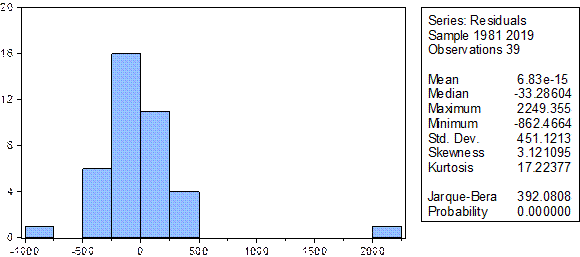
Normality test is done to check if the residuals of the error term have a normal distribution. Normality test is conducted using Jacques-Bera (JB) test. In testing for normality, approach used by Paavola (2006) for testing normality using Jacques-Bera test was adopted (Figure 1).
Jarque-Bera (JB) test is statistics that compute both skewness and Kurtosis. Skewness shows the degree symmetry (normal distribution). The normal measurement is zero/0. Kurtosis is a statistics that compute degree of peakedness. The normal measurement is three/3. A distribution is skewed if one of its tails is longer than the other. A skewed distribution can be positive or negative. Positive skewed distribution means that it has a long tail in the positive direction. Negative skewed distribution means that it has a long tail in the negative direction. The null hypothesis is that there is no skewness and Kurtosis in the model. We reject the null hypothesis because the probability value of Jarqua-Bera statistics (0.0000000) which is less than 0.05. This implies that the residuals do not follow normal distribution.
Figure 1: Presents Normality Test for each of the Distribution
Sources: E-view 9.0 Version
Test of Hypothesis Two
HO2 = Total Export Value has no Significant Impact on the Poverty Reduction in Nigeria: The empirical result shows that the coefficient of Total Export Value (TEV) has positive and significant impact on poverty rate (proxy for poverty reduction) because probability value of 0.0005 which is less than 0.05. The empirical finding reveals that Total Export Value (TEV) has significant impact on the poverty reduction in Nigeria during period covered by the study.
Test of Hypothesis Three
HO3 = Foreign Direct Investment has no Significant Impact on the Poverty Reduction in Nigeria: The Foreign Direct Investment (FDI) has positive and insignificant impact on poverty rate because probability value of 0.8596 which is greater than 0.05. The empirical finding reveals that Foreign Direct Investment (FDI) has no significant impact on the poverty reduction in Nigeria during period covered by the study.
Summary of Findings
The following are the major findings of the study.
Total Export Value (TEV) has positive significant impact on poverty reduction since (t-statistics (6.0593)> critical value (1.684). Total export value has 56% positive significant impact on poverty reduction in Nigeria. A percent change in Total export value results to 56% increase in poverty rate in Nigeria.
Total Import Value (TIV) has negative significant impact on poverty reduction since (t-statistics (-3.3968) > critical value (1.684). Total import value has 79% positive significant impact on poverty reduction in Nigeria. A percent change in Total import value results to 79% decrease on poverty rate in Nigeria.
Foreign Direct Investment (FDI) has positive insignificant impact on poverty reduction since (t-statistics (0.2781) < critical value (1.684). Foreign direct investment has 30 percent positive insignificant impact on poverty reduction in Nigeria. A percent change in foreign direct investment results to 30% increase in poverty rate in Nigeria.
This study concludes that international trade has positive significant impact on poverty reduction in Nigeria. This study was in line the postulation of John Maynard Keynes and post Keynesian analysis that strengthen net export of a country results to economic growth. Nigeria has profited from international trade over the years. However, the gains of trade could be greater if the economy and the production structures had been responsive and more adaptable to changes both internally and externally on the basis of international economic system. In ever changing and highly competitive global environment, Nigeria needs to continually re-examine, revise and re-evaluate sources of strengths, weaknesses, opportunities and threats (SWOT analysis) in order to develop appropriate policy strategies that can lead to maximum national benefits within the context of identified problems.
Recommendations of the Study
Based on the findings of this study, the following recommendations were made:
Government should start and sustain export promotion strategy. Nigeria government should strengthen the competiveness of exports by combing the imports of high technology and domestic independent research
The government should start and sustain export diversification. Non-oil sector exports especially agricultural sector should be encouraged and concentration on oil sector export should be minimized. Expenditure on projects and infrastructures that would facilitate trade and economic growth should be encouraged and the monetary authority should give priority to exchange rate stability. The government should encourage farmers by providing them with loans, agricultural schools, farm to market roads, as most of the export goods come from the agricultural sector
The government should start and sustain re-orientation advertisement for consumption of made-in-Nigeria goods and reframe from excessive consumption of foreign goods and services so that their imports might be cutoff. Manufacturing industries should improve on their production so that their output would be competitive in the global market. Excise duties should be lowered so as to encourage local industries to export their goods and services. Lifting of trade barriers on local output should not be followed by the introduction of new ones. Only the importation of capital goods that are essential should be encourages, since not all importation are necessary for economic growth
Obadan, M.I. and I.E. Okojie. "An empirical analysis of the impact of trade on economic growth in Nigeria." Jos Journal of Economic, vol. 4, no. 1, 2012, pp. 1–23.
Gbanador, C.A. "Devaluation and balance of payments stability in an oil producing economy." Nigeria Journal of Monetary Economics, vol. 5, no. 4, 2005, pp. 4–13.
Owolabi-Merus, O. et al. "An investigation into the impact of international trade in the growth of Nigeria's economy." International Letters of Social and Humanistic Sciences, vol. 6, no. 1, 2015, pp. 116–125.
Ezindu, O.N. et al."Impact of international trade on Nigerian economic growth: Evidence from oil terms of trade." International Journal of Economics and Financial Management, vol. 5, no. 2, 2020, pp. 20–31.
Frankel, A.J. and D. Romer. "Does trade cause growth." The American Economic Review, vol. 89, no. 6, 1999, pp. 79–99.
Obayori, J.B. "Fiscal policy and unemployment in Nigeria." International Journal of Social Sciences and Humanities Invention, vol. 3, no. 2, 2016, pp. 1887–1891.
World Development Report 1990: Poverty. World Bank, Oxford University Press, 1990.
Federal Republic of Nigeria Poverty Profile of Nigeria. National Bureau of Statistics, 2004.
Akpokodje, J. and S. Sheu. "Oil pollution and agricultural productivity in the Niger Delta of Nigeria." Environmental Economics, vol. 6, no. 4, 2015, pp. 68–75.
Nnabuenyi, U.M. "Impact of oil exploration and exploitation on the Niger Delta region: Environmental perspective." Five Decades of Oil Production in Nigeria: Impact on the Niger Delta, edited by A.S. Akpotor et al., Centre for Environmental and Niger Delta Studies, Ibadan, 2012.
Jhingan, M.L. Money, Banking, International Trade and Public Finance. 8th Edn., Vrinda Publications, 2006.
Yakubu, M.M. and B.N. Akanegbu. "The impact of international trade on economic growth in Nigeria: 1981–2012." European Journal of Business, Economics and Accountancy, vol. 3, no. 6, 2015, pp. 56–68.
Gafar, T.I. et al."Economic growth and poverty reduction in Nigeria." International Journal of Business and Social Science, vol. 2, no. 15, 2011, pp. 147–157.
Komal, C. and L. Madan. "The role of international trade in poverty reduction: A case study of India." Journal of Commerce and Accounting Research, vol. 9, no. 2, 2020, pp. 27–40.
Sheereen, F. "Investigating the impact of trade on poverty reduction in a small island economy." International Journal of Economics and Financial Management, vol. 5, no. 2, 2020, pp. 20–31.
Adegbemi, O. et al. "Poverty and trade liberalization: Empirical evidence from 21 African countries." Economic Research–Ekonomska Istraživanja, vol. 32, no. 1, 2019, pp. 635–656.
Komal, C. and L. Madan. "Role of trade in growth and poverty reduction: A review of literature with special reference to India." Journal of International Business, vol. 4, no. 2, 2017, pp. 101–123.