A profitable and sustainably giant pawpaw bioenterprise requires an efficient seedling production. During ripening, the seeds in pawpaw fruits frequently appear in different colours which may affect the the ability of the seeds to germinate during seedling development a key practice in commercial pawpaw bioenterprise. Two sets of trials were conducted at Bio resources Development Centre (BIODEC), National Biotechnology Development Agency Owode-Yewa South Ogun State, Nigeria on the germination potential of giant pawpaw (Carica papapa Linn) seeds as influenced by changes in the color of the seeds inside the fruits during ripening. Two ripening pawpaw fruits were harvested from a single pawpaw plant and the seeds were collected, prepared, separated and assigned as Treatment 1 Orange submerged (ORSub), Treatment 2 Orange float (ORFlt), Treatment 3 Black submerged (BLSub) and Treatment 4 Mixture (MIXtu) that served as the control. Top soil was used as media for germination in polyethene bags and the trials were laid down using a Completely Randomized Design (CRD) replicated five (5) times. Data were collected on percentage germination, number of leaves produced and plant heights. All the data collected from the two trials were pooled and subjected to one way Analysis of Variance (ANOVA), means were separated with Duncan Multiple Range Test (DMRT). The result revealed that treatment 3 (Black submerged (BLSub) showed the highest germination percentage (52.99), number of leaves growth (6.37) and plant height (14.56 cm). The DMRT revealed that there was no significant difference statistically (P>0.05) between all the treatments in terms of all the parameters measured. It was recommended that giant pawpaw seed could be separated based on colour differences of the seeds in the ripening fruit prior to development in the nursery for uniformity of growth, efficient and sustainable seedling production.
Key findings:
This study investigated the germination potential of giant pawpaw seeds affected by seed color changes during ripening. Results showed no significant difference in germination, leaf growth, and plant height among treatments. However, the highest germination percentage, leaf growth, and plant height were observed in seeds from black-submerged fruits. Separating seeds based on ripening color could enhance uniform seedling growth in commercial pawpaw bioenterprises.
What is known and what is new?
Existing knowledge suggests that seed color changes during ripening may influence germination in certain plant species. This study adds to this knowledge by specifically examining the germination potential of giant pawpaw seeds affected by ripening color. The finding that seed color did not significantly affect germination, leaf growth, or plant height in giant pawpaw seeds is a novel contribution to understanding seedling development in this species.
What is the implication, and what should change now?
The implication of this study is that giant pawpaw seedlings can be produced efficiently without the need to separate seeds based on ripening color. This finding simplifies the seedling production process, potentially reducing labor and costs for pawpaw bioenterprises. Farmers and nursery operators can now focus on other aspects of seedling management, leading to more sustainable and profitable pawpaw cultivation practices.
Pawpaw otherwise called papaya (Carica papaya L.) belongs to the family Caricaceae and order Brassicales. It is among the most widely grown fruit crops worldwide. Papaya is native to tropical America but currently grown in all tropical and subtropical countries including Nigeria [1].
Papaya is a fruit in which its consumption has no cultural boundary as it is eating by all irrespective of social status at any convenient time of the day. It is a recipe in a variety of cookeries especially for dieters all over the world. Unripe fruits and leaves are consumed as vegetable while the seeds are also used as ingredient in salad dressings [2].
The use of papaya goes beyond its fruit consumption alone. The seed, leaves, peels and aerial parts are good for medicine and pharmacological purposes [3]. On wildlife, a study by Ogunkunle and Lamidi (2014) [4], revealed that best growth performance could be achieved on black skinned Ecotype Giant African Land snail when fed with Brown pawpaw leave meal and groundnut cake mixture. According to literatures, there are many varieties of papaya with different genetic and agronomic characteristics which has been explored for the benefit of human being socio-economically. As part of the mandate of bioresources development centre, gaint pawpaw is a living resource that present a fascinating feature that worth harnessing for bio-enterprise development.
The pawpaw possesses an exciting yield characteristic in which an average weight of a matured fruit ranges between 5-10kg compared to other known varieties with far lesser weight. In sub-Saharan Africa, specifically in Kenya, as submitted by Asudi, (2010) [5], pawpaw has high economic important and cultivated for both domestic use and for any other purpose on both small and large scale with most of farmers being small-scale farmers.
Generally, the contribution of this pawpaw variety to the socio-economic livelihood of people had been kick stated. Recently, from around the study area, training and capacity building on the production of this pawpaw had been conducted to expose its potency as a candidate crop for prosperity among the ruralites. In this respect, it is interesting to note that farmers had been trained on the production methodology during the Special Programme on Entrepreneurship Development training tagged ‘BIOSPEED’ organised by Bioresources Development Centre (BIODEC OWODE), National Biotechnology Development Agency, Nigeria [6].
Convincingly, this identified quality in this papaya variety then needs to be fully harnessed and preserved for human benefit and also to avoid extinction in order to help in boosting the socio-economic status of growers. Success in this endeavor therefore requires concerted efforts in terms of various empirical studies to unveil these potentials.
Growth is one of the basic characteristics of living organism and it is not sudden, rather, it occurs gradually. During the process of seed formation in fruits, the male and female gametes gradually combine together to form zygote. The efficacy of this fertilization process in fruits is a precursor to the development of a viable seed. Usually, mortality and incomplete germination experience in some seed after planting might have been brought about by a short fall in the fertilization process which can be linked to reduced survival percentage of seeds including papaya [7].
For commercial production, seedling development in the nursery is germane in crop like papaya. Efforts directed towards every nursery practices and operations are targeted at developing uniform seedlings with high vigour. Suffice it then to say that uniformity in seedling growth in the nursery is a prerequisite towards uniform field establishment, bumper harvest, and effective labour utilization for a profitable bio-enterprise.
The occurrence of erratic germination in pawpaw seed in the nursery is very common according to several literatures. This may be as a result of diverse factors but specifically on the quality of seeds planted. Several studies involving pawpaw seed germination to reduce this gap had been conducted. Zulhisyam et al., (2013) [8], found that pawpaw seeds dried to 6% moisture content and stored at a temperature of 0oc gave the highest germination percentage. Seeds require oxygen for respiration and according to Ibrahim et al., (2011) [2] pawpaw seeds dried with the removal of sarcotesta tend to have increased oxygen supply to the embryo during drying process which promote germination.
The report had confirmed that high quality seeds are obtained at the central position of land race pawpaw fruits, while a high proportion of dormant and empty seed has been identified at the extreme of the fruit at 25% ripening stage when sliced transversely. Similarly on other crops such as cassava, the top and middle parts of cassava stem was discovered to achieve the highest root yield [9].
Morphologically, the variation in skin colour on matured and ripened papaya fruits observed among the new hybrid lines and Sunrise solo could be associated with enzymatic or chlorophyll degradation during ripening which may be influential to the viability of the seeds (Ding et al., 2007; Zuhair et al., 2013) [10,11]. At molecular level, the major determinant of colour changes in the fruits of flesh papaya has been attributed to the presence of carotenoid pigments with red and yellow colours controlled by a single genetic locus with yellow being dominant (Storey, 1969 , as cited in Gaudence et al.,(2019) [12].
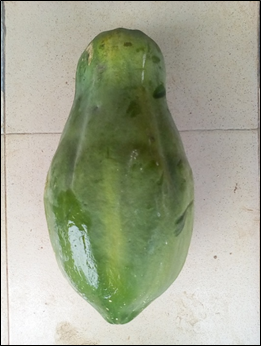
Therefore, the observed changes in the seed colour inside papaya fruits (Figure 1a) at different stages of ripening is not unexpected. The reports of Ocampo et al., (2006) and Aikpokpodion, (2012) [13,14] had attested to the fact that papaya exhibits a wide variation in many traits which include plant height, fruits shape, size, leaf characteristics and taste of the fruits.
As demanded by the cultural practices, increased number of seedling is require for a productive papaya plantation establishment in order to ensure appropriate plant density at all time. Implying that establishment of papaya plantation for sustainability requires a robust plan for a continuous replacement of old plant with new seedling.
This observed change in seed colour inside the fruits might have influence on viability and germination ability of the seeds. This has therefore provided us an impetus to conduct this research in order to advance the body of knowledge as it relates to erratic seed germination usually recorded in the growth of pawpaw seeds in the nursery. It is against this background that this research was conducted to ascertain the viability of the seeds as influenced by the observed colour variation in giant pawpaw seeds during fruit ripening.
Experimental Area
Two sets of trials were conducted on giant papaya seeds from August to November, 2019 under the nursery shed at Bioresources Development Centre (BIODEC), Owode- Yewa South which is an outreach centre of National Biotechnology Development Agency, Nigeria. Owode - Yewa town lies between latitude 60 481 N, 20 571 E and longitude 6.80 N 2.951 E (Wikipedia, 2014). The (BIODEC) centre has a specific geospatial coordinate of N 060 43.7121 E 0020 59.5311, obtained from a field survey 2019 via the use of hand-held GPS receiver, (model etrex, legend H, Germin). The study area lies in the rain forest agro ecological zone with two raining seasons from February to July and September to November. The rest months are characterized by dry season and hamattan.
Source of Seeds and Seed Preparation
A fruiting giant pawpaw tree was purposively selected for the study based on its perceived sweetness and shape from which two fruits used for the experiments were harvested from the demonstration farm within the premises of the centre.


Figure 1a Figure 1b


Figure 1c Figure 1d
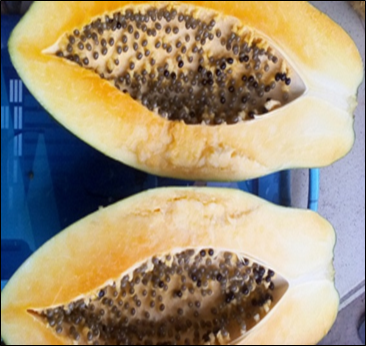
The fruit(s) (Figure 1a) were harvested at stage 1 of ripening and kept in the laboratory under ambient temperature for 5 days after which it was then sliced longitudinally into equal halve (Figure 1b) to collect the seeds.
Collection and Separation of Seed
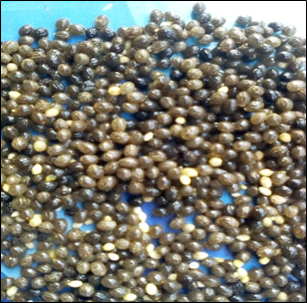
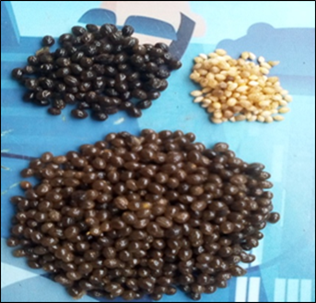
Firstly, the seeds were collected together (Figure 1c) and separated into white, black and orange based on differences in the colour observed (Figure 1d). The white ‘inviable’ seeds (Figure 1d) (upper right) were discarded while the remaining black seeds (Figure 1d) (upper left) and orange seeds (Figure 1d) at bottom were packed in plastic bucket separately. The different seeds were then washed separately inside plastic containers under running tap water in the laboratory. After washing, it was observed that some of the orange coloured seeds submerged while some float. But all the black coloured seed submerged under the water, these were further separated and named accordingly as orange submerged, orange float and black submerged.
Preparation of Seed Separates
The different separates (orange submerged, orange float and black submerged seeds were washed with hand and sharp sand in the laboratory under running tap water to remove the sarcotesta which according to Ibrahim et al.,(2011)[2] improves the germination potentials of pawpaw seed when removed. The total numbers of each separates were then counted and recorded (Table 1).
The cleaned seeds were air dried in the laboratory for 5 days and then assigned as Treatment 1 Orange submerged (ORSub), Treatment 2 Orange float (ORFlt), Treatment 3 Black submerged (BLSub) . Meanwhile, Treatment 4 Mixture (MIXtu) that served as the control for this study was computed by randomly selecting 15 percent of the number from each of the seeds counted in Trt 1, Trt 2 and Trt 3 respectively. These were collated by summing up as (56+13+24= 93seeds). The same procedures were used for trial 2 (39+8+17= 64 seeds) (Table 1). For trial 1, after deducting 15 percent, the remaining number of seeds for treatment 1, 2 and 3 were therefore 317, 74 and 137 while for trial 2 has 220, 44 and 99 seeds while the mixture (control) were 93 and 64 (Table 2).
Soil Used for the Trial and Bagging
The soil sample used for trials was collected from 0-10cm depth around Bioresources Development Centre (BIODEC) compound. The soil was sieved to remove stone to ensure homogeneity of the soil particles. Twenty 20 polyethene sacks each of 56 cm diameter used for the trial were purchased from Owode Yewa market. The sacks were perforated at the bottom to allow easy water drainage and then filled to equal height of 30 cm and equal weight of 35kg.
Experimental Design
The total number of seeds obtained were then divided into five parts to represent 5 replicates and then planted at a uniform depth of 0.5 cm and 4 cm apart in polyethene sacs. The sacs were arranged under the nursery shed using a Completely Randomised Design (CRD) making a total of twenty (20) polyethene sacs for the whole experiment in each of the experiment 1 and 2 (Table 1).
Table 1:Showing the Number of Pawpaw Seed Separates and Calculation of Number of Seeds Utilised as Treatment 4 Mixture (Control).
| Trial 1 | Trial 2 | |||
| Seed separates | Number of separates | Random selection of 15% of total number of separates. | Number of separates | Random selection of 15% of total number of separates. |
| Trt1 (ORSub) | 373 | 56 | 259 | 39 |
| Trt2 (ORFlt) | 87 | 13 | 52 | 8 |
| Trt3 (BLSub | 161 | 24 | 116 | 17 |
| Trt4 (MIXtu) control. | - | ∑= 93* | - | ∑= 64* |
*Sum of 15% randomly selected pawpaw seeds from the separates to form treatment 4 (control) ORSub- Orange Submerged, ORFlt- Orange float, BLSuB- Black submerged, MIXtu- Mixture
Table 2: Showing the Total Number of Seeds Utilized for the Trials.
| Seed separates | Trial 1 | Trial 2 |
| Trt1 (ORSub) | 373-56 = 317 | 259-39 = 220 |
| Trt2 (ORFlt) | 87-13 =74. | 52-8 = 44 |
| Trt3 (BLSub | 161-24= 137 | 116-17= 99. |
| Trt4 (MIXtu) control. | 56+13+24= 93 | 39+8+17 = 64 |
Management Practices
Wetting was done at 72 hours interval at 11.00am while weeds were removed by hand picking as at when due.
Data Collection and Analysis
The total number of germinated seeds were counted at 14, 16, 18 and 20 days after sowing (DAS) at 12.00 noon. Data on plant heights were collected from 10 randomly selected seedlings from each sac by measuring the plant from the base to the highest leaf and recorded in centimetre (cm) while the number of leaves were obtained by counting the total number of visible leaves on the selected seedlings.
Data Characteristics and Testing
Data for trial 1 and 2 were pooled. All the data collected most specifically counts and percentages were tested for normality of distribution following Shapiro-wilk test procedure [15]. All the data that passed normality test and those that failed were ascertained. Data set that passed the tests were further subjected to a one-way ANOVA while data that failed normality test were transformed using square root and arcsine transformation accordingly prior to analysis and the mean of the original data was reported. Differences in the means were established using Duncans’ multiple range test (DMRT) at 0.05 level of significant. All data was analysed with the use of Statistical Package for Social Science (SPSS) version 22.
![]()
Percentage Germination of Separate Pawpaw Seeds
Table 3 showed the percentage germination of pawpaw seeds. It was revealed that Trt3 black submerged (BLSub) seed separates had the highest mean percentage germination of 52.99 while the least 39.28 was recorded on Trt2 orange float (ORFlt). Specifically, the result showed that at 14, 16, 18 and 20 days after sowing, treatment 3 black submerged (BLSub) seed separate progressively had the highest mean percentage germination of 22.52, 44.93, 65.72 and 78.78 percent while the least was recorded on both treatment 2 and 4. There was no statistically significant different (P>0.05) in the percentage germination among the treatments. The highest percentage germination on black submerged seed separates may be attributed to the fact that the seed separate had fully reached the pick of physiological maturity unlike treatment 1ans 2 as well as treatment 4 which is the mixture.
Table 3: Showing Percentage Germination (%) of Giant Pawpaw Seeds
| Days after sowing (DAS) | |||||
| Seed separates | 14 | 16 | 18 | 20 | Mean |
| Trt1 (ORSub) | 18.97a | 32.24a | 63.48a | 75.75a | 47.61 |
| Trt2 (ORFlt) | 15.11a | 30.68a | 53.56a | 57.78b | 39.28 |
| Trt3 (BLSub | 22.52a | 44.93a | 65.72a | 78.78a | 52.99 |
| Trt4 (MIXtu) control. | 18.46a | 40.81a | 53.35a | 77.70a | 47.58 |
| Mean | 24.89 | 37.17 | 59.03 | 72.51 | |
| SEM | 64.025 | 139.64 | 85.61 | 51.54 | |
| F-value | 0.428 | 1.868 | 2.470 | 9.498 | |
| P-value | 0.736 | 0.214 | 0.099 | 0.001 | |
| Shapiro-wilk test | N.N.D | N.D | N.D | N.D | |
ORSub-Orange submerged, ORFlt- Orange float, BLSub- Black submerged, MIXtu- Mixture.
Mean with the same letter within the same column are not significantly difference at 0.05 level of significance using Duncan Multiple Range Test (DMRT), SEM - Standard error of the Mean, Shapiro-wilk test remark – (N.D- Normally Distributed, N.N.D Not normally distributed)
Number of Leaves Produced by the Separated Pawpaw Seedlings
Table 4 showed the mean number of leaves produced by the separated pawpaw seeds. There was no significant difference (P>0.05) in the number of leaves grown by the seedlings across the experimental period. Treatment 3 (Black submerged BLSub) seeds had the higher number of leaves of 4.80, 6.23, 6.91 and 7.49 across the weeks after sowing (WAS) .While averagely, the least number of leaves of 5.99 was recorded on treatment 2 (orange float ORFlt with the mean weekly leaf number of 4.67, 5.75, 6.74 and 6.81 respectively. Generally, the mean number of leaves progresses from Trt 2, Trt 4, Trt 1 and Trt 3 with values of 5.99, 6.08, 6.24 and 6.37.
Table 4: Showing Mean Number of Leaves Produced by the Pawpaw Seeds
| Weeks after sowing (WAS) | |||||
| Seed separates | 3 | 4 | 5 | 6 | Mean |
| Trt1 (ORSub) | 4.76a | 5.91a | 7.26a | 7.03a | 6.24 |
| Trt2 (ORFlt) | 4.67a | 5.75a | 6.74a | 6.81a | 5.99 |
| Trt3 (BLSub | 4.80a | 6.23a | 6.91a | 7.49a | 6.37 |
| Trt4 (MIXtu) control. | 4.60a | 6.13a | 6.83a | 6.74a | 6.08 |
| Mean | 4.71 | 6.601 | 6.94 | 7.02 | |
| SEM | 0.175 | 0.321 | 0.340 | 0.312 | |
| F-value | 0.232 | 0.729 | 0.757 | 1.831 | |
| P-value | 0.873 | 0.550 | 0.535 | 0.182 | |
| Shapiro-wilk test | N.D | N.D | N.D | N.D | |
ORSub-Orange submerged, ORFlt- Orange float, BLSub- Black submerged, MIXtu- Mixture.
Mean with the same letter within the same column are not significantly difference at 0.05 level of significance using Duncan Multiple Range Test (DMRT), SEM - Standard error of the Mean, Shapiro-wilk test remark – (N.D- Normally Distributed).
Plant Height of the Pawpaw Seedlings Seeds
Table 4 revealed the mean plant height (cm) by the separated pawpaw seeds as influenced by changes in the seed colour. There was significant difference (P≤0.05) in plant height at 3rd weeks after sowing while there was no significant different (P≥0.05) in the plant height at 4, 5 and 6 weeks after sowing (WAS) as influenced by colour variation in the seeds . Across the weeks after sowing, treatment 3 showed the highest plant height of 7.49 cm, 10.52 cm, 16.51 cm and 24.82 cm. The highest overall mean of 14.56 cm was recorded for treatment 3. Generally, there was a progressive increase in plant height across the period of the trial. The mean plant height progresses from Trt 4, Trt 2, Trt 1 and Trt 3 with values of 13.24, 13.32, 14.42 and 14.56 cm.
Table 5: Showing Mean Plant Height (Cm)
| Weeks after sowing (WAS) | |||||
| Seed separates | 3 | 4 | 5 | 6 | Mean |
| Trt1 (ORSub) | 6.39ab | 10.51a | 15.86a | 23.83a | 14.42 |
| Trt2 (ORFlt) | 6.54ab | 9.06a | 14.77a | 22.89a | 13.32 |
| Trt3 (BLSub | 7.49a | 10.52a | 16.51a | 24.82a | 14.56 |
| Trt4 (MIXtu) control. | 5.80b | 9.37a | 15.40a | 22.38a | 13.24 |
| Mean | 6.56 | 9.86 | 15.62 | 23.48 | |
| SEM | 0.790 | 3.710 | 5.482 | 15.75 | |
| F-value | 3.132 | 0.780 | 0.528 | 0.369 | |
| P-value | 0.055 | 0.522 | 0.670 | 0.776 | |
| Shapiro-wilk test | N.D | N.D | N.D | N.D | |
ORSub-Orange submerged, ORFlt- Orange float, BLSub- Black submerged, MIXtu- Mixture.
Mean with the same letter within the same column are not significantly difference at 0.05 level of significance using Duncan Multiple Range Test (DMRT), SEM - Standard error of the Mean, Shapiro-wilk test remark – (N.D- Normally Distributed)
Giant pawpaw seeds in the fruit during ripening showed differences in viability. The black submerged (BLSub) treatment 3 exhibited the highest percentage viability as they exhibited the highest recorded values in percentage germination, number of leaves and plant height in the nursery as reported by this research. This may be due to differences in the time of fertilisation during fruit formation.
Recommendations
Giant pawpaw seeds could be separated based on colour differences in the ripening fruit before sowing.
Float seeds should not be discarded but sown at increased numbers of stand per nursery bag for more seedling production.
Giant pawpaw fruits should be harvested at early stages of ripening to avoid excessive internal germination of the seeds.
More awareness should be created among farmers and horticulturists through participatory demonstration for quick adoption of these research findings by the farmers in and around the study area to boot their production efficiency.
Funding: No funding sources
Conflict of interest: None declared
Ethical approval: The study was approved by the Institutional Ethics Committee of (BIODEC), National Biotechnology Development Agency
FAOSTAT. (2018). Data for Agriculture: Statistic database (August, 2018). http://www.fao.org/faostat/en/#data
Ibrahim, Haruna, J. A. Oladiran, and J. Habila. "The effects of sarcotesta and storage temperature on the longevity of seeds of five papaya (Carica papaya) landraces." (2011). http://repository.futminna.edu.ng:8080/jspui/handle/123456789/15620
Kadiri, Oseni, et al. "Nutraceutical and antioxidant properties of the seeds, leaves and fruits of Carica papaya: Potential relevance to humans diet, the food industry and the pharmaceutical industry-a review." Turkish Journal of Agriculture-Food Science and Technology 4.12 (2016): 1039-1052. http://agrifoodscience.com/index.php/TURJAF/article/view/569
Ogunkunle, T., and A. A. Lamidi. "Growth response of Archachatina marginata (Swainson) to brown pawpaw leaves meal (BPLM) and groundnut cake (GNC) mixture." Global journal of Bio-science and Biotechnology 3.4 (2014): 406-410.
Asudi, G. O., et al. "Morphological diversity of Kenyan papaya germplasm." African Journal of Biotechnology 9.51 (2010): 8754-8762. https://www.ajol.info/index.php/ajb/article/view/125888
Akinfenwa, G. "NABDA Sets up Capacity Building Training for Bio-entrepreneurs." The Guardian, 2019, https://guardian.ng/features/nabda-sets-up-capacity-building-training-for-bio-entrepreneurs/. Accessed 30 Jan. 2020.
Bhardwaj, R. L. "Effect of growing media on seed germination and seedling growth of papaya cv.‘Red lady’." African journal of plant science 8.4 (2014): 178-184. https://academicjournals.org/journal/AJPS/article-full-text-pdf/FA9447944194
Zulhisyam, A. K., Chuah, T. S. E., Ahmad, A. I., Azwanida, N. N., Shazani, S. 1., & Jamaludin, M. H. 1. (2013). Effect of Storage Temperature and Seed Moisture Contents on Papaya (Carica Papaya L.) Seed Viability and Germination. Journal of Sustainability Science and Management, 8(1), 87-92.
Legese, H., et al. "Impact of planting position and planting material on root yield of cassava (Manihot esculenta Crantz)." Nong Ye Ke Xue Yu Ji Shu 5.4 (2011). https://www.researchgate.net/profile/Abe-Gerrano/publication/308778653_Impact_of_Planting_Position_and_Planting_Material_on_Root_Yield_of_Cassava_Manihot_esculenta_Crantz/links/57fffaea08ae32ca2f5db609/Impact-of-Planting-Position-and-Planting-Material-on-Root-Yield-of-Cassava-Manihot-esculenta-Crantz.pdf
Ding, Phebe, et al. "Plastid ultrastructure, chlorophyll contents, and colour expression during ripening of cavendish banana (musa acuminata’Williams') at 18° C and 27° C." New Zealand Journal of Crop and Horticultural Science 35.2 (2007): 201-210. https://doi.org/10.1080/01140670709510186
Zuhair, R. A., et al. "Antioxidant activity and physicochemical properties changes of papaya (Carica papaya L. cv. Hongkong) during different ripening stage." International Food Research Journal 20.4 (2013).
Nishimwe, Gaudence, et al. "Evaluation of the morphological and quality characteristics of new papaya hybrid lines in Kenya." African Journal of Biotechnology 18.2 (2019): 58-67. https://academicjournals.org/journal/AJB/article-full-text/DBCB53A59915
Ocampo, John, et al. "Organization of morphological and genetic diversity of Caribbean and Venezuelan papaya germplasm." Fruits 61.1 (2006): 25-37. DOI: https://doi.org/10.1051/fruits:2006003
Aikpokpodion, Peter O. "Assessment of genetic diversity in horticultural and morphological traits among papaya (Carica papaya) accessions in Nigeria." Fruits 67.3 (2012): 173-187. DOI: https://doi.org/10.1051/fruits/2012011
Kent, L. (2013). Normality test Using SPSS: How to check if data are normally distributed. Available on line at: https://www.youtube.com/watch?v=IiedOyglLn0 Accessed 8/3/2020