Research Article | Volume 3 Issue 2 (July-Dec, 2022) | Pages 1 - 5
Factors Affecting Employee Performance in Pt. Serikat Sejahtera Utama
 ,
 ,
1
Master of Agribusiness Study Program, Faculty of Agriculture, UPN Veterans East Java, Jl. Rungkut Madya No. 1 Mountain Anyar, Gunung Anyar District, Surabaya East Java City, 60294, Indonesia
Under a Creative Commons license
Open Access
Received
June 25, 2022
Revised
July 10, 2022
Accepted
July 20, 2022
Published
Sept. 20, 2022
Abstract

Employee performance is the result of work in quality and quantity that can be achieved by an employee in carrying out tasks in accordance with the responsibilities assigned to him. The company must also carry out social functions internally and externally to ensure the welfare of its members as well as having an impact on the survival of the company. To be able to compete with other similar industries, companies must have competitive advantages that are very difficult to imitate, which will only be obtained from employees who are productive, innovative, creative, always enthusiastic and loyal. This study aims to analyze the effect of work motivation on employee performance, work supervision affects employee performance, work discipline affects employee performance and job satisfaction affects employee performance at PT. Play Welfare Union. This research was conducted at PT. Union Prosperous Utama with the consideration that the location is an agribusiness institution, especially in the field of mechanization technology for sugarcane farming equipment at PT. Nusantara XII Plantation in Banyuwangi area. The object of this research is the employees of the mechanization department at PT. Serikat Sejahtera Utama. The sample used in this study amounted to 56 respondents, sampling using the Random Sampling formula. The analysis in this study uses descriptive analysis and Partial Least Square (PLS) analysis. The results of the study that work motivation has a positive and significant effect on employee performance, if employees get high motivation it will improve their performance. Work supervision has a positive and significant effect on employee performance, if employees are supervised or controlled during work then employees will feel supervised and this can improve employee performance.

Keywords
IMPORTANT NOTE

Key findings:

This study at PT. Play Welfare Union analyzes the impact of work motivation, supervision, discipline, and job satisfaction on employee performance. Findings show that higher work motivation, effective supervision, and job satisfaction positively affect employee performance. These results emphasize the importance of these factors in enhancing employee productivity and organizational success.


What is known and what is new?

This study reaffirms the established understanding that work motivation, supervision, discipline, and job satisfaction significantly influence employee performance. However, it adds to the literature by specifically examining these factors in the context of PT. Play Welfare Union, providing context-specific insights. The findings underscore the importance of these factors in enhancing employee performance, contributing to the existing body of knowledge on organizational behavior and human resource management.


What is the implication, and what should change now?

The implication of this study is that PT. Play Welfare Union should focus on enhancing work motivation, effective supervision, discipline, and job satisfaction among its employees to improve overall performance. This could involve implementing incentive programs, improving supervision practices, and ensuring job satisfaction through various means. These changes could lead to increased productivity and competitiveness for the company in the long term.

INTRODUCTION

Human resources in an organization determine whether the organization is running well or not in accordance with company procedures. Utilization of the management function is expected to be able to support the company in achieving its goals. In human resource management, employees are the company's main asset that must be managed properly to achieve the desired results. The company's goals will be achieved if the performance of human resources works well, the ability of employees is reflected in their performance, good performance is optimal performance [1].


Employee performance is the result of work in quality and quantity that can be achieved by an employee in carrying out tasks in accordance with the responsibilities assigned to him. Success in achieving superior performance requires a strategy for the role of employees as actors in every company activity [2]. Employee performance can be seen from the amount of work produced by employees, the level of efficiency and effectiveness of employees in carrying out their work, and the timeliness of completion of the work that has been determined [3]. Employees will work hard so that their needs can be met such as eating, drinking, clothing, boards and others, if these needs are not fulfilled then people will be motivated to work [4].


Deviations in work result in decreased work results, therefore every ongoing activity in the organization must be based on management functions, one of which is the function of supervising employee work discipline so that organizational goals can be achieved efficiently and effectively. The implementation of an organization's activities without any supervision can result in an automatic decrease in work discipline and will have a direct effect on other activities, so that it can hinder the process of an organization's activities. Therefore, an efficient and effective supervision system is needed so that it can have a positive impact on the development of the company [5].


Latent problems also often arise in PT. The Main Prosperity Union is why some employees work less well than others or why some employees have different levels of work performance, it is a question that often arises and is always faced by managers or company leaders. Problems in terms of the quality of employee work faced by PT. The Main Prosperity Union is that there are still mistakes in cultivating the land, some are tilted when plowing so that the plots are not the same. The problem in terms of timeliness faced by PT. The Main Prosperity Union is that there are still employees who delay work and have not been able to achieve the target. Problems in terms of work effectiveness faced by PT. The Main Prosperity Union is a production cost that can swell due to mistakes when working, such as wrongly working on the land, so it needs repetition in working on the land. From the problems that occur, it is necessary to provide work motivation, work supervision from superiors and increase work discipline so as to minimize errors while working.


On the other hand, the company must also carry out social functions internally and externally to ensure the welfare of its members and also have an impact on the survival of the company. To be able to compete with other similar industries, companies must have competitive advantages that are very difficult to imitate, which will only be obtained from employees who are productive, innovative, creative, always enthusiastic and loyal. Employees who meet such criteria will only be owned through the application of appropriate human resource management concepts and techniques with high morale as well as effective leaders and a supportive work environment.


With the above problems, it is necessary to have a knowledge and understanding about improving the performance of employees being studied, to increase productivity by identifying scientifically through research that examines the factors that affect the performance of employees of PT. The Main Prosperity Union which in this case focuses on providing work motivation, work supervision, work discipline and job satisfaction that affect employee performance. This study aims to analyze the effect of work motivation on employee performance, work supervision affects employee performance, work discipline affects employee performance and job satisfaction affects employee performance at PT. Serikat Sejahtera Utama.


RESEARCH METHODS

Study this carried out at PT. Serikat Sejahtera Utama with consideration that location the is institution agribusiness specifically in the field technology mechanization tool agriculture sugarcane at PT. Nusantara XII Plantation Region Banyuwangi. Object study this is employee part mechanization at PT. The Serikat Sejahtera Utama. Sample used _ in study this of 56 respondents , sampling using _ Random Sampling formula, the type of data used on research this there are 2, namely secondary data and primary data. Method data analysis used that is use analysis equality structural with approach warpPLS. In use PLS analysis usually there is the two models used reference in data testing, the first is the Outer Model (Measurement Model) used for test whether the data is valid and reliable, second is the Inner Model (Structural Model) used for test causality, hypothesis, and predictive model test [6] .

RESULTS AND DISCUSSION
  • General Condition of PT. Serikat Sejahtera Utama:

PT. Serikat Sejahtera Utama is company private moving national _ in the field mechanization sugarcane that has been weave cooperation with PT. Nusantara Plantation, wrong the only one located in Glenmore District, Banyuwangi company this since 2016 has been cooperate with PT. Nusantara XII Plantation in working land Sugarcane HGU (Hak Business Use) with mechanization tool heavy or Alsintan (tools) machine agriculture). This company was founded on base existence problem increase cost production plantation and expensive power work in the sector agriculture by because problem the so application mechanization on plantation sugarcane Becomes very needed.


  • Structural Equation Analysis:

The method of data analysis and processing in this study uses the Partial Least Square (PLS) approach with the analytical tool used is the WarpPLS version 7.0 program. According to Latan and Ghozali (Ghozali, I., & Latan, H. 2015) [7], the analysis stage using WarpPLS must at least go through five stages of process, namely conceptualizing the model, determining the algorithm analysis method, determining the resampling method, drawing path diagrams, and evaluating the model including evaluating the outer model or measurement model and evaluating the structural model. or inner models.


  • Evaluation of Outer Model or Measurement Model:

  1. Convergent Validity


Table 1: Outer Loading (Measurement Model) Indicator

Variable Latent

Indicator

Outer Loading

Convergent Validity

Motivation WorkNeeds Physique

0.872

Valid

Giving Incentive

0.778

Valid

Development Potency

0.630

Valid

Actualization Self

0.705

Valid

Supervision WorkDirect

0.926

Valid

Not direct

0.926

Valid

Discipline WorkFrequency Presence

0.752

Valid

Alert Level

0.547

Valid

Not quite enough Answer

0.834

Valid

Obedience in Standard work

0.865

Valid

Ethics Work

0.611

Valid

SatisfactionSatisfaction to Compensation

0.619

Valid

Satisfaction to promotion

0.637

Valid

Satisfaction To Colleague Work

0.632

Valid

Satisfaction To Condition Work

0.744

Valid

PerformanceQuality

0.892

Valid

Quantity

0.670

Valid

Accuracy Time

0.550

Valid

Effectiveness

0.916

Valid

Independence

0.872

Valid

Source: Primary data analysis, 2022


Based on table 1, based on the table, it can be concluded that the average outer loading value is more than 0.7 and only some indicators are below 0.7 but for the initial stage it is sufficient to assess the loading factor of 0.50 so that all manifest variables are considered to have met the measurement model.


Table 2: Reliability Test Results

Variable

Cronbachs Alpha

Composite Reliability

Reliability

Motivation

0.711

0.873

Reliable

Supervision

0.833

0.923

Reliable

Discipline

0.504

0.613

Reliable

Satisfaction

0.623

0.788

Reliable

Performance

0.862

0.837

Reliable

Source: primary data analysis, 2022


Table 2 shows that the reliability value in each variable is declared reliable or consistent because the resulting value is greater than 0.5. Thus the measurement items on each variable of motivation, supervision, discipline, satisfaction and performance are declared reliable or consistent so that they are suitable for use in research.


  • Evaluation of Inner Model or Measurement Model:

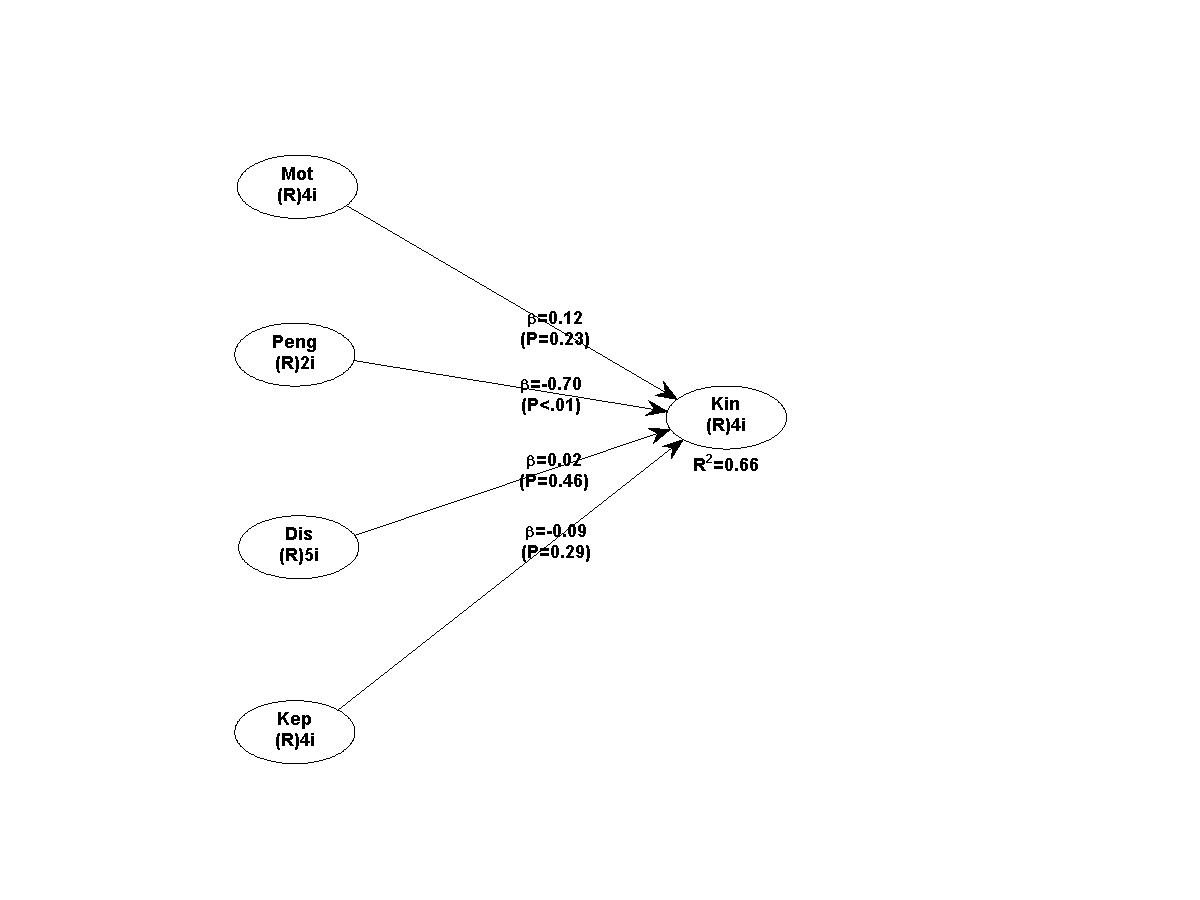
The inner model is evaluating the effect of latent variables and testing the hypothesis. The structural model was evaluated using R-square for endogenous variables, path coefficients and probabilities between variables. This study has 1 (one) endogenous variable, namely the employee performance variable. Endogenous variables of employee performance are influenced by motivation, supervision, discipline and job satisfaction. The results of the Partial Least Square (PLS) test output with the WarpPLS 7.0 program.


Description: Gambar

Figure 1: Path Diagram


  • R-Square (Coefficient of Determination):

R-Square is a test of the coefficient of determination that is carried out to find out how much the endogenous variables are simultaneously able to explain exogenous variables. The higher the R2 value, the better the prediction model of the proposed research model. The output of the coefficient of determination (R – Square) from the WarpPls structural model equation.


Table 3: R.Square Value of Satisfaction and Motivation Variables


R - Squere

Performance

0.65

Source: primary data analysis, 2022


Based on table 3 the results of the R-Square test show that the R-Square of motivation, supervision, discipline and job satisfaction on performance is 0.65 or 0.7 which can be interpreted that motivation, supervision, discipline and job satisfaction have a positive contribution to performance by 70% while 30% is explained by other variables outside the studied.


  • Path Coefficient Value (Path Coefficient):

The path coefficient is a value that indicates whether or not the linear relationship between variables is strong. The results of the WarpPLS output for the Path Coefficient value can be seen in Table 4.


Table 4: Path Coefficient Value

Variable Latent

Coefficient Track

Sign Coefficient track

Information

Independent

Dependent

Motivation

Performance

0.361

Positive

Significant

Supervision

Performance

0.472

Positive

Significant

Discipline

Performance

0.164

Positive

Significant

Satisfaction

Performance

0.133

Positive

Significant

Source: primary data analysis, 2022


The path coefficient shows the strength (strength) of a linear relationship and the direction of the relationship between two variables, in each path the coefficient value is above 0.1 and the sign of the path coefficient is + (positive) then the two variables have a unidirectional relationship which means that the increase X will coincide with an increase in Y and vice versa. From the description of the results of the analysis above, it can be interpreted that the higher the motivation, supervision, discipline and satisfaction given, the higher the performance will affect.


  • Probability Value (P - Value):

The probability value (P-Value) can be interpreted as the magnitude of the observed probability (probability) from statistical tests. The results of the WarpPLS output for the probability value (P-Value) can be seen in Table 5.


Table 5: Probability Value (P –Value)

Variable Latent

P - Value

Information

Independent

Dependent

Motivation

Performance

<0.01

Significant

Supervision

Performance

<0.01

Significant

Discipline

Performance

0.01

Significant

Satisfaction

Performance

0.01

Significant

Source: primary data analysis, 2022


The output results of the probability test are 0.01 and <0.01 which means that if the value of sig. (p-value) is compared with a significant level of = 0.1 (alpha 10%) then automatically the results of the sig value. (p-value) is smaller than the value of = 10% which means out of 100, at most 10 errors can be tolerated and in this study has an error rate below 1 or 1.


  • Hypothesis of the Effect of Motivation on Performance:

This hypothesis testing stage is carried out after the structural model evaluation stage is carried out. This stage is carried out to determine whether the research hypothesis proposed in the research model is accepted or rejected. Path coefficient values that are in the range of values of -0.1 to 0.1 are considered insignificant, values greater than 0.1 are significant and directly proportional values, and values smaller than -0.1 are significant values. and vice versa. Another consideration is to use a significant value, at least at = 0.1, so that it is considered significant if the P-value is less than 0.1. Therefore, the hypothesis is accepted if the path coefficient value is greater than 0.1 and the P value is less than 0.05. Table 6 shows the results of hypothesis testing on the research model as follows.


Table 6: Path Coefficients

Variable Latent

Coefficient Track

P - Value

Sign

Information

Independent

Dependent

Motivation

Performance

0.361

<0.01

Positive

Significant

Supervision

Performance

0.472

<0.01

Positive

Significant

Discipline

Performance

0.164

0.01

Positive

Significant

Satisfaction

Performance

0.133

0.01

Positive

Significant

Source: primary data analysis, 2022

The test results on the path coefficient between the independent variables to the dependent variable show significant results, namely by showing the path coefficient results greater than 0.1 and a significant positive value, this indicates an increase in the independent variable will coincide with an increase in the dependent variable and vice versa and the probability The research shows the results are smaller than = <0.1 (significant) which means that this study has a 90% chance of being right and 10% of the hypothesis being wrong.


The independent variables of motivation, supervision, discipline and job satisfaction have a significant and positive effect on the dependent variable of employee performance, which means that the higher the independent variable, the employee's performance variable will increase. Vice versa, the less the independent variable, the lower the dependent variable.

CONCLUSION

Based on results calculation analysis equality structural show that motivation work take effect positive and significant to performance employees, if employee get high motivation _ so will increase its performance. Supervision work take effect positive and significant to performance employees, if employee supervised or controlled during work so employee will feel supervised and Thing this can increase performance employees. Discipline work take effect positive and significant to performance employee, level discipline employee will result in enhancement its performance. Satisfaction work take effect positive and significant to performance employees, more tall level satisfaction work, then level performance performance will the more increase.

Conflict of Interest:

The authors declare that they have no conflict of interest.

Funding:

No funding sources 

Ethical approval:

The study was approved by the Institutional Ethics Committee of UPN Veterans East Java

References
  1. Candana, Dori Mittra, Ramdani Bayu Putra, and Ronni Andri Wijaya. "Pengaruh Motivasi Dan Lingkungan Kerja Terhadap Kinerja Karyawan Dengan Disiplin Kerja Sebagai Variabel Intervening Pada PT Batang Hari Barisan." Jurnal Ekonomi Manajemen Sistem Informasi, vol. 2, no. 1, 2020, pp. 47-60. https://doi.org/10.31933/jemsi.v2i1.329.

  2. Alam, Mohammad Nurul, et al. "The Effects of Wages and Welfare Facilities on Employee Productivity: Mediating Role of Employee Work Motivation." Australasian Accounting, Business and Finance Journal, vol. 14, no. 4, 2020, pp. 38-60. https://doi.org/10.14453/aabfj.v14i4.4.

  3. Bukit, B., Malusa, T., and Rahmat, A. Pengembangan Sumber Daya Manusia. Teori, Dimensi Pengukuran. 2017, file:///C:/Users/Smile/Downloads/manajemen%20sumber%20daya%20manusia%20(PDFDrive.com).pdf.

  4. Putri, Kartika Anggraeni Sudiono, Amelindha Vania, and Nur Laili Fikriah. "Pengaruh Kualitas Layanan Terhadap Kepuasan Pelanggan Dengan Kepercayaan Pelanggan Sebagai Variabel Mediasi Pada UKM Kharisma Sejahtera." Journal of Industrial Engineering & Management Research, vol. 1, no. 2, 2020, pp. 140-152. https://doi.org/10.7777/jiemar.v1i2.

  5. Sutedi, Sutedi, Wawan Prahiawan, and Hayati Nupus. "Pengaruh Komitmen Organisasi Dan Pengawasan Terhadap Disiplin Pegawai Melalui Kepuasan Kerja Sebagai Variabel Intervening (Studi pada Koperasi Simpan Pinjam Makmur Mandiri Cabang Kota Tangerang)." Jurnal Riset Bisnis dan Manajemen Tirtayasa, vol. 5, no. 1, 2021, pp. 84-97. https://jurnal.untirta.ac.id/index.php/JRBM/article/view/11544.

  6. Fernandes, Adji Achmad Rinaldo. Metode Statistika Multivariat Pemodelan Persamaan Struktural (SEM) Pendekatan WarpPLS. Universitas Brawijaya Press, 2017. https://opac.perpusnas.go.id/DetailOpac.aspx?id=1141341.

  7. Ghozali, Imam, and Hengky Latan. Concepts, Techniques, Applications Using Smart PLS 3.0 for Empirical Research. BP Undip. Semarang, 2015. https://www.researchgate.net/publication/283619375_Partial_Least_Squares_Concepts_Techniques_and_Applications_using_SmartPLS_3
License
CC BY-NC-ND
Creative Commons Attribution-NonCommercial-NoDerivatives 4.0 International License
Factors Affecting Employee Performance in Pt. Serikat Sejahtera Utama © 2026 by Novan Noviansyah, Indra Tjahaja Amir, Hamidah Hendrarini licensed under CC BY-NC-ND 4.0
All papers should be submitted electronically. All submitted manuscripts must be original work that is not under submission at another journal or under consideration for publication in another form, such as a monograph or chapter of a book. Authors of submitted papers are obligated not to submit their paper for publication elsewhere until an editorial decision is rendered on their submission. Further, authors of accepted papers are prohibited from publishing the results in other publications that appear before the paper is published in the Journal unless they receive approval for doing so from the Editor-In-Chief.
Himalayan Journal of Agriculture open access articles are licensed under a Creative Commons Attribution-Share A like 4.0 International License. This license lets the audience to give appropriate credit, provide a link to the license, and indicate if changes were made and if they remix, transform, or build upon the material, they must distribute contributions under the same license as the original.
Advertisement
Recommended Articles
Research Article
Mating behaviour of Cavariella aegopodii
Published: 19/07/2024
Download PDF
Research Article
The Role of Indigenous Microbes and Earthworm in the Bioconversion of Dairy Wastewater Solids into Organic Fertilizer
...
Published: 17/01/2024
Download PDF
Research Article
The Effect of Green Marketing Mix on Purchasing Decisions by Greenly Salad Consumers in Surabaya
...
Published: 30/01/2023
Download PDF
Review Article
Registration of Gute-19 (Late Set) Soybean Varieties (Late Maturity Class)
Published: 10/10/2020
Download PDF
Chat on WhatsApp
Flowbite Logo
Najmal Complex,
Opposite Farwaniya,
Kuwait.
Email: kuwait@iarcon.org

Editorial Office:
J.L Bhavan, Near Radison Blu Hotel,
Jalukbari, Guwahati-India
Useful Links
Order Hard Copy
Privacy policy
Terms and Conditions
Refund Policy
Others
About Us
Team Members
Contact Us
Online Payments
Join as Editor
Join as Reviewer
Subscribe to our Newsletter
Follow us
MOST SEARCHED KEYWORDS
scientific journal
 | 
business journal
 | 
medical journals
 | 
Scientific Journals
 | 
Academic Publisher
 | 
Peer-reviewed Journals
 | 
Open Access Journals
 | 
Impact Factor
 | 
Indexing Services
 | 
Journal Citation Reports
 | 
Publication Process
 | 
Impact factor of journals
 | 
Finding reputable journals for publication
 | 
Submitting a manuscript for publication
 | 
Copyright and licensing of published papers
 | 
Writing an abstract for a research paper
 | 
Manuscript formatting guidelines
 | 
Promoting published research
 | 
Publication in high-impact journals
Copyright © iARCON Internaltional LLP . All Rights Reserved.