Analysis of the Total Number of Bacteria, Total Coliform and Staphylococcus Aureus in Chicken Meat from Traditional Markets and Supermarkets (Case Study of Traders in Traditional Markets and Supermarkets in the Cimahi Area)
Yuli Astuti Hidayati
1
,
Eulis Tanti Marlina
1
,
Eka Wulandari
1
,
Ellin Harlia
1
1
Department of Animal Products Technology, Faculty of Animal Husbandry, Padjadjaran University,West Java, Indonesia
Traditional markets and supermarkets offer chicken meat at set hours, open tables and room temperature. However, in supermarkets, the tables are equipped with coolers like ice cubes, low temperatures and longer serving times. This has the potential for bacterial contamination. This research aimed to evaluate the microbiological quality of chicken meat sold in traditional markets and supermarkets based on the total number of bacteria, Coliforms, Staphylococcus aureus and the pH value of the chicken meat. The survey method is used and the data is analyzed descriptively. Surveys were conducted on chicken meat sold in traditional markets and supermarkets regarding the total number of bacteria, Coliforms and Staphylococcus aureus and the pH in the chicken carcass. The total number of bacteria in chicken meat in traditional markets for all traders is between 1.2 x 10⁵ – 1.4 x 10⁸ cfu/g, while that sold in supermarkets (12 × 106 cfu/g), all exceed the BMC based on SNI 7388:2009, while coliforms and Staphylococcus aureus were only found in trader B (4 × 10⁶ cfu/g and 3 × 10² cfu/g), trader D (2 × 10² cfu/g and 2 × 10² cfu/g) and trader F 1 × 10⁴ cfu/g and 2 × 10² cfu/g), the pH value of chicken meat sold in traditional markets and supermarkets is 5.64 - 6.30.
Keywords
Chicken Carcass
Bacteria
Coliform
Staphylococcus Aureus
PH
INTRODUCTION
The model for serving chicken carcasses in traditional markets and supermarkets is served on open tables, at room temperature and for a certain time. However, in supermarkets, the table where chicken meat is sold is equipped with a cooler in the form of ice cubes at low temperatures and over a longer period. This provides an opportunity for contamination with microorganisms, both based on the conditions of the serving location and the length of time it is served. In traditional markets, chicken carcasses are served on open tables, from 05.00 am to 11.00 noon. In contrast, in supermarkets they are usually served on open tables equipped with refrigeration at a temperature of ±10oC. Starting from 10.00 am to 8.00 pm, after it is stored in the refrigerator (4oC), it is served again on an open table the next day and the product change time is once every 3 days. Based on this, as a case study, it is necessary to analyze the biological quality of chicken meat carcasses served in traditional markets and supermarkets in the Cimahi area. The biological quality examined includes the total number of Coliform bacteria and the number of Staphylococcus aureus in marketed chicken meat, carried out in the morning when the chicken carcass is served.
In contrast, chicken meat served in supermarkets is analyzed at the start of serving. This is intended to determine whether the biological quality of the chicken carcass is safe for trade. Chicken meat sold in supermarkets is not much different from that sold in traditional markets, except that the table served is equipped with a cooler. According to [1], chicken meat sold in supermarkets is contaminated with bacteria that exceeds the BMC based on SNI 7388:2009.
Chicken meat contains high protein, which is liked by bacteria, so chicken meat is easily contaminated with bacteria. Bacterial contamination of chicken meat can come from the slaughter place, the tools used, workers, dust, air and water for washing. According to Aulia, chicken meat sold in several traditional markets contains a total bacterial plate count of 3.7 × 10⁷ cfu/g, while according to [2], chicken meat sold in traditional markets contains a total bacterial plate count of 1 x 10⁶ cfu/g. According to [3], the total number of bacteria in chicken meat in traditional markets from various traders is 1.2 x 10⁵ – 1.4 x 10⁸ cfu/g. According to [4], the total number of bacteria in chicken meat sold in traditional markets is a low number of bacteria, namely between 2.5 x 10³ and 1.2 x 10⁵; this can happen because the chicken meat is sold fresh. And in a short time, less than 4 hours.
Coliform bacteria can be used as indicators to determine the quality of food contaminated with pathogenic bacteria. Coliforms consist of Escherichia coli, Klebsiella sp and Citrobacter sp [5]. Amirah et al., [5], Coliform bacterial contamination of chicken meat can cause human diseases, known as food-borne diseases, such as diarrhea and typhoid fever. Coliform bacterial contamination in chicken meat can come from workers, water sources and the surrounding environment [4], [6]. Coliform bacteria that contaminate chicken meat sold in supermarkets show low numbers, around 83.2 x 10³ cfu/g, related to the marketing place and storage temperature. [7].
Staphylococcus aureus bacterial contamination in chicken meat will affect the quality of chicken meat. According to Rahmawati et al. [8], the source of Staphylococcus aureus bacterial contamination comes from equipment and workers who do not implement good sanitation. If it contaminates food, the Staphylococcus aureus bacteria can cause poisoning and dehydration. Sources of contaminants can come from workers who do not implement good sanitation [9]. The standard maximum limit for bacterial contamination (BMCB) in chicken meat based on SNI 7388:2009 (30 °C, 72 hours) is 1 × 10⁶ cfu/g for a total plate count, 1 × 10² cfu/g [10], for Coliform bacteria and 1 × 10² cfu/g for Staphylococcus aureus. This research aimed to evaluate the microbiological quality of chicken meat sold in traditional markets and supermarkets based on the total number of bacteria, the number of Coliform bacteria and the number of Staphylococcus found in chicken meat.
MATERIALS AND METHODS
The research material used included chicken meat sold in traditional markets and supermarkets in the Cimahi area, West Java.
This research method is a survey method and the data is analyzed descriptively. Surveys were conducted on chicken carcasses sold in traditional markets and supermarkets regarding the total number of bacteria, the number of Coliform bacteria and Staphylococcus aureus bacteria and the pH in the chicken carcass. Analysis of the total number of bacteria, number of coliform bacteria and number of Staphylococcus aureus pH measurements were carried out in the test laboratory. Data was obtained by carrying out the Total Plate Count (TPC) test to determine the total number of bacteria using Nutrient Agar (NA) media and the number of coliform bacteria using MacConkey Agar (MCA) media, as well as calculating the number of Staphylococcus aureus bacteria using Mannitol Salt Agar (MSA) media), pH measurement in chicken carcasses.
Calculation of Total Plate Count Bacteria, Number of Coliform Bacteria and Number of Staphylococcus aureus (SNI 7388:2009)
Calculating the total number of bacteria, the number of Coliform bacteria and the number of Staphylococcus aureus bacteria using the dilution method, thigh meat samples from each trader were weighed 10 g each, then 90 ml of physiological NaCl solution was added and stirred until homogeneous so that a dilution was obtained. 10-1. The sample mixture was transferred 1 ml into a test tube containing 9 ml of NaCl solution and this was a 10-2 dilution and so on up to a 10-8 dilution.
The TPC test begins by inserting 1 ml of sample from the 10-8 dilution into a petri dish filled with 20 ml of NA media. Then incubated at 37°C for 48 hours. The Coliform bacteria test begins by inserting 1 ml of sample from dilution 10-6 into a petri dish filled with 20 ml of McConkey's medium, then incubating at 37°C for 48 hours. The Staphylococcus aureus bacterial test begins by inserting 1 ml of sample from the 10-2 dilution into a petri dish filled with 20 ml of Mannitol Salt Agar (MSA), then incubating at 37°C for 48 hours. All chicken carcass samples from each trader had their pH measured.
RESULTS
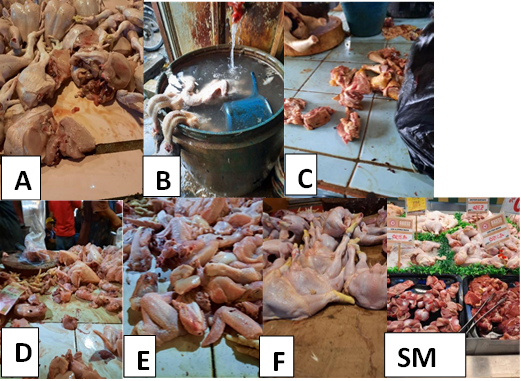
Chicken carcasses sold in traditional markets are sold in the open and at room temperature (25oC) starting in the morning at 05.00 and ending at 13.00. In contrast, chicken carcasses sold in supermarkets are sold in open areas equipped with refrigeration (low temperature). 10oC), starting at 10.00 until 20.00. The results of interviews with traders at traditional markets showed that several traders slaughtered themselves and then sold the chicken carcasses directly in the exact location as the slaughtering place. Some traders take their chickens from the chicken slaughtering place and then take them to the market to be sold, starting at 05.00 WIB and ending at 13.00. At the same time, the results of interviews with supermarket officers show that chicken carcasses are obtained from suppliers every 3 days and served immediately in an open area equipped with a cooler (temperature 10oC). The results of the analysis of the total number of bacteria, the number of Coliform bacteria, the number of Staphylococcus aureus bacteria and the pH value in the chicken carcass are presented in Table 1.
The results of testing the total number of bacteria (Table 1) show that overall, the total number of bacteria in all traders in traditional markets is higher than in supermarkets. The total number of bacteria tested exceeds the limit of all traders from both traditional markets and supermarkets. According to SNI 7388: 2009, maximum bacterial contamination is Total Plate Number (30oC, 72 hours) 1 × 10⁶ cfu/g. For Trader B, trader D and trader F, the total number of bacteria on chicken meat was very high because Trader B slaughtered the chickens he sold himself and the slaughtering place was attached to the place selling the chicken meat. Vendor D and Vendor F placed the chicken meat they were selling on a dirty table and Vendor F even added a cardboard mat to his selling table. This is thought to be bacterial contamination from the environment. This is in line with the opinion of Nugroho Aerita et al., [11], which states that sanitation of chicken carcass marketing locations influences the amount of bacterial contamination in chicken meat carcasses. According to Aulia, chicken meat marketed in several traditional markets contains a total bacterial plate count of 3.7 × 10⁷ cfu/g and according to [3], the total number of bacteria in chicken meat in traditional markets from various traders between 1.2 x 10⁵ – 1.4 x 10⁸ cfu/g. The total bacterial test results of the plate count of chicken meat sold in supermarkets (12 × 106 cfu/g) still exceed the BMC, this is even though the chicken meat is sold in an open place equipped with a cooler (low-temperature 10oC), but the chicken meat is replaced within 3 days. Once, thus allowing the growth of bacteria in the chicken meat. According to Astalia Zuanita et al. [12] and [1], chicken meat sold in supermarkets is contaminated with bacteria that exceeds the BMC based on SNI 7388:2009.
The results of testing for Coliform bacteria on chicken meat sold in traditional markets and supermarkets, there were three traders whose Coliforms were identified as exceeding the SNI 7388:2009 standard, namely 12 × 102 cfu/g, namely trader B, trader D and trader F, each chicken meat those sold were identified as being contaminated with coliform bacteria as much as 4 × 10⁶ cfu/g, 2 × 10² cfu/g, 1 × 10⁴ cfu/g. This Coliform bacterial contamination is thought to come from the water used. If the condition of the water used and the place where the chicken meat is sold to Trader B, trader D and trader F, it shows that it is less hygienic. This aligns with the opinion Bambang et al. [13], which states that coliform bacteria contamination was found in the water. According to Nugroho Aerita et al., [11], sanitation of sales places equipment used can influence the growth of bacteria in chicken meat, while according to Astalia Zuanita et al. [12] and [14], Coliform bacteria were found in meat chickens sold in supermarkets and traditional markets whose quantity exceeds the maximum contamination limit set by SNI 7388: 2009.
The results of testing for Staphylococcus aureus bacteria in chicken meat sold in traditional markets and supermarkets, three traders identified Staphylococcus aureus bacteria that exceeded the SNI 7388:2009 standard, namely in trader B there were 3 × 10² cfu/g Staphylococcus aureus bacteria, trader D as much as 2 × 10²cfu/g and trader F as much as 2 × 10² cfu/g. Unhygienic chicken meat has the potential to be contaminated with Staphylococcus aureus bacteria and this Staphylococcus aureus bacterial contamination is thought to come from less clean workers. This is in line with the opinion of Hidayati, [15] and Apriliana, [16], who state that there is Staphylococcus aureus bacterial contamination in chicken meat sold at open stalls.
Table 1: Average Total Number of Bacteria, Number of Coliform Bacteria, Number Bacteria of Staphylococcus Aureus, PH Value in Chicken Carcasses Sold in Traditional Markets and Supermarket
Sample
Chicken meat
Total number of bacteria (cfu/g)
Number of Coliform Bacteria (cfu/g)
Number of S.aureus Bacteria (cfu/g)
pH
Traditional market
A
39 × 107
-
-
6,01
B
134 × 108
4 × 10⁶
3 × 10²
5,58
C
25 × 107
-
-
6,28
D
70 × 108
2 × 10²
2 × 10²
5,83
E
14 × 107
-
-
6,09
F
117 × 108
1 × 10⁴
2 × 10²
5,64
Supermarket
SM
12 × 106
-
-
6,30
Information: A: Trader 1 in the traditional markets, B: Trader 2 in the traditional markets, C: Trader 3 in the traditional markets, D: Trader 4 in the traditional markets, E: Trader 5 in the traditional markets, F: Trader 6 in the traditional markets, SM: Trader at Supermarket
Figure 1: Trader A, Trader B, Trader C, Trader D, Trader E, Trader F, SM Supermarket Traders
The pH value of chicken meat sold in traditional markets and supermarkets shows a pH value of 5.64 - 6.30; this allows contaminating bacteria to live on chicken meat. According to Yanti and Kurniatuhadi, [17], the growth of Staphylococcus aureus is in the pH range of 5 - 8 and according to research results [18], the pH of chicken meat is in the range of 5.7 - 5.98 and all samples are contaminated with Coliform bacteria.
CONCLUSION
The results of testing and evaluating the microbiological quality of chicken meat sold in traditional markets and supermarkets based on the total number of bacteria found in chicken meat sold by all traders exceed the maximum limit of contamination according to SNI 7388:2009, while based on the number of Coliform bacteria and the number of Staphylococcus aureus bacteria There were three traders (traders B, D and F) who exceeded the maximum contamination limit, the pH value of the chicken meat sold ranged from 5.64 - 6.30.
REFERENCES
Suprayogo, D. et al. “Storage times of chicken meat on the growth of coliform in showcase from supermarket in Denpasar.” Indonesia Medicus Veterinus, vol. 3, no. 2, 2014, pp. 92–98.
Apriyanti, A.A.D. et al. “Analisis cemaran mikrobiologi pada daging ayam broiler yang beredar di pasar tradisional Kecamatan Denpasar Barat.” Gema Agro, vol. 25, no. 2, 2020, pp. 115–127.
Ramadhani, W.M. et al. “Microbiological quality of broiler chicken meat sold at Banyumanik traditional markets of Semarang.” Jurnal Biologi Tropika, vol. 1, no. 1, 2020, pp. 8–16.
Utari, L.K. et al. “Status mikrobiologis daging broiler di pasar tradisional Kabupaten Pringsewu.” Jurnal Ilmiah Peternakan Terpadu, vol. 4, no. 1, 2016.
Amirah, A. et al. “Detection of contamination levels of Staphylococcus aureus bacteria in broiler chicken sold at traditional markets in Lhokseumawe.” Comserva: Jurnal Penelitian dan Pengabdian Masyarakat, vol. 1, no. 12, 2022, pp. 1074–1084.
Zelpina, E. et al. “The presence of coliform in shredded chicken meat of chicken porridge sold around Dramaga Bogor.” Jurnal Teknologi Pangan dan Gizi (Journal of Food Technology and Nutrition), vol. 19, no. 1, 2020, pp. 1–6.
Zuanita, D.A. et al. “Contaminan of coliform in broiler sold in supermarket Denpasar.” Indonesia Medicus Veterinus, vol. 3, no. 1, 2014, pp. 26–31.
Rahmawati, R. et al. “Identification of Staphylococcus aureus of chicken in Pasar Besar of Palangka Raya City.” Borneo Journal of Medical Laboratory Technology, vol. 1, no. 1, 2018, pp. 13–16.
Primatika, R.A. et al. “Contamination analysis of Staphylococcus aureus in glass, blood and herb with blood Java cobra (Naja sputatrix).” Jurnal Sain Veteriner, vol. 33, no. 2, 2015.
Firdausyi, A.A. et al. “Total plate count of broiler meat at various market in Bekasi City in March 2021.” Jurnal Medik Veteriner, vol. 5, no. 2, 2022, pp. 157–161.
Nugroho Aerita, A. et al. “Hubungan higiene pedagang dan sanitasi dengan kontaminasi Salmonella pada daging ayam potong.” Unnes Journal of Public Health, vol. 3, no. 4, 2014. http://journal.unnes.ac.id/sju/index.php/ujph
Zuanita, D.A. et al. “Contaminan of coliform in broiler sold in supermarket Denpasar.” Indonesia Medicus Veterinus, vol. 3, no. 1, 2014, pp. 26–31.
Bambang, A.G. et al. “Analisis cemaran bakteri coliform dan identifikasi Escherichia coli pada air isi ulang dari depot di Kota Manado.” Pharmacon: Jurnal Ilmiah Farmasi-UNSRAT, vol. 3, no. 3, 2014.
Rizaldi, A. et al. “Coliform contamination and total plate count in broiler chicken meat: A case study of traditional markets in East Barito Regency.” n.d. https://ojs.unsulbar.ac.id/index.php/jstp
Hidayati, Y.A. “Evaluation of sanitation of chicken carcass sales against the total amount of bacteria, Staphylococcus aureus, pH and the beginning of the putrefaction (Case study of standard traders in Padasuka-Cimahi Region).” Jurnal Ilmu Ternak Universitas Padjadjaran, vol. 21, no. 2, 2021, p. 124. https://doi.org/10.24198/jit.v21i2.36767
Apriliana, E. “Identification of Staphylococcus aureus of chicken in Pasar Besar of Palangka Raya City.” Borneo Journal of Medical Laboratory Technology, vol. 1, no. 1, 2018.
Yanti, D. and R. Kurniatuhadi. “Morphological and physiological characterization of endophytic from the pneumatophores of Avicennia marina (Forsk.) Vierh in Mempawah Mangrove Park (MMP).” Biologica Samudra, vol. 3, no. 2, 2021, pp. 166–183. https://doi.org/10.33059/jbs.v2i1.4220
Ollong, A.R. et al. “Analysis of (MPN) of coliform bacteria and faecal coli on fresh beef and chicken in Manokwari.” Jurnal Ilmu Peternakan dan Veteriner Tropis (Journal of Tropical Animal and Veterinary Science), vol. 10, no. 2, 2020, p. 113. https://doi.org/10.46549/jipvet.v10i2.124
None
License
Creative Commons Attribution-NonCommercial-NoDerivatives 4.0 International License
All papers should be submitted electronically. All submitted manuscripts must be original work that is not under submission at another journal or under consideration for publication in another form, such as a monograph or chapter of a book. Authors of submitted papers are obligated not to submit their paper for publication elsewhere until an editorial decision is rendered on their submission. Further, authors of accepted papers are prohibited from publishing the results in other publications that appear before the paper is published in the Journal unless they receive approval for doing so from the Editor-In-Chief.
Himalayan Journal of Agriculture open access articles are licensed under a Creative Commons Attribution-Share A like 4.0 International License. This license lets the audience to give appropriate credit, provide a link to the license, and indicate if changes were made and if they remix, transform, or build upon the material, they must distribute contributions under the same license as the original.
Recommended Articles
Research Article
The Role of Indigenous Microbes and Earthworm in the Bioconversion of Dairy Wastewater Solids into Organic Fertilizer
Marlina ,
...
N. Meynadhea
Published: 17/01/2024
Download PDF
Cite
x
APA
None, M., Rahayu, N. A., Badruzzaman, D. Z., Hidayati, Y., Harlia, E., Kurniawan, E. & Meynadhea, N. (2024). The Role of Indigenous Microbes and Earthworm in the Bioconversion of Dairy Wastewater Solids into Organic Fertilizer. Himalayan Journal of Agriculture, 5(1), 1-7.
MLA
None, Marlina, et al. "The Role of Indigenous Microbes and Earthworm in the Bioconversion of Dairy Wastewater Solids into Organic Fertilizer." Himalayan Journal of Agriculture 5.1 (2024): 1-7.
Chicago
None, Marlina, N. A. Rahayu, D. Z. Badruzzaman, Y.A. Hidayati, E. Harlia, E. Kurniawan and N. Meynadhea. "The Role of Indigenous Microbes and Earthworm in the Bioconversion of Dairy Wastewater Solids into Organic Fertilizer." Himalayan Journal of Agriculture 5, no. 1 (2024): 1-7.
Harvard
None, M., Rahayu, N. A., Badruzzaman, D. Z., Hidayati, Y., Harlia, E., Kurniawan, E. and Meynadhea, N. (2024) 'The Role of Indigenous Microbes and Earthworm in the Bioconversion of Dairy Wastewater Solids into Organic Fertilizer' Himalayan Journal of Agriculture 5(1), pp. 1-7.
Vancouver
Marlina M, Rahayu NA, Badruzzaman DZ, Hidayati Y, Harlia E, Kurniawan E, Meynadhea N. The Role of Indigenous Microbes and Earthworm in the Bioconversion of Dairy Wastewater Solids into Organic Fertilizer. Himalayan Journal of Agriculture. 2024 Jan;5(1):1-7.
Download PDF
Research Article
Mating behaviour of Cavariella aegopodii
Nidhi Dhatwalia
Published: 19/07/2024
Download PDF
Cite
x
APA
Dhatwalia, N. (2024). Mating behaviour of Cavariella aegopodii. Himalayan Journal of Agriculture, 5(1), 1-7.
MLA
Dhatwalia, Nidhi. "Mating behaviour of Cavariella aegopodii." Himalayan Journal of Agriculture 5.1 (2024): 1-7.
Chicago
Dhatwalia, Nidhi. "Mating behaviour of Cavariella aegopodii." Himalayan Journal of Agriculture 5, no. 1 (2024): 1-7.
Harvard
Dhatwalia, N. (2024) 'Mating behaviour of Cavariella aegopodii' Himalayan Journal of Agriculture 5(1), pp. 1-7.
Vancouver
Dhatwalia N. Mating behaviour of Cavariella aegopodii. Himalayan Journal of Agriculture. 2024 Jan;5(1):1-7.
Download PDF
Research Article
Efficiency of Some Salicylic Acid Concentrations in Tetranychus urticae Koch on Some Eggplant Varieties
Yusra Jamal Talib,
...
Nadia Kadhim Thamer
Published: 10/04/2023
Download PDF
Cite
x
APA
Talib, Y. J., Abass, M. H. & Thamer, N. K. (2023). Efficiency of Some Salicylic Acid Concentrations in Tetranychus urticae Koch on Some Eggplant Varieties. Himalayan Journal of Agriculture, 4(1), 1-7.
MLA
Talib, Yusra J., Mohammed H. Abass and Nadia K. Thamer. "Efficiency of Some Salicylic Acid Concentrations in Tetranychus urticae Koch on Some Eggplant Varieties." Himalayan Journal of Agriculture 4.1 (2023): 1-7.
Chicago
Talib, Yusra J., Mohammed H. Abass and Nadia K. Thamer. "Efficiency of Some Salicylic Acid Concentrations in Tetranychus urticae Koch on Some Eggplant Varieties." Himalayan Journal of Agriculture 4, no. 1 (2023): 1-7.
Harvard
Talib, Y. J., Abass, M. H. and Thamer, N. K. (2023) 'Efficiency of Some Salicylic Acid Concentrations in Tetranychus urticae Koch on Some Eggplant Varieties' Himalayan Journal of Agriculture 4(1), pp. 1-7.
Vancouver
Talib YJ, Abass MH, Thamer NK. Efficiency of Some Salicylic Acid Concentrations in Tetranychus urticae Koch on Some Eggplant Varieties. Himalayan Journal of Agriculture. 2023 Jan;4(1):1-7.
Download PDF
Research Article
Efficiency of Production Factors Usage on Sorgum (Sorghum Bicolor L) (Case in Keyongan Village, Babat Sub-District, Lamongan Regency)
Evi Maf'idatul Ilmi,
...
Hamidah Hendrarini
Published: 20/12/2022
Download PDF
Cite
x
APA
Ilmi, E. M., Amir, I. T. & Hendrarini, H. (2022). Efficiency of Production Factors Usage on Sorgum (Sorghum Bicolor L) (Case in Keyongan Village, Babat Sub-District, Lamongan Regency). Himalayan Journal of Agriculture, 3(2), None-None.
MLA
Ilmi, Evi M., Indra T. Amir and Hamidah Hendrarini. "Efficiency of Production Factors Usage on Sorgum (Sorghum Bicolor L) (Case in Keyongan Village, Babat Sub-District, Lamongan Regency)." Himalayan Journal of Agriculture 3.2 (2022): None-None.
Chicago
Ilmi, Evi M., Indra T. Amir and Hamidah Hendrarini. "Efficiency of Production Factors Usage on Sorgum (Sorghum Bicolor L) (Case in Keyongan Village, Babat Sub-District, Lamongan Regency)." Himalayan Journal of Agriculture 3, no. 2 (2022): None-None.
Harvard
Ilmi, E. M., Amir, I. T. and Hendrarini, H. (2022) 'Efficiency of Production Factors Usage on Sorgum (Sorghum Bicolor L) (Case in Keyongan Village, Babat Sub-District, Lamongan Regency)' Himalayan Journal of Agriculture 3(2), pp. None-None.
Vancouver
Ilmi EM, Amir IT, Hendrarini H. Efficiency of Production Factors Usage on Sorgum (Sorghum Bicolor L) (Case in Keyongan Village, Babat Sub-District, Lamongan Regency). Himalayan Journal of Agriculture. 2022 Jul;3(2):None-None.
Hidayati, Y. A., Marlina, E. T., Wulandari, E. & Harlia, E. (2023). Analysis of the Total Number of Bacteria, Total Coliform and Staphylococcus Aureus in Chicken Meat from Traditional Markets and Supermarkets (Case Study of Traders in Traditional Markets and Supermarkets in the Cimahi Area). Himalayan Journal of Agriculture, 4(2), 1-4.
MLA
Hidayati, Yuli A., et al. "Analysis of the Total Number of Bacteria, Total Coliform and Staphylococcus Aureus in Chicken Meat from Traditional Markets and Supermarkets (Case Study of Traders in Traditional Markets and Supermarkets in the Cimahi Area)." Himalayan Journal of Agriculture 4.2 (2023): 1-4.
Chicago
Hidayati, Yuli A., Eulis T. Marlina, Eka Wulandari and Ellin Harlia. "Analysis of the Total Number of Bacteria, Total Coliform and Staphylococcus Aureus in Chicken Meat from Traditional Markets and Supermarkets (Case Study of Traders in Traditional Markets and Supermarkets in the Cimahi Area)." Himalayan Journal of Agriculture 4, no. 2 (2023): 1-4.
Harvard
Hidayati, Y. A., Marlina, E. T., Wulandari, E. and Harlia, E. (2023) 'Analysis of the Total Number of Bacteria, Total Coliform and Staphylococcus Aureus in Chicken Meat from Traditional Markets and Supermarkets (Case Study of Traders in Traditional Markets and Supermarkets in the Cimahi Area)' Himalayan Journal of Agriculture 4(2), pp. 1-4.
Vancouver
Hidayati YA, Marlina ET, Wulandari E, Harlia E. Analysis of the Total Number of Bacteria, Total Coliform and Staphylococcus Aureus in Chicken Meat from Traditional Markets and Supermarkets (Case Study of Traders in Traditional Markets and Supermarkets in the Cimahi Area). Himalayan Journal of Agriculture. 2023 Jul;4(2):1-4.


 Download PDF
 Download XML