Chicken skin can be processed optimally into high economic value products such as gelatin because of the collagen content in it. The collagen molecule structure can be hydrolyzed using hydrochloric acid. This study was conducted to determine the effect of variations in the concentration of hydrochloric acid on chicken skin gelatin on pH, viscosity and gel strength. The material used was Cobb strain chicken skin, hydrochloric acid, aquades. The study used a Completely Randomized Design (CRD) with five treatments of hydrochloric acid concentrations (2%, 3%, 4%, 5% and 6%) and four repetitions. The data obtained were analyzed using a variance test and to find out the differences between treatments the Duncan Multiple Range Test was performed. Then, to find out the relationship pattern, it was analyzed using Orthogonal Polynomial. The results showed that the use of hydrochloric acid concentration had no significant effect (P> 0.05) on pH, viscosity and gel strength. The optimum gelatin quality in the treatment of 2% hydrochloric acid concentration (pH 4,13; viscosity 1,403; and gel strength 11,795 g Bloom). The relationship between treatment and response to pH follows the linear regression equation Y = 0.2223x + 3,719, the strength of the gel follows the linear regression equation Y= -0,2479x + 3.8807.
Keywords
Gelatin
PH
Viscosity
Gel Strength
Chicken’s Skin
INTRODUCTION
Gelatin is a collagen product derived from animal skin, bones and connective tissue which is generally applied in the food and non-food sectors such as in the food, cosmetics, pharmaceutical and medical industries, as well as photography. Gelatin production in Indonesia is currently unable to meet the increasing domestic demand, because in Indonesia there are very few companies that produce gelatin. Data from the Indonesian’s Central Bureau of Statistics for 2023 shows that the number of imports of gelatin in Indonesia in 2022 reach 18.5 million kg, which the value were 50.7 billion rupiah [1]. Most of the world's gelatin products come from pigs and cows. There are obstacles for consumers to consume products containing gelatin, such as Hindus are not allowed to consume cows and Muslims are not allowed to consume all types of products containing pork. Situations like this cause the need to look for various alternatives to gelatin that come from other sources. One of the raw materials for making gelatin that has the potential to be developed is chicken skin.
Gelatin production is divided into several main stages, namely the degreasing stage, which is the raw material preparation stage by removing non-collagen substances from the raw material such as fat, non-collagen protein and other substances with or without reducing the bonds between collagen components. Second is the demineralization stage, that is the swelling of the skin, reduction of minerals or reduction of ash content using acids or bases, next is the extraction and purification stage, namely the conversion of collagen in to gelatin and the last is the drying and flouring stage [2]. The classification of gelatin is categorized based on the type of soaking agent in demineralization process. Gelatin type A that use acid in demineralization process while gelatin type B use alkaline in demineralization process [3]. The purpose of soaking or hydrolysis in acid or base solution is to weaken the collagen structure, dissolve non-collagen proteins, hydrolyze some of the peptide bonds while still maintaining the consistency of collagen fibers and kill bacteria [4]. Hydrolysis of collagen facilitates its solubility in hot water during gelatin extraction, this occurs because the collagen structure opens due to several bonds in the protein molecules being released [5]. Soaking can use inorganic acid solvents such as hydrochloric acid, sulfuric acid, sulfite acid or phosphoric acid. A short acid soak can break the bonds and structure of the triple helix collagen into one strand, while alkaline soaking can only change the shape of triple helix into double helix [6]. Soaking with hydrochloric acid has advantages compared to other acids, it can break down collagen fibers more and more quickly without reducing the quality of gelatin [7].
Ones of the gelatin source is chicken skin which contains collagen. Chicken skin is a part of the chicken carcass that has a high collagen content, about 38.9%, so it can be used as a source of gelatin [8]. The potential source of chicken skin is obtained from increasing consumption of chicken fillets and it’s supported by the broiler chicken population which increase continuously every year. Gelatin is chemically obtained from hydrolysis of collagen in the skin [9]. The process of making gelatin cannot be separated from a process called demineralization. The demineralization is the soaking process in an acid or base solution to swell the skin or bones, so the collagen within them can easily come out [7]. Collagen is easily soluble both in acid solutions and water. Soaking in an acid solution too long or too much will cause the triple helix collagen become a single strand and dissolve in the acid solution so that when rinsing, the collagen will also be wasted.
Parameters for determining gelatin quality cannot be separated from pH measurements. Measuring the pH value of the gelatin solution is important because it affects to other properties such as viscosity and gel strength. The pH value is greatly influenced by the type of soaking solution and its concentration. The pH value of gelatin greatly determines the application of gelatin in food products. Type A gelatin is more suitable for application in food products with a neutral pH [10].
Viscosity is inversely proportional to temperature, the higher the temperature, the lower the viscosity. Viscosity is directly proportional to gel strength [10]. The viscosity value is also influenced by the molecular weight and chain length of the amino acid. The longer the gelatin amino acid chain, the greater the gelatin viscosity value. Increasing the gelatin concentration and decreasing the temperature will increase the viscosity of the gelatin solution [7].
Gel strength is one of the material texture parameters and it is described the force to produce certain deformations. The gelatin gel strength is influenced by the raw material type, pretreatment type (acid or base) and extraction conditions [7]. Gel strength is related to the amino acid chain length, where a long amino acid chain will produce a large gel strength. Optimal hydrolysis will produce long amino acid chains during the conversion of collagen to gelatin and it will produce high gel strength gelatin [12].
Several researchers have conducted research on the use of hydrochloric acid in gelatin. Research on catfish skin gelatin by soaking in hydrochloric acid affected the physical quality (pH, viscosity and gel strength) [12]. Gelatin extraction from chicken intestines using hydrochloric acid affected the pH quality and gel strength gelatin from chicken intestines [2]. Gelatin from goat bones affected to the gel strength and viscosity [13]. Research on gelatin production from chicken skin using hydrochloric acid in the demineralization as a marinade has not been widely published. This research aims to determine the optimal use of hydrochloric acid on the physical quality of gelatin from chicken skin.
MATERIALS AND METHODS
Material
The research materials used were 8 kg of Cobb strain broiler chicken skin, HCl (Merck) and aquades. This research used the following tools: beaker glass, analytical scales (Sartorius brand, TE 214S), digital scales (Ohaus), water bath (Julabo, TW 20), drying oven (Lab Companion), universal pH paper (Merck), desiccator, magnetic stirrer, refrigerator, pH meter (HANNA Instruments), Ostwald Viscometer, texture analyzer (TA-XT Express).
Method
Chicken Skin Gelatin Production: Chicken skins gelatin production was carried out based on the method proposed by Ockerman and Hansen [14]. The first stage begins with degreasing, namely soaking the chicken skins in boiling water for 30 minutes, after that the chicken skins were cut into 3 cm2 per pieces, then the chicken skins were weighed, each experimental unit was 150 grams/unit and put into a beaker glass. The second stage is the demineralization process, namely chicken skins were added to a 2%, 3%, 4%, 5% and 6% HCl solution and then covered with aluminum foil then soaked for 24 hours. Next step was neutralization process, namely washing until it reaches a neutral pH. The third stage was the extraction process, namely the obtaining gelatin process from collagen which was heated in a water bath at 80°C for 7 hours, then filtered, concentrated in an evaporator/refrigerator for 72 hours and finally dried using a drying oven at a temperature of 50°C for 48 hours.
pH
pH test based on British Standard 757 [15]. A gelatin solution was made using distilled water (1 : 100) at a temperature of 25°C and homogenized using a magnetic stirrer, then the degree of acidity was measured using a portable pH meter at room temperature.
Viscosity
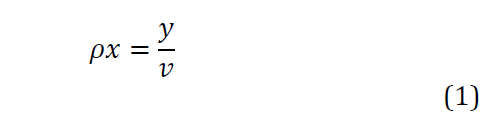
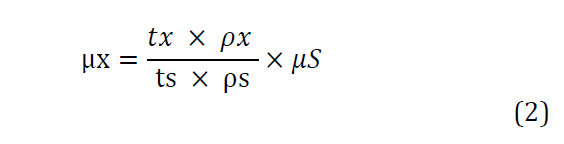
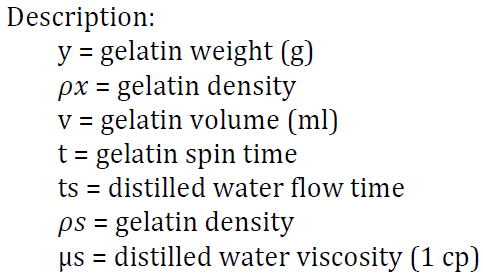
Viscosity test was based on British Standard 757 [15], a gelatin solution with a concentration of 6.67% (w/w) was made using distilled water, after that the viscosity was measured using an Ostwald viscometer. Determination of the viscosity value was carried out by measuring the time required for the gelatin solution to flow in the upper line pipe to the lower limit at a temperature of 60°C. Gelatin specific gravity (density) was measured using a 10 ml viscometer, the specific gravity was calculated using formula 1. After obtaining the density value and flow time, the viscosity of the gelatin was calculated using formula 2.
Gel Strength
Gel strength test was based on British Standard 757 [15]. A gelatin solution was made in distilled water with a concentration of 6.67% (w/v), then a magnetic stirrer was used to stir the solution until homogeneous, after which the solution was heated for 15 minutes at 60°C. The solution is poured into a standard bloom jar, then covered and left for two minutes. The solution was incubated for 19 hours at 10°C. Then measured using the TA-XT Express Texture Analyzer with a probe speed of 0.05 mm/s to a depth of 4 mm. The unit of gel strength was determined by Bloom's g.
Statistical Analysis
The research was carried out experimentally with a completely randomized design (CRD). This research was chicken skin gelatin production with HCl concentration treatments of 2% (P1), 3% (P2), 4% (P3), 5% (P4) and 6% (P5) in the demineralization process, each treatment were repeated four times. Analysis of variance was used to analyze research data. Further tests used Duncan's multiple range test and orthogonal polynomials to saw research trend patterns.
RESULTS AND DISCUSSION
Chicken Skin Gelatin pH
One of the parameters for determining the standard quality of gelatin is the pH value [16]. pH value data from research using hydrochloric acid variations concentration in gelatin making from chicken skin can be seen in Table 1.
Table 1 shows that the highest average pH value for gelatin was 5.04 in treatment P5; then followed by hydrochloric acid treatment P4, P2, P3 and the lowest P1, respectively 4.94; 4.52; 4.42; and 4.13. However, the average pH of chicken skin gelatin for each treatment met the requirements for type A gelatin pH according to GMIA [17], namely 3.8 - 5.5.
The average pH value produced by chicken skin gelatin treated with a 2% HCl concentration (P1) was 4.13. This result was lower when compared to Revi et al. [12] research which produced a pH of 4.60 in catfish skin gelatin with the same HCl concentration and soaking time, as well as the research resulted of Rinta et al. [18] which produced red snapper bone gelatin with 4.43 pH value. The pH value indicates the acidity of gelatin. A low pH value will provide an advantage to gelatin because it will be more resistant to microbial contamination [7]. The pH value which tends to be acidic also has advantages because it is in accordance with the pH of the human digestive system which tends to be acidic so it can be applied to food products [19].
The analysis of variance results showed that the treatment had no significant effect (P>0.05) on the chicken skin gelatin pH. The pH values of the gelatin samples from this research tend to be the same, which is thought to be caused by the demineralization and neutralization processes. The higher the hydrochloric acid concentration value during demineralization, the longer the neutralization process will take. The length of the neutralization process causes water to be trapped in the ossein, causing the pH value to become uniform during extraction, so the pH value was not significantly different in each treatment. The purpose of washing or neutralization was to remove the remaining hydrochloric acid in the ossein. This made ossein having a neutral pH. Hydrochloric acid excessive residual would remain in the ossein cavity if the washing or neutralization was not optimal, causing the gelatin obtained to contain a lower pH value so that it could not meet the gelatin standards.
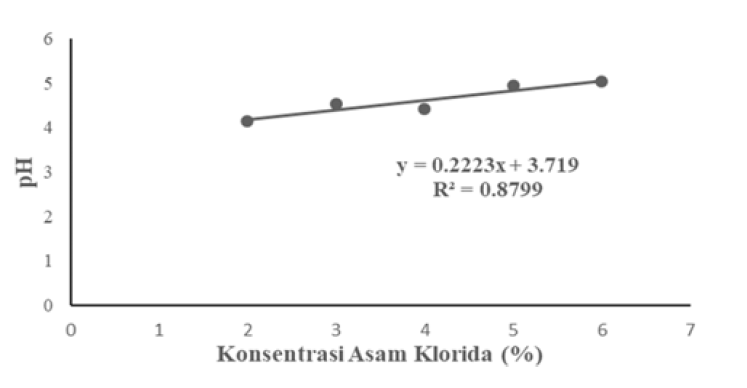
The relationship between treatment with various concentrations of hydrochloric acid and pH was determined by an orthogonal polynomial test. Based on orthogonal polynomial analysis of variance, it showed a significant effect (P<0.05) following a linear regression pattern with the equation Y = 0.2223x + 3.719 with R2 = 0.8799. The pH value increased as the concentration of hydrochloric acid increased. The coefficient of determination (R2) value was obtained at 0.8799, which showed that variations in various concentrations of 87% hydrochloric acid affect the gelatin pH value. The graphic of this relationship pattern can be seen in Figure 1.
Figure 1 showed that the pH value of gelatin increased in line with the increased in the concentration of hydrochloric acid given. The pH value of the curing material used would be followed by the pH value of the gelatin. This was influenced by the hydrochloric acid used in the demineralization processed. The curing material enters the tissue when collagen undergoes a swelling process [20].
Figure 1: Graph of the relationship between the hydrochloric acid use and the pH of chicken skin gelatin
Table 1: pH Value of Gelatin Treatment Using Hydrochloric Acid Various Concentrations
The level of gelatin viscosity can be determined by measuring the viscosity of the gelatin solution at a certain concentration and temperature. Gelatin viscosity is generally measured at a gelatin solution concentration of 6.67% (w/v) at a temperature of 60oC [21]. The results of research testing viscosity values at various hydrochloric acid concentrations can be seen in Table 2.
Table 2: Gelatin Viscosity with Various Hydrochloric Acid Concentration Treatments
The results of gelatin viscosity measurements listed in Table 9. The highest average viscosity value was produced by 2% hydrochloric acid treatment, namely 1.403 cP, then continued by 6%, 3%, 5% and 4% with viscosity values of 1.147 cP; 1,132 cP; 1,050 cP; and 1,048 cP respectively. The average viscosity value of chicken skin gelatin ranges from 1.048 cP-1.403 cP, this value is slightly lower than the edible gelatine standard of 1.5-7.5 cP [17].
Chicken skin gelatin viscosity value produced by 2% HCl (P1) treatment was 1.403 cP. These result was lower than research conducted by Rinta et al. [18] that produced gelatin from Red snapper bones had a viscosity of 7.46 cP. However, these result was higher than the result of research conducted by Puspitasari et al. [4], which made a gelatin from chicken feet bone, that produced a viscosity of 1.32 cP. Avena [22] stated that low viscosity values can be caused by the smaller the molecular weight of gelatin so that the distribution of gelatin molecules in the solution is faster, conversely, high viscosity values are caused by the greater molecular weight of gelatin so that the distribution of gelatin molecules in solution is slower.
Analysis of variance and orthogonal polynomial analysis of variance showed that the treatment had no significant effect (P>0.05) on the viscosity of chicken skin gelatin and did not form a particular pattern. The viscosity value of gelatin which tends to be the same was thought to be influenced by the pH value and protein concentration in chicken skin gelatin. The pH value of chicken skin gelatin which was not significantly different could be cause the viscosity value not be significantly different either. Factors that influence viscosity are pH, temperature and concentration, as well as hydrodynamic interactions between gelatin molecules.
Gelatin solution viscosity can increase if the gelatin concentration increases and the temperature decreases. Abustam et al. [23] suggested that the molecular chains length make up gelatin can influence the gelatin viscosity value. The higher the viscosity value, the longer the chain. The gelatin average molecular weight and the molecules distribution are related to the viscosity value, while the gelatin amino acid chain length is directly related to the gelatin molecular weight. The higher the viscosity value, the longer the amino acid chain, low viscosity values are caused by short amino acid chains.
Chicken Skin Gelatin Gel Strength
The gelatin main physical characteristic is gel strength. Gel strength describes the ability of gelatin to form a gel [24]. The results of gel strength analysis at various HCl concentrations can be seen in Table 3.
The gelatin gel strength test results listed in Table 3 showed that the average value of chicken skin gelatin gel strength ranges from 4.739-11.795 g Bloom. Gelatin soaked in 2% HCl (P1) produced the highest average gel strength of 11.795 g bloom. This result was lower than research by Rinta et al. [18], which resulted in a red snapper bone gel strength of 202.00 g bloom. However, these results were higher compared to research by Puspitasari et al. [4] which produced lower gel strength using chicken feet bone as a raw material, namely 0 g bloom or it could be said that it did not form a gel.
Analysis of variance revealed that the hydrochloric acid concentration showed no significant effect (P>0.05) on the chicken skin gelatin gel strength. The gelatin gel strength values which tend to be the same are thought to be influenced by the pH value and protein content in chicken skin gelatin. The pH value of chicken skin gelatin which is not significantly different can cause the gel strength value to be not significantly different. This opinion is in line with Schrieber and Gareis [7] who stated that the factors that influence the gel strength characteristics are pH value, protein concentration, salt concentration, salt type and temperature. The gelatin gel type and characteristics result gel strength differences. Low gel strength indicates that chicken skin gelatin has short amino acids and produces low molecular weights.
The amino acid chain length affects the gelatin gel strength. If the collagen hydrolysis process takes place under the right conditions, where hydrogen bonds are broken in the polypeptide chains, cross covalent bonds and some peptide bonds, it will produce gelatin with a long peptide chain structure so that the gel strength is high. Apart from that, according to Gumilar et al., [25] the livestock age affects the collagen content in the skin, the older the livestock, the higher the collagen protein content. Proteins are composed of amino acids chains that linked to other peptide bonds. The longer the amino acid chain can produce gelatin with greater gel strength. The low hydroxyproline content causes low gelatin gel strength. Hydroxyproline forms stable hydrogen bonds between water molecules and the amino acids free hydroxyl groups in gelatin, this is very important to increase the gelatin gel strength.
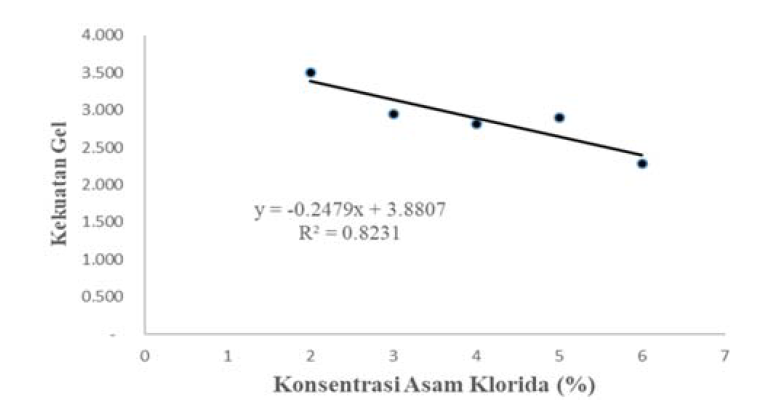
The relationship pattern between treatment and gel strength was determined by orthogonal polynomial test. Based on orthogonal polynomial variance analysis, it showed that the significant difference followed a linear regression pattern with the equation Y = -0.2479x + 3.8807 with R2 = 0.8231. The gel strength value decreased as the hydrochloric acid concentration increased. The coefficient of determination (R2) value was found to be 0.8231, which showed that varying concentrations of 82% hydrochloric acid affected the gelatin gel strength. The graphic of this relationship pattern can be seen in Figure 2.
Figure 2 shows that the gelatin gel strength value decreases as the hydrochloric acid concentration used increases. The gel strength level is thought to be influenced by the gelatin protein concentration. Proteins denatured, causing the protein molecular weight to be higher or lower, which causes high or low gel strength. The low gel strength indicates that the amino acid chain content of proline and hydroxyproline is low. The lower the hydroxyproline content, the lower the gelatin gel strength produced [13].
Figure 2: The relationship graph between hydrochloric acid use and chicken skin gelatin gel strength
Table 3: Gelatin Gel Strength on Hydrochloric Acid Various Concentrations
The hydrochloric acid concentrations used in the demineralization process has no effect on pH, viscosity and gel strength. Using a hydrochloric acid concentration of 2% (P1) in the demineralization process produced good gelatin with a pH value of 4.13; viscosity 1.403; and gel strength 11.795 g Bloom. The relationship pattern between treatments using various concentrations of hydrochloric acid and gelatin pH followed the linear regression equation Y = 0.2223x + 3.719, gel strength followed the linear regression equation Y = 0.2479x + 3.8807, while viscosity did not form a relationship pattern.
Acknowledgment
The author would like to thank Universitas Padjadjaran for funding this research through the Padjadjaran University Fundamental Research (RFU) grant program.
REFERENCE
Central Bureau of Statistics. Data Ekspor Impor Indonesia. Jakarta, 2023. http://bps.go.id/exim/. Accessed 01 September 2023.
Gumilar, J. and A. Pratama. “Production and characterization of halal gelatine made from chicken intestine.” Jurnal Teknologi Industri Pertanian, vol. 28, no. 1, 2018, pp. 75-81.
Ismeri, R. et al. Optimizing the Quality of Fish Gelatin by Using the Transglutaminase Enzyme as a Driver for Domestic Gelatin Production. IPB University, 2009.
Puspitasari, D.A.P. et al. “Gelling properties of chicken shank bone gelatin.” Jurnal Pangan dan Gizi, vol. 4, no. 7, 2013, pp. 20-23.
Chamidah, A. and Elita Ch. “Effect of processing on the quality of shark skin gelatin.” National Seminar PATPI, Malang, 2002. ISBN: 979-95249-6-2.
Ramadhan, F. et al. “The effect of NaOH concentration on yield, water and ash content of duck (Anas platyrhynchos javanica) feet gelatin.” Jurnal Ilmu dan Teknologi Hasil Ternak, vol. 14, no. 1, 2019, pp. 1-10.
Schrieber, R. and H. Gareis. Gelatine Handbook. Wiley-VCH Verlag GmbH & Co. KGaA, 2007.
Cliché, S. et al. “Extraction and characterization of collagen with or without telopeptides from chicken skin.” Poultry Science, vol. 82, no. 3, 2003, pp. 503-509.
Abustam, E.D. and M.I. Said. “Production of gelatin from chicken feet skin.” Proceedings of the National Seminar on Modern Animal Husbandry Industry, 2004, pp. 125-136.
Astawan, M. et al. “Analysis of the gelatin rheological properties from shark skin.” Jurnal Teknologi dan Industri Pangan, vol. 8, no. 1, 2002, pp. 38-46.
Astawan, M. and T. Aviana. “The influence of solvent variety and drying method on physical, chemical and functional characteristic of shark skin gelatin.” Jurnal Teknologi dan Industri Pangan, vol. 14, no. 1, 2002, pp. 7-13.
Revi, Y. et al. “The effect of several types of acid solutions on making gelatin from dried swamp sepat fish (Trichogaster trichopterus) skin as an alternative gelatin.” Scientia, vol. 5, no. 2, August 2015. ISSN: 20187-5045.
Sarabia, A.I. et al. “The effect of added salts on the viscoelastic properties of fish skin gelatin.” Food Chemistry, vol. 70, 2000, pp. 71-76.
Ockerman, H.W. and C.L. Hansen. Animal By-Product Processing and Utilization. CRC Press, 2000.
British Standard 757: Sampling and Testing of Gelatin. 1975. Cited in Imeson. Thickening and Gelling Agents for Food. Academic Press, New York, 1992.
Junianto, K.H. and I. Maulina. Gelatin Production from Fish Bones and Its Use as a Basic Material for Making Capsule Shells. Competitive Grant Research Report IV, Faculty of Fisheries and Marine, Universitas Padjajaran, 2006.
GMIA. Standard Methods for the Testing of Edible Gelatin. Gelatin Manufacturers Institute of America, 2012.
Rinta, K. et al. “Effect of soaking in hydrochloric acid on the quality of red snapper (Lutjanus sp.) bone gelatin.” Jurnal Pascapanen dan Bioteknologi Kelautan dan Perikanan, vol. 3, no. 1, 2008, p. 65.
Khomsatin, S. Evaluation of Differences in Hydrochloric Acid Concentration and Soaking Time on Gelatin Quality from Trimming Cowhide. Dept. of Animal Production Science and Technology, IPB University, 2004.
Hajrawati. Physical and Chemical Properties of Beef Bone Gelatin by Soaking in Hydrochloric Acid at Different Concentrations and Soaking Durations. MA thesis, IPB University, 2006.
Gelatin Manufactures of Europe (GME). Standardised Methods for the Testing of Edible Gelatine. Secretariat Gelatin Manufacturers of Europe, 2017.
Avena-Bustillos, R.J. “Water vapor permeability of mamalian and fish gelatine films.” Journal of Food Science, vol. 71, no. 4, 2006, pp. 202-207.
Abustam, E.D. et al. “Physical properties of chicken foot skin gelatin through acid, alkali and enzyme denaturation process.” National Seminar on Animal Husbandry and Veterinary Technology, 2008, p. 724.
Rusli, A. Study of the Gelatin Extraction Process from Fresh Patin Fish Skin. MA thesis, IPB University, 2004.
Gumilar, J. et al.Skin and Pre Tanning Technology. Unpad Press, 2021.
Advertisement
Recommended Articles
Research Article
Mating behaviour of Cavariella aegopodii
Nidhi Dhatwalia
Published: 19/07/2024
Download PDF
Cite
x
APA
Dhatwalia, N. (2024). Mating behaviour of Cavariella aegopodii. Himalayan Journal of Agriculture, 5(1), 1-7.
MLA
Dhatwalia, Nidhi. "Mating behaviour of Cavariella aegopodii." Himalayan Journal of Agriculture 5.1 (2024): 1-7.
Chicago
Dhatwalia, Nidhi. "Mating behaviour of Cavariella aegopodii." Himalayan Journal of Agriculture 5, no. 1 (2024): 1-7.
Harvard
Dhatwalia, N. (2024) 'Mating behaviour of Cavariella aegopodii' Himalayan Journal of Agriculture 5(1), pp. 1-7.
Vancouver
Dhatwalia N. Mating behaviour of Cavariella aegopodii. Himalayan Journal of Agriculture. 2024 Jan;5(1):1-7.
Download PDF
Research Article
The Role of Indigenous Microbes and Earthworm in the Bioconversion of Dairy Wastewater Solids into Organic Fertilizer
Marlina ,
...
N. Meynadhea
Published: 17/01/2024
Download PDF
Cite
x
APA
None, M., Rahayu, N. A., Badruzzaman, D. Z., Hidayati, Y., Harlia, E., Kurniawan, E. & Meynadhea, N. (2024). The Role of Indigenous Microbes and Earthworm in the Bioconversion of Dairy Wastewater Solids into Organic Fertilizer. Himalayan Journal of Agriculture, 5(1), 1-7.
MLA
None, Marlina, et al. "The Role of Indigenous Microbes and Earthworm in the Bioconversion of Dairy Wastewater Solids into Organic Fertilizer." Himalayan Journal of Agriculture 5.1 (2024): 1-7.
Chicago
None, Marlina, N. A. Rahayu, D. Z. Badruzzaman, Y.A. Hidayati, E. Harlia, E. Kurniawan and N. Meynadhea. "The Role of Indigenous Microbes and Earthworm in the Bioconversion of Dairy Wastewater Solids into Organic Fertilizer." Himalayan Journal of Agriculture 5, no. 1 (2024): 1-7.
Harvard
None, M., Rahayu, N. A., Badruzzaman, D. Z., Hidayati, Y., Harlia, E., Kurniawan, E. and Meynadhea, N. (2024) 'The Role of Indigenous Microbes and Earthworm in the Bioconversion of Dairy Wastewater Solids into Organic Fertilizer' Himalayan Journal of Agriculture 5(1), pp. 1-7.
Vancouver
Marlina M, Rahayu NA, Badruzzaman DZ, Hidayati Y, Harlia E, Kurniawan E, Meynadhea N. The Role of Indigenous Microbes and Earthworm in the Bioconversion of Dairy Wastewater Solids into Organic Fertilizer. Himalayan Journal of Agriculture. 2024 Jan;5(1):1-7.
Download PDF
Research Article
The Effect of Green Marketing Mix on Purchasing Decisions by Greenly Salad Consumers in Surabaya
Almira Parahita Soekarno,
...
Sigit Dwi Nugroho
Published: 30/01/2023
Download PDF
Cite
x
APA
Soekarno, A. P., Hendrarini, H. & Nugroho, S. D. (2023). The Effect of Green Marketing Mix on Purchasing Decisions by Greenly Salad Consumers in Surabaya. Himalayan Journal of Agriculture, 4(1), 1-7.
MLA
Soekarno, Almira P., Hamidah Hendrarini and Sigit D. Nugroho. "The Effect of Green Marketing Mix on Purchasing Decisions by Greenly Salad Consumers in Surabaya." Himalayan Journal of Agriculture 4.1 (2023): 1-7.
Chicago
Soekarno, Almira P., Hamidah Hendrarini and Sigit D. Nugroho. "The Effect of Green Marketing Mix on Purchasing Decisions by Greenly Salad Consumers in Surabaya." Himalayan Journal of Agriculture 4, no. 1 (2023): 1-7.
Harvard
Soekarno, A. P., Hendrarini, H. and Nugroho, S. D. (2023) 'The Effect of Green Marketing Mix on Purchasing Decisions by Greenly Salad Consumers in Surabaya' Himalayan Journal of Agriculture 4(1), pp. 1-7.
Vancouver
Soekarno AP, Hendrarini H, Nugroho SD. The Effect of Green Marketing Mix on Purchasing Decisions by Greenly Salad Consumers in Surabaya. Himalayan Journal of Agriculture. 2023 Jan;4(1):1-7.
Download PDF
Research Article
Efficiency of Production Factors Usage on Sorgum (Sorghum Bicolor L) (Case in Keyongan Village, Babat Sub-District, Lamongan Regency)
Evi Maf'idatul Ilmi,
...
Hamidah Hendrarini
Published: 20/12/2022
Download PDF
Cite
x
APA
Ilmi, E. M., Amir, I. T. & Hendrarini, H. (2022). Efficiency of Production Factors Usage on Sorgum (Sorghum Bicolor L) (Case in Keyongan Village, Babat Sub-District, Lamongan Regency). Himalayan Journal of Agriculture, 3(2), None-None.
MLA
Ilmi, Evi M., Indra T. Amir and Hamidah Hendrarini. "Efficiency of Production Factors Usage on Sorgum (Sorghum Bicolor L) (Case in Keyongan Village, Babat Sub-District, Lamongan Regency)." Himalayan Journal of Agriculture 3.2 (2022): None-None.
Chicago
Ilmi, Evi M., Indra T. Amir and Hamidah Hendrarini. "Efficiency of Production Factors Usage on Sorgum (Sorghum Bicolor L) (Case in Keyongan Village, Babat Sub-District, Lamongan Regency)." Himalayan Journal of Agriculture 3, no. 2 (2022): None-None.
Harvard
Ilmi, E. M., Amir, I. T. and Hendrarini, H. (2022) 'Efficiency of Production Factors Usage on Sorgum (Sorghum Bicolor L) (Case in Keyongan Village, Babat Sub-District, Lamongan Regency)' Himalayan Journal of Agriculture 3(2), pp. None-None.
Vancouver
Ilmi EM, Amir IT, Hendrarini H. Efficiency of Production Factors Usage on Sorgum (Sorghum Bicolor L) (Case in Keyongan Village, Babat Sub-District, Lamongan Regency). Himalayan Journal of Agriculture. 2022 Jul;3(2):None-None.
Gumilar, J., Putranto, W. S. & Auliya, L. (2023). Physical Quality of Gelatin from Chicken Skin Treated with Hydrochloric Acid (HCl) in the Demineralization Process. Himalayan Journal of Agriculture, 4(2), 1-6.
MLA
Gumilar, Jajang, Wendry S. Putranto and Luthfi Auliya. "Physical Quality of Gelatin from Chicken Skin Treated with Hydrochloric Acid (HCl) in the Demineralization Process." Himalayan Journal of Agriculture 4.2 (2023): 1-6.
Chicago
Gumilar, Jajang, Wendry S. Putranto and Luthfi Auliya. "Physical Quality of Gelatin from Chicken Skin Treated with Hydrochloric Acid (HCl) in the Demineralization Process." Himalayan Journal of Agriculture 4, no. 2 (2023): 1-6.
Harvard
Gumilar, J., Putranto, W. S. and Auliya, L. (2023) 'Physical Quality of Gelatin from Chicken Skin Treated with Hydrochloric Acid (HCl) in the Demineralization Process' Himalayan Journal of Agriculture 4(2), pp. 1-6.
Vancouver
Gumilar J, Putranto WS, Auliya L. Physical Quality of Gelatin from Chicken Skin Treated with Hydrochloric Acid (HCl) in the Demineralization Process. Himalayan Journal of Agriculture. 2023 Jul;4(2):1-6.


 Download PDF
 Download XML