Argopolitan Area Development Strategy Based on Increasing the Competitiveness of Leading Horticultural Commodities in Pacet District, Mojokerto Regency
Ery Pudyaningtyas
1
,
Teguh Soedarto
1
,
Hamidah Hendrarini
1
1
Master of Agribusiness Study Program, Faculty of Agriculture, UPN Veterans East Java, Jl. Rungkut Madya No. 1 Gunung Anyar, Gunung Anyar District, Kota Surabaya East Java, 60294
The agropolitan concept proposed by Friedman and Douglass is a concept of rural development based on the village's potential. This research was conducted in Pacet District, Mojokerto Regency, considering that the research location is one of the development areas for the largest agropolitan area producing horticultural crops in Mojokerto Regency, East Java Province. The sampling technique in this study is with purposive sampling techniques, the selected samples are agropolitan areas, as well as stakeholders in Pacet District, Mojokerto Regency who understand and are competent with this research. Quantitative data from SWOT analysis was processed using Microsoft Excel 2016 with the scoring method. The results of this study are The strategy for developing agropolitan areas in Pacet District based on the SWOT diagram is located in quadrant I (Aggressive) and the strategy used is the S-O strategy (Strenght-Opportunities) which means that the strategy that can be applied is to use strengths and take advantage of existing opportunities.
Keywords
Agropolitan
Horticulture
Development Strategy
SWOT
Important Note
Key findings:
The study identifies that the agropolitan development strategy in Pacet District, Mojokerto Regency, should leverage its strengths and seize existing opportunities. Using SWOT analysis and purposive sampling, findings show an aggressive S-O strategy is optimal for enhancing the region's potential in horticultural crop production.
What is known and what is new?
The agropolitan concept focuses on rural development based on village potential. The optimal strategy for Pacet District's agropolitan development is an aggressive S-O approach, leveraging strengths and opportunities in horticultural crop production.
What is the implication, and what should change now?
The implication is that Pacet District should focus on maximizing its strengths and opportunities to enhance agropolitan development. Stakeholders should now implement the aggressive S-O strategy to boost horticultural production and rural growth, ensuring sustainable development by leveraging local resources and market opportunities.
Introduction
Agropolitan was first introduced by Mc. Douglass and Friedmann for rural development. Agropolitan comes from the word agro which means agriculture and politan / polis which means city. So in general in the agropolitan program is the development of certain areas based on agriculture. The agropolitan concept proposed by Friedman and Douglass is a concept of rural development based on the village's potential. Agropolitan characteristics include: (1) Relatively small geographical scale, (2) Autonomous and independent planning and decision-making processes based on community participation, (3) Diversification of rural labor in agricultural and non-agricultural sectors emphasizes the growth of small industries, (4) The existence of rural-urban industry functional relationships and linkages with local economic resources, and (5) Utilization and improvement of local resource and technology capabilities.
The government develops regions with the concept of agropolitan through the optimization of plant and animal resources, namely agriculture, plantations, fisheries and animal husbandry. If an area only has fisheries potential, it can also be referred to as a minapolitan area. The agropolitan concept is realized into a national program stated in the National Development Long-Term Plan (RJPN) for 2005-2025, at point 32 which states that rural development is encouraged through agropolitan development, especially for agriculture-based areas [1].
The development of Agropolitan Areas aims to increase income and community welfare through accelerating regional development and increasing village and city entanglement [2]. Through the Development of Agropolitan Areas, the government makes every effort to encourage the creation of rural community welfare [2]. The agricultural sector in a region must have superior commodities to be developed as the main driver of national and regional development growth [4]. However, the agropolitan system based on superior commodities has not been able to increase farmers' income, so agropolitan development is needed with advances in the competitiveness of superior agribusiness products developed in agribusiness activities [5].
Rural development is inseparable from the increasing intensity of rural-urban linkages through the development of economic activities based on village potential. Potential-based rural development is packaged in the Agropolitan program [6]. One of the largest argopolitan areas in Mojokerto Regency is in Pacet District. According to the stipulation of the East Java Governor's Decree No. 188.45/451/HK/416-012/2003, Pacet District was determined as an agropolitan area with superior horticultural commodities in Mojokerto Regency, with 7 development villages, namely: Cepokolimo, Claket, Kemiri, Pacet, Padusan, Petak and Sajen.
Based on this background, it can be seen that the argopolitan area with superior commodities of horticultural crops plays an important role in the welfare of farmers in Pacet District, Mojokerto Regency, it is necessary to conduct a study on the relationship and impact of agropolitan areas. This study aims to analyze strategies to increase the competitiveness of superior commodities of horticultural crops in agropolitan areas in Pacet District, Mojokerto Regency.
Research Methods
This research was conducted in Pacet District, Mojokerto Regency, considering that the research location is one of the development areas for the largest agropolitan area producing horticultural crops in Mojokerto Regency, East Java Province. The sampling technique in this study is with purposive sampling techniques, wherein the technique is to determine research samples with certain considerations that aim to make the data obtained later more representative. The sample selected is an agropolitan area, as well as stakeholders in Pacet District, Mojokerto Regency who understand and are competent with this research. This study aims to identify competitiveness factors and to find out strategies that can be done in order to increase the competitiveness of superior commodities of horticultural crops in agropolitan areas. The data analysis method used is the SWOT analysis method. Quantitative data from SWOT analysis was processed using Microsoft Excel 2016 with scoring method. A popular model for situation analysis is SWOT analysis using the Internal Factor Analysis Summary Matrix (IFAS Matrix) and the External Factor Analysis Summary Matrix (EFAS Matrix).
Results and Discussion
Internal factors that are the strengths and weaknesses of the argopolitan area of Pacet District
Analysis of the internal environmental conditions of the Pacet District Agropolitan Area through functional aspects which include financial, marketing, operational, and human resource aspects resulted in several factors that became the strengths and weaknesses of the Pacet District Agropolitan Area. The Internal Factors Evaluation (IFE) analysis method is used to evaluate these internal factors. In the IFE analysis method, each of these internal factors is given a weight and rating. The weighting of each factor is obtained by pairwise comparison technique. Meanwhile, in determining the ranking of each factor, a scale of 1-4 is used based on the level of influence or strategic role of factors on the competitiveness of agropolitan areas.
Table 1. Identify the Strengths and Weaknesses of the Agropolitan Area of Pacet District
No.
Internal Strategy Factors
Rating
Total
Average
Weight
Score
1
2
3
4
(a)
(b)
(a*b)
Strengths
1.
Good Product Quality
5
20
95
3,8
0,18
0,68
2.
Production facilities are quite complete
2
8
15
88
3,52
0,17
0,58
3.
Production Results Meet Market Demand
7
18
93
3,72
0,18
0,65
Total Score Strenghts
1,91
Weakness
1.
Agribusiness Sub-Terminal Not Running Optimally
10
15
90
3,6
0,17
0,61
2.
Unimplemented Technology
6
7
12
81
3,24
0,15
0,49
3.
Lack of Product Innovation
5
6
14
84
3,36
0,16
0,53
Total Score Weakness
1,64
Total Internal Factors
0
13
43
94
531
21,2
1,00
3,55
Source: Data processed by researchers (2023)
From the results of the analysis in Table 1, it can be seen that the main strength of the Agropolitan area of Pacet District is that the product quality is quite good with a score (0.68). Meanwhile, the main weakness is that the Agribusiness Sub Terminal has not run optimally with a score of (0.61). The total score of (3.55) shows that the Agropolitan area of Pacet District already has a fairly good internal condition.
External factors that become opportunities and threats to the argopolitan area of Pacet District
Analysis of the external environmental conditions of the Agropolitan area of Pacet District produces several factors that become opportunities and threats. External factors are analyzed using the External Factors Evaluation (EFE) analysis method. The results of the EFE analysis can be seen in Table 2. next.
Table 2. Identification of Opportunities and Threats in the Agropolitan Area of Pacet District
No.
External Strategy Factors
Rating
Total
Average
Weight
Score
1
2
3
4
(a)
(b)
(a*b)
Opportunity
1.
Natural Resources Available
3
22
97
3,88
0,18
0,69
2.
Positive Vegetable Industry Growth
10
15
90
3,6
0,17
0,60
3.
Healthy Lifestyle Trends
7
18
93
3,72
0,17
0,64
Total Score Opportunity
1,93
Threats
1.
Pest Attack
9
16
91
3,64
0,17
0,61
2.
Growing Number of Competitors
5
11
9
79
3,16
0,15
0,46
3.
Climate Uncertainty
8
17
92
3,68
0,17
0,62
Total Score Threats
1,70
Total External Factors
0
5
48
97
542
21,68
1,00
3,63
Source: Data processed by researchers, (2023)
From the results of the analysis, it is known that the main opportunity factor for the Agropolitan area of Pacet District is the available natural resources with a score of (0.69), while the main threat to the Agropolitan area of Pacet District is Climate Uncertainty with a score of (0.62). The total score of external factors is (3.63) which means that the Agropolitan area of Pacet District is good at responding to external factors by taking advantage of opportunities and avoiding existing threats.
SWOT Matrix Analysis
Based on the results of SWOT measurement analysis which includes internal factors and external factors in agropolitan areas in Pacet District, the results of each factor are obtained as follows.
Strength factor score = 1.91
Weakness factor score = 1.64
Odds factor score = 1.93
Threat factor score = 1.70
The results are used to determine the x and y coordinate points that describe the condition of the agropolitan area in Pacet District based on internal and external factors. Here is the calculation of the x and y coordinate axes:
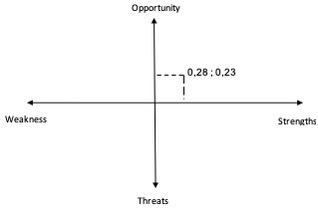
The x-coordinate axis as an internal factor obtained a result of 1.91 – 1.64 = 0.28
The y-coordinate axis as an external factor obtained a result of 1.93 – 1.70 = 0.23
Based on the results of the calculation above, it is known that the positive coordinate point indicated by the coordinate axis (x) is 0.28 and the coordinate axis (y) is 0.23. The coordinate points (x) and (y) can be seen in the SWOT diagram as follows.
Figure 1. SWOT Diagram
Based on the results of the SWOT diagram, it is known that the position of the agropolitan area in Pacet District is in quadrant I (first), namely S-O, which means that the agropolitan area in Pacet District is profitable and allows for implementing an aggressive strategy. An aggressive strategy is a strategy designed to achieve growth in sales, assets, profits or a combination of the three. This means that agropolitan area in Pacet District has strength factors in good condition but farmers have not maximized existing opportunities so the agropolitan area in Pacet District has not developed as expected. For this reason, an aggressive strategy is needed to increase growth to the maximum by utilizing existing opportunities and strengths (Strengths-Opportunity Strategy).
The agropolitan alert development strategy in Pacet sub-district can be formulated through SWOT matrix analysis. SWOT matrix analysis develops four types of strategies which include SO (strength-opportunity), WO (weakness-opportunity), ST (strength-threat), and WT (weakness-threat) strategies. The following is a SWOT matrix for agropolitan alert development strategies in Pacet District.
Table 3. Matrix SWOT
Strength(S)
Product quality is good.
Production facilities are quite complete.
The production results meet market demand.
Weakness (W)
The agribusiness sub-terminal has not run optimally.
The use of technology has not been applied optimally.
Lack of product innovation.
Opportunity (O)
Natural resources are available.
The growth of the vegetable industry is positive.
Healthy lifestyle trends.
S – O
Develop the resources owned.
Conduct agricultural intensification.
Expand marketing and distribution
Using information technology in production and marketing activities.
W – O
Optimize the function of the Agribusiness Sub-Terminal.
Diversify products by utilizing existing natural resources and technology.
Threat (T)
Pest attack.
The growing number of competitors.
Climate and weather uncertainty.
S – T
Conduct planting patterns based on rainfall patterns and irrigation water availability.
Using the concept of Integrated Pest Control (IPM) which is environmentally friendly.
Maintain and improve product quality in order to survive in the face of competition.
W – T
Continuously monitoring the phenomenon of climate decay and pest attacks.
Improve the quality of human resources by empowering farmers.
Utilizing technology in the face of pest attacks and climate change.
Source: Data processed by researchers (2023)
After an analysis of internal environmental factors and external environmental factors, a process of determining alternative strategies in the development of agropolitan areas is carried out, namely:
S-O Strategy
The S-O strategy is structured by maximizing the strengths possessed and taking advantage of existing opportunities. The proposed strategies are:
Develop the resources owned.
Conduct agricultural intensification.
Expand marketing and distribution
Using information technology in production and marketing activities.
W-O Strategy
The W-O strategy is structured to reduce weaknesses by taking advantage of existing opportunities. Proposed strategies include:
Optimize the function of the Agribusiness Sub-Terminal.
Diversify products by utilizing existing natural resources and technology.
S-T Strategy
The S-T strategy is structured using force to avoid existing threats in developing coffee agribusiness. The proposed S-T strategies are:
Conduct planting patterns based on rainfall patterns and irrigation water availability.
Using the concept of Integrated Pest Control (IPM) which is environmentally friendly.
Maintain and improve product quality in order to survive in the face of competition.
W-T Strategy
The W-T strategy is structured by minimizing weaknesses and avoiding existing threats in developing coffee agribusiness. The proposed W-T strategies are:
Continuously monitoring the phenomenon of climate decay and pest attacks.
Improve the quality of human resources by empowering farmers.
Utilizing technology in the face of pest attacks and climate change.
Conclusion
Based on the research that has been done, conclusions can be obtained, namely the strategy for developing agropolitan areas in Pacet District based on the SWOT diagram is located in quadrant I (Aggressive) and the strategy used is the S-O strategy (Strenght-Opportunities) which means that the strategy that can be applied is to use strengths and take advantage of existing opportunities. There are 3 S-O strategies that can be applied to develop agropolitan areas in Pacet District, namely 1) Developing owned resources, 2) Intensifying agriculture, 3) Expanding marketing and distribution, and 4) Using information technology in production and marketing activities.
Conflict of Interest
The authors declare that they have no conflict of interest.
Funding: No funding sources
Ethical approval: The study was approved by the Institutional Ethics Committee of University on Pembangunan Naisonal
References
Desi, Terryna Lady. Identifikasi strategi peningkatan daya saing kawasan agropoltan kabupaten cianjur menggunakan metode analityc network process. BS thesis. Fakultas Ekonomi dan Bisnis uin jakarta. URI: https://repository.uinjkt.ac.id/dspace/handle/123456789/57041
Yuni, Siska Wulan. "Implementasi Kebijakan Pengembangan Kawasan Agropolitan Di Desa Ringinrejo Kecamatan Kalitidu Kabupaten Bojonegoro." Publika 4.7 (2016). DOI: https://doi.org/10.26740/publika.v4n7.p%25p
Umum, K. P. (2012). Agropolitan dan Minapolitan Konsep Kawasan Menuju Keharmonian. Direktorat Jenderal Cipta Karya, Kementerian PU, Jakarta.
Ramli, Anwar. "Strengthening agricultural sector superior commodities-based against the economic growth in South Sulawesi, Indonesia." International Journal of Advanced Research 3.2 (2015): 753-760. https://citeseerx.ist.psu.edu/document?repid=rep1&type=pdf&doi=7b0e6b2556e27c8735715872bf657cedeb317a14
Farhanah, Laelatul, and Sucihatiningsih Dian Wisika Prajanti. "Strategies in developing agropolitan areas in Indonesia." Jurnal Ekonomi Pembangunan: Kajian Masalah Ekonomi dan Pembangunan 16.2 (2015): 158-165. DOI: 10.23917/jep.v16i2.1460
Annisa, Chichik Ilmi, and Eko Budi Santoso. "Arahan pengembangan kawasan agropolitan berdasarkan komoditas unggulan prioritas tanaman pangan kabupaten bojonegoro." Jurnal Teknik ITS 8.2 (2020): C175-C181. DOI: 10.12962/j23373539.v8i2.46914
License
Creative Commons Attribution-NonCommercial-NoDerivatives 4.0 International License
All papers should be submitted electronically. All submitted manuscripts must be original work that is not under submission at another journal or under consideration for publication in another form, such as a monograph or chapter of a book. Authors of submitted papers are obligated not to submit their paper for publication elsewhere until an editorial decision is rendered on their submission. Further, authors of accepted papers are prohibited from publishing the results in other publications that appear before the paper is published in the Journal unless they receive approval for doing so from the Editor-In-Chief.
Himalayan Journal of Agriculture open access articles are licensed under a Creative Commons Attribution-Share A like 4.0 International License. This license lets the audience to give appropriate credit, provide a link to the license, and indicate if changes were made and if they remix, transform, or build upon the material, they must distribute contributions under the same license as the original.
Advertisement
Recommended Articles
Research Article
Mating behaviour of Cavariella aegopodii
Nidhi Dhatwalia
Published: 19/07/2024
Download PDF
Cite
x
APA
Dhatwalia, N. (2024). Mating behaviour of Cavariella aegopodii. Himalayan Journal of Agriculture, 5(1), 1-7.
MLA
Dhatwalia, Nidhi. "Mating behaviour of Cavariella aegopodii." Himalayan Journal of Agriculture 5.1 (2024): 1-7.
Chicago
Dhatwalia, Nidhi. "Mating behaviour of Cavariella aegopodii." Himalayan Journal of Agriculture 5, no. 1 (2024): 1-7.
Harvard
Dhatwalia, N. (2024) 'Mating behaviour of Cavariella aegopodii' Himalayan Journal of Agriculture 5(1), pp. 1-7.
Vancouver
Dhatwalia N. Mating behaviour of Cavariella aegopodii. Himalayan Journal of Agriculture. 2024 Jan;5(1):1-7.
Download PDF
Research Article
The Role of Indigenous Microbes and Earthworm in the Bioconversion of Dairy Wastewater Solids into Organic Fertilizer
Marlina ,
...
N. Meynadhea
Published: 17/01/2024
Download PDF
Cite
x
APA
None, M., Rahayu, N. A., Badruzzaman, D. Z., Hidayati, Y., Harlia, E., Kurniawan, E. & Meynadhea, N. (2024). The Role of Indigenous Microbes and Earthworm in the Bioconversion of Dairy Wastewater Solids into Organic Fertilizer. Himalayan Journal of Agriculture, 5(1), 1-7.
MLA
None, Marlina, et al. "The Role of Indigenous Microbes and Earthworm in the Bioconversion of Dairy Wastewater Solids into Organic Fertilizer." Himalayan Journal of Agriculture 5.1 (2024): 1-7.
Chicago
None, Marlina, N. A. Rahayu, D. Z. Badruzzaman, Y.A. Hidayati, E. Harlia, E. Kurniawan and N. Meynadhea. "The Role of Indigenous Microbes and Earthworm in the Bioconversion of Dairy Wastewater Solids into Organic Fertilizer." Himalayan Journal of Agriculture 5, no. 1 (2024): 1-7.
Harvard
None, M., Rahayu, N. A., Badruzzaman, D. Z., Hidayati, Y., Harlia, E., Kurniawan, E. and Meynadhea, N. (2024) 'The Role of Indigenous Microbes and Earthworm in the Bioconversion of Dairy Wastewater Solids into Organic Fertilizer' Himalayan Journal of Agriculture 5(1), pp. 1-7.
Vancouver
Marlina M, Rahayu NA, Badruzzaman DZ, Hidayati Y, Harlia E, Kurniawan E, Meynadhea N. The Role of Indigenous Microbes and Earthworm in the Bioconversion of Dairy Wastewater Solids into Organic Fertilizer. Himalayan Journal of Agriculture. 2024 Jan;5(1):1-7.
Download PDF
Research Article
The Effect of Green Marketing Mix on Purchasing Decisions by Greenly Salad Consumers in Surabaya
Almira Parahita Soekarno,
...
Sigit Dwi Nugroho
Published: 30/01/2023
Download PDF
Cite
x
APA
Soekarno, A. P., Hendrarini, H. & Nugroho, S. D. (2023). The Effect of Green Marketing Mix on Purchasing Decisions by Greenly Salad Consumers in Surabaya. Himalayan Journal of Agriculture, 4(1), 1-7.
MLA
Soekarno, Almira P., Hamidah Hendrarini and Sigit D. Nugroho. "The Effect of Green Marketing Mix on Purchasing Decisions by Greenly Salad Consumers in Surabaya." Himalayan Journal of Agriculture 4.1 (2023): 1-7.
Chicago
Soekarno, Almira P., Hamidah Hendrarini and Sigit D. Nugroho. "The Effect of Green Marketing Mix on Purchasing Decisions by Greenly Salad Consumers in Surabaya." Himalayan Journal of Agriculture 4, no. 1 (2023): 1-7.
Harvard
Soekarno, A. P., Hendrarini, H. and Nugroho, S. D. (2023) 'The Effect of Green Marketing Mix on Purchasing Decisions by Greenly Salad Consumers in Surabaya' Himalayan Journal of Agriculture 4(1), pp. 1-7.
Vancouver
Soekarno AP, Hendrarini H, Nugroho SD. The Effect of Green Marketing Mix on Purchasing Decisions by Greenly Salad Consumers in Surabaya. Himalayan Journal of Agriculture. 2023 Jan;4(1):1-7.
Download PDF
Review Article
Registration of Gute-19 (Late Set) Soybean Varieties (Late Maturity Class)
Adane Arega,
Alemayeh Dabessa
Published: 10/10/2020
Download PDF
Cite
x
APA
Arega, A. & Dabessa, A. (2020). Registration of Gute-19 (Late Set) Soybean Varieties (Late Maturity Class). Himalayan Journal of Agriculture, 1(1), 1-4.
MLA
Arega, Adane and Alemayeh Dabessa. "Registration of Gute-19 (Late Set) Soybean Varieties (Late Maturity Class)." Himalayan Journal of Agriculture 1.1 (2020): 1-4.
Chicago
Arega, Adane and Alemayeh Dabessa. "Registration of Gute-19 (Late Set) Soybean Varieties (Late Maturity Class)." Himalayan Journal of Agriculture 1, no. 1 (2020): 1-4.
Harvard
Arega, A. and Dabessa, A. (2020) 'Registration of Gute-19 (Late Set) Soybean Varieties (Late Maturity Class)' Himalayan Journal of Agriculture 1(1), pp. 1-4.
Vancouver
Arega A, Dabessa A. Registration of Gute-19 (Late Set) Soybean Varieties (Late Maturity Class). Himalayan Journal of Agriculture. 2020 Jan;1(1):1-4.
Pudyaningtyas, E., Soedarto, T. & Hendrarini, H. (2023). Argopolitan Area Development Strategy Based on Increasing the Competitiveness of Leading Horticultural Commodities in Pacet District, Mojokerto Regency. Himalayan Journal of Agriculture, 4(1), 1-6.
MLA
Pudyaningtyas, Ery, Teguh Soedarto and Hamidah Hendrarini. "Argopolitan Area Development Strategy Based on Increasing the Competitiveness of Leading Horticultural Commodities in Pacet District, Mojokerto Regency." Himalayan Journal of Agriculture 4.1 (2023): 1-6.
Chicago
Pudyaningtyas, Ery, Teguh Soedarto and Hamidah Hendrarini. "Argopolitan Area Development Strategy Based on Increasing the Competitiveness of Leading Horticultural Commodities in Pacet District, Mojokerto Regency." Himalayan Journal of Agriculture 4, no. 1 (2023): 1-6.
Harvard
Pudyaningtyas, E., Soedarto, T. and Hendrarini, H. (2023) 'Argopolitan Area Development Strategy Based on Increasing the Competitiveness of Leading Horticultural Commodities in Pacet District, Mojokerto Regency' Himalayan Journal of Agriculture 4(1), pp. 1-6.
Vancouver
Pudyaningtyas E, Soedarto T, Hendrarini H. Argopolitan Area Development Strategy Based on Increasing the Competitiveness of Leading Horticultural Commodities in Pacet District, Mojokerto Regency. Himalayan Journal of Agriculture. 2023 Jan;4(1):1-6.


 Download PDF
 Download XML