This study aims to analyze the cost, revenue, income and business feasibility of milkfish ponds in Sedati District, Sidoarjo Regency. This research was conducted in Sedati District, Sidoarjo Regency in December 2022 - January 2023. The method used in this study is quantitative using data analysis of income, B/C ratio, and R/C ratio. The number of respondents in this study were 58 farmers. The results showed that the average milkfish production for one period was 1,706.54 Kg, and the average revenue obtained by farmers was Rp 42,053,643.18/ha/season, while the average total costs incurred by farmers was Rp 17,649,438.26/ha/season. And the average income of farmers in Sedati District, Sidoarjo Regency, was obtained at Rp 24,404,204.92/ha/season. The B/C ratio value is 1.38 and the R/C ratio value is 2.38, which means it is feasible to cultivate.
Keywords
Milkfish
Income
Feasibility
INTRODUCTION
Indonesia is a maritime country with 17,504 islands, 5.8 million km2 of marine waters, and 95,181 km of coastline, the second longest in the world after Canada. With these conditions, Indonesia has the potential in the fisheries sector that can support the national economy. Aquaculture is the utilization of coastal areas as maintenance land. These activities are expected to improve the welfare of farmers and fishermen in coastal areas and increase the income and standard of living of farmers / fishermen and reduce dependence on capture fisheries production. One type of fish that has the potential to be cultivated in ponds is milkfish.
Milkfish has been cultured in the Philippines, Taiwan, and Indonesia for hundreds of years [1]. Milkfish is a type euryhaline fish, which can live in a fairly wide range of salinity (0-140 ppt) [2]. Milkfish is a type of fish that is familiar to the community. Milkfish is a pond product that has high prospects for development. The cultivation of these animals was originally a side business for fishermen who could not go to sea, therefore the ponds were traditionally located on the seashore. In general, milkfish cultivation consists of several stages, namely hatching, breeding, and rearing. Naturally, these organisms consume natural food such as plankton and pond periphyton depending on their size and age. [3]. Milkfish is a fish commodity that can be cultivated in brackish and freshwater ponds, besides that milkfish has the highest consumption value in Indonesia [4]. Milkfish is a food that contains nutrients that are quite beneficial for the body. The nutritional content of milkfish is 70.7% water content, 1.4% ash content; 24.1% protein; 0.85% fat; and 2.7% carbohydrate [5].
Milkfish in several provinces, especially in Java, is a leading commodity and its preparations have become provincial specialties. Such as Banten, the province is famous for its milkfish satay products which are very distinctive. In Central Java, especially the Semarang area, it is famous for milkfish presto and in East Java, especially the Sidoarjo area, many produce smoked milkfish and milkfish pulled out of thorns. According to the data Central Bureau of Statistics the total production of milkfish in Indonesia is 824,395 tons. East Java Province is the second largest with a production of 171,361 tons or 20.79%. As the second largest milkfish production, there are several districts whose geographical areas are very potential to be used as milkfish farming.
East Java Province has fisheries potential spread across several regencies/cities. Covering the southern coast facing the Indian Ocean, the north coast facing the Java Sea, the Madura Strait coast, and the Bali Strait coast even to the Kangean Islands located north of Bali Island. Fish products are also enjoyed by the people of East Java who are not geographically located on the coast and are used as raw materials for food made from seafood. One of the most widely cultivated fish in East Java is milkfish. According to data from BPS East Java [6], the total production of milkfish in East Java was 171,361 tons. Sidoarjo Regency has the second highest production with 34,150 tons or 19.92%.
Sidoarjo District is a district that has the potential to develop milkfish aquaculture because of its proximity to the sea and the suitability of water conditions. Sidoarjo District has 18 sub-districts with 8 sub-districts that cultivate milkfish. These subdistricts include Waru Subdistrict, Buduran Subdistrict, Sidoarjo Subdistrict, Tanggulangin Subdistrict, Porong Subdistrict, Jabon Subdistrict, and Sedati Subdistrict. Each sub-district has a different area. The following is a table of pond area per sub-district in Sidoarjo Regency in 2015-2019.
Based on table 1 above, Sedati Sub-district has the largest ponds in Sidoarjo Regency amounting to 4,890 Ha in 2019. This shows that Sedati Sub-district is mostly populated by pond farmers. The sub-district is located at the far end bordering the Madura Strait. In this area there is also a small river that serves as a parking lot for boats of fishermen from various villages. The cultivation of milkfish carried out by the people of Sedati Subdistrict is one of the businesses that has the most significant role in contributing to the income of the people in the subdistrict. On the other hand, there are constraints in the cultivation of milkfish ponds in Sedati Subdistrict because they still apply traditional cultivation systems, the existence of tidal floods, erratic climate change, and diseases that attack. So that the cultivation of ponds that can theoretically produce crops 3 to 4 times a year will not be fulfilled in reality. The water used to irrigate the ponds is also polluted due to waste water from household waste, industry, and also Juanda airport. This causes milkfish pond farmers to experience uncertain income.
The business of milkfish ponds is profitable or feasible if the analysis of the pond business shows decent results. A milkfish pond business can be said to be feasible or not to do can be seen from the use of costs and the magnitude of the ratio between total revenue to total costs. Based on the description and the above problems, the authors are interested in examining the analysis of income and feasibility of milkfish ponds in Sedati District Sidoarjo Regency. The purpose of this study were (i) to analyze the cost, revenue, and income of milkfish ponds in Sedati District Sidoarjo Regency (ii) to analyze the feasibility of milkfish ponds in Sedati District Sidoarjo Regency.
MATERIALS AND METHODS
This research was conducted in Sedati District, Sidoarjo Regency. The research location was chosen purposive with the consideration that the sub-district is the largest area of ponds in Sidoarjo Regency. The research was conducted from December 2022 to January 2023. The data used in this study are primary data and secondary data. Primary data were obtained directly from the field, namely interviews with respondents using a questionnaire. Secondary data were obtained indirectly from the East Java Central Bureau of Statistics and the Sidoarjo Regency Marine and Fisheries Office.
Population is all components or all research objects that will be studied by researchers [7]. The population in this study were farmers who cultivated milkfish in Sedati District, Sidoarjo Regency. Total farmers as many as 136 people. The sampling technique of farmers using simple random sampling method is a sampling technique by taking sample members from the population randomly without regard to the strata in the popula [8]. Sampling to determine the number of farmers using the Slovin formula. According to (Riyanto and Hatmawan, 2020) the Slovin formula can be formulated as follows:
= 57.62 ≈ 58 farmers
Based on the formula above, the sample results were 58 farmers from a population of 136 farmers and with an error rate of 10% or 0.1.
Data Analysis
Data analysis is used to solve problems in research so that it is useful for research purposes. The first objective is to use income analysis to analyze the cost, revenue, and income of milkfish ponds in Sedati District, Sidoarjo Regency.
Table 1: Pond Area Subdistrict in Sidoarjo Regency in 2015-2019
District
Pond Area (Ha)
2015
2016
2017
2018
2019
Waru
407,18
407,18
407,18
407,18
407,18
Sedati
4.890
4.890
4.890
4.890
4.890
Buduran
1.477,52
1.477,52
1167,52
1.167,52
1.167,52
Sidoarjo
2.770,05
2.770,05
2.770,05
2.770,05
2.770,05
Temple
1.031
1.031
1.031
1.031
1.031
Tanggulangin
496,64
496,64
496,64
496,64
496,64
Porong
496
496
496,00
496
496
Jabon
3.962
3.962
3.962
3.962
3.962
Total
15.530,385
15.530,39
15.220,39
15.520,39
15.520,39
Source: Sidoarjo Regency Marine and Fisheries Service, 2019
Cost Analysis
There are two types of cost analysis, namely fixed costs and variable costs. According to [9] calculating the amount of total cost is obtained by summing fixed costs with variable costs with the following formula:
TC = TFC + TVC
Where:
TC: Total cost of milkfish pond farmers (IDR/ha/season)
TFC: Total fixed costs of milkfish pond farmers (IDR/ha/season)
TVC: Total variable costs of milkfish pond farmers (IDR/ha/season)
Acceptance Analysis
Farm income is the multiplication of the amount of production by the selling price according to [9]. Mathematically formulated as follows:
TR = P x Q
Where:
TR: Total revenue of milkfish pond farmers (IDR/ha/season)
P: Selling price of milkfish pond farmers (IDR/kg)
Q: The number of products produced by milkfish pond farmers (kg)
Revenue Analysis
According to [9], that income analysis is the difference between total revenue and total costs incurred and is expressed by the following formula:
Π = TR – TC
Where:
Π: Income of milkfish pond farmers (IDR/ha/season)
TR: Total revenue of milkfish pond farmers (IDR/ha/ season)
TC: Total cost of milkfish pond farmers (IDR/ha/season)
The second objective uses feasibility analysis to analyze the feasibility of milkfish ponds in Sedati District, Sidoarjo Regency.
Benefit Cost Ratio (B/C) Analysis
Benefit Cost Ratio is a comparison of profits with the costs used to realize the planning and operating a business that sees the benefits obtained by the pond in rupiah units. The mathematical formula used as follows:
B/C =
Where:
B/C ratio: Comparison between total revenue and total cost
TI: Total income of milkfish pond farmers (IDR)
TC: Total cost of milkfish pond farmers (IDR)
Criteria as follows:
B/C > 1, milkfish farming is feasible.
B / C = 1, milkfish pond business is said to break even
BC < 1, milkfish farming is not feasible
Revenue Cost Ratio (R/C) Analysis
Revenue Cost Ratio is the value of the conversion of revenue costs divided by production costs in a business unit with the following formula:
R/C =
Where:
R/C ratio: Comparison between revenue and cost
TR: Total revenue of milkfish pond farmers (IDR)
TC: Total cost of milkfish pond farmers (IDR)
Criteria as follows:
R/C > 1, then the milkfish pond business is feasible.
R / C = 1, then the milkfish pond business breaks even
R/C < 1, then the milkfish pond business is not feasible
RESULTS
General Situation of the Research Area
Sedati Sub-district is one of the sub-districts in Sidoarjo Regency. Administratively, Sedati Sub-district has 16 villages consisting of Kwangsan Village, Pepe Village, Buncitan Village, Kalanganyar Village, Tambak Cemandi Village, Gisik Cemandi Village, Cemandi Village, Pulungan Village, Betro Village, Sedati Agung Village, Sedati Gede Village, Pabean Village, Semampir Village. Pranti village, Segoro Tambak village and Banjar Kemuning village. The distance from Sedati sub-district to Sidoarjo Regency is 14 km. Sedati sub-district has an area of 79.26 km2, with most of it used for ponds covering 4,890 ha or 62%. The total population in Sedati sub-district is 98,186 people, consisting of 49,427 men and 48,759 women. Geographically, the Sedati sub-district is located at an altitude of 4 m above sea level. The average rainfall is 147 mm.
Characteristics of Milkfish Farmers
Farmer characteristics are used to determine the diversity of respondents based on gender, age, education level, number of family members, farming experience, and land area. This can provide an overview of the condition and diversity of respondents and its relation to the problems and objectives of the study. Characteristics of milkfish farmers can be seen in Table 2.
Table 2 shows the characteristics of milkfish farmers, totaling 58 people. Gender characteristics indirectly affect the quality of work, especially in milkfish farming. Men are usually involved in activities that are classified as more difficult than women. The gender of most farmers is male with 57 respondents. This shows that the milkfish farming business requires the physical strength of men compared to the physical strength of women. While the smallest gender is female with a total of 1 person.
Table 2: Characteristics of milkfish farmers in Sedati Subdistrict
No.
Characteristics
Number (Person)
(%)
1.
Gender
Male
Female
57
1
98,28
1,72
Total
58
100,00
2.
Age
40-45
46-50
51-55
56-60
61-65
12
15
11
14
6
29,69
25,86
18,97
24,14
10,34
Total
58
100,00
3.
Education Level
Elementery School
Junior High School
Senior High School
Diploma
Bachelor
Postgraduate
8
20
23
1
5
1
13,79
36,21
37,94
1,72
8,62
1,72
Total
58
100,00
4.
Number of Family Dependents (Person)
1-3
4-6
7-9
26
31
1
44,83
53,45
1,72
Total
58
100,00
5.
Pond Business Experience (Years)
1-10
11-20
21-30
31-40
41-50
18
29
6
3
2
31,03
50,00
10,34
5,17
3,45
Total
58
100,00
6.
Land Area (Ha)
1-5
6-10
11-15
36
15
7
62,07
25,86
12,07
Total
58
100,00
Source: Primary Data Processed, 2023
Table 3: Average Total Costs, Revenue, and Income of Milkfish Farms in Sedati Subdistrict
No.
Description
Cost (IDR/ha/season)
1.
Fixed Cost
Land tax
67.851
Land rent
1.199.638
Tool depreciation:
Mesh netting
Kerakat
Seser
Basket
25.859,93
15.132,43
25.787,11
36.493,25
Block ice
179.610,19
Transportation
221.870,88
Variable Cost
Nener
1.569.415,29
Fertilizer
12.721.767,02
Feed
258.110,94
Medicine
840.346,33
Labor
487.556
Average Total Cost
17.649.438,26
2.
Income
Average production (Kg)
1.706,54
Average selling price (IDR/Kg)
24.642,68
Average Total Revenue
42.053.643,18
3.
Average Income
24.404.204,92
Source: Primary Data Processed, 2023
The age of farmers is one of the factors that are closely related to the work ability of farmers in carrying out business activities of milkfish pond aquaculture. The dominant age of farmers involved in aquaculture business activities is the age of 46-50 years with the number of respondents 15 people and a percentage level of 25.86%. This shows that the age level of farmers who are productive and have stronger energy to do milkfish farming business. While the lowest age is the age of 61-65 years with the number of respondents 6 people and a percentage level of 10.34%, this shows that the age classified as old has a low productive level.
The level of education is one of the factors that greatly affects a business in understanding the program to be run, as well as the application of technology and things that are new in nature are greatly influenced by the level of education, human resources depend on the level and quality of education and will determine the character of economic and social development because humans are active actors of all these activities. The highest level of education of farmers is the Senior High School level as many as 23 people with a percentage of 37.94%. While respondents who plaing little level of education is Diploma and Postgraduate as many as 1 person with a percentage of 1.72%. It can be concluded that the level of education of farmers in Sedati District is still very good because the number of respondents with a Senior High School education level is quite a lot. In addition to being very attentive in managing their cultivation business, farmers can also accept the development of new technologies and innovations easily.
The number of family members can affect an activity because large family members merupat large assets in the provision of family labor, the more families who play a role in it, the more productivity will be produced. Farmers who have the highest number of family dependents are in the group of 4-6 people, namely 31 people with a percentage of 53.45%. While farmers who have the smallest dependents are in the group of 7-9 people, namely 1 person with a percentage of 1.72%. This explains that family dependents are not too many so that they can balance the amount of family income, the more family members, the more expenses.
Pond business experience is a major factor in determining the quality of a person's resources. Pond business experience is the number of years of experience that farmers go through as part of the learning process in cultivation activities, production and the ins and outs of business and marketing of crops in order to earn income. The length of farming will measure the ability of farmers in conducting pond business. Most farmers have experience in pond business in the range of 11-20 years as many as 29 people with a percentage of 50%. While the least farmers in the range of 41-50 years as many as 2 people with a percentage of 3.45%. This shows that the long experience of farmers is able to manage the milkfish farming business well.
The land area used for milkfish farming varies. In addition, land area can affect the yield obtained. The more land area owned by farmers, the greater the production yield obtained. The largest land area managed by farmers is 1-5 hectare as many as 36 people with a percentage of 62.07%, while the smallest is 11-15 hectare as many as 7 people with a percentage of 12.07%. This shows that the average land area owned by farmers in Sedati District has a large enough land area to produce milkfish.
Milkfish Pond Business Income
Milkfish pond business income is the difference between revenue (TR) and Total Costs (TC) incurred during one season in Sedati District. Income is said to be profitable if the revenue is higher than the total cost and vice versa if the total cost is greater than the revenue is said to be a loss. Revenue is the result of sales or exchange of production so that the more products sold it will increase revenue [10]. Acceptance of milkfish pond business is the product of the number of milkfish production produced in units of tails with the selling price of milkfish in units of rupiah. The size of the revenue obtained is influenced by the production and selling price. The greater the amount of harvest produced and the selling price, the greater the revenue obtained.
Farming costs are a form of sacrifice made by producers, both farmers, ranchers and fishermen, to obtain production factors used to manage their business so as to get maximum results [11]. The cost of milkfish pond business is all the costs incurred by milkfish pond farmers in their efforts to produce milkfish during one cultivation period. In this study, the business costs incurred for milkfish farming are divided into two, namely fixed costs and variable costs. Fixed costs are costs that are constantly incurred and the relative amount even though the production of milkfish is large or small [12]. Fixed costs incurred by farmers in Sedati Subdistrict include land tax, land rent, and depreciation of equipment. Variable costs are costs incurred by farmers that are influenced by the size of production. The types of variable costs in milkfish farming in Sedati Subdistrict are production costs and labor costs. The following is the average total cost, revenue, and income of milkfish farms in Sedati District can be seen in Table 3.
Based on table 3 shows that the average production obtained in one period is 1,706.54 kg with a selling price of Rp 24,642.68/kg and total revenue of Rp 42.053.643,18/ha/season with an average total cost incurred of Rp 17,649,438.26/ha/season. The amount of income earned by farmers can be shown by the following calculation:
Π = TR – TC
= Rp 42,053,643.18 – Rp 17,649,438.26
= IDR 24,404,204.92
Feasibility of Milkfish Farming Business
Feasibility means that in-depth research is conducted to determine whether the business will provide benefits that outweigh the costs. In other words, feasibility can mean that the business being run will provide financial and non-financial benefits in accordance with the goals they will want. According to Hendra et al. [13], a business feasibility study is an activity to assess or measure the extent to which the benefits can be obtained in carrying out a business activity or a study of whether or not a business if feasible. Feasible means that it will provide benefits not only for the company that runs it, but also for investors, creditors, government, and the wider community. Every business activity must be assessed as to the extent of the benefits that can be obtained. The results of this analysis are used as a consideration for decisions for business actors whether this business will continue or not for certain reasons.
Feasibility of Milkfish Farming B/C Ratio
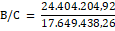
Business feasibility analysis of milkfish ponds B/C ratio is the ratio between total revenue to total costs used in one harvest season period. To find out more details about the analysis of the feasibility of B/C ratio of milkfish ponds in Sedati District can be seen as follows:
1,38
Based on the above calculation shows the B / C value of 1.38. This value is greater than 1, so the milkfish farming business in Sedati Subdistrict is feasible. That is, if every cost sacrificed by farmers of Rp 1 then farmers will get a profit of Rp 1.38.
Feasibility of Milkfish Farm R/C Ratio
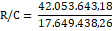
Analysis of the feasibility of milkfish ponds R/C ratio is a comparison between total revenue and total costs used in one harvest season period. The greater the R/C ratio will provide greater benefits to farmers in carrying out their farming business. To find out more details about the feasibility analysis of the R/C ratio of milkfish ponds in Sedati District can be seen as follows:
2,38
Based on the above calculations show the R / C ratio value of 2.38. This value is greater than 1, so the milkfish farming business in Sedati Subdistrict is feasible. That is, if every cost sacrificed by farmers of Rp 1 then farmers will get a profit of Rp 2.38.
CONCLUSION
Based on the results of the analysis and discussion that has been done about the income and business feasibility of milkfish ponds in Sedati District, Sidoarjo Regency, it can be concluded that:
The income of milkfish farmers in Sedati District, Sidoarjo Regency is profitable. The average fixed costs incurred by farmers in one period amounted to Rp 1,772,242.46/ha/season and the average variable costs incurred by farmers amounted to Rp 15,877/195.80/ha/season, so that the average total costs incurred amounted to Rp 17,649,438.26/ha/season. The average revenue earned by farmers amounted to IDR 42,053,643.18/ha/season. The average income generated by farmers in the amount of Rp 24,404,204.92/ha/season
From the results of the analysis of the feasibility of milkfish pond business shows that the value of the Benefit Cost Ratio (B/C Ratio) of 1.38 and Revenue Cost Ratio (R/C Ratio) of 2.38 so that the milkfish pond business in Sedati District Sidoarjo Regency is feasible to run because it provides benefits to farmers
REFERENCES
Sulu, R. et al. The Feasibility of Milkfish (Chanos Chanos) Aquaculture in Solomon Islands. Working Papers, 2016.
Asrial, E. et al. "Sustainability Analysis of Milkfish Aquabusiness Management on Sumbawa Island: A Bioecology, Technology, and Economic Approach." Jurnal AGRISEP, vol. 19, no. 2, 2020, pp. 417–432.
Arsad, S. et al. "Milkfish (Chanos Chanos Forskal) Traditional Pond Stability Based on Microalgae Periphyton Availability and Water Quality Analyses." Omni-Akuatika, vol. 15, no. 1, 2019, pp. 59–65.
Handayani, R. et al. "Evaluasi Kelayakan Usaha Budidaya Ikan Bandeng (Chanos Chanos) Secara Semi Intensif di Kecamatan Ulujami, Kabupaten Pemalang." Jurnal Sains Akuakultur, vol. 3, 2019, pp. 2621–0525.
Hafiludin. "Analisis Kandungan Gizi pada Ikan Bandeng yang Berasal dari Habitat yang Berbeda." Jurnal Kelautan, vol. 8, no. 1, 2015, pp. 37–43.
BPS Jawa Timur. Produksi dan Nilai Produksi Perikanan Budidaya Menurut Kabupaten Kota dan Komoditas Utama di Provinsi Jawa Timur. 2019.
Indah, P.N. et al. Metodologi Penelitian Agribisnis. 2016, http://repository.upnjatim.ac.id/2173/1/MPA.pdf
Siyoto, Sandu, and M.Ali Sodik. Dasar Metedologi Penelitian. Edited by Ayub, Cetakan 1, Literasi Media Publishing, 2015.
Suratiyah, Ken. Ilmu Usaha Tani. Revised ed., edited by Syarifa Rizki Annisa, Penebar Swadaya Grup, 2015.
Zaman, N. et al. Ilmu Usahatani. Edited by Ronal Watrianthos, Cetakan 1, Yayasan Kita Menulis, 2020.
Mooduto, A. et al. "Analisis Pendapatan Usahatani Cengkeh di Desa Iloheluma Kecamatan Posigadan Kabupaten Bolaang Mongondow Selatan." Agrinesia: Jurnal Ilmiah, 2021.
Indah, P.N. et al. "Analisis Pendapatan Usaha Tambak Bandeng di Desa Lalombi Kecamatan Banawa Selatan Kabupaten Donggala." Jurnal Pembangunan Agribisnis, vol. 7, April 2019, pp. 274–279.
Hendra, F. et al. "A Business Feasibility Analysis of Small and Medium Enterprises for Product Strategy Determination." Scientific Journal of Reflection: Economic, Accounting, Management and Business, vol. 4, no. 3, 2021, pp. 421–431. https://doi.org/10.37481/sjr.v4i3.320
None
None
None
None
License
Creative Commons Attribution-NonCommercial-NoDerivatives 4.0 International License
All papers should be submitted electronically. All submitted manuscripts must be original work that is not under submission at another journal or under consideration for publication in another form, such as a monograph or chapter of a book. Authors of submitted papers are obligated not to submit their paper for publication elsewhere until an editorial decision is rendered on their submission. Further, authors of accepted papers are prohibited from publishing the results in other publications that appear before the paper is published in the Journal unless they receive approval for doing so from the Editor-In-Chief.
Himalayan Journal of Agriculture open access articles are licensed under a Creative Commons Attribution-Share A like 4.0 International License. This license lets the audience to give appropriate credit, provide a link to the license, and indicate if changes were made and if they remix, transform, or build upon the material, they must distribute contributions under the same license as the original.
Advertisement
Recommended Articles
Research Article
Mating behaviour of Cavariella aegopodii
Nidhi Dhatwalia
Published: 19/07/2024
Download PDF
Cite
x
APA
Dhatwalia, N. (2024). Mating behaviour of Cavariella aegopodii. Himalayan Journal of Agriculture, 5(1), 1-7.
MLA
Dhatwalia, Nidhi. "Mating behaviour of Cavariella aegopodii." Himalayan Journal of Agriculture 5.1 (2024): 1-7.
Chicago
Dhatwalia, Nidhi. "Mating behaviour of Cavariella aegopodii." Himalayan Journal of Agriculture 5, no. 1 (2024): 1-7.
Harvard
Dhatwalia, N. (2024) 'Mating behaviour of Cavariella aegopodii' Himalayan Journal of Agriculture 5(1), pp. 1-7.
Vancouver
Dhatwalia N. Mating behaviour of Cavariella aegopodii. Himalayan Journal of Agriculture. 2024 Jan;5(1):1-7.
Download PDF
Research Article
The Role of Indigenous Microbes and Earthworm in the Bioconversion of Dairy Wastewater Solids into Organic Fertilizer
Marlina ,
...
N. Meynadhea
Published: 17/01/2024
Download PDF
Cite
x
APA
None, M., Rahayu, N. A., Badruzzaman, D. Z., Hidayati, Y., Harlia, E., Kurniawan, E. & Meynadhea, N. (2024). The Role of Indigenous Microbes and Earthworm in the Bioconversion of Dairy Wastewater Solids into Organic Fertilizer. Himalayan Journal of Agriculture, 5(1), 1-7.
MLA
None, Marlina, et al. "The Role of Indigenous Microbes and Earthworm in the Bioconversion of Dairy Wastewater Solids into Organic Fertilizer." Himalayan Journal of Agriculture 5.1 (2024): 1-7.
Chicago
None, Marlina, N. A. Rahayu, D. Z. Badruzzaman, Y.A. Hidayati, E. Harlia, E. Kurniawan and N. Meynadhea. "The Role of Indigenous Microbes and Earthworm in the Bioconversion of Dairy Wastewater Solids into Organic Fertilizer." Himalayan Journal of Agriculture 5, no. 1 (2024): 1-7.
Harvard
None, M., Rahayu, N. A., Badruzzaman, D. Z., Hidayati, Y., Harlia, E., Kurniawan, E. and Meynadhea, N. (2024) 'The Role of Indigenous Microbes and Earthworm in the Bioconversion of Dairy Wastewater Solids into Organic Fertilizer' Himalayan Journal of Agriculture 5(1), pp. 1-7.
Vancouver
Marlina M, Rahayu NA, Badruzzaman DZ, Hidayati Y, Harlia E, Kurniawan E, Meynadhea N. The Role of Indigenous Microbes and Earthworm in the Bioconversion of Dairy Wastewater Solids into Organic Fertilizer. Himalayan Journal of Agriculture. 2024 Jan;5(1):1-7.
Download PDF
Research Article
The Effect of Green Marketing Mix on Purchasing Decisions by Greenly Salad Consumers in Surabaya
Almira Parahita Soekarno,
...
Sigit Dwi Nugroho
Published: 30/01/2023
Download PDF
Cite
x
APA
Soekarno, A. P., Hendrarini, H. & Nugroho, S. D. (2023). The Effect of Green Marketing Mix on Purchasing Decisions by Greenly Salad Consumers in Surabaya. Himalayan Journal of Agriculture, 4(1), 1-7.
MLA
Soekarno, Almira P., Hamidah Hendrarini and Sigit D. Nugroho. "The Effect of Green Marketing Mix on Purchasing Decisions by Greenly Salad Consumers in Surabaya." Himalayan Journal of Agriculture 4.1 (2023): 1-7.
Chicago
Soekarno, Almira P., Hamidah Hendrarini and Sigit D. Nugroho. "The Effect of Green Marketing Mix on Purchasing Decisions by Greenly Salad Consumers in Surabaya." Himalayan Journal of Agriculture 4, no. 1 (2023): 1-7.
Harvard
Soekarno, A. P., Hendrarini, H. and Nugroho, S. D. (2023) 'The Effect of Green Marketing Mix on Purchasing Decisions by Greenly Salad Consumers in Surabaya' Himalayan Journal of Agriculture 4(1), pp. 1-7.
Vancouver
Soekarno AP, Hendrarini H, Nugroho SD. The Effect of Green Marketing Mix on Purchasing Decisions by Greenly Salad Consumers in Surabaya. Himalayan Journal of Agriculture. 2023 Jan;4(1):1-7.
Download PDF
Review Article
Registration of Gute-19 (Late Set) Soybean Varieties (Late Maturity Class)
Adane Arega,
Alemayeh Dabessa
Published: 10/10/2020
Download PDF
Cite
x
APA
Arega, A. & Dabessa, A. (2020). Registration of Gute-19 (Late Set) Soybean Varieties (Late Maturity Class). Himalayan Journal of Agriculture, 1(1), 1-4.
MLA
Arega, Adane and Alemayeh Dabessa. "Registration of Gute-19 (Late Set) Soybean Varieties (Late Maturity Class)." Himalayan Journal of Agriculture 1.1 (2020): 1-4.
Chicago
Arega, Adane and Alemayeh Dabessa. "Registration of Gute-19 (Late Set) Soybean Varieties (Late Maturity Class)." Himalayan Journal of Agriculture 1, no. 1 (2020): 1-4.
Harvard
Arega, A. and Dabessa, A. (2020) 'Registration of Gute-19 (Late Set) Soybean Varieties (Late Maturity Class)' Himalayan Journal of Agriculture 1(1), pp. 1-4.
Vancouver
Arega A, Dabessa A. Registration of Gute-19 (Late Set) Soybean Varieties (Late Maturity Class). Himalayan Journal of Agriculture. 2020 Jan;1(1):1-4.
Nursyadrina, A., Widayanti, S. & Roidah, I. S. (2023). Analysis of Income and Profitability of Milkfish Ponds in Sedati Subdistrict, Sidoarjo Regency. Himalayan Journal of Agriculture, 4(1), 1-6.
MLA
Nursyadrina, Andhari, Sri Widayanti and Ida S. Roidah. "Analysis of Income and Profitability of Milkfish Ponds in Sedati Subdistrict, Sidoarjo Regency." Himalayan Journal of Agriculture 4.1 (2023): 1-6.
Chicago
Nursyadrina, Andhari, Sri Widayanti and Ida S. Roidah. "Analysis of Income and Profitability of Milkfish Ponds in Sedati Subdistrict, Sidoarjo Regency." Himalayan Journal of Agriculture 4, no. 1 (2023): 1-6.
Harvard
Nursyadrina, A., Widayanti, S. and Roidah, I. S. (2023) 'Analysis of Income and Profitability of Milkfish Ponds in Sedati Subdistrict, Sidoarjo Regency' Himalayan Journal of Agriculture 4(1), pp. 1-6.
Vancouver
Nursyadrina A, Widayanti S, Roidah IS. Analysis of Income and Profitability of Milkfish Ponds in Sedati Subdistrict, Sidoarjo Regency. Himalayan Journal of Agriculture. 2023 Jan;4(1):1-6.


 Download PDF
 Download XML





 1,38
1,38
 2,38
2,38