Implementation Of Knowledge Management to Increase Company Performance, Case Study: The Engineers in Construction Department – Design Department and MandE Department
Adinda Maulida
1
,
Achmad Ghazali
1
1
Master of Business Administration Program, Bandung Institute of Technology
This study delves into PT Takenaka Indonesia's approach to Knowledge Management (KM) amid the rapid digitalization landscape, aiming to bolster organizational performance. Recognizing KM's pivotal role in gaining competitive edges, the organization grapples with challenges in kickstarting KM practices and selecting appropriate tools. Their response involves merging KM and Organizational Learning across vital departments like construction, design and MandE to adapt to evolving information dynamics. Initial surveys and interviews uncover performance gaps, leading to a comprehensive analysis that integrates survey data and diagrams. PT Takenaka Indonesia's KM readiness evaluation reveals strengths in 'Technology' but underscores the necessity for enhancing 'People' aspects, positioning their readiness at 160.61, indicating a 'Refinement' stage in KM implementation. This emphasizes the need for bolstering employee development to uplift KM execution and company performance. Recommendations encompass leveraging the Kaizen methodology for incremental changes and adopting a five-step KM framework for innovation. The proposal to establish Communities of Practice (COP) stands out as vital for continuous employee learning in an era dominated by digital advancements. Ultimately, this study underscores KM's pivotal role amid digitalization, advocating strategic adaptations within PT Takenaka Indonesia to fortify KM practices and overall organizational performance.
Keywords
Knowledge Management
Organizational Performance
KM Readiness Level
Kaizen Methodology
Communities of Practice (COP)
Innovation
Organizational Development
INTRODUCTION
Knowledge Management (KM) according to [1] is a set of processes or methods used to seek vital knowledge for organizations [2]. Meanwhile, according to [3], knowledge management (KM) is a process to assist organizations in finding, selecting, organizing, discriminating and transferring crucial information to those in need. Knowledge management (KM) is the process of creating, influencing, distributing and applying knowledge, providing arrangements for feedback, retraining, or eliminating instructions, typically utilized to create, maintain and restore organizational capabilities [4]. Researchers can conclude that Knowledge Management (KM) is a concept of managing collective knowledge within an organization with the primary goal of adding value to stakeholders who utilize it.
In several countries, particularly in developing nations, knowledge management is a rapidly evolving discipline [5]. According to the Regulation of the Minister of State Apparatus Empowerment and Bureaucratic Reform Number 14 of 2011 concerning Guidelines for Knowledge Management Programs, Indonesia has launched a program to implement knowledge management. Despite the acknowledgment that knowledge management is now recognized as a crucial factor in achieving competitive advantages within a competitive business environment, the challenge seems to lie in initiating KM and identifying the tools and techniques applied, evaluated and implemented within internal organizational structures [6].
PT Takenaka Indonesia aims to enhance its organizational performance by aligning with the digital era, systematizing all aspects to streamline operations across divisions, ensuring the sustainable continuity of their business. This initiative stems from their understanding of the rapid growth in information and knowledge, intensifying business competition, necessitating the company's adaptation through digitalization and the establishment of systems facilitating engineers' work and enabling better managerial control. The company recognizes that swift changes in the landscape compel the utilization of tool ensure business resilience. To this end, PT Takenaka Indonesia endeavors to employ knowledge management as a tool, aiming to improve employee performance. Knowledge management involves intentional and systematic coordination among individuals within the organization, technology, processes and organizational structure, fostering added value through reuse and innovation.[7].
This system has not been maximally utilized by engineers from the construction, design and MandE departments. Therefore, the company aims to improve this situation to enhance overall performance through knowledge management, mediated by Organization Learning [8].
In preparation for this research, the researcher conducted interviews with project managers from PT Takenaka Indonesia's construction, design and MandE departments, aiming to pinpoint underlying issues affecting the company's performance. The pre-survey identified critical hurdles in IT tool implementation, notably a lack of user training and knowledge, particularly in utilizing Autodesk BIM. Issues such as mismatched tool usage with project needs, communication gaps between IT and project teams, resistance to change and limited understanding of tool capabilities were also highlighted. These challenges underscored the significance of effective knowledge management practices, prompting the collection of data to assess the impact of implementing KM within PT Takenaka Indonesia.
PT Takenaka Indonesia, established in 1974 through collaboration between PT Hutama Karya, Indonesia and Takenaka Corporation, Japan, underwent a significant transformation in 1999 when Takenaka Corporation became its primary shareholder. This company specializes in comprehensive construction and design services, boasting a rich history from its Japanese counterpart, which dates back to 1610 and is renowned for iconic architectural landmarks. PT Takenaka Indonesia operates as a general contractor, serving various clients in Indonesia, including notable projects like Summitmas I Building and Bank International Indonesia in Jakarta. Their management philosophy centers on delivering top-quality work that meets clients' needs while considering local conditions like topography and climate, aiming for efficiency, safety and environmental awareness. The company's vision involves enhancing urban spaces and sustainable communities, while its mission emphasizes integrity, professionalism, innovation, teamwork and community prosperity.
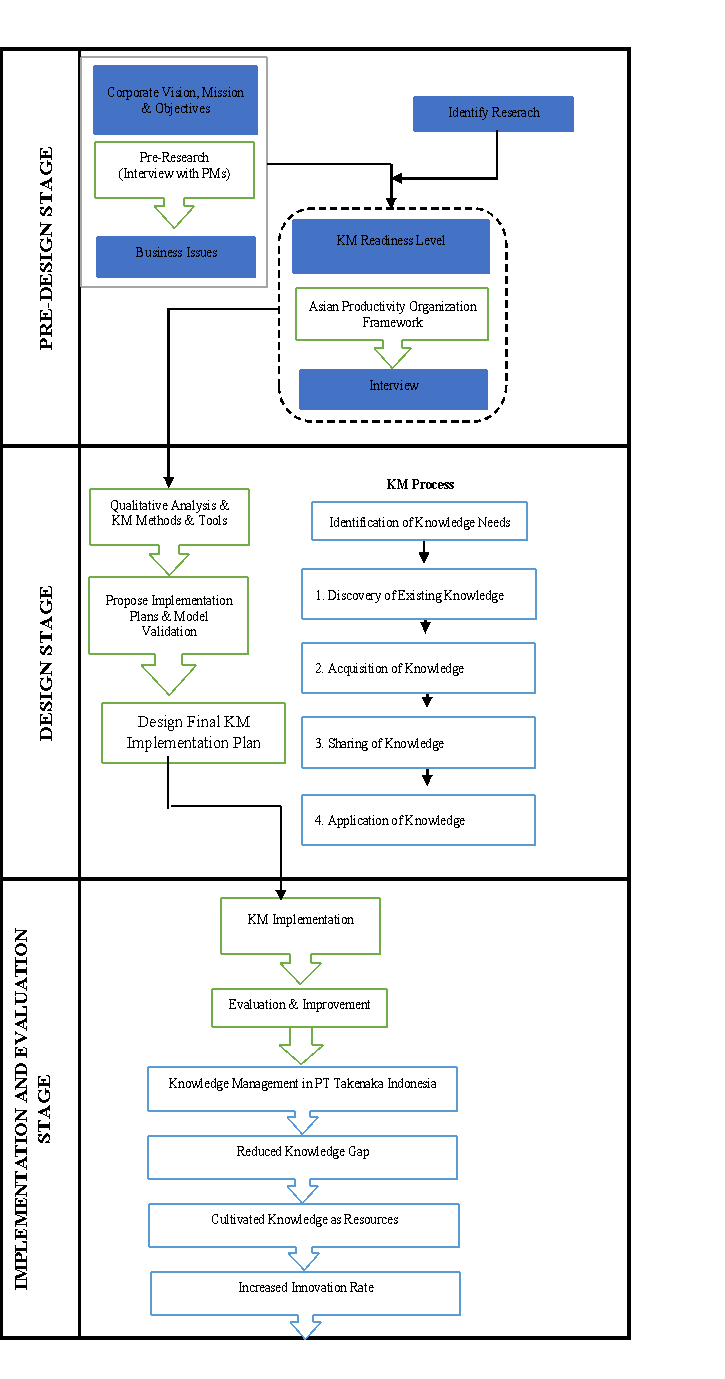
This research aims to address the challenges in managing knowledge and implementing IT tools at PT Takenaka Indonesia, emphasizing the need for a robust knowledge management strategy. The study focuses on understanding the current knowledge management readiness level, identifying gaps for improvement and devising an implementation plan to enhance readiness and drive innovation. The research questions explore the existing readiness level, gaps needing attention, the plan for implementation and the influence of this plan on innovation. Several Research Questions are:
Figure 1: Conceptual Framework
What is the current Knowledge Management (KM) readiness level at PT Takenaka Indonesia?
What are the existing gaps that need attention to enhance the KM's readiness level at PT Takenaka Indonesia?
What is the implementation plan for KM to enhance the readiness level at PT Takenaka Indonesia?
How does the implementation plan for KM influence the increase in the innovation level?
The research objectives encompass measuring the current readiness level of knowledge management (KM) at PT Takenaka Indonesia, identifying gaps, crafting an implementation plan for improvement and exploring possibilities to enhance innovation. The scope of this study targets engineers from specific departments and involves quantitative methods employing questionnaires for data collection and analysis to develop the KM implementation plan. The outcomes hinge on the questionnaire's distribution, aiming to offer an initial overview of KM implementation at PT Takenaka Indonesia, albeit considering the impact of KM on innovation assuming no additional influencing factors.
This research employed semi-structured interviews as a means of data collection, enabling a detailed exploration of specific issues within various departments of PT Takenaka Indonesia. These purposeful conversations, guided by an interview outline, involved open-ended questions allowing both interviewer and interviewee to delve deeply into chosen topics. The study included departments like Site Engineer, Architect, Structure, BIM Engineer, Draftsman, ME Engineer, Construction and Technical Engineer, aiming to gather recommendations and implementation strategies using the APO framework categories.
Data analysis in qualitative research, performed concurrently with data collection, involves non-numeric data collection and subsequent explanations based on data attributes, often utilizing a qualitative scoring system. The KM Assessment used a questionnaire with 42 questions across seven audit categories, scoring practices on a scale from 1 to 5, aiding in evaluating Knowledge Management practices within PT Takenaka Indonesia.
RESULTS
Problem Identification
The study at PT Takenaka Indonesia acknowledges the critical need to leverage knowledge as a resource for sustainable competitive advantage. However, despite adopting Knowledge Management (KM) principles, the outcomes have fallen short of stakeholder expectations. The primary driver for this research lies in the inefficiencies observed in KM readiness. Pre-survey findings reveal pivotal challenges encompassing a lack of IT tool understanding, misalignment with project needs, communication gaps between IT and project teams, resistance to change, limited tool utilization understanding and constraints hindering tool efficiency. These issues hinder the optimal use of IT tools, especially Autodesk BIM. The main focus is the inadequacy of user training and knowledge, a significant barrier to maximizing tool potential. Additional concerns span project-needs understanding, communication gaps, resistance to change, limited tool understanding and usage constraints. These findings underscore a suboptimal KM implementation at PT Takenaka Indonesia, necessitating data collection for pre and post-KM usage evaluation. This aligns with the larger aim of fostering a culture valuing knowledge as a strategic asset for PT Takenaka Indonesia's long-term sustainability.
The pre-survey results, highlight critical issues plaguing PT Takenaka Indonesia’s knowledge management and IT tool implementation. Firstly, a lack of training and user knowledge regarding IT tools, particularly Autodesk BIM, inhibits effective usage. This is compounded by insufficient training and understanding of IT software tools, impeding their effectiveness and a limited grasp of knowledge management tools and practices. Secondly, the disconnect between IT tools and project needs arises from the IT team's inadequate understanding of project requirements.
Communication gaps between the IT and project teams exacerbate this issue, impacting the alignment of IT tools with project needs. Resistance to change in IT tool usage further hampers their effectiveness, necessitating a focus on strategies like kaizen improvement and addressing tacit knowledge. Additionally, limited understanding of IT tool potential and constraints in tool utilization, such as over-reliance on subcontractors, hinder efficiency and require improvements in knowledge sharing and communication among team members to maximize tool capabilities. These findings underscore the complexity and depth of challenges facing PT Takenaka Indonesia in its KM and IT tool implementation endeavors.
Analysis
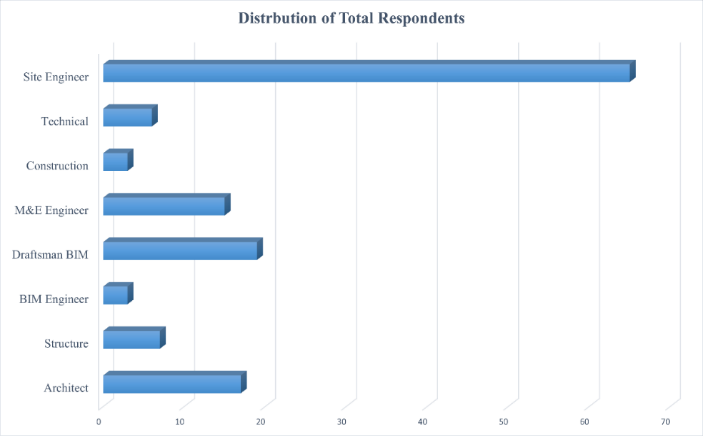
This assessment was taken by 135 employees from a total of 256 employees using Microsoft Forms survey (it fulfilled the minimum 72 sample size criteria). The distribution of respondents explained by Figure 2.
Figure 2: Distribution of respondents
Table 1: APO KM Readiness Level Result in each Category
Category
KM Analysis Assesment
MAX Score
Average Score
Gap
Rank
1.0
KM Leadership
30
23,68
6,32
2
2.0
Process
30
23,42
6,58
3
3.0
People
30
21,8
8,2
7
4.0
Technology
30
24,84
5,16
1
5.0
Knowledge Process
30
22,32
7,68
5
6.0
Learning and Innovation
30
22,02
7,98
6
7.0
KM Outcomes
30
22,53
7,47
4
Total Score
210
160,61
49,39
-
Table 2 KM Maturity Level in PT. Takenaka Indonesia
Level
Describe
Score
Maturity
KM is fully integrated into the organization's operations.
189-210
-
-
-
-
Refinement
KM practices are ongoing to make them better.
-
147-188
-
Expansion
KM is being used in specific areas within the organization.
-
-
126-146
-
Initiation
Organization sees the need for managing knowledge and starts a pilot KM project.
-
-
-
84-125
-
Reaction
Organization is unaware of or not implementing KM in their area.
-
-
-
-
42-83
Table 3 KM Readiness Analysis and OFI for each area
Category
Strengths
Opportunities for Improvement
1.0
KM Leadership
Management leads in the implementation of KM
Management needs more active on implementing KM to the staff
2.0
Process
Implementing knowledge management initiatives
Improvement in Organizational Knowledge internal source (Kaizen improvement,)
3.0
People
Employees are organized into small teams/groups to respond to workplace problems/concerns
Employee can exchange knowledge more frequently and beyond their own unit
4.0
Technology
Promoting automated construction methods
also, coordination across department and enhancing IT usage
It should be developing a dashboard that has proper knowledge management or collaborating tools that facilitate virtual collaboration for project management software, team communication platforms and document sharing tools.
5.0
Knowledge Process
There is a few sharing knowledge from previous employee and documentation
Systematic knowledge processes are in place and are well deployed throughout the company.
Sharing knowledge must be conduct via live action or documentation
6.0
Learning and Innovation
Employees sometimes share ideas about products or processes to improve performance.
A systematic evaluation and improvement process and some organizational learning, including innovation, are in place for improving the efficiency and effectiveness of key processes
7.0
KM Outcomes
Employees can improve quality of product and services
The organization has to inform employees gradually about organizational performance results including some trends that have been sustained over time.
APO KM Readiness Level Assessment Overall Result
From the data above, KM in Takenaka Indonesia is in the Refinement stage, with People as the area that has to be improved the most and Technology as the strongest point of KM in Takenaka Indonesia. This Refinement stage positions the company within a range of scores, according to the KM Maturity Level in Table 2, signifying ongoing efforts to enhance KM practices for better integration into the organization's operations.
According to the previous data, the category People is the area that has room for improvement in Takenaka Indonesia. The Table 3 will describe the KM Readiness Analysis for every area.
The Relation of Process, People and Learning Innovation
Based on the KM Readiness Analysis Table 4, it states that the Process area is closely related to Learning and Innovation. Currently, the strength of the process area lies in implementing Knowledge Management policies, with the area for improvement being the addition of the Kaizen method. The inclusion of the Kaizen method necessitates employees to learn new skills, wherein they are required to share the knowledge they acquire with their fellow colleagues.
The strength of the Learning and Innovation area at PT. Takenaka Indonesia lies in employees occasionally sharing knowledge about their work. This aspect will be more interconnected if management properly implements the Kaizen Method as an improvement in their process area, aiming to achieve effectiveness in both of these areas.
Table 5 regarding the effects of implementing IT tools at PT Takenaka Indonesia. The table explains that the IT tools built within the environment of PT Takenaka Indonesia have not been maximally implemented by users, especially engineers.
The Relations of Knowledge Process and KM Outcomes
The current Knowledge Process at PT. Takenaka Indonesia highlights strengths in knowledge transfer from resigning employees to newcomers, albeit with limited exchanges. However, constraints like restricted time for new employee onboarding and inadequate documentation of existing work hinder this exchange. Addressing these gaps through extensive documentation and streamlining replacement recruitment processes upon employee resignation stands as a critical improvement area. Enacting these enhancements is expected to yield favorable KM outcomes, fostering employees' comprehensive understanding of their roles and tasks, encompassing both products and services. This deeper understanding will empower employees to effectuate numerous improvements in their daily work, consequently driving positive performance impacts for the company. The KM Assessment Level results in Categories 5.0 (Knowledge Process) and 7.0 (KM Outcomes) reflect significant gaps between the current scores and the maximum achievable scores, indicating substantial room for improvement in these areas.
Table 4: KM Assessment Level Result in Improvement Area
Category
KM Analysis Assessment
MAX Score
Average Score
Gap
2.0
Process
30
23,42
6,58
3.0
People
30
21,8
8,2
6.0
Learning and Innovation
30
22,02
7,98
Table 5: Evaluation of the implementation of IT Tools at PT Takenaka Indonesia
Aspect of Evaluation
Before Implementation of IT Tools (2019 -2021)
After Implementation of IT Tools (2022 - 2023)
People
Understanding and Training
Lack of adequate understanding and training
Improvement in training and understanding of software is ongoing, but not significant yet.
Sub-Contractor Usage
Usage of sub-contractors for some work
Reduction system regarding the usage of sub-contractors in work is being implemented
Process
Project Integration
No integration between IT Tools and project needs
Initiation of integration between IT Tools and project needs has begun
Table 6: KM Assessment Level Result in Category 5.0 and 7.0
Category
KM Analysis Assessment
MAX Score
Average Score
Gap
5.0
Knowledge Process
30
22,32
7,68
7.0
KM Outcomes
30
22,53
7,47
Table 7: KM Assessment Level Result in Category 1.0 and 4.0
Category
KM Analysis Assessment
MAX Score
Average Score
Gap
1.0
KM Leadership
30
23,68
6,32
4.0
Technology
30
24,84
5,16
Table 8: Implementation of IT Tools in KM Technology Category
Aspect of Evaluation
Before Implementation of IT Tools (2019 - 2021)
After Implementation of IT Tools (2022 - 2023)
Technology
Software usage
Limited to one department, which is the design department
Increased with an expansion of usage in 3 departments (design department, construction department and MandE department)
Table 9: 17 KM Readiness Criteria by Urgency Sequence
Category
KM Analysis Assessment
MAX Score
Average Score
Gap
Urgency Sequence
1.0
KM Leadership
30
23,68
6,32
6
2.0
Process
30
23,42
6,58
5
3.0
People
30
21,8
8,2
1
4.0
Technology
30
24,84
5,16
7
5.0
Knowledge Process
30
22,32
7,68
3
6.0
Learning and Innovation
30
22,02
7,98
2
7.0
KM Outcomes
30
22,53
7,47
4
Total Score
210
160,61
49,39
The Relations of Leadership and Technology
The Leadership area in the KM Readiness Analysis mentions that the management has initiated the implementation of KM in each department, particularly in the IT department, which facilitates software to streamline and expedite existing work. However, there is an issue where many employees are not using this software. Therefore, it’s appropriate for the management to delve deeper into this matter and identify the root cause of the problem. The management should also make improvements to the software to make it more user-friendly for non-technical users, simpler and certainly easier for employees to use, including in project areas.
From the table above, it can be seen that before and after the implementation of IT tools at PT Takenaka Indonesia, there is a quite significant improvement, indicating that the technology is easily accepted by the employees.
Sequence of KM Readiness Level Category Urgency
The entire KM is reorganized based on the previously calculated results for each component with the same assessment score. This sequence is then used to determine the urgency level of handling for each level of the KM readiness criteria category at PT Takenaka Indonesia.
Based on the table above, it can be seen that the People category ranks first in need of improvement in this Knowledge Management chain, followed by the Learning and Innovation category.
Developing OFI as Business Solutions
Many business solutions can be developed based on the findings of OFI to generate implementation solutions. However, the researcher can conclude from interview data and a summary of OFIs that the following crucial issues need to be addressed as key points in developing business solutions to reduce the gap in learning and innovation and human resources. Three crucial points are emphasized:
Balanced Reward and Correction Systems: There's a need for a fairer balance between acknowledging employee successes and addressing failures. Lack of recognition for achievements and excessive focus on punishing failures hinders innovation. Implementing effective reward and correction systems could stimulate innovation by motivating employees
RASCI methodological approach can be utilized to develop a competency matrix for roles based on user inputs from relevant departments through discussions and agreements among the concerned management. The job competency matrix should then be distributed among employees and labor unions. A clear role competency matrix will help employees improve themselves and understand their rights and obligations. Clarity in this regard will motivate employees and, ultimately, potentially increase the innovation rate
Employee career development programs need to be established and disseminated by the company as soon as possible so that each employee has a career trajectory. Career development programs can be adjusted to fit each department's organizational structure and climate. Career development through programs will be more effective if achieved through an experimental proportion of 70% (through daily work), 20% relationship-based (through coaching, mentoring and tutoring) and 10% education-based (through formal educational background). Career development programs are ultimately closely related to changes in organizational structure, the availability of company resources and more. Hence, monitoring and evaluation are necessary in career development programs to ensure they remain updated, adaptable and can cope with dynamic changes. The POAC approach might be used to develop career development programs
To enhance employee performance, it's crucial to focus on career development. The emergence of employee creativity, crucial for innovation, can be facilitated through career development, which also impacts worker productivity. Employees are mandated to make their best contributions through career development programs, contributing innovative ideas beneficial to the business. Clarity in this regard might play a role in potentially increasing the rate of innovation.
Developing KM Methods and Tools as Business Solutions
Apart from using OFI as an effort to reduce the gaps, there's a need for a process model to address these gaps by developing knowledge management. Aligning it with the APO five-step knowledge management process is imperative. The Five-Step KM Process is associated with five crucial steps:
Identifying knowledge
Creating knowledge
Storing knowledge
Sharing knowledge
Applying knowledge
As a first step, identifying these five steps we want to address within the KM implementation initiative, a list of KM methods and tools to be considered for implementation based on best KM practices needs to be developed.
Communities of Practices (COPs)
A Community of Practice (CoP) brings together individuals with a shared interest to improve their skills through regular interaction. These groups, whether planned or arising naturally, aim to share and develop common expertise among employees.
Knowledge Management Communities of Practice (KM CoPs) vary in scope, spanning from a single division to multiple departments within an organization or even bridging across several organizations, depending on their objectives. Typically, they aim to share and cultivate collective skills and knowledge. Some prioritize creating new knowledge and fostering innovation. CoPs can comprise a few members to thousands, with expertise among members being similar or diverse. Three crucial elements are considered when designing CoPs.
Domain: CoPs aren't merely social groups; they're defined by a shared interest or expertise. Membership involves a commitment to this domain, fostering a unique collective competence among members. Although this expertise might not be recognized beyond the community, members value their shared competence and learn from each other regardless of external acknowledgment
Community: Members within a CoP engage in shared activities, discussions, mutual aid and knowledge sharing within their domain. Trust-based relationships form the foundation, necessitating a platform for interactions that encourage frequent engagement and collective development
Practice: Unlike casual interest groups, CoPs consist of practitioners who develop shared resources and practices. These include experiences, tools, stories and solutions to common issues. Building these shared practices requires ongoing interaction and time investment among members
The combination of these three elements forms a practice community. By developing these elements in parallel, a CoP can be cultivated. CoPs can be non-IT or IT-based, depending on where their members reside.
Since a CoP is essentially a gathering of people, it's crucial for participants to remain energized. However, communities cannot be forced to engage actively and active communities cannot be artificially designed. In practice, the most common reason for CoP failure is a lack of energy to attract and maintain active participation. Many successful CoPs nurture activity seeds through intricate and flexible design, even though CoPs themselves are spontaneous and organic.
The following steps outline the basic principles for designing and sustaining an active CoP.
Find Opportunities Around Strong Needs
CoPs usually function well when there's a strong need to share common interests, skills, or knowledge. Identifying such opportunities, like common technological skills among maintenance engineers or shared experiences in machinery design, is crucial. Defining this initial domain will attract like-minded individuals with parallel needs, fostering a vibrant CoP focused on meaningful knowledge sharing.
Invite enthusiastic individuals and consider their input
To design an effective CoP, key individuals (two or three people are sufficient to begin) are needed to act as stewards of the CoP. They are typically highly passionate (often well-versed) about the primary focus of the CoP. The design of the CoP is discussed with them, with a focus on:
What is the strategic context of CoP?
What is the key knowledge that should be shared and created?
Who are the potential participants benefiting from and contributing to CoP?
What are the main activities that will sustain the strength of CoP?
Where can community members interact physically (and virtually)?
What are the core values for both the organization and the participants?
Launching the CoP with a socializing event
The inception of any CoP always begins with social connections. If participants do not develop a sense of trust among themselves, the CoP won't progress, even if there's a shared reason for knowledge exchange. One easy way is by utilizing existing social networks, often forming the core group of the CoP and expanding it through face-to-face meetings.
Create outcomes through activities and storytelling
Following the CoP launch, essential activities are needed to sustain enthusiasm and deliver outcomes for the community.
The success of Communities of Practice (CoPs) hinges on three core elements: domain, community and activities. Several supporting factors contribute to their effectiveness:
Stewards: Key individuals passionate about the subject matter and committed to managing the CoP are essential. They serve as linchpins for CoP success
Incentives: Genuine motivation, driven by factors like problem-solving, growth opportunities, or intellectual satisfaction, sustains active participation. Monetary incentives are typically unnecessary
Physical/Virtual Space: CoPs, being social entities, require spaces for interaction. These spaces can be physical or virtual, fostering trust-based human relationships essential for CoP vitality
Information Technology: While not mandatory for all CoPs, some heavily rely on IT for knowledge sharing and activities, aligned with the CoP's domain, community and activities
Management Support
Strong strategic alignment with organizational goals necessitates management support. However, excessive control can stifle motivation. Optimal support involves backing CoP activities while allowing autonomy for members.
CONCLUSION
In conclusion, the KM readiness level at PT Takenaka Indonesia presently indicates a commendable execution at 160.61, falling within the 'Refinement' category. However, there remain areas necessitating improvement. Notably, the 'People' category displays a lower score, signaling a crucial need for employee development to ensure successful KM implementation and prevent potential declines in company performance. Elevating KM readiness involves adopting the kaizen method, initiating small yet impactful changes across divisions, ultimately leading to organizational transformation. Anticipated gradual integration of KM is expected to fuel increased innovation, commencing with initiatives like fostering curiosity and encouraging questioning among employees. To bridge the gap in learning, innovation and human management, implementation of OFI findings alongside a process model aligned with the APO knowledge management process proves essential. Moreover, establishing a Community of Practice (COP) could provide a platform for employees to exchange experiences and knowledge, fostering an environment conducive to enhancing performance through shared insights and collaboration.
REFERENCES
Wiig, K. (1995). Knowledge Management Methods: Practical Approaches to Managing Knowledge (3rd ed.). Schema Press.
Wati, R. and Indrajit, R. E. (2021). Knowledge Management - Mengintegrasikan Perangkat Digital dalam Rencana Pembelajaran di Kelas Online (M. Kika (ed.); 1st ed.). Andi Offset.
Kumar, S. et al. Top management knowledge value, knowledge sharing practices, open innovation and organizational performance. Journal of Business Research, 128(3), 788–798. https://doi.org/10.1016/j.jbusres.2019.04.040
Shehabat, I. (2020). The Role of Knowledge Management in Organizational Performance and Gaining Sustainable Competitive Advantage. ASSE - Asia Service Sciences and Software Engineering Conference. https://doi.org/10.1145/3399871.3399878
Arrau, G. P. (2015). Knowledge management in the context of developing countries: The case of Chile. Proceedings of the European Conference on Knowledge Management, ECKM, 0(September 2015), 1011–1016.
Mahdi, O. R. et al. Knowledge management processes and sustainable competitive advantage: An empirical examination in private universities. Journal of Business Research, 94, 320–334. https://doi.org/10.1016/j.jbusres.2018.02.013
Girard, J. et al. Defining knowledge management: Toward an applied compendium. Online Journal of Applied Knowledge Management, 3(June 2015), 1–20.
Orishede, F. and Ndudi, F. (2020). Flexible Work Arrangement and Employee Performance: A Review. Journal of Resources and Economic Development, 3(1), 56–62. https://www.researchgate.net/publication/354682319
License
Creative Commons Attribution-NonCommercial-NoDerivatives 4.0 International License
All papers should be submitted electronically. All submitted manuscripts must be original work that is not under submission at another journal or under consideration for publication in another form, such as a monograph or chapter of a book. Authors of submitted papers are obligated not to submit their paper for publication elsewhere until an editorial decision is rendered on their submission. Further, authors of accepted papers are prohibited from publishing the results in other publications that appear before the paper is published in the Journal unless they receive approval for doing so from the Editor-In-Chief.
Himalayan Journal of Economics and Business Management open access articles are licensed under a Creative Commons Attribution-Share A like 4.0 International License. This license lets the audience to give appropriate credit, provide a link to the license, and indicate if changes were made and if they remix, transform, or build upon the material, they must distribute contributions under the same license as the original.
Advertisement
Recommended Articles
Research Article
Modelling Structure Job Quality, Job Design and Job Satisfaction
Moch Nurhadi,
...
Avi Sunani
Published: 30/08/2022
Download PDF
Cite
x
APA
Nurhadi, M., Bisyri Effendi, M., Saiful Ulum, A. & Sunani, A. (2022). Modelling Structure Job Quality, Job Design and Job Satisfaction. Himalayan Journal of Economics and Business Management, 3(2), 1-4.
MLA
Nurhadi, Moch, et al. "Modelling Structure Job Quality, Job Design and Job Satisfaction." Himalayan Journal of Economics and Business Management 3.2 (2022): 1-4.
Chicago
Nurhadi, Moch, Moch Bisyri Effendi, Achmad Saiful Ulum and Avi Sunani. "Modelling Structure Job Quality, Job Design and Job Satisfaction." Himalayan Journal of Economics and Business Management 3, no. 2 (2022): 1-4.
Harvard
Nurhadi, M., Bisyri Effendi, M., Saiful Ulum, A. and Sunani, A. (2022) 'Modelling Structure Job Quality, Job Design and Job Satisfaction' Himalayan Journal of Economics and Business Management 3(2), pp. 1-4.
Vancouver
Nurhadi M, Bisyri Effendi M, Saiful Ulum A, Sunani A. Modelling Structure Job Quality, Job Design and Job Satisfaction. Himalayan Journal of Economics and Business Management. 2022 Jul;3(2):1-4.
Download PDF
Research Article
Accountability and Transparency of Village Fund Management in Lumajang District
Nurina Ayuningtiyas,
...
Muhammad Miqdad
Published: 28/12/2023
Download PDF
Cite
x
APA
Ayuningtiyas, N., Santosa Putra, H. & Miqdad, M. (2023). Accountability and Transparency of Village Fund Management in Lumajang District. Himalayan Journal of Economics and Business Management, 4(2), 1-4.
MLA
Ayuningtiyas, Nurina, Hendrawan Santosa Putra and Muhammad Miqdad. "Accountability and Transparency of Village Fund Management in Lumajang District." Himalayan Journal of Economics and Business Management 4.2 (2023): 1-4.
Chicago
Ayuningtiyas, Nurina, Hendrawan Santosa Putra and Muhammad Miqdad. "Accountability and Transparency of Village Fund Management in Lumajang District." Himalayan Journal of Economics and Business Management 4, no. 2 (2023): 1-4.
Harvard
Ayuningtiyas, N., Santosa Putra, H. and Miqdad, M. (2023) 'Accountability and Transparency of Village Fund Management in Lumajang District' Himalayan Journal of Economics and Business Management 4(2), pp. 1-4.
Vancouver
Ayuningtiyas N, Santosa Putra H, Miqdad M. Accountability and Transparency of Village Fund Management in Lumajang District. Himalayan Journal of Economics and Business Management. 2023 Jul;4(2):1-4.
Download PDF
Research Article
Proposed Digital Marketing Strategy to Enhance Engineering Consultancy Company Revenue
Alfarisy, K. A.,
Wandebori, H.
Published: 30/04/2024
Download PDF
Cite
x
APA
K. A., A. & H., W. (2024). Proposed Digital Marketing Strategy to Enhance Engineering Consultancy Company Revenue. Himalayan Journal of Economics and Business Management, 5(1), 1-18.
MLA
K. A., Alfarisy, and Wandebori, H.. "Proposed Digital Marketing Strategy to Enhance Engineering Consultancy Company Revenue." Himalayan Journal of Economics and Business Management 5.1 (2024): 1-18.
Chicago
K. A., Alfarisy, and Wandebori, H.. "Proposed Digital Marketing Strategy to Enhance Engineering Consultancy Company Revenue." Himalayan Journal of Economics and Business Management 5, no. 1 (2024): 1-18.
Harvard
K. A., A. and H., W. (2024) 'Proposed Digital Marketing Strategy to Enhance Engineering Consultancy Company Revenue' Himalayan Journal of Economics and Business Management 5(1), pp. 1-18.
Vancouver
K. A. A, H. W. Proposed Digital Marketing Strategy to Enhance Engineering Consultancy Company Revenue. Himalayan Journal of Economics and Business Management. 2024 Jan;5(1):1-18.
Download PDF
Research Article
The Constitutional and Legislative Basis for Considering the Taxable Capacity of Taxpayers in Iraqi Tax Legislation
Hussein Kamel Wadaa
Published: 05/05/2025
Download PDF
Cite
x
APA
Wadaa, H. K. (2025). The Constitutional and Legislative Basis for Considering the Taxable Capacity of Taxpayers in Iraqi Tax Legislation. Himalayan Journal of Economics and Business Management, 6(1), 1-10.
MLA
Wadaa, Hussein Kamel. "The Constitutional and Legislative Basis for Considering the Taxable Capacity of Taxpayers in Iraqi Tax Legislation." Himalayan Journal of Economics and Business Management 6.1 (2025): 1-10.
Chicago
Wadaa, Hussein Kamel. "The Constitutional and Legislative Basis for Considering the Taxable Capacity of Taxpayers in Iraqi Tax Legislation." Himalayan Journal of Economics and Business Management 6, no. 1 (2025): 1-10.
Harvard
Wadaa, H. K. (2025) 'The Constitutional and Legislative Basis for Considering the Taxable Capacity of Taxpayers in Iraqi Tax Legislation' Himalayan Journal of Economics and Business Management 6(1), pp. 1-10.
Vancouver
Wadaa HK. The Constitutional and Legislative Basis for Considering the Taxable Capacity of Taxpayers in Iraqi Tax Legislation. Himalayan Journal of Economics and Business Management. 2025 Jan;6(1):1-10.
Maulida, A. & Ghazali, A. (2024). Implementation Of Knowledge Management to Increase Company Performance, Case Study: The Engineers in Construction Department – Design Department and MandE Department. Himalayan Journal of Economics and Business Management, 5(1), 1-7.
MLA
Maulida, Adinda and Achmad Ghazali. "Implementation Of Knowledge Management to Increase Company Performance, Case Study: The Engineers in Construction Department – Design Department and MandE Department." Himalayan Journal of Economics and Business Management 5.1 (2024): 1-7.
Chicago
Maulida, Adinda and Achmad Ghazali. "Implementation Of Knowledge Management to Increase Company Performance, Case Study: The Engineers in Construction Department – Design Department and MandE Department." Himalayan Journal of Economics and Business Management 5, no. 1 (2024): 1-7.
Harvard
Maulida, A. and Ghazali, A. (2024) 'Implementation Of Knowledge Management to Increase Company Performance, Case Study: The Engineers in Construction Department – Design Department and MandE Department' Himalayan Journal of Economics and Business Management 5(1), pp. 1-7.
Vancouver
Maulida A, Ghazali A. Implementation Of Knowledge Management to Increase Company Performance, Case Study: The Engineers in Construction Department – Design Department and MandE Department. Himalayan Journal of Economics and Business Management. 2024 Jan;5(1):1-7.



 Download PDF
 Download XML