The Impact of Total Quality Environmental Management on Achieving Environmental Sustainability: An Analytical Study of Badr Residential Complex-Baghdad
Aaisha Hamoudi Hasham
1
,
Diala Dhouib Karray
1
1
Faculty of Economic Science and Management, University of Sfax, Iraq
This research aims to examine the impact of ISO 14001 Total Quality Environmental Management on achieving environmental sustainability. It is an analytical study conducted in the Badr Residential Project-Baghdad, focusing on the owners of VIP units and economic units within the Badr Residential Complex. To achieve the research objective, the main research problem was formulated as: How can environmental sustainable development be achieved through the application of ISO 14001 Total Quality Environmental Management requirements? The study employed a comparative analytical approach targeting a purposive sample from senior management levels (owners of VIP and economic units). The total population size was 650 individuals and the questionnaire was distributed to a sample of 242 according to the "D. Morgan" formula, resulting in 237 valid responses for statistical analysis from the Badr Residential Complex. The questionnaire served as the primary tool for data collection. The SPSS software version 24 was used to analyze the data and test the research hypotheses. The study revealed several results, most notably the significant impact of ISO 14001 Total Quality Environmental Management requirements in achieving environmental sustainability. The study also confirmed that senior management in the residential complex perceives the benefits and advantages of implementing the total quality environmental management system to achieve sustainability in the housing units.
Keywords
Total Quality Environmental Management
Environmental Sustainability
INTRODUCTION
Total Quality Management (TQM) and environmental sustainability are among the most important intellectual concepts that have gained significant attention from researchers and thinkers in the fields of management and continuous improvement of production and service performance in various institutions. Like other management concepts, opinions on these vary according to each researcher's perspective and approach. However, this difference mainly revolves around the goal that the company seeks to achieve, which is customer satisfaction through the interaction of all activities within projects and institutions.
The focus is on the method of TQM, its principles and the diversity of its application areas, as well as the successes achieved by ISO standards. The emphasis is on enhancing quality and its relationship to management, highlighted by the International Organization for Standardization’s issuance of the ISO 14001 series. This standard introduced the concept of total quality environmental management, which aims to balance environmental protection with economic success, provided that it aligns with established environmental policies and objectives.
Environmental management standards do not independently set environmental performance criteria; rather, they require organizations and institutions to establish policies and goals that consider all environmental impacts, laws and regulations. Total Quality Management thus becomes a necessity for institutions and countries seeking to survive and sustain their existence.
RESEARCH METHODOLOGY
Research Problem
The research problem represents a real need perceived by the researcher and discussed through logical reasons that outline the features of the problem. Some of these reasons are discussed in the previous literature, which forms the knowledge background from which the research problem should be approached. This section aims to clarify the idea of the topic, the motivations for choosing it and the justifications for undertaking it.
The current era witnesses tremendous development in sustainable development, especially environmental sustainability. In light of the rapid environmental developments worldwide, the environmental reality has imposed the need to develop a new set of environmental requirements to preserve the environment, among which the requirements of Total Quality Environmental Management are essential. Therefore, Total Quality Management has become one of the most important and central factors for achieving success and competitive excellence for housing projects, companies and various sectors.
Based on the above, the researcher formulates the research problem through the following main question:
What is the impact of Total Quality Environmental Management on achieving environmental sustainability?
Research Objective
The objective is to identify the level of awareness of Total Quality Environmental Management and its impact on environmental sustainability on one hand and its impact on society on the other. The study aims to highlight the cognitive and analytical aspects, as well as discuss the philosophical content and modern academic methodologies related to the research variables (Total Quality Environmental Management and Environmental Sustainability). It also seeks to determine the degree of the relationship between the main research variables, help understand the nature of the requirements of Total Quality Environmental Management in the Badr Residential Complex, assess the environmental sustainability level and test the correlation and impact relationship between them.
Research Hypothesis
The research is based on the following hypothesis:
There is a statistically significant correlation and impact relationship between the requirements of Total Quality Environmental Management and environmental sustainability
Research Model
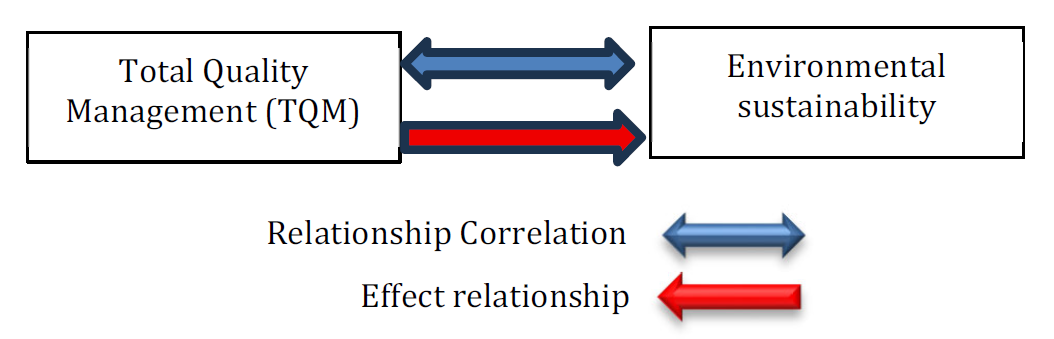
Based on the views of several researchers in previous studies that examine the independent variable (Total Quality Management) and its effects on the dependent variable (Environmental Sustainability), as illustrated in Figure 1.
Theoretical Review
Concept of Total Quality Environmental Management ISO 14001: In 1992, the Global Environmental Management Initiative (GEMI) introduced a management concept known as Total Quality Environmental Management (TQEM) to the business world. This concept combines the principles of Total Quality Management, as adopted by management expert Dr. W. Edwards Deming, with environmental management objectives. GEMI commits to Total Quality Environmental Management as it focuses on the continuous improvement of a company’s environmental activities. Within this commitment, the initiative provides guidelines on TQEM concepts and forms a forum for their exchange. The secret to the proper implementation of Total Quality Environmental Management lies in the harmonious integration of all components of this system so that they work together to achieve the desired goals [1].
The concept of Total Quality Environmental Management emerged in 1990 when the Global Environmental Management Institute gathered more than 20 major companies in the United States with the aim of adopting the TQEM concept [2]. The concept of Total Quality Management is considered the backbone of organizational management for continuous improvement, as it is one of the best methods that allow for ongoing and sustainable development to achieve environmental sustainability and improve environmental performance.
Total Quality Environmental Management has been defined in several ways, including as an organized and holistic approach used to develop the environmental performance of an organization through the implementation of total quality management and environmental practices aimed at solving general environmental problems [3]. It is the system that combines two sub-systems: Total Quality Management and Environmental Management through their administrative approaches [4]. Khanna et al. [5] defined Total Quality Environmental Management as the application of environmental management principles within the total quality management concept, which focuses on prevention by detecting and reducing defects and improving quality in all aspects of the manufacturing process. This system can be applied to prevent pollution problems within the framework of total quality environmental management, considering pollution as a defect that should be continuously reduced by developing products and processes that minimize waste generation at the source.
Ansari et al. [4] stated that it is a system designed to create more environmentally sustainable products by adopting processes that improve the environmental performance of the organization. Rashan and Abdul Razzaq [6] noted that it is an approach for continuous improvement aiming to integrate total quality management and environmental systems for organizational processes with comprehensive contributions from various levels by reducing or limiting waste and pollution in various forms. This definition emphasizes preventing pollution problems at their source and reducing waste generation.
Figure 1: The Research Hypothetical Model
Importance of Total Quality Environmental Management The importance of the Total Quality Environmental Management (TQEM) system can be presented through the following points [7]:
Achieving better control over the environmental impacts that may affect the activities of the organization by combining the principles of total quality management and environmental management to improve the organization's environmental performance and contribute to sustainable development. This is due to increasing environmental and societal pressures. Organizations adopting the TQEM system seek to become environmentally responsible by involving stakeholders such as customers, employees and the community in environmental issues, thereby achieving environmental efficiency [2]
Organizations can avoid penalties and fines that may be imposed if TQEM is not implemented
Business organizations comply with environmental laws and regulations and pay attention to environmental impacts, enabling the organization to prevent pollution
Objectives of Total Quality Environmental Management TQEM is a priority in global agendas. In today's competitive environment, environmental commitment is crucial. There is a global agreement to reduce pollutants such as greenhouse gases, which integrates the generation of benign energy in production processes. Organizations plan, implement and monitor activities linked to their goals accordingly. Opinions differ regarding the objectives of TQEM, which include improving environmental performance, cost savings, ensuring environmental compliance, enhancing the organization's overall image, improving environmental management documentation, reducing damages and pollution, increasing awareness and motivating environmental responsibility [8].
Requirements of Total Quality Environmental Management Comprehensive environmental management has emphasized improving quality's relationship with environmental management due to recent developments in integrating TQM with environmental management. Environmental management has gone through stages similar to quality management, initially relying on post-pollution inspection, which made responsive treatment the priority. This led to treating environmental issues as technical topics requiring separate departments, staff, procedures and policies [9]. Specific requirements for TQEM exist in projects and service and industrial organizations, especially in residential complexes. The dimensions selected to suit the current research include: senior management commitment [10], customer focus [11], continuous improvement [12] and teamwork [13].
Concept of Environmental Sustainability
Sustainable development and environmental sustainability have entered the international political agenda, focusing on systemic changes underpinning social and productive development regionally and globally within the environment's capacity to absorb human impacts without compromising the needs of future generations or resources [14]. Environmental sustainability can be defined via two axes: Outputs-ability to contain waste and emissions from activities and inputs-controlling and measuring resource and energy inputs to regulate outputs [15]. Morelli [16] defined environmental sustainability as the balance and interconnected resilience enabling human society to meet needs without exceeding ecosystem capacity and ensuring the continual renewal of necessary services. Cai et al. [17] defined it as the ability to minimize negative effects and maximize positive effects of human behavior and the environment through designing, producing, applying, operating and disposing of products in environmentally non-harmful ways.
Importance of Environmental Sustainability
Environmental sustainability links economic growth with environmental protection, meaning investment in resource provision and preserving natural capital while benefiting from sustainable production techniques and financial gains. Environmental protection plays a major role in achieving business sustainability. Sustainability requires a long-term perspective considering business system evolution, flexibility, adaptability, ongoing local and global condition awareness and respect for nature and biodiversity [18]. It also involves respecting human capacity to manage natural resources responsibly to improve life for all societal groups by regulating human activities and environmental elements, avoiding harm, raising environmental awareness, fostering individual responsibility toward the environment and ensuring environmental planning's integration in all developmental planning stages for responsible and conscious natural resource use without depletion or destruction [19].
Objectives of Environmental Sustainability
Many intertwined and varied objectives exist for environmental sustainability, including achieving better living standards, protecting and exploiting natural environments, rational use and exploitation of resources, linking modern technology with societal goals and continuously adjusting society’s needs and priorities [20].
Dimensions of Environmental Sustainability
The sustainability concept arose from poor environmental management and its reflection on health and productivity. It focuses on achieving ecological balance and preserving the environment, both natural and built. For better understanding, sustainability’s interconnected dimensions are divided into three:
Environmental dimension: Avoiding infringement on vital surrounding resources, meaning the environment’s ability to absorb human disturbances without degradation [21]
Social dimension: Companies’ social responsibility role covering voluntary or discretionary relationships with environmental and community stakeholders [22]
Economic dimension: Concerning economic structure issues such as per capita GDP share, investment share in GDP and debt share. Developed countries have achieved significant results in using renewable energy sources [23]
Practical Aspect
Questionnaire Validity Test: Table 1 shows the validity and reliability values of the questionnaire components. The questionnaire represents one of the important statistical tools for data collection, consisting of a specific set of questions aimed at collecting the data required for the study and investigation. The total number of questionnaire items is 36 and the overall reliability coefficient reached 0.891, reflecting a very strong internal consistency at the questionnaire level as a whole. The overall validity coefficient reached 0.944, indicating the questionnaire's accuracy in measuring the targeted concepts generally. The high values of reliability and validity coefficients confirm that the questionnaire enjoys a high level of reliability and accuracy in measuring the concerned variables.
Table 1: Reliability and Validity
Main Variable
Reliability
Number of Items
Validity
Number of Dimensions
Total Quality Environmental Management
0.806
21
0.898
4
Environmental Sustainability
0.793
15
0.891
3
Total Items
0.891
36
0.944
-
Source: Prepared by the researcher
Normality Test
Table 2 presents the results of the normality test for the research variables using Kolmogorov-Smirnov and Shapiro-Wilk tests:
Total Quality Environmental Management: In the Kolmogorov-Smirnov test, the test statistic value was (0.086) with 237 observations and a significance level of (0.073). Since the significance level is greater than (0.05), this indicates that the data follows a normal distribution. In the Shapiro-Wilk test, the test statistic was (0.991) with a significance of (0.085), which is also greater than (0.05), meaning the data for Total Quality Environmental Management follows the normal distribution
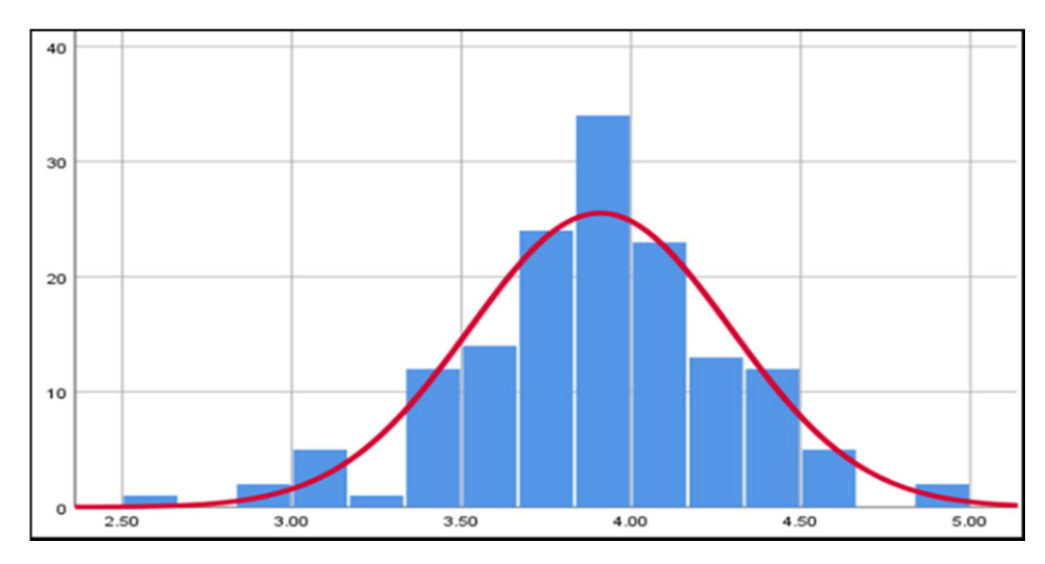
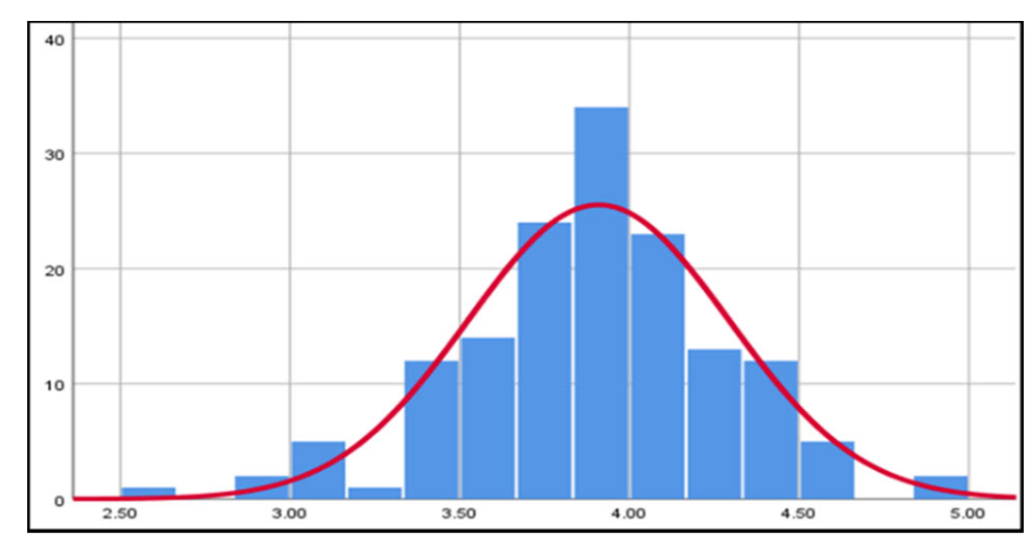
Environmental Sustainability: In the Kolmogorov-Smirnov test, the test statistic was (0.091) with 237 observations and a significance of (0.067), which is greater than (0.05), indicating the data follows a normal distribution. In the Shapiro-Wilk test, the test statistic was (0.88) with a significance of (0.091), also greater than (0.05), indicating that the data for Environmental Sustainability follows the normal distribution It is clear from the above that all variables (Total Quality Environmental Management and Environmental Sustainability) follow the normal distribution according to the results of both tests, as the significance values for all variables are greater than 0.05, as shown in Table 2 and Figure 2 and 3.
Table 2: Normality Test for Study Variables
Variables
Kolmogorov-Smirnov
Shapiro-Wilk
Test Statistic
N
Test Statistic
N
Total Quality Environmental Management
0.086
237
0.991
237
Environmental Sustainability
0.091
237
0.880
237
Source: Prepared by the researcher
Figure 2: Distribution of Data for the Variable Total Quality Environmental Management
Figure 3: Distribution of Data for the Variable Environmental Sustainability
Test of Correlation Between Variables
Correlation is a statistical measure used to determine the strength and direction of the relationship between variables. It is usually expressed by a correlation coefficient, such as Pearson's coefficient, which ranges between -1 and 1. A value of -1 indicates a perfect negative relationship (when one variable increases, the other decreases), while a value of 1 indicates a perfect positive relationship (when one variable increases, the other also increases).
The relationship between the two variables indicates a statistically significant association between Total Quality Environmental Management and achieving Environmental Sustainability. Table 3 shows the correlation values, which indicate the following: The analysis results show a strong positive direct relationship between [Total Quality Environmental Management] and [Environmental Sustainability], with a correlation coefficient of (0.752**). This means that increasing reliance on Total Quality Environmental Management leads to an increase in Environmental Sustainability in the residential complex. The probability value was (0.000), indicating that this relationship is significant at the 99% confidence level. Despite the sample size of 237 participants, the results are statistically significant, which suggests the need for the residential complex to enhance its capabilities in Total Quality Environmental Management to further improve Environmental Sustainability.
Table 3: Correlation Coefficient Values Between Total Quality Environmental Management and Environmental Sustainability
Variable
Indicator
Environmental Sustainability Variable
Total Quality Environmental Management
Correlation Coefficient
0.752**
Probability Value
0.000
Sample Size
237
Source: Prepared by the researcher
Test of the Impact Relationship Between Variables
The impact of Total Quality Environmental Management on Environmental Sustainability
The results of the impact test showed that the constant (α) value was (1.014), indicating the minimum value reached by the variable Total Quality Environmental Management (Table 4). The marginal slope (β) was (0.729), indicating the positive impact of Total Quality Environmental Management on Environmental Sustainability. The coefficient of determination (R²) was (0.486), indicating that 49% of the variance in Environmental Sustainability can be explained by Total Quality Environmental Management, while the remaining 51% is due to other factors not included in the research model. The F-test value reached (221.993) with a probability value of (0.000), which is less than the significance level (0.05), indicating a strong significant impact of Total Quality Environmental Management on Environmental Sustainability.
Table 4: Impact of Total Quality Environmental Management on Environmental Sustainability
Dependent Variable
Sig.
F
Beta
R
R²
Sig.
T
β
Environmental Sustainability
0.000b
221.993
0.697
0.697
0.486
0.000
5.677
1.014a
Independent Variable
-
-
-
-
-
-
14.899
0.729b
Total Quality Environmental Management
-
-
-
-
-
-
-
-
CONCLUSION AND RECOMMENDATIONS
Conclusions
Based on the theoretical literature discussed and the practical side analysis and the hypothesis testing of the main variables (Total Quality Environmental Management and Environmental Sustainability), the following are the main conclusions reached by the current study:
There is a high awareness among senior management in the residential project (Badr Complex) about the benefits of implementing a Total Quality Environmental Management system. Those responsible for the project are concerned with the quality of work and services provided to residents in the housing units
The management of the residential complex studies customer requirements, including delivery and after-sales service, through consultations between the project owners and customers regarding key handover, installments and the financial and legal requirements needed by both the residential project management and customers during the unit handover
Environmental quality in the complex is determined based on the preferences of internal and external customers through ongoing efforts between project management and sales management, considering customer preferences according to predetermined specifications and design, such as modifying materials or interior design to meet customer needs at mutually agreed costs
Senior management continuously implements improvements in the residential complex, including skill development for sales, inquiries, maintenance staff and customer service to enhance the project's image. They also attempt to improve housing unit models by enhancing designs and avoiding flaws found in previous models
Environmental performance improvement processes by management involve continuous enhancement of all project operations, including materials, design, construction processes and green spaces, as well as eco-friendly power stations and providing diverse services to customers
Problems in the project (residential complex) are effectively addressed through teamwork and the participation of all employees. Issues faced by management, project owners, sales department or residents are managed by specialized committees
aimed at avoiding losses or damage. Senior management supports teamwork and authorizes employees to solve problems they encounter on the job
Recommendations
In light of the conclusions obtained from the study results, the main recommendations to enhance and strengthen the role of Total Quality Environmental Management in achieving environmental sustainability are as follows:
Enhance senior management awareness in the residential project (Badr Complex) about the benefits of implementing a Total Quality Environmental Management system in housing units
Diligently employ post-delivery indicators in managing the residential complex and thoroughly study customer requirements, including delivery and after-sales services
The Badr Residential Complex must strengthen its capabilities in senior management commitment and financial resources to better improve and reduce environmental pollution by using eco-friendly technologies and devices
The role of senior management in the residential complex should be enhanced to improve consumption rationalization by providing instructions and guidance to residents on rational consumption and encouraging them to use environmentally friendly technologies
The residential complex management should utilize its capabilities in senior management commitment and financial resources to reduce human health impacts by minimizing gaseous emissions from generators or other pollution and guide citizens to use solar energy or energy-efficient devices
The residential complex should focus on customer needs and financial capabilities to improve environmental pollution reduction by paying attention to customer needs and financial resources to use renewable energy and provide high-quality services for environmental sustainability
REFERENCE
Aragón-Correa, J.A. and S. Sharma. “A Contingent Resource-Based View of Proactive Corporate Environmental Strategy.”Academy of Management Review, vol. 28, no. 1, 2003, pp. 71-88.
Al-Tawil, Akram Ahmed et al. “Feasibility of Implementing Total Quality Environmental Management Requirements: An Exploratory Study at Badoush Cement Expansion Plant.”Rafidain Development Journal, Al-Hadbaa University College, 2011.
Shamiah, Ben Abbas et al. “Application of Environmental Total Quality Management According to ISO 14001 Standard in an Economic Institution to Improve Its Environmental Performance and Competitiveness: A Case Study of the Cement Corporation in Ain Touta, Batna Province.” 2018, p. 255.
Ansari, Khalid Hussain et al.“Total Quality Environmental Management: Enablers and Barriers.”Proceedings of the International Conference on Industrial Engineering and Operations Management, Bangalore, India, August 2021.
Khanna, Madhu et al. “Adoption of Pollution Prevention Techniques: The Role of Management Systems and Regulatory Pressures.”Environmental and Resource Economics, vol. 44, no. 1, 2009, pp. 85-106.
Rasan, Ikhlas Jasim and Mohammed Sadiq Abdul Razzaq. “Assessment of the Actual Situation of Total Quality Environmental Management Requirements According to ISO 14001:2015: A Case Study in the Midland Oil Company/Eastern Baghdad Field.”Tikrit Journal of Administrative and Economic Sciences, Tikrit University, Iraq, 2022.
Gizaw, E. et al.“Assessment of Factors Contributing to Eutrophication of Aba Samuel Water Reservoir in Addis Ababa, Ethiopia.”Ethiopian Journal of Health Sciences, vol. 14, no. 2, 2004.
Delucchi, M. and M. Jacobson. “Providing All Global Energy with Wind, Water, and Solar Power.”Energy Policy, vol. 39, no. 3, 2013, pp. 1170-1190. Renewable Energy Sources, www.renewable-energy-sources.com/.
Al-Azzawi, Mohammed Abdul Wahab. Environmental Quality Management Systems ISO 9000, ISO 14000. 1st ed., Dar Wael Publishing, Amman, Jordan, 2022, p. 238.
Al-Taie, Youssef Hjeim et al. “Quality Management Systems in Production and Service Organizations.” Dar Al-Yazouri for Publishing and Distribution, Amman, 2009, p. 375.
Naji, Ahmed Abdelfattah. Sustainable Development in the Developing Society in Light of Modern Global and Local Variables. Open University Press, Egypt, 2013.
Qasim, Khaled Mustafa. Environmental Management and Sustainable Development in the Context of Contemporary Globalization. 1st Edn., University Publishing House, Alexandria, 2007, pp. 283-284.
Fossler, Claude and Peter James. Environmental Management for Quality of Life. Translated by Ola Ahmed Salah, Technical Expertise Center for Management, Egypt, 2001, p. 44.
Vezzoli, C. and E. Manzini. Design for Environmental Sustainability. Springer, London, 2008, p. 4.
Bouaoune, Mohammed. Modern Applications of Environmental Management and Its Effectiveness in Achieving the Competitive Advantage of the Organization. Doctoral Thesis, University of Algiers 3, Algeria, 2020.
Morelli, John. “Environmental Sustainability: A Definition for Environmental Professionals.”Journal of Environmental Sustainability, vol. 1, no. 1, 2011, p. 2.
Cai, Shun et al. “Exploring the Role of IT for Environmental Sustainability in China: An Empirical Analysis.”International Journal of Production Economics, vol. 146, 2013, pp. 491-500.
Jabbour, C.J.C. “Non-Linear Pathways of Corporate Environmental Management: A Survey of ISO 14001-Certified Companies in Brazil.”Journal of Cleaner Production, vol. 18, no. 12, 2010, pp. 1222-1225.
Al-Shammari, Hashim Marzouk Ali, et al.Green Economy: A New Path in Sustainable Development. Dar Al-Ayyam for Publishing and Distribution, Amman, 2016, p. 47.
Deep, Kamal. Fundamentals of Sustainable Development. 1st Edn., Dar Al-Khaldounia Publishing and Distribution, 2015, p. 54.
Christian, R.R. “Concepts of Ecosystem, Level, and Scale.”Ecology Research, vol. 1, 2003, pp. 1-5.
Gomes, L.P. et al.“Maintenance of an Environmental Management System Based on ISO 14001 in a Brazilian Private University, Seeking Sustainable Development.”International Journal of Sustainability in Higher Education, vol. 24, no. 2, 2023, pp. 361-381.
Aboelsoud Mohammed, E. “The Impact of Applying the Integrated Management System for Quality, Environment and Health on Human Performance in Egyptian Hotels.” vol. 11, no. 3, 2022, pp. 287-338.
License
Creative Commons Attribution-NonCommercial-NoDerivatives 4.0 International License
All papers should be submitted electronically. All submitted manuscripts must be original work that is not under submission at another journal or under consideration for publication in another form, such as a monograph or chapter of a book. Authors of submitted papers are obligated not to submit their paper for publication elsewhere until an editorial decision is rendered on their submission. Further, authors of accepted papers are prohibited from publishing the results in other publications that appear before the paper is published in the Journal unless they receive approval for doing so from the Editor-In-Chief.
Himalayan Journal of Economics and Business Management open access articles are licensed under a Creative Commons Attribution-Share A like 4.0 International License. This license lets the audience to give appropriate credit, provide a link to the license, and indicate if changes were made and if they remix, transform, or build upon the material, they must distribute contributions under the same license as the original.
Advertisement
Recommended Articles
Research Article
Influence of Leadership on Poverty Reduction in the Devolved Government in Trans-Nzoia County, Kenya
Kinisu Sifuna,
...
Peter Simotwo
Published: 30/06/2021
Download PDF
Cite
x
APA
Sifuna, K., Lwangale, D. W., Simotwo, P., Sifuna, K., Lwangale, D. W. & Simotwo, P. (2021). Influence of Leadership on Poverty Reduction in the Devolved Government in Trans-Nzoia County, Kenya. Himalayan Journal of Economics and Business Management, 2(1), None-None.
MLA
Sifuna, Kinisu, et al. "Influence of Leadership on Poverty Reduction in the Devolved Government in Trans-Nzoia County, Kenya." Himalayan Journal of Economics and Business Management 2.1 (2021): None-None.
Chicago
Sifuna, Kinisu, David W. Lwangale, Peter Simotwo, Kinisu Sifuna, David W. Lwangale and Peter Simotwo. "Influence of Leadership on Poverty Reduction in the Devolved Government in Trans-Nzoia County, Kenya." Himalayan Journal of Economics and Business Management 2, no. 1 (2021): None-None.
Harvard
Sifuna, K., Lwangale, D. W., Simotwo, P., Sifuna, K., Lwangale, D. W. and Simotwo, P. (2021) 'Influence of Leadership on Poverty Reduction in the Devolved Government in Trans-Nzoia County, Kenya' Himalayan Journal of Economics and Business Management 2(1), pp. None-None.
Vancouver
Sifuna K, Lwangale DW, Simotwo P, Sifuna K, Lwangale DW, Simotwo P. Influence of Leadership on Poverty Reduction in the Devolved Government in Trans-Nzoia County, Kenya. Himalayan Journal of Economics and Business Management. 2021 Jan;2(1):None-None.
Download PDF
Research Article
Modelling Structure Job Quality, Job Design and Job Satisfaction
Moch Nurhadi,
...
Avi Sunani
Published: 30/08/2022
Download PDF
Cite
x
APA
Nurhadi, M., Bisyri Effendi, M., Saiful Ulum, A. & Sunani, A. (2022). Modelling Structure Job Quality, Job Design and Job Satisfaction. Himalayan Journal of Economics and Business Management, 3(2), 1-4.
MLA
Nurhadi, Moch, et al. "Modelling Structure Job Quality, Job Design and Job Satisfaction." Himalayan Journal of Economics and Business Management 3.2 (2022): 1-4.
Chicago
Nurhadi, Moch, Moch Bisyri Effendi, Achmad Saiful Ulum and Avi Sunani. "Modelling Structure Job Quality, Job Design and Job Satisfaction." Himalayan Journal of Economics and Business Management 3, no. 2 (2022): 1-4.
Harvard
Nurhadi, M., Bisyri Effendi, M., Saiful Ulum, A. and Sunani, A. (2022) 'Modelling Structure Job Quality, Job Design and Job Satisfaction' Himalayan Journal of Economics and Business Management 3(2), pp. 1-4.
Vancouver
Nurhadi M, Bisyri Effendi M, Saiful Ulum A, Sunani A. Modelling Structure Job Quality, Job Design and Job Satisfaction. Himalayan Journal of Economics and Business Management. 2022 Jul;3(2):1-4.
Download PDF
Research Article
Accountability and Transparency of Village Fund Management in Lumajang District
Nurina Ayuningtiyas,
...
Muhammad Miqdad
Published: 28/12/2023
Download PDF
Cite
x
APA
Ayuningtiyas, N., Santosa Putra, H. & Miqdad, M. (2023). Accountability and Transparency of Village Fund Management in Lumajang District. Himalayan Journal of Economics and Business Management, 4(2), 1-4.
MLA
Ayuningtiyas, Nurina, Hendrawan Santosa Putra and Muhammad Miqdad. "Accountability and Transparency of Village Fund Management in Lumajang District." Himalayan Journal of Economics and Business Management 4.2 (2023): 1-4.
Chicago
Ayuningtiyas, Nurina, Hendrawan Santosa Putra and Muhammad Miqdad. "Accountability and Transparency of Village Fund Management in Lumajang District." Himalayan Journal of Economics and Business Management 4, no. 2 (2023): 1-4.
Harvard
Ayuningtiyas, N., Santosa Putra, H. and Miqdad, M. (2023) 'Accountability and Transparency of Village Fund Management in Lumajang District' Himalayan Journal of Economics and Business Management 4(2), pp. 1-4.
Vancouver
Ayuningtiyas N, Santosa Putra H, Miqdad M. Accountability and Transparency of Village Fund Management in Lumajang District. Himalayan Journal of Economics and Business Management. 2023 Jul;4(2):1-4.
Download PDF
Research Article
National Approaches to Supply Chain Risk Management: A Comparative Analysis of Singapore and Vietnam with Policy Recommendations
Nguyen Thanh Binh,
Vuong Thi Bich Nga
Published: 27/01/2025
Download PDF
Cite
x
APA
Binh, N. T. & Nga, V. T. B. (2026). National Approaches to Supply Chain Risk Management: A Comparative Analysis of Singapore and Vietnam with Policy Recommendations. Himalayan Journal of Economics and Business Management, 7(1), 1-12.
MLA
Binh, Nguyen T. and Vuong T. B. Nga. "National Approaches to Supply Chain Risk Management: A Comparative Analysis of Singapore and Vietnam with Policy Recommendations." Himalayan Journal of Economics and Business Management 7.1 (2026): 1-12.
Chicago
Binh, Nguyen T. and Vuong T. B. Nga. "National Approaches to Supply Chain Risk Management: A Comparative Analysis of Singapore and Vietnam with Policy Recommendations." Himalayan Journal of Economics and Business Management 7, no. 1 (2026): 1-12.
Harvard
Binh, N. T. and Nga, V. T. B. (2026) 'National Approaches to Supply Chain Risk Management: A Comparative Analysis of Singapore and Vietnam with Policy Recommendations' Himalayan Journal of Economics and Business Management 7(1), pp. 1-12.
Vancouver
Binh NT, Nga VTB. National Approaches to Supply Chain Risk Management: A Comparative Analysis of Singapore and Vietnam with Policy Recommendations. Himalayan Journal of Economics and Business Management. 2026 Jan;7(1):1-12.
Hamoudi Hasham, A. & Dhouib Karray, D. (2025). The Impact of Total Quality Environmental Management on Achieving Environmental Sustainability: An Analytical Study of Badr Residential Complex-Baghdad. Himalayan Journal of Economics and Business Management, 6(2), 1-6.
MLA
Hamoudi Hasham, Aaisha and Diala Dhouib Karray. "The Impact of Total Quality Environmental Management on Achieving Environmental Sustainability: An Analytical Study of Badr Residential Complex-Baghdad." Himalayan Journal of Economics and Business Management 6.2 (2025): 1-6.
Chicago
Hamoudi Hasham, Aaisha and Diala Dhouib Karray. "The Impact of Total Quality Environmental Management on Achieving Environmental Sustainability: An Analytical Study of Badr Residential Complex-Baghdad." Himalayan Journal of Economics and Business Management 6, no. 2 (2025): 1-6.
Harvard
Hamoudi Hasham, A. and Dhouib Karray, D. (2025) 'The Impact of Total Quality Environmental Management on Achieving Environmental Sustainability: An Analytical Study of Badr Residential Complex-Baghdad' Himalayan Journal of Economics and Business Management 6(2), pp. 1-6.
Vancouver
Hamoudi Hasham A, Dhouib Karray D. The Impact of Total Quality Environmental Management on Achieving Environmental Sustainability: An Analytical Study of Badr Residential Complex-Baghdad. Himalayan Journal of Economics and Business Management. 2025 Jul;6(2):1-6.



 Download PDF
 Download XML