This study aims to analyze and examine the effect of financial ratios on stock prices of companies with the Basic Industry and Chemicals sector listed on the Indonesia Stock Exchange in the 20156-2019 period. Sampling was done by purposive sampling. The independent variables in this study are Current Ratio (CR), Total Assets Turnover (TAT), Debt to Equity (DER), Return on Equity (ROE), and Earning per Share (EPS). Then with the dependent variable Stock Price (Stock Price). The test in this study used Eviews 10. The results showed that the Current Ratio (CR) and Total Asset Turnover (TAT) had no significant effect. Meanwhile, Debt to Equity (DER). Return to Equity (ROE), and Earning per Share (EPS) have a significant effect on stock prices.
Indonesia is one of the countries that has a very large diversity of natural resources which causes many companies in Indonesia to engage in manufacturing. Manufacturing companies that process raw materials so that they become products that are ready to be marketed and consumed as well as semi-finished products that will be sold for reprocessing. Industrial and chemical manufacturing plants are one of the most widely available in Indonesia. The Ministry of Industry [1] stated that the chemical industry in Indonesia is one of the government's priorities to welcome industry 4.0 which is predicted by the Indonesian government. This sector is also called by the government to be one of the sectors that will be able to make a significant contribution to foreign exchange earnings. During the January-August 2019 period, the value of exports produced in this sector was able to reach US$9 billion. The chemical sector in Indonesia is expected to increase as investment increases.
The Indonesia Stock Exchange (IDX) is one of the capital markets in Indonesia which is managed by the government with the legal status of a State-Owned Enterprise (BUMN). IDX is a company that provides a means to bring together offers and buys and sells of shares and other securities. Stock is one of the products that can be marketed through the IDX. One of the conditions is the deposit of financial statements by companies listed on the IDX. The financial report aims to provide information to shareholders and the public. Shares according to paper proof of ownership of capital or funds in a company clearly stated nominal value, company name and followed by clear rights and obligations to each holder [2]. Companies, both private and government or state-owned companies, usually sell and buy shares to get capital. Shares are traded on the capital market as a long-term financial instrument. The higher the value of a company's stock price, in general, will represent the higher the value of the company.
Financial statement analysis is one way that can be used by users of financial statements to be able to improve the information. The information has been written in the financial statements so that it can be used as information that is more useful in decision making. One of the financial analyzes is ratio analysis, which is to compare the numbers contained in the financial statements by dividing one number by another [3]. The results of the comparison of these figures can be used to assess the company's management performance. Investors can use these ratios as a basis for making a decision whether the investor will buy shares or invest in the company or not. The decision is based on what kind of ratio is used and what the investor actually wants because each of the ratios relates information to one another. This ratio can be calculated using the information contained in the financial statements such as the statement of financial position and income statement.
Shareholders are one of the users of financial statements who need information in making decisions so that they can accurately estimate or project management performance that has been carried out in the previous period. Then, the lenders and the government are also users of financial statement information who have their respective interests in the use of that information. The government uses the information contained in the financial statements of a company, usually with regard to the application of taxation of related companies. Lenders generally use the information in the financial statements to calculate whether the company can pay its obligations for future periods as well as to evaluate the company regarding management performance.
Literature Review
Theoretical Review
Share: Shares according to paper proof of ownership of capital or funds in a company are clearly stated as nominal value, company name and followed by clear rights and obligations to each holder [2]. Shares are one of the securities traded in the capital market that are ownership. Shares are also a sign of a person's or business entity's capital participation in a company or limited liability company [4]. The Indonesia Stock Exchange (IDX) states that there are two benefits that can be obtained by an investor who makes a purchase or who already owns shares, namely Dividends and Capital Gains.
Share Price
Agus [5] states that stock prices are formed through the mechanism of supply and demand in the capital market. If a stock is in excess of demand, the stock price tends to rise. On the other hand, if there is an excess supply, the stock price tends to fall. The secondary market or in daily stock trading activities, stock prices fluctuate either in the form of increases or decreases. The formation of stock prices occurs because of the demand and supply of these shares. In other words, stock prices are formed by supply and demand for these shares. This supply and demand occurs because of many factors, both specific to the stock (performance of the company and the industry in which the company operates) and macro factors such as interest rates, inflation, exchange rates and non-economic factors such as social conditions. and politics and other factors.
Factors that affect stock prices are the secondary market or in daily stock trading activities, stock prices fluctuate either in the form of increases or decreases. The formation of stock prices occurs because of the demand and supply of these shares. In other words, stock prices are formed by supply and demand for these shares. This supply and demand occurs because of many factors, both specific to the stock (performance of the company and the industry in which the company operates) and macro factors such as interest rates, inflation, exchange rates and non-economic factors. The factors that influence the stock price include: fundamental factors (internal environment) and economic conditions (external environment).
Analysis of Financial Statements
Financial statement analysis is a method or technique used to conduct a thorough examination of financial statements. Generally, this analysis is used by companies or organizations in checking all types of financial statements on a regular basis. Doing this analysis is very important because it can see financial stability and even calculate the profit and loss of a company.
Three types of comparisons that can be made on the company's financial statements so as to produce more useful and informative information, namely:
Horizontal Analysis (Trend Analysis)
This analysis, also known as trend analysis, involves analyzing financial data over time. The analysis is not too complicated which shows the change from year to year of each financial statement item in percentage.
Vertical or Common Size Analysis
This analysis focuses on the relationship between items in the financial statements at a certain time. The Common-Size report (Common-size financial statement) is a vertical analysis in which each financial statement item is expressed as a percentage. In financial statements, all items are usually expressed as a percentage of sales, in the balance sheet all items are usually expressed as a percentage of total assets.
Ratio
Financial ratios are activities to compare the numbers in the financial statements by dividing one number by another. While finance is something related to accounting such as financial management and financial reports. So that the financial ratio is an index that connects two accounting numbers and is obtained by dividing one number by another [3].
Hypothesis Development and Previous Research
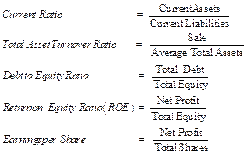
Effect of Current Asset Ratio (CR) on Stock Price: Current Asset Ratio (CR) is a ratio to measure the company's ability to meet its short-term obligations that are due soon using available current assets [6] and Sutapa [7] proves that the current ratio has a significant effect on stock prices because of the ratio From this ratio, it can be seen how safe a company is in paying its short-term obligations. The higher the liquidity ratio, the better the company's operating level, therefore its shares can increase along with the increase in the Current Ratio (CR) [8]. The results of this study are also supported by research from Pratama and Erawati [9] where the Current Ratio (CR) does have a significant effect on stock prices. Then also research from Sondakh et al. [10] which proves the results of the same study. However, there is also research from Widayanti and Colline [11] which proves that the Current Ratio (CR) does not significantly affect stock prices, this may be due to differences in the sample and the period when the related research was conducted. Then there is also the research of Kadek and Ni Nyoman [12] which proves the results of the same research, namely the insignificant effect of the Current Ratio (CR) on stock prices in companies in LQ45. Because this study uses different samples and populations, the hypothesis that is formed based on the differences above is as follows.
H1: Current Asset Ratio (CR) has a significant effect on stock prices
Influence of Total Asset Turnover (TAT) on Share Price
Total Asset Turnover (TAT) is a ratio used to measure how effective the use of assets is in generating sales. The higher this ratio, the better the use of assets by the company which causes the company's performance to be better [8]. This ratio is useful for measuring asset turnover and the amount of sales obtained by the company [3]. Research from Rani and Diantini [13] proves that Total Asset Turnover (TAT) has a significant effect on stock prices, this proves that investors are still very concerned about the value of TAT in making decisions on stock prices, if the TAT ratio increases, there will be an increase in share prices. stock price too. However, there is research that shows an insignificant effect between the Total Asset Turnover (TAT) variable on stock prices as evidenced by Widayanti and Collune [11]. These results were obtained using a sample from the LQ45 company, while this study used a different sample and period, so it is used hypothesis as follows.
H2: Total Asset Turnover (TAT) has a significant effect on stock prices
Effect of Debt to Equity (DER) on Stock Price
Debt to Equity Ratio (DER) is a ratio used to measure the ratio between total debt and total equity [6]. The higher the DER, the more vulnerable the company is to fluctuations in economic conditions. This research is also supported by Widayanti and Colline [11] who prove there is a significant influence between the Debt to Equity Ratio (DER) and the Stock Price, because the higher the DER ratio can lead to a higher risk of bankruptcy and this affects investors' views in invest in the company, but this can also be a good thing if the company is able to use and manage the debt well so that the debt can be able to leverage profits which in turn can increase the EPS ratio. If the company takes advantage of debt, the company will bear interest costs, this interest expense can be a tax deduction and make profits bigger and this can be responded positively by potential investors. However, Sutapa [7] proves that the Debt to Equity Ratio (DER) has an insignificant effect on stock prices in LQ45 companies in the 2015-2016 period, because a high DER is something that is considered reasonable by investors because companies that are developing will definitely requires very large operational costs that cannot be met by own capital, thus requiring long-term credit. These results may occur due to differences in the sample and the period during which the study was conducted, therefore this can be the basis for the following hypothesis.
H3: Debt to Equity Ratio (DER) has a significant effect on stock prices
Effect of Return on Equity (ROE) on Stock Price
Return on Equity Ratio (ROE) is a ratio that shows the results (return) on the use of company equity in creating net income. In other words, this ratio is used to measure how much net profit will be generated from each rupiah of funds embedded in total equity. Research conducted by Sondakh et al. [10] proves that there is a significant effect of the Return on Equity (ROE) ratio on stock prices because this ratio is directly related to the profits generated by the company obtained based on invested funds. The results of this study are also supported by research from Feri [14] which proves that this ratio affects the stock price significantly so that it can reduce or increase stock prices. If the ROE is high or the return on equity is high, it will be a good signal for investors because the funds invested in equity will get a high rate of return in the future. However, there is research from Sutapa [7], Widayanti and Colline [11], Rusli and Dasar [15] whose research results prove that Return on Equity (ROE) does not have a significant effect on stock prices, the research was conducted on listed companies. at LQ45 and with different periods. The study states that profit is not the only indicator that investors pay attention to in making investment decisions and also that the cost of capital is strongly influenced by interest rates. So from the previous research that had the contradiction, the following hypothesis was made.
H4: Return on Equity Ratio (ROE) has a significant effect on stock prices
Effect of Earning per Share (EPS) on Share Price
Earning per Share (EPS) is a ratio to measure the success of the company's management in providing benefits for common shareholders. This ratio shows the relationship between the amount of net income and the share of shareholder ownership in the investe company. Potential investors will use this earnings per share figure to make investment decisions among the various alternatives. EPS is a ratio that is widely considered by potential investors, because EPS information is the most basic and useful information that can describe the company's earning prospects in the future, this ratio has a significant effect on stock prices [7]. This research is also supported by research conducted by Widayanti and Colline [11] which proves that EPS describes the amount of rupiah earned for each share. Potential investors are attracted to large EPS, because EPS is an indicator to measure the success of a company. The higher the EPS received by investors will provide a fairly good rate of return on investment. However, there are several studies that have inversely proportional results, namely there is no significance, research by Rizqi and Rishi [16] conducted with a sample of telecommunication companies and research by Randonuwu et al. [17] with a sample of food and beverages companies showed the same results. That EPS is not the only factor that investors look at before making an investment. The sector or field of the company may also be one of these determining factors. Based on this, the following hypothesis can be made due to differences in the samples used in the study.
H5: Earning per Share (EPS) has a significant effect on stock prices
Research Design
This research design is a rationale for researchers to conduct research so that research can be carried out and run in a systematic and measurable manner. This research is associative research which means research that aims to determine the influence or relationship between two or more variables [18]. This study is a replication study of research conducted by Widayanti and Colline [11] the difference in this study is in the population section and the sample taken this time using companies with the Basic Industry and Chemicals sector listed on the Indonesia Stock Exchange using purposive sampling with criteria certain.
Operasional Variable
Independent Variables:
Dependent Variable
The stock price data used in this study is the stock price at the time of closing for the 2015-2019 period which is listed on the Indonesia Stock Exchange (IDX) (Table 1).
Population and Sample Technique
Data Processing and Data Analysis: This study uses panel data regression method, the purpose of using this method is to predict the value of the intercept and the value of the slope. In other words it has the same goal as multiple linear. The intercept is an ordinary constant, then the slope is an ordinary regression coefficient. Panel data is also data that has cross section and time series characteristics at the same time. Cross section is data that consists of more than 1 entity, while time series is data of an entity with a fairly long period or not one period.
The panel data regression model is as follows:
Keterangan:
Y = Stock Price
X1 = Current Ratio
X2 = Debt to Equity
X3 = Total Asset Turnover
X4 = Return on Equity
X5 = Earning per Share
α = Constant
Description of Research Object
This study uses data analysis techniques with panel data regression method, where panel data is a combination of cross section data and time series data. Aims to see the extent of the influence that occurs between two or more variables used in this study in a research model. There are three selection methods, namely, Common Effect Model, Fixed Effect Model and Random Effect Model. The results of this test are as follows.
In the results of the common effect test model above, it can be seen that the Adjusted R-Square result is 62.07%, it can be interpreted that in this regression model the independent variables can explain the dependent variable, namely the stock price of 62.07% while the rest is explained by other variables. EPS or Earning Per Share and DER have a significant effect on stock prices because the probability value is smaller than 0.05, while other variables do not because the value is greater than 0.05 (Table 2).
Tabel 1: Sample
| Description | Amount |
| Companies in the Basic Industry and Chemicals sector listed on the IDX | 80 |
| Companies that always report financial statements on the IDX for the 2015-2019 period | 61 |
| Companies with Listed Shares > 3.5 Billion | 26 |
| Companies that did not experience a loss during the 2015-2019 period | 15 |
Source: Idx.co.id
Table 2: Common Effect Model
Dependent Variable: Y Method: Panel Least Squares Date: 08/22/21 Time: 12:38 Sample: 2015 2019 Periods included: 5 Cross-sections included: 15 Total panel (balanced) observations: 75 | ||||
| Variable | Coefficient | Std. Error | t-Statistic | Prob. |
| C | 5563.730 | 1996.824 | 2.786289 | 0.0069 |
| X1 | 51.99882 | 479.8994 | 0.108354 | 0.9140 |
| X2 | -185.1063 | 1296.325 | -0.142793 | 0.8869 |
| X3 | -4329.692 | 1153.117 | -3.754772 | 0.0004 |
| X4 | -5834.232 | 10161.88 | -0.574129 | 0.5677 |
| X5 | 12.73035 | 1.606277 | 7.925378 | 0.0000 |
| R-squared | 0.646375 | Mean dependent var | 3986.933 | |
| Adjusted R-squared | 0.620750 | S.D. dependent var | 5777.769 | |
| S.E. of regression | 3558.138 | Akaike info criterion | 19.26848 | |
| Sum squared resid | 8.74E+08 | Schwarz criterion | 19.45388 | |
| Log likelihood | -716.5680 | Hannan-Quinn criter. | 19.34251 | |
| F-statistic | 25.22443 | Durbin-Watson stat | 0.738746 | |
| Prob(F-statistic) | 0.000000 | |||
Eviews 9.0
Table 3: Fixed Effect Model
Dependent Variable: Y Method: Panel EGLS (Cross-section weights) Date: 08/22/21 Time: 12:42 Sample: 2015 2019 Periods included: 5 Cross-sections included: 15 Total panel (balanced) observations: 75 Linear estimation after one-step weighting matrix | ||||
| Variable | Coefficient | Std. Error | t-Statistic | Prob. |
| C | 3407.223 | 389.5677 | 8.746163 | 0.0000 |
| X1 | -203.9518 | 112.2052 | -1.817667 | 0.0746 |
| X2 | -83.99857 | 101.6513 | -0.826341 | 0.4122 |
| X3 | -494.6405 | 115.5394 | -4.281142 | 0.0001 |
| X4 | -2468.314 | 983.8194 | -2.508909 | 0.0151 |
| X5 | 8.294526 | 1.453055 | 5.708338 | 0.0000 |
| Effects Specification | ||||
| Cross-section fixed (dummy variables) | ||||
| Weighted Statistics | ||||
| R-squared | 0.921986 | Mean dependent var | 5040.406 | |
| Adjusted R-squared | 0.895036 | S.D. dependent var | 3665.652 | |
| S.E. of regression | 1792.310 | Sum squared resid | 1.77E+08 | |
| F-statistic | 34.21054 | Durbin-Watson stat | 1.943819 | |
| Prob(F-statistic) | 0.000000 | |||
| Unweighted Statistics | ||||
| R-squared | 0.901963 | Mean dependent var | 3986.933 | |
| Sum squared resid | 2.42E+08 | Durbin-Watson stat | 2.287152 | |
Eviews 9.0
Table 4: Random Effect Model
Dependent Variable: Y Method: Panel EGLS (Cross-section weights) Date: 08/22/21 Time: 12:42 Sample: 2015 2019 Periods included: 5 Cross-sections included: 15 Total panel (balanced) observations: 75 Linear estimation after one-step weighting matrix | ||||
| Variable | Coefficient | Std. Error | t-Statistic | Prob. |
| C | 5204.557 | 1809.960 | 2.875509 | 0.0054 |
| X1 | -402.0644 | 365.6758 | -1.099511 | 0.2754 |
| X2 | -39.69726 | 1050.923 | -0.037774 | 0.9700 |
| X3 | -2029.884 | 1081.707 | -1.876555 | 0.0648 |
| X4 | -7967.159 | 7508.122 | -1.061139 | 0.2923 |
| X5 | 10.26970 | 1.517108 | 6.769259 | 0.0000 |
| Effects Specification | S.D. | Rho | ||
| Cross-section random | 2827.322 | 0.6506 | ||
| Idiosyncratic random | 2072.115 | 0.3494 | ||
| Weighted Statistics | ||||
| R-squared | 0.477592 | Mean dependent var | 1241.753 | |
| Adjusted R-squared | 0.439737 | S.D. dependent var | 2909.995 | |
| S.E. of regression | 2178.152 | Sum squared resid | 3.27E+08 | |
| F-statistic | 12.61616 | Durbin-Watson stat | 1.629155 | |
| Prob(F-statistic) | 0.000000 | |||
| Unweighted Statistics | ||||
| R-squared | 0.562236 | Mean dependent var | 3986.933 | |
| Sum squared resid | 1.08E+09 | Durbin-Watson stat | 0.493169 | |
Eviews 9.0
Table 5: Chow Test
Redundant Fixed Effects Tests Equation: Untitled Test cross-section fixed effects | |||
| Effects Test | Statistic | d.f. | Prob. |
| Cross-section F | 10.603885 | (14,55) | 0.0000 |
| Cross-section Chi-square | 98.108150 | 14 | 0.0000 |
Table 6: Hausman Test
Correlated Random Effects - Hausman Test Equation: Untitled Test cross-section random effects | |||
| Test Summary | Chi-Sq. Statistic | Chi-Sq. d.f. | Prob. |
| Cross-section random | 12.242667 | 5 | 0.0316 |
Table 7: Lagrange Multiplier (LM) Test
Lagrange Multiplier Tests for Random Effects Null hypotheses: No effects Alternative hypotheses: Two-sided (Breusch-Pagan) and one-sided (all others) alternatives | |||
| Test Hypothesis | |||
| Cross-section | Time | Both | |
| Breusch-Pagan | 35.78873 | 0.135508 | 35.92424 |
| (0.0000) | (0.7128) | (0.0000) | |
| Honda | 5.982368 | -0.368115 | 3.969877 |
| (0.0000) | -- | (0.0000) | |
| King-Wu | 5.982368 | -0.368115 | 2.495469 |
| (0.0000) | -- | (0.0063) | |
| Standardized Honda | 7.376999 | -0.112214 | 1.461675 |
| (0.0000) | -- | (0.0719) | |
| Standardized King-Wu | 7.376999 | -0.112214 | 0.142197 |
| (0.0000) | -- | (0.4435) | |
| Gourierioux et al.* | -- | -- | 35.78873 |
| (<0.01) | |||
Eviews 9.0
The test results using the Fixed Effect Model show the Adjusted R-Square results with a value of 89.50% which means it is greater than the Adjusted R-Square results from the Common Effect Model. This value means that the dependent variable can be explained by the independent variable of 89.50% and the rest is explained by other variables. Debt to Equity Ratio (DER), Return on Equity (ROE) and Earning Per Share (EPS) have significance on stock prices because the probability value is less than 0.05. While the Current Ratio (CR) and Total Asset Turnover (TAT) have a probability value greater than 0.05 so they have no significant effect on stock prices (Table 3).
The Adjusted R-Square value in the Random Effect Model is 43.97%, this value is smaller than the value obtained in the Fixed Effect Model. it can be interpreted that the independent variable explains the dependent variable by 43.97% while the rest is explained by other variables. For the Random Effect Model, Earning Per Share (EPS) still has a significant influence on stock prices because the probability value is <0.05 (Table 4).
Panel Data Regression Model Selection
The selection of this regression model is intended to determine which panel data estimation method will be used in the study. This test consists of the Chow test, Hausman test and Lagrange Multiplier (LM) test. To determine whether the Common Effect Model, Fixed Effect Model, or Random Effect Model is more appropriate. Here are the test results (Table 5).
The hypothesis of the Chow test is as follows:
H0 = Model follows the Common Effect approach
H1 = Model follows Fixed Effect approach
Provisions of results if Cross-Section F is more than 0.05 then H0 is accepted and vice versa if Cross-Section F is less than 0.05 then H1 is accepted.
The probability value of Cross-Section F obtained in the Chow test is 0.0000 so that it is smaller than the value of 0.05. Then H0 is rejected and H1 is accepted where the estimation method used is the Fixed Effect Model.
The hypothesis of the Hausman test is as follows:
H0 = Model follows the Random Effect approach
H1 = Model follows Fixed Effect approach
Provisions of results if Cross-Section F is more than 0.05 then H0 is accepted and vice versa if Cross-Section F is less than 0.05 then H1 is accepted.
The results of the Hausman test that were carried out showed a Cross-Section value of 0.0316 which was less than the value of 0.05 so that the estimated data used was the Fixed Effect Model (Table 6).
The hypothesis of the Lagrange Multiplier Test is as follows:
H0 = Common Effect Model
H1 = Random Effect Model
The result is that if Cross-Section F is greater than 0.05 then H0 is accepted and vice versa if Cross-Section F is less than 0.05, then H1 is accepted.
The results of this LM test found that the Cross-Section in Breusch-Pagan is 0.0000 which is smaller than the value of 0.05 so that H1 is accepted and the Random Effect Model is selected (Table 7).
Classic Assumption Test
Normality Test
The results of the Chow test above show a probability value of 0.330301 where the value is more than 0.05 which is used as a significance reference. Then there is the Jarque-Bera value of 2.215503, with the Chi-Square of 11.07050 where the Jarque-Bera value is smaller than the Chi-Square value which indicates that the data used is normally distributed.
The results of the Multicollinearity Test above show that there is no data that has a relationship. The value used as the tolerance limit is 0.80, the results of the data above do not have a value that is close to or more than 0.80 so that the data can be said to be free from multicollinearity (Table 8).
The results of the Heteroscedasticity Test above show a probability level of more than 0.05 so it can be concluded that there is no heteroscedasticity problem with the data used (Table 9).
The data above shows the number of samples used is 75 and with a total of 6 variables, consisting of 1 dependent variable and 5 independent variables. So that the DU value is 1.7698, with these data the following equation can be generated as DU<DW<4-DU with a value of 1.7698 (DU) < 1.943819 (DW) <2,2302 (4-DU). The above data can be called free from autocorrelation (Table 10).
Table 8: Multicollinearity Test
| X1 | X2 | X3 | X4 | X5 | |
| X1 | 1.000000 | -0.073498 | -0.519894 | 0.211162 | 0.221612 |
| X2 | -0.073498 | 1.000000 | -0.051914 | 0.542815 | -0.191595 |
| X3 | -0.519894 | -0.051914 | 1.000000 | -0.110931 | -0.068440 |
| X4 | 0.211162 | 0.542815 | -0.110931 | 1.000000 | 0.405303 |
| X5 | 0.221612 | -0.191595 | -0.068440 | 0.405303 | 1.000000 |
Eviews 9.0s
Table 9: Heteroscedasticity Test
Dependent Variable: RESABS Method: Panel Least Squares Date: 08/22/21 Time: 13:00 Sample: 2015 2019 Periods included: 5 Cross-sections included: 15 Total panel (balanced) observations: 75 | ||||
| Variable | Coefficient | Std. Error | t-Statistic | Prob. |
| C | 1587.712 | 914.8127 | 1.735560 | 0.0882 |
| X1 | -231.9509 | 194.2242 | -1.194243 | 0.2375 |
| X2 | 94.91082 | 578.9780 | 0.163928 | 0.8704 |
| X3 | -198.4185 | 619.3977 | -0.320341 | 0.7499 |
| X4 | -1666.614 | 4084.581 | -0.408026 | 0.6848 |
| X5 | 1.376228 | 0.880250 | 1.563450 | 0.1237 |
| Effects Specification | ||||
| Cross-section fixed (dummy variables) | ||||
| R-squared | 0.584085 | Mean dependent var | 1136.855 | |
| Adjusted R-squared | 0.440405 | S.D. dependent var | 1401.007 | |
| S.E. of regression | 1048.039 | Akaike info criterion | 16.97041 | |
| Sum squared resid | 60411162 | Schwarz criterion | 17.58840 | |
| Log likelihood | -616.3903 | Hannan-Quinn criter. | 17.21717 | |
| F-statistic | 4.065180 | Durbin-Watson stat | 2.134087 | |
| Prob(F-statistic) | 0.000024 | |||
Eviews 9.0
Table 10: Autocorrelation Test
Dependent Variable: Y Method: Panel EGLS (Cross-section weights) Date: 08/22/21 Time: 12:42 Sample: 2015 2019 Periods included: 5 Cross-sections included: 15 Total panel (balanced) observations: 75 Linear estimation after one-step weighting matrix | ||||
| Variable | Coefficient | Std. Error | t-Statistic | Prob. |
| C | 3407.223 | 389.5677 | 8.746163 | 0.0000 |
| X1 | -203.9518 | 112.2052 | -1.817667 | 0.0746 |
| X2 | -83.99857 | 101.6513 | -0.826341 | 0.4122 |
| X3 | -494.6405 | 115.5394 | -4.281142 | 0.0001 |
| X4 | -2468.314 | 983.8194 | -2.508909 | 0.0151 |
| X5 | 8.294526 | 1.453055 | 5.708338 | 0.0000 |
| Effects Specification | ||||
| Cross-section fixed (dummy variables) | ||||
| Weighted Statistics | ||||
| R-squared | 0.921986 | Mean dependent var | 5040.406 | |
| Adjusted R-squared | 0.895036 | S.D. dependent var | 3665.652 | |
| S.E. of regression | 1792.310 | Sum squared resid | 1.77E+08 | |
| F-statistic | 34.21054 | Durbin-Watson stat | 1.943819 | |
| Prob(F-statistic) | 0.000000 |
| ||
Eviews 9.0
Hypothesis Testing:
Regression Equation
The following is the regression equation obtained from the tests that have been carried out:
Closing Share Price (y) = 3407,223 (c) - 203.9518
(CR) - 83,99857 (TAT) - 494,6405 (DER) - 2468,314 (ROE) + 8,294526 (EPS).
The above equation shows all the coefficients on each related variable. The constant value is 3407,223, the Current Ratio (CR) value is -203.9518, the Total Asset Turnover (TAT) value is -83.99857, the Debt to Equity Ratio (DER) value is -494.6405, the Return on Equity (ROE) value is -2468.314 and Earning per Share (EPS) value is 8.294526. which can be read as follows:
The constant value is 3407,223. this value can be interpreted if all variables are in the value 0 it will increase the stock price by 3407,223
The coefficient value for the variable x1 is the Current Ratio (CR) of -203.9518. This value can be interpreted if the CR variable increases by (1) unit, it will decrease the value of the stock price by 203.9518 with the assumption that the other variables are zero
The coefficient value for the x2 variable, namely Total Asset Turnover (TAT) is -83,99857. This value can be interpreted if the TAT variable increases by 1 unit, it will decrease the value of the stock price by 83,99857 with the assumption that the other variables have a value of 0
The coefficient value for the x3 variable is the Debt to Equity Ratio (DER) of -494.6405. This value can be interpreted if the DER variable increases by 1unit, it will decrease the value of the stock price by 494,6405 with the assumption that the other variables have a value of 0
The coefficient value for the x4 variable, namely Return on Equity (ROE) is -2468.314. This value can be interpreted if the ROE variable increases by (1) unit, it will decrease the value of the stock price by 2468,314 assuming the value of other variables is 0
The coefficient value for the x5 variable is Earning per Share (EPS) of 8.294526. This value can be interpreted if the EPS variable increases by (1) unit, it will increase the share price by 8.294526 assuming the value of other variables is 0
T-Test
This t test is used to see whether there is a partial effect by each independent variable significantly on the dependent variable. The results will be said to be significant if the probability value of an independent variable <0.05 value. However, if the probability value is >0.05, it can be said that the independent variable has no significant effect on the dependent variable. Then the results of the t-test carried out are as follows.
Current Ratio (CR)
The variable x1 or Current Ratio (CR) has a probability value of 0.0746 which is greater than the value of 0.05, so it can be concluded that the Current Ratio variable has no significant effect on stock prices or the dependent variable.
Total Asset Turnover (TAT)
The variable x2 or Total Asset Turnover (TAT) has a probability value of 0.4122 which is greater than the level of significance value of 0.05. it can be concluded that this Total Asset Turnover does not have a significant effect on stock prices as the dependent variable.
Debt to Equity Ratio (DER)
The variable x3 or Debt to Equity Ratio (DER) has a probability value of 0.0001, which is smaller than the significance level of 0.05. it can be concluded that this Debt to Equity Ratio has a significant influence on stock prices.
Return on Equity (ROE)
The x4 variable or Return on Equity (ROE) has a probability value of 0.0151 which is smaller than the significance level value of 0.05. it can be concluded that this ROE variable can significantly affect stock prices.
Earnings per Share (EPS)
The variable x5 or Earning per Share (EPS) has a probability value of 0.0000 where this value is smaller than the significance level value of 0.05. it can be concluded that this EPS variable has a significant influence on stock prices.
The Influence of Current Ratio (CR) on Stock Price
Based on the results of the t test or partial test that has been carried out previously which shows the results where the Current Ratio or hereinafter referred to as CR gets a probability value of 0.0746 where this value is greater than the significance number of 0.05 which can be concluded that CR has no significant effect. to the Share Price. The coefficient value of the CR shows a negative number, which means that if the CR increases by 1 unit, it will reduce the value of the Share Price. This result is also reinforced by previous research conducted by Widayanti and Colline [11] where the result is that the Current Ratio has no significant effect on stock prices.
These results do not match or contradict what the authors hypothesized in chapter 2, where CR has a significant effect on stock prices but the results of the test show no significant effect. CR is a ratio used to see the extent to which the company's ability to fulfill its short-term obligations by only using its current assets. From the test results above, it turns out that there is no significant effect if there is an increase or decrease in the CR ratio to the stock price. This is in accordance with the existing theory because it may happen because if the CR is high it does not necessarily describe the company as good, but if this ratio increases there is also the possibility that there is stockpiled inventory due to unwise purchases, as well as non-current receivables that are not collectible.

Therefore, care must be taken in interpreting this ratio. Increasing is not necessarily a good indicator and vice versa [6].
The Influence of Total Asset Turnover (TAT) on Stock Price
Seeing the results of the t-test or partial test shows the results where Total Asset Turnover or hereinafter referred to as TAT shows a value of 0.4122 where this value is greater than the level of significance value that has been determined, which is 0.05, so it can be concluded that TAT has no significant effect on stock prices. The coefficient value of TAT is negative so that if the TAT value increases by (1) unit, the stock price will decrease according to the proportion of the TAT value that increases. This is also in accordance with previous research conducted by Widayanti and Colline [11] where TAT does not have a significant effect on stock prices.
This is not in line with the hypothesis that the author has put forward in chapter 2 regarding Total Asset Turnover (TAT) which has a significant influence on stock prices. TAT is used to measure whether management has carried out its operational activities effectively or not if it is measured by the value of its assets. This turned out to have no significant effect on changes in the stock price that occurred. Perhaps this is because investors are of the view that the effective use of assets should be carried out by management and this is not the only benchmark used for investors to invest in a company.
The Influence of Debt to Equity Ratio (DER) on Stock Price
The Debt to Equity Ratio or hereinafter referred to as DER in the t-test or partial test gets a value of 0.0001 where this value is lower than the significance level of 0.05. it can be concluded that DER has a significant effect on stock prices. The value of the DER coefficient is negative which means that every DER increases by (1) unit, there will be a decrease in the share price according to the DER value. research from Banchuenvijit [8] which shows that DER has a significant influence on stock prices.
These results are in accordance with the hypothesis that the author has described in chapter 2 where DER has a significant influence on stock prices. DER is a ratio used to calculate how much of the proportion of funds owned by the company comes from credit loans. This ratio in the results of this study shows that there is a significant influence on stock prices. A high DER tends to indicate the company has a responsibility to third parties to settle its obligations, on the other hand the high use of debt in the company shows that the company needs additional funds to increase its business to get more profits and this is considered reasonable by investors as long as the company's business it generates a decent profit.
The Effect of Return on Equity (ROE) on Stock Prices
Return on Equity or hereinafter referred to as ROE has the result of the t-test or partial test of 0.0151 where the value is smaller than the predetermined significance level value of 0.05. then it can be interpreted that ROE has a significant effect on the stock price. The coefficient value of ROE is negative which can be interpreted that if the ROE value increases by 1 unit, then the value of the Stock Price will decrease as much as the ROE value with the assumption that other variables are fixed.
This is contrary to the results of previous research conducted by Sutapa [7] where ROE has no significant effect and research by Widayanti and Colline [11] which has the same result, which is not significant. This may be due to limitations or differences in the samples used. ROE is a ratio used to find out how much the value of the rate of return on capital invested in the company in the form of shares is.
The Effect of Earning per Share (EPS) on Stock Price
Earning per Share or hereinafter referred to as EPS has a probability value from the results of the t test or partial test of 0.0000 where the value is smaller than the 0.05 significance level value which can be interpreted that there is a significant influence between the EPS variable on the Stock Price . The coefficient value of EPS is positive which means that if the value of EPS increases by 1 unit, the value of the Share Price will also increase according to the value of EPS assuming the variable is fixed. This is in accordance with the hypothesis that the researcher put forward in chapter 2 where EPS has a significant effect on stock prices. Previous research also strengthens this result where previous research conducted by Sutapa [7] proves that EPS has a significant effect on stock prices, then there is also Widayanti and Colline [11] proving the same thing where EPS has a significant effect on stock prices.
EPS is a ratio used to measure how much profit is earned per share by shareholders so that there is a direct influence where earnings per share depend on whether there is a stock split or share repurchase made by the management. EPS is one of the basic information in describing the company's prospects in the future, this calculation has the aim of seeing the progress of the company's operations and being one indicator of the success of a company.
Based on research that has been conducted on the independent variables, namely Current Ratio (CR), Total Asset Turnover (TAT), Debt to Equity Ratio (DER), Return on Equity (ROE) and Earning per Share (EPS) on the dependent variable, namely Stock Price . The sample is 15 (nine) companies in the Basic Industry and Chemicals sector listed on the IDX during the 2015-2019 period. The tests that have been carried out are based on the panel data regression model using the Fixed Effect Model method. Based on the objectives that have been previously stated by the researchers with the results of the study, the following conclusions can be drawn:
Current Ratio (CR) has no significant effect on stock prices in a sample of 15 (nine) companies in the Basic Industry and Chemicals sector listed on the IDX with a period of 2015-2019
Total Asset Turnover (TAT) has no significant effect on stock prices in a sample of 15 (nine) companies in the Basic Industry and Chemicals sector listed on the IDX with a period of 2015-2019
Debt to Equity Ratio (DER) has a significant effect on stock prices in a sample of 15 (nine) companies in the Basic Industry and Chemicals sector listed on the IDX with a period of 2015-2019

Return on Equity (ROE) has a significant effect on stock prices in a sample of 15 (nine) companies in the Basic Industry and Chemicals sector listed on the IDX with a period of 2015-2019

Kemenperin. "Pemerintah pacu industri kimia jadi penggerak ekonomi nasional." Kemenperin, 2019, https://kemenperin.go.id/artikel/21103/Pemerintah-Pacu-Industri-Kimia-Jadi-Penggerak-Ekonomi-Nasional.
Fahmi, I. and Y.L. Hadi. Teori profotolio dan analisis investasi. 2nd ed., Bandung: Alfabeta, 2011.
Kasmir. Analisa laporan keuangan. Depok: PT Raja Grafindo Persada, 2013.
Hermuningsih, S. Pengantar pasar modal Indonesia. Yogyakarta: UPP STIM YKPN, 2012.
Agus, S. Manajemen keuangan teori dan aplikasi. Yogyakarta: BPFE, 2011.
Hery. Analisa laporan keuangan. Jakarta: Grasindo, 2016.
Sutapa, I. Nyoman. "Pengaruh rasio dan kinerja keuangan terhadap harga saham pada Indeks LQ45 di Bursa Efek Indonesia (BEI) periode 2015–2016." Jurnal KRISNA, vol. 9, 2018, pp. 2599–1809.
Banchuenvijit, W. "Financial ratios and stock prices: Evidence from the agriculture firms listed on the stock exchange of Thailand." International Journal of Business and Economics, 2015.
Pratama, A. and T. Erawati. "Pengaruh current ratio, debt to equity, return on equity, net profit margin dan earning per share terhadap harga saham (Studi kasus pada perusahaan manufaktur yang terdaftar di Bursa Efek Indonesia periode 2008–2011)." Jurnal Akuntansi, vol. 2, no. 1, 2014.
Sondakh, F., P. Tommy and M. Mangatar. "Current ratio, debt to equity ratio, return on asset, return on equity pengaruhnya terhadap harga saham pada Indeks LQ45 di BEI periode 2010–2014." Jurnal EMBA, 2015, pp. 2303–1174.
Widayanti, R. and F. Colline. "Pengaruh rasio keuangan terhadap harga saham perusahaan LQ45 periode 2011–2015." Volume 21, 2017.
Kadek, S.R. and N.N.A. Diantini. "Pengaruh kinerja keuangan perusahaan terhadap harga saham dalam Indeks LQ45 di BEI." E-Jurnal Manajemen Unud, vol. 2302, 2015, pp. 8912.
Rani, K.S. and N.N.A. Diantini. "Pengaruh kinerja keuangan perusahaan terhadap harga saham dalam Indeks LQ45 di BEI." E-Jurnal Manajemen Unud, 2015, pp. 1504–1524.
Feri, M. "Pengaruh rasio profitabilitas terhadap perubahan harga saham pada perusahaan sektor properti yang listing di Bursa Efek Indonesia periode 2008–2012." Jurnal Ilmu Manajemen, vol. 2, no. 4, 2014, pp. 1526–1537.
Rusli, A. and T. Dasar. "Pengaruh rasio keuangan terhadap harga saham pada perusahaan BUMN perbankan yang terdaftar di Bursa Efek Indonesia." Jurnal Akuntansi, vol. 1, no. 2, 2014, pp. 10–17.
Rizqi, A.T. and S.S. Rishi. "Analisis pengaruh profitabilitas terhadap harga saham (Studi kasus perusahaan telekomunikasi yang terdaftar di Bursa Efek Indonesia (BEI) periode 2012–2014)." Jurnal Online Insan Akuntan, vol. 2528, 2016, pp. 0163.
Randonuwu, E.F., L. Linda and K.W. Stanley. "Pengaruh current ratio, net profit margin dan earning per share terhadap harga saham di Bursa Efek Indonesia (Studi kasus pada sub sektor food and beverages)." Jurnal Riset Akuntansi Going Concern, 2017, pp. 204–212.
Sugiyono. Metode penelitian pendidikan pendekatan kuantitatif, kualitatif dan R&D. Bandung: Alfabeta, 2013.