This study aims to assesses the stability of Technical Efficiency (TE) scores of major tomato producers in Middle East North African (MENA) region through Jackknife technique. Idea behind this technique is to eliminate outliers that may affect efficiency frontier and scores of efficiencies. Those major producers are Iran, Turkey and Jordan. During the study period, a gap was formed between demand and supply of tomato. Widening this gap might lead to a problem of food unsecured. Being food unsecured might related to being technically inefficient. This study finds that average Pure Technical Efficiency (PTE) was (0.91, 0.98 and 0.89) percent for Iran, Turkey and Jordan, respectively. This means that those countries can save inputs by (0.9, 0.2 and 0.11) respectively and still getting the same level of output. Jackknife technique results have found that there is no extreme outliers’ effect for Iran. However, there is an outlier effect for Turkey and Iran. In other words, by eliminating outlier years from analysis, policy analysis based on TE scores can be more dependable and trustworthy. Stakeholders within these countries can utilize the output of this study to increase their productivity which will lead to food security.
Keywords
Tomato production
Inputs Utilization
VRS
Data Envelopment Analysis
INTRODUCTION
One of the most consumed vegetables around the world is tomatoes. Based on Food and Agriculture Organization (FAO), 170 million tons were produced worldwide [1]. Tomato's harvested area occupied 12.4 million acres of farmland globally. On the other hand, production had increased considerably. Between 2000 and 2014, production increased by 54% [1]. Based on Guan et al. [2], China, the United States, India, European Union and Turkey are top-five producers in the tomato market. The supply of those significant players forms 70% of tomato supply around the world.
In the Middle East, North African (MENA) region, Turkey, Iran and Jordan occupy the most significant pie share of tomato production [3]. According to [4], the production of the top three countries we just mentioned is 12 million tons for Turkey, 6.6 million tons for Iran and 864 thousand tons. The share of those three countries counts for 89% of total production in the MENA region.
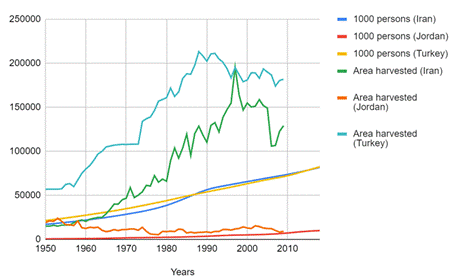
Even though we have three countries leading the production within the MENA region, harvested area and domestic demand had a significant gap between them. Figure 1 shows the trend of harvested area for Turkey, Iran and Jordan compared to the population of these three countries.
Ceteris Paribus, the growth in tomato demand is greater than the growth rate of the harvested area, with an increased gap between the two. This gap expansion is fueling policymakers' concerns about MENA food insecurity. This gap formed because the supply of local production is insufficient to consistently meet the needs of increased demand.
In Turkey, literature has been conducted on analyzing economically different vegetables and fruits. Examples would be studies that analyzed the economic efficiency of dry apricot Gündüz et al. [5], kiwiGökdoğan [6], pumpkin Oğuz et al. [7] wheat and sunflower Unakıtan and Aydın [8] and Altaie [9], peach and cherry Aydın and Aktürk [10], pomegranate Ozalp et al. [11] and pear Aydın et al. [12]. On the other hand, some literature has been concerned with the economic analysis of tomato production in Turkey such as Yenihebit et al. [13], Akdogan [14], Weldegiorgis et al. [15] and Yelmen et al. [16]. In Iran and Jordan, literature that tackle the economic efficiency of tomato are inconclusive. Examples would be such as Hesampour et al. [17], Hasanshahi [18] and Raheli et al. [19]. Literature in technical efficiency in other MENA countries are Hassan [20,21,22,23] and Frhan [24]. However, to the author's knowledge, no study assessed tomato productive efficiency of those three countries in MENA region using Data Envelopment Analysis (DEA) employing the jackknife technique.
Figure 1: Tomato harvested area and population in Turkey, Iran and Jordan between (1961 and 2019)
Analysis in this piece can benefit policymakers navigating through different initiatives to increase food security level. By demonstrating the use of standard methodologies to an empirical agricultural problem, this work contributes to the burgeoning literature in efficiency economics.
The aims of this piece are put together to show the source of inefficiency in tomato production at a macroeconomic level. This paper aims to:
Measuring technical efficiency (i.e. Overall Technical Efficiency (OTE), Pure Technical Efficiency (PTE) and Scale Efficiency (SE)) for each country. This can demonstrate how these countries can improve their performance or efficiency.
Testing Technical Efficiency Scores Stability
The efficiency of tomato production in Turkey, Iran and Jordan can be considered an effective way to improve food security in the MENA region. Comparing the productive efficiency of tomatoes in these three countries can show strategies that may enhance the domestic production of tomatoes.
MATERIALS AND METHODS
This study investigated factors affecting tomato production in the biggest producers in the MENA region. Those countries are Turkey, Iran and Jordan. Data utilized in this study were obtained from FAOSTAT. More specifically, data between 1961 and 2020 were used to study the economic analysis of the production of tomatoes.
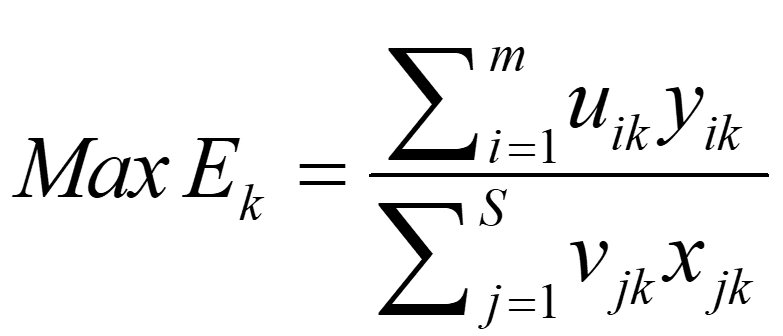
For the empirical part of this study, data envelopment analysis is used. More specifically, the jackknife technique will be followed to provide a robust, trusted and stable inquiry into the problem being studied. The following mathematical framework was used in the calculation of technical efficiency scores Mahajan et al. [25]:
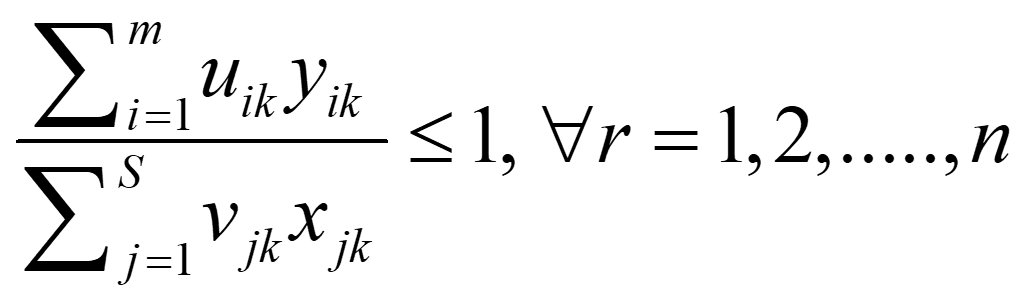
Subject to:
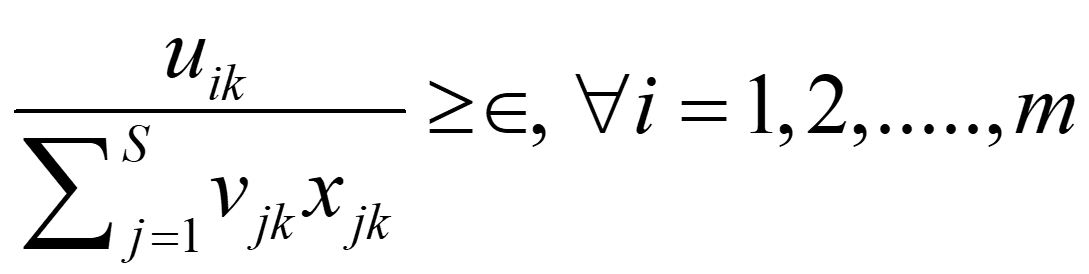
where:
yik = The i-th output produced by the k-th DMU
xjk =The j-th input used by the k-th DMU
uik = The weight is given to input
vjk = The weight given to output
n = The number of DMUs
m = The number of the output
s = Outputs number
Î = A constant value and very small
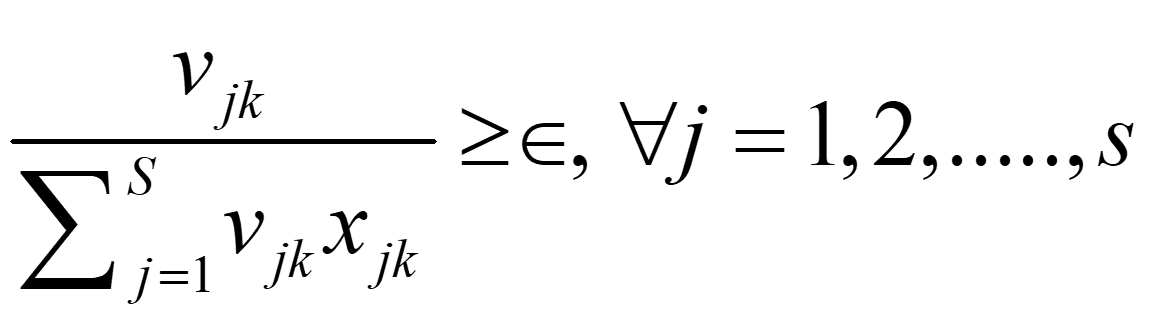
In the above expression, the goal is to find values of uik and vjk to maximize the efficiency of the k-th DMU. This is subject to a constraint that all efficiency measures must be£1. This expression is hard to solve. One way to solve it is to rely on a linear programming model called multiplier form. So, in order to estimate technical efficiency scores based on VRS, a convexity constraint
(i.e. .) need to be imposed to get technical efficiency scores for the k-th firm. Based on what was just mentioned, an equivalent envelopment form can be derived by the following duality in linear programming.
Factors affecting production and technical efficiency scores of tomato production in Turkey, Iran and Jordan are divided into standard production factors and sociodemographic variables related to climate change factors. Standard production factors are used in the first stage, while sociodemographic and variables related to climate change factors are used in the second. Variables in the first stage consist of area harvested, as a dependent variable, population (1000 person), yield (hg/ha), arable land (%), nitrogen nutrient (tonnes), phosphate nutrient (tonnes) and potash nutrient (tonnes). The second stage analysis consists of export values of tomato (1000 USD), gross production value (1000 USD), index of gross per capita production (number), emission of CH4, emission of N2O and emission of CO2. Also, trend analysis was utilized to determine the trend of the population in Iran, Jordan and Turkey and the trend of the harvested area in previously mentioned countries for the period of 1961-2020.
RESULTS AND DISCUSSION
In this section, technical efficiency scores are reported. These are the Overall Technical Efficiency score (OTE), pure technical efficiency score and scale efficiency. After showing the previous score, efficiency scores and stability using the jackknife technique are shown and explained.
Technical Efficiency Score Analysis
One important thing worth mentioning is that the efficiency scores shown here are relative efficiency scores. That means efficient years (with technical efficiency score =1) are used as a benchmark. In other words, efficiency scores are calculated relative to an efficient frontier.
The CCR model was adopted first to calculate the technical efficiency score. However, the CCR model utilized Constant Return to Scale (CRS), where Scale Efficiency (SE) will not be considered. Based on that, pure technical efficiency is going to be assessed. The process of assessing is all around using the BCC model. This model will be followed to know the source of inefficiency, whether it is based on production inefficiency or the firm size. This is the definition of pure technical efficiency which means that it is that kind of efficiency that is attributed to the efficient exploitation of inputs taking into account the firm's size represented by scale size. Table 1 shows DEA results using the specification described above for Iran.
Out of 59 years, one is found to be overall technically efficient. Seven firms are technically efficient (BCC score = 1), i.e., they can reduce their excess inputs being utilized while maintaining the same output level. In comparison, the remaining 52 firms are relatively inefficient (BCC scores <1). PTE measures how efficiently inputs are converted into output(s) irrespective of the size of the firms. The average PTE is set to be 0.91, which means that given the operation scale, firms can reduce their inputs by 9 per cent of their observed levels without affecting output levels.
The results in Table 1 show that 1967, 1975, 1991, 2017, 2018 and 2019 are technically inefficient with CCR but efficient with BCC. This demonstrates unequivocally that businesses in these years can convert their inputs into outputs with 100% efficiency, but their OTE is poor because of the low scale efficiency score.
Scale Efficiency (SE) can measure if the firm's size affects its efficiency score. In order to calculate scale efficiency, you need to divide the efficiency score obtained by CCR by the same score obtained by BCC. Getting a value of scale efficiency equals one means the firm operates at an optimal scale. Value of scale efficiency less than one means the firm is not operating at its optimum scale.
Table 1: Technical efficiency scores with CRS and VRS of Iran between (1961-2019)
CRS_TE
VRS_TE
SCALE
1961
0.924819
0.924819
1.000000
1962
0.949130
0.949130
1.000000
1963
0.952148
0.964955
0.986729
1964
1.000000
1.000000
1.000000
1965
0.950572
0.966893
0.983119
1966
0.970086
0.991782
0.978124
1967
0.996337
1.000000
0.996337
1968
0.877967
0.955882
0.918489
1969
0.815871
0.938833
0.869027
1970
0.799794
0.938196
0.852481
1971
0.881425
0.996324
0.884677
1972
0.806913
0.962759
0.838126
1973
0.794643
0.966022
0.822593
1974
0.784597
0.973650
0.805831
1975
0.807881
1.000000
0.807881
1976
0.717817
0.959448
0.748156
1977
0.631659
0.911141
0.693262
1978
0.554771
0.859439
0.645504
1979
0.574461
0.889942
0.645504
1980
0.530010
0.861197
0.615435
1981
0.530058
0.874421
0.606182
1982
0.439402
0.786083
0.558977
1983
0.775131
0.954727
0.811887
1984
0.707620
0.948579
0.745979
1985
0.643177
0.939779
0.684391
1986
0.622624
0.898231
0.693167
1987
0.599057
0.941887
0.636019
1988
0.529235
0.863638
0.612797
1989
0.643491
0.961290
0.669404
1990
0.640006
0.953723
0.671061
1991
0.705325
1.000000
0.705325
1992
0.556067
0.821630
0.676785
1993
0.417140
0.745785
0.559330
1994
0.460007
0.827449
0.555934
1995
0.419137
0.767938
0.545795
1996
0.391122
0.761550
0.513587
1997
0.524919
0.840919
0.624221
1998
0.415348
0.782050
0.531101
1999
0.396623
0.792185
0.500670
2000
0.424896
0.802240
0.529636
2001
0.464405
0.812334
0.571692
2002
0.460345
0.822551
0.559656
2003
0.472262
0.832797
0.567080
2004
0.506090
0.842923
0.600399
2005
0.465371
0.852838
0.545673
2006
0.436700
0.862526
0.506304
2007
0.433149
0.872082
0.496683
2008
0.236891
0.881668
0.268685
2009
0.411006
0.891500
0.461028
2010
0.494638
0.901740
0.548537
2011
0.440633
0.912406
0.482935
2012
0.461535
0.923468
0.499784
2013
0.471684
0.934985
0.504483
2014
0.473687
0.947012
0.500191
2015
0.488342
0.959560
0.508923
2016
0.490705
0.972663
0.504497
2017
0.817722
1.000000
0.817722
2018
0.811883
1.000000
0.811883
2019
0.682404
1.000000
0.682404
Results show that out of 59 years, four years are scale efficient while the remaining 55 years are scale inefficient. The average SE is 0.68, indicating that an average firm in these years may be able to decrease its inputs by 32 per cent beyond its best practice targets under VRS if it operated at CRS.
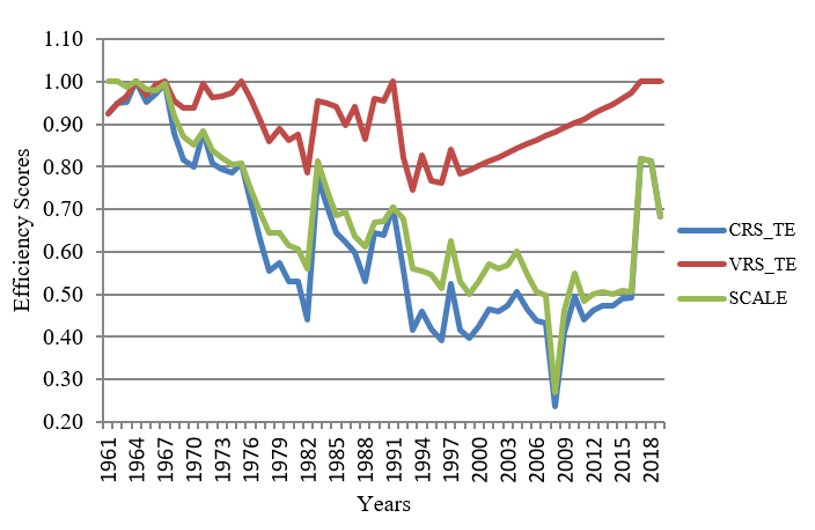
Figure 2: Trend of technical efficiency scores following CRS, VRS and SE of Iran between (1961-2019)
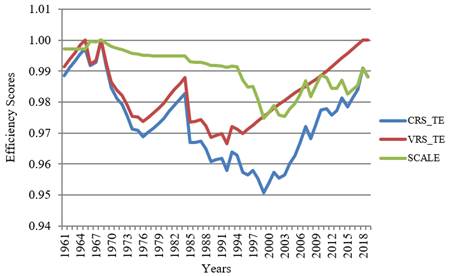
Figure 3: Depicts the trend of technical efficiency scores following CRS, VRS, and SE of Turkey between (1961-2019)
Figure 2 shows the trend of TEs over 59 years. Quick skimming over the figure shows that TE with VRS is decreasing at decreasing rate except in 2016, when things started to get back on track. In 2018, things started to get worse and this is concerning that this decrease might continue.
Moving on to Turkey. Table 2 shows technical efficiency scores with CRS and VRS in Turkey between (1961-2019). From the whole study sample, three are found to be overall technically efficient and nine years are pure technically efficient (BCC score = 1). In comparison, the remaining 50 years are relatively inefficient (BCC scores <1). The average PTE is set to be 0.98, which means that given the operation scale, firms can reduce their inputs by 2 per cent of their observed levels without affecting output levels.
The results in Table 2 show that 1963, 2015, 2016, 2017, 2018 and 2019 are technically inefficient with CCR but efficient with BCC. This demonstrates unequivocally that businesses in these years can convert their inputs into outputs with 100% efficiency, but their OTE is poor because of the low scale efficiency score.
Results show that out of 59 years, 16 years are scale efficient while the remaining 43 years are scale inefficient. The average SE is 0.99, indicating that an average firm in these years may be able to decrease its inputs by 1 per cent beyond its best practice targets under VRS if it operated at CRS.
Figure 3 shows Turkey's trend of TEs and scale efficiency between 1961 and 2019. The same story is repeated here, similar to Iran. Technical efficiency when using VRS has significant volatility. The trend of VRS-TE decreased until 1992 when things started to improve.
Jordan’s TE scores are depicted in Table 3. This table depicts technical efficiency scores with CRS and VRS in Jordan. Between 1961 and 2019, one year is found to be overall technically efficient and four years are pure technically efficient (BCC score = 1), while the remaining 55 years are found to be relatively inefficient (BCC scores <1).
Table 2: Technical efficiency scores with CRS and VRS of Turkey between (1961-2019)
CRS_TE
VRS_TE
SCALE
1961
0.988588
0.991380
0.997183
1962
0.990911
0.993710
0.997183
1963
0.993221
0.996027
0.997183
1964
0.995523
0.998335
0.997183
1965
0.997183
1.000000
0.997183
1966
0.991913
0.992269
0.999641
1967
0.992893
0.993379
0.999511
1968
1.000000
1.000000
1.000000
1969
0.991664
0.992726
0.998930
1970
0.984598
0.986579
0.997992
1971
0.981208
0.983741
0.997426
1972
0.979220
0.982164
0.997002
1973
0.975512
0.979027
0.996410
1974
0.971328
0.975450
0.995774
1975
0.970902
0.975274
0.995518
1976
0.968904
0.973664
0.995111
1977
0.970174
0.975018
0.995032
1978
0.971432
0.976359
0.994954
1979
0.973088
0.978061
0.994915
1980
0.974757
0.979777
0.994877
1981
0.976989
0.982005
0.994892
1982
0.978910
0.983951
0.994877
1983
0.980885
0.985944
0.994869
1984
0.982800
0.987876
0.994862
1985
0.966874
0.973567
0.993125
1986
0.966854
0.973720
0.992949
1987
0.967385
0.974368
0.992834
1988
0.964887
0.972245
0.992432
1989
0.960759
0.968624
0.991879
1990
0.961328
0.969290
0.991786
1991
0.961797
0.969859
0.991687
1992
0.958004
0.966525
0.991183
1993
0.963967
0.972113
0.991621
1994
0.962864
0.971236
0.991380
1995
0.957332
0.969779
0.987165
1996
0.956425
0.971183
0.984805
1997
0.957996
0.972583
0.985002
1998
0.955175
0.973973
0.980701
1999
0.950688
0.975342
0.974723
2000
0.953782
0.976683
0.976552
2001
0.957332
0.978003
0.978864
2002
0.955516
0.979305
0.975708
2003
0.956512
0.980576
0.975459
2004
0.960114
0.981800
0.977913
2005
0.962720
0.982969
0.979401
2006
0.966690
0.984072
0.982336
2007
0.972116
0.985126
0.986794
2008
0.968233
0.986182
0.981799
2009
0.972790
0.987308
0.985296
2010
0.977450
0.988545
0.988777
2011
0.977938
0.989898
0.987919
2012
0.975798
0.991339
0.984323
2013
0.977304
0.992834
0.984358
2014
0.981430
0.994339
0.987018
2015
0.978364
0.995814
0.982477
2016
0.981280
0.997262
0.983974
2017
0.984095
0.998677
0.985398
2018
0.991080
1.000000
0.991080
2019
0.988187
1.000000
0.988187
The average PTE is set to be 0.89, which means that given the operation scale, firms can reduce their inputs by 11 per cent of their observed levels without affecting output levels.
Table 3 shows that 1963, 2015, 2016, 2017, 2018 and 2019 are technically inefficient with CCR but efficient with BCC. This demonstrates unequivocally that businesses in these years can convert their inputs into outputs with 100% efficiency, but their OTE is poor because of the low scale efficiency score.
Table 3: Technical efficiency scores with CRS and VRS of Jordan between (1961-2019)
CRS_TE
VRS_TE
SCALE
1961
0.68
0.75
0.92
1962
0.68
0.75
0.91
1963
0.69
0.76
0.91
1964
0.68
0.76
0.90
1965
0.70
0.77
0.91
1966
0.72
0.78
0.93
1967
0.73
0.79
0.93
1968
0.74
0.79
0.93
1969
0.73
0.80
0.91
1970
0.77
0.81
0.95
1971
0.78
0.81
0.96
1972
0.78
0.82
0.95
1973
0.78
0.82
0.95
1974
0.78
0.83
0.95
1975
0.81
0.83
0.98
1976
0.83
0.83
0.99
1977
0.82
0.83
0.98
1978
0.81
0.84
0.97
1979
0.82
0.84
0.98
1980
0.82
0.84
0.97
1981
0.82
0.85
0.97
1982
0.82
0.85
0.96
1983
0.83
0.86
0.96
1984
0.84
0.86
0.98
1985
0.82
0.87
0.95
1986
0.86
0.87
0.99
1987
0.91
0.91
1.00
1988
0.92
0.92
1.00
1989
0.93
0.93
1.00
1990
0.88
0.89
0.99
1991
0.89
0.89
0.99
1992
0.89
0.90
0.99
1993
0.90
0.91
0.99
1994
0.88
0.91
0.96
1995
0.89
0.92
0.97
1996
0.93
0.93
1.00
1997
0.92
0.92
1.00
1998
0.94
0.94
1.00
1999
0.93
0.93
1.00
2000
0.93
0.93
1.00
2001
0.93
0.93
1.00
2002
0.94
0.94
1.00
2003
0.93
0.93
0.99
2004
0.93
0.94
0.99
2005
0.91
0.94
0.97
2006
0.91
0.94
0.97
2007
0.93
0.95
0.97
2008
0.92
0.95
0.96
2009
0.92
0.96
0.96
2010
0.91
0.97
0.94
2011
0.93
0.97
0.95
2012
0.94
0.98
0.96
2013
0.92
0.98
0.94
2014
0.93
0.99
0.94
2015
0.95
0.99
0.95
2016
0.95
1.00
0.96
2017
0.96
1.00
0.96
2018
0.98
1.00
0.98
2019
1.00
1.00
1.00
Results show that out of 59 years, 16 years are scale efficient while the remaining 43 years are scale inefficient. The average SE is 0.99, indicating that an average firm in these years may be able to decrease its inputs by 1 per cent beyond its best practice targets under VRS if it operated at CRS.
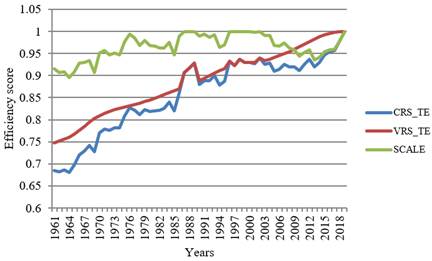
Figure 4: Trend of technical efficiency scores following CRS, VRS, and SE of Jordan between (1961-2019)
Table 4: Karl Person correlation coefficient with Jackknifing analysis using Pure Technical Efficiency (PTE) scores
VRS-TE w/out 1991
VRS-TE w/out 1991
VRS-TE w/out 1991
VRS-TE w/out 1991
1.000
58
VRS-TE w/out 1991
0.837 (0.001)
58
1.000
58
VRS-TE w/out 1991
0.822 (0.001)
58
0.979 (0.001)
58
1.000
58
Note: Numbers in parenthesis are p-value, and 58 is the sample size.
Table 5: Correlation coefficients of Spearman rank of Jackknifing analysis using (PTE) scores
VRS-TE w/out 1991
VRS-TE w/out 1991
VRS-TE w/out 1991
VRS-TE w/out 1991
1.000
VRS-TE w/out 1991
0.892 (0.001)
1.000
VRS-TE w/out 1991
0.862 (0.001)
0.959 (0.001)
1.000
Note: Numbers in parenthesis are p-value
Table 6: Karl Person correlation coefficient with Jackknifing analysis using Pure Technical Efficiency (PTE) scores
VRS-TE w/out 1984
VRS-TE w/out 2016
VRS-TE w/out 2017
VRS-TE w/out 2018
VRS-TE w/out 1984
1.000
58
VRS-TE w/out 2016
0.735 (0.001)
58
1.000
58
VRS-TE w/out 2017
0.737 (0.001)
58
0.999 (0.001)
58
1.000
58
VRS-TE w/out 2018
0.281 (0.032)
58
0.295 (0.024)
58
0.282 (0.023)
58
1.000
58
Note: Numbers in parenthesis are p-value, and 58 is the sample size.
Table 7: Correlation coefficients of Spearman rank of Jackknifing analysis using (PTE) scores
VRS-TE w/out 1984
VRS-TE w/out 2016
VRS-TE w/out 2017
VRS-TE w/out 2018
VRS-TE w/out 1984
1.000
VRS-TE w/out 2016
0.759 (0.001)
1.000
VRS-TE w/out 2017
0.757 (0.001)
0.999 (0.001)
1.000
VRS-TE w/out 2018
0.281 (0.005)
0.295 (0.004)
0.282 (0.004)
1.000
Note: Numbers in parenthesis are p-value
Table 8. Karl Person correlation coefficient with Jackknifing analysis using pure technical efficiency (PTE) scores
VRS-TE w/out 1988
VRS-TE w/out 1989
VRS-TE w/out 2015
VRS-TE w/out 2019
VRS-TE w/out 1988
1.000
58
VRS-TE w/out 1989
0.989 (0.001)
58
1.000
58
VRS-TE w/out 2015
0.154 (0.001)
58
0.080 (0.001)
58
1.000
58
VRS-TE w/out 2019
0.168 (0.207)
58
0.091 (0.496)
58
0.986 (0.001)
58
1.000
58
Note: Numbers in parenthesis are p-value, and 58 is the sample size.
Table 9: Correlation coefficients of Spearman rank of Jackknifing analysis using (PTE) scores
VRS-TE w/out 1988
VRS-TE w/out 1989
VRS-TE w/out 2015
VRS-TE w/out 2019
VRS-TE w/out 1988
1.000
VRS-TE w/out 1989
0.979 (0.001)
1.000
VRS-TE w/out 2015
0.097 (0.001)
0.036 (0.001)
1.000
VRS-TE w/out 2019
0.133 (0.005)
0.064 (0.004)
0.984 (0.004)
1.000
Note: Numbers in parenthesis are p-value
Jackknife Analysis or Stability Testing of Efficient Years
When testing for stability, we need to drop the highest efficient years with the most enormous peer count. This was done utilizing Pure Technical Efficiency scores or (PTE) obtained by VRS. This has to be done one at a time. In other words, you need to remove the most efficient first year and run DEA, then remove the second-highest efficient year, perform DEA and so on. This was done for Iran, Turkey and Jordan, respectively. This was done to test if outliers can affect technical efficiency scores and efficiency frontier. This procedure, known as Jackknifing, is based on Mostafa [26] and Ramanathan [27], whom they imposed a procedure testing the robustness of the results of DEA when outliers existed. Joshi and Singh [28] also follows the dropping of efficient firms with the most peer account.
In Iran, three years got the highest peer count. Those years are 1991, 2006 and 2018. For Turkey, the story is different. Four years recorded the highest number of peer counts. Those years are 1984, 2016, 2017 and 2018. Finally, the highest peer count in Jordan was 1988, 1989, 2015 and 2019. Those years were dropped one at a time and each time DEA scores were recalculated for each country (Figure 4).
After getting all technical efficiency scores, with Jackknifing technique and measuring efficiency change and years ranking, calculating the Spearman and Karl Pearson correlation coefficient of PTE scores need to be performed.
Spearman and Pearson coefficients of correlation are depicted in Tables 4 and 5, respectively.
What can be inferred from Person correlation coefficients is that they ranged from 0.822 to 0.979 at a 5 per cent level of significance. This implies that the efficiency scores are still stable even with excluded most efficient years. Same story with Spearman correlation. Table 5 shows that correlation coefficients range from 0.862 to 0.959. This is an indicator that ranking years are also stable.
Tables 6 and 7 for Turkey show Pearson and Spearman correlation coefficients.
For Turkey, the story here is a little different. Person correlation coefficients ranged from 0.735 to 0.999 at a 5 per cent significance level. However, when excluding 2018, efficiency scores became unstable. For Spearman rank correlation, it ranged between 0.757 and 0.999. With this ranking correlation, an unstable rank was approved when the year 2018 was excluded.
Tables 8 and 9 show Pearson and Spearman rank correlation for Jordan between 1961 and 2019.
The same scenario happened here compared in Turkey. When excluding the most efficient years, 2015 and 2019, one at a time, Karl Pearson correlation coefficients approved that efficiency scores became unstable. Also, Spearman rank correlation showed that the whole rank became unstable when excluding these two most efficient years.
CONCLUSION
This work use panel data of the top three tomato producers within the MENA region between 1961 and 2019. For Iran, results showed that one year using CCR and seven years using BCC is recorded as technically efficient. However, one year in CCR and four years in BCC have shown efficiency for Turkey and Jordan. The remaining years within the three previously mentioned countries were operating far from the efficient frontier. The average pure technical efficiency was (0.91, 0.98 and 0.89) per cent for Iran, Turkey and Jordan, respectively. This means that, on average, these countries can reduce their input usage by (0.9, 0.2 and 0.11) per cent, respectively, without affecting their output level given their operation scale. This would also mean that those years are (0.91, 0.98, 0.89) per cent technically inefficient and (0.33, 0.1 and 0.4) scale inefficient due to lack of management performance. This suggests that in those years, improvements were possible. For Iran, jackknife analysis showed stability over technical efficiency scores when the most efficient years. The story is different for Turkey and Jordan. Results showed that technical efficiency scores are unstable when the most efficient years are excluded. This would strongly recommend that jackknife analysis is very crucial in efficiency analysis. This is because it pays strong attention to outliers since those can affect technical efficiency scores and affect policy extracted from those scores.
Gündüz, O. et al. "Measuring the metafrontier efficiencies and technology gaps of dried apricot farms in different agro-ecological zones." [Include journal name if available], 2021.
Gökdoğan, O. "Energy and economic efficiency of kiwi fruit production in Turkey: A case study from Mersin Province." Erwerbs-Obstbau, 2022, pp. 1–6.
Oğuz, H.İ. et al. "Determination of the energy input-output analysis and economic efficiency of pumpkin seed (Cucurbita pepo L.) production in Turkey: A case study of Nevsehir province." [Include journal name if available], 2020.
Unakıtan, G. and Aydın, B. "A comparison of energy use efficiency and economic analysis of wheat and sunflower production in Turkey: A case study in Thrace Region." Energy, vol. 149, 2018, pp. 279–285.
Altaie, K. "Three essays on wheat production efficiency in Iraq: Comparison between MENA countries and internal comparison of districts." Colorado State University, 2019.
Aydın, B. and Aktürk, D. "Energy use efficiency and economic analysis of peach and cherry production regarding good agricultural practices in Turkey: A case study in Çanakkale province." Energy, vol. 158, 2018, pp. 967–974.
Ozalp, A. et al. "Energy analysis and emissions of greenhouse gases of pomegranate production in Antalya province of Turkey." Erwerbs-Obstbau, vol. 60, no. 4, 2018, pp. 321–329.
Aydın, B. et al. "Comparative profitability and productivity analysis in dwarf pear production in Turkey: Case of Bursa Province." Custos e Agronegocio On Line, vol. 15, no. 1, 2019, pp. 397–416.
Yenihebit, N. et al. "An efficiency assessment of irrigated tomato (Solanum lycopersicum) production in the Upper East Region of Ghana." Journal of Development and Agricultural Economics, vol. 12, no. 1, 2020, pp. 1–8.
Akdogan, A. "Data envelopment analysis and an application in the tomato sector in Turkey." PhD thesis, Washington State University, 2019.
Weldegiorgis, L.G. et al. "Resources use efficiency of irrigated tomato production of small-scale farmers." International Journal of Vegetable Science, vol. 24, no. 5, 2018, pp. 456–465.
Yelmen, B. et al. "Energy efficiency and economic analysis in tomato production: A case study of Mersin province in the Mediterranean region." Applied Ecology and Environmental Research, vol. 17, no. 4, 2019, pp. 7371–7379.
Hesampour, R. et al. "Technical efficiency, sensitivity analysis and economic assessment applying data envelopment analysis approach: A case study of date production in Khuzestan State of Iran." Journal of the Saudi Society of Agricultural Sciences, vol. 21, no. 3, 2022, pp. 197–207.
Hasanshahi, M. "Measuring the effect of heavy spring rainfall on technical efficiency of tomato production in Arsanjan." [Include journal name if available], 2019.
Raheli, H. et al. "A two-stage DEA model to evaluate sustainability and energy efficiency of tomato production." Information Processing in Agriculture, vol. 4, no. 4, 2017, pp. 342–350.
Hassan, F.A.M. "Data envelopment analysis (DEA) approach for assessing technical, economic and scale efficiency of broiler farms." Iraqi Journal of Agricultural Sciences, vol. 52, no. 2, 2021, pp. 291–300, https://doi.org/10.36103/ijas.v52i2.1290.
Al, A., et al. "Impact of herd size on the productive efficiency of sheep breeding projects at the Kokjali region in Nineveh Governorate for the production season 2018." Iraqi Journal of Agricultural Sciences, vol. 51, no. 6, 2020, pp. 1613–1622, https://doi.org/10.36103/ijas.v51i6.1188.
Lafta, A., et al. "Measuring the economic efficiency and total productivity of resource and the technical change of agricultural companies in Iraq using SFA and DEA for the period 2005-2017." Iraqi Journal of Agricultural Sciences, vol. 51, no. 4, 2020, pp. 1104–1117, https://doi.org/10.36103/ijas.v51i4.1089.
Al, K. and E. "Economical analysis of efficiency of rice farms in Al-Najaf Alashraf for the agricultural season 2017." Iraqi Journal of Agricultural Sciences, vol. 50, no. 2, 2019, https://doi.org/10.36103/ijas.v2i50.654.
Frhan, A.H. et al. "A comparative study of technical efficiency of certified wheat cultivars (ADNA 99 and IPA 99) in Iraq during the season 2014-2015: Wasit Governorate as a case study." Iraqi Journal of Agricultural Sciences, vol. 48, no. 6B, 2017, https://doi.org/10.36103/ijas.v48i6.
Mahajan, V. et al. "Technical efficiency analysis of the Indian drug and pharmaceutical industry: A non-parametric approach." Benchmarking: An International Journal, 2014.
Mostafa, M. "Benchmarking top Arab banks’ efficiency through efficient frontier analysis." Industrial Management and Data Systems, 2007.
Ramanathan, R. An introduction to data envelopment analysis: A tool for performance measurement. Sage, 2003.
Joshi, R.N. and Singh, S.P. "Technical efficiency and its determinants in the Indian garment industry." Journal of the Textile Institute, vol. 103, no. 3, 2012, pp. 231–243.
License
Creative Commons Attribution-NonCommercial-NoDerivatives 4.0 International License
All papers should be submitted electronically. All submitted manuscripts must be original work that is not under submission at another journal or under consideration for publication in another form, such as a monograph or chapter of a book. Authors of submitted papers are obligated not to submit their paper for publication elsewhere until an editorial decision is rendered on their submission. Further, authors of accepted papers are prohibited from publishing the results in other publications that appear before the paper is published in the Journal unless they receive approval for doing so from the Editor-In-Chief.
Himalayan Journal of Economics and Business Management open access articles are licensed under a Creative Commons Attribution-Share A like 4.0 International License. This license lets the audience to give appropriate credit, provide a link to the license, and indicate if changes were made and if they remix, transform, or build upon the material, they must distribute contributions under the same license as the original.
Recommended Articles
Research Article
Influence of Leadership on Poverty Reduction in the Devolved Government in Trans-Nzoia County, Kenya
Kinisu Sifuna,
...
Peter Simotwo
Published: 30/06/2021
Download PDF
Cite
x
APA
Sifuna, K., Lwangale, D. W., Simotwo, P., Sifuna, K., Lwangale, D. W. & Simotwo, P. (2021). Influence of Leadership on Poverty Reduction in the Devolved Government in Trans-Nzoia County, Kenya. Himalayan Journal of Economics and Business Management, 2(1), None-None.
MLA
Sifuna, Kinisu, et al. "Influence of Leadership on Poverty Reduction in the Devolved Government in Trans-Nzoia County, Kenya." Himalayan Journal of Economics and Business Management 2.1 (2021): None-None.
Chicago
Sifuna, Kinisu, David W. Lwangale, Peter Simotwo, Kinisu Sifuna, David W. Lwangale and Peter Simotwo. "Influence of Leadership on Poverty Reduction in the Devolved Government in Trans-Nzoia County, Kenya." Himalayan Journal of Economics and Business Management 2, no. 1 (2021): None-None.
Harvard
Sifuna, K., Lwangale, D. W., Simotwo, P., Sifuna, K., Lwangale, D. W. and Simotwo, P. (2021) 'Influence of Leadership on Poverty Reduction in the Devolved Government in Trans-Nzoia County, Kenya' Himalayan Journal of Economics and Business Management 2(1), pp. None-None.
Vancouver
Sifuna K, Lwangale DW, Simotwo P, Sifuna K, Lwangale DW, Simotwo P. Influence of Leadership on Poverty Reduction in the Devolved Government in Trans-Nzoia County, Kenya. Himalayan Journal of Economics and Business Management. 2021 Jan;2(1):None-None.
Download PDF
Research Article
Modelling Structure Job Quality, Job Design and Job Satisfaction
Moch Nurhadi,
...
Avi Sunani
Published: 30/08/2022
Download PDF
Cite
x
APA
Nurhadi, M., Bisyri Effendi, M., Saiful Ulum, A. & Sunani, A. (2022). Modelling Structure Job Quality, Job Design and Job Satisfaction. Himalayan Journal of Economics and Business Management, 3(2), 1-4.
MLA
Nurhadi, Moch, et al. "Modelling Structure Job Quality, Job Design and Job Satisfaction." Himalayan Journal of Economics and Business Management 3.2 (2022): 1-4.
Chicago
Nurhadi, Moch, Moch Bisyri Effendi, Achmad Saiful Ulum and Avi Sunani. "Modelling Structure Job Quality, Job Design and Job Satisfaction." Himalayan Journal of Economics and Business Management 3, no. 2 (2022): 1-4.
Harvard
Nurhadi, M., Bisyri Effendi, M., Saiful Ulum, A. and Sunani, A. (2022) 'Modelling Structure Job Quality, Job Design and Job Satisfaction' Himalayan Journal of Economics and Business Management 3(2), pp. 1-4.
Vancouver
Nurhadi M, Bisyri Effendi M, Saiful Ulum A, Sunani A. Modelling Structure Job Quality, Job Design and Job Satisfaction. Himalayan Journal of Economics and Business Management. 2022 Jul;3(2):1-4.
Download PDF
Research Article
The Constitutional and Legislative Basis for Considering the Taxable Capacity of Taxpayers in Iraqi Tax Legislation
Hussein Kamel Wadaa
Published: 05/05/2025
Download PDF
Cite
x
APA
Wadaa, H. K. (2025). The Constitutional and Legislative Basis for Considering the Taxable Capacity of Taxpayers in Iraqi Tax Legislation. Himalayan Journal of Economics and Business Management, 6(1), 1-10.
MLA
Wadaa, Hussein Kamel. "The Constitutional and Legislative Basis for Considering the Taxable Capacity of Taxpayers in Iraqi Tax Legislation." Himalayan Journal of Economics and Business Management 6.1 (2025): 1-10.
Chicago
Wadaa, Hussein Kamel. "The Constitutional and Legislative Basis for Considering the Taxable Capacity of Taxpayers in Iraqi Tax Legislation." Himalayan Journal of Economics and Business Management 6, no. 1 (2025): 1-10.
Harvard
Wadaa, H. K. (2025) 'The Constitutional and Legislative Basis for Considering the Taxable Capacity of Taxpayers in Iraqi Tax Legislation' Himalayan Journal of Economics and Business Management 6(1), pp. 1-10.
Vancouver
Wadaa HK. The Constitutional and Legislative Basis for Considering the Taxable Capacity of Taxpayers in Iraqi Tax Legislation. Himalayan Journal of Economics and Business Management. 2025 Jan;6(1):1-10.
Download PDF
Research Article
Proposed Digital Marketing Strategy to Enhance Engineering Consultancy Company Revenue
Alfarisy, K. A.,
Wandebori, H.
Published: 30/04/2024
Download PDF
Cite
x
APA
K. A., A. & H., W. (2024). Proposed Digital Marketing Strategy to Enhance Engineering Consultancy Company Revenue. Himalayan Journal of Economics and Business Management, 5(1), 1-18.
MLA
K. A., Alfarisy, and Wandebori, H.. "Proposed Digital Marketing Strategy to Enhance Engineering Consultancy Company Revenue." Himalayan Journal of Economics and Business Management 5.1 (2024): 1-18.
Chicago
K. A., Alfarisy, and Wandebori, H.. "Proposed Digital Marketing Strategy to Enhance Engineering Consultancy Company Revenue." Himalayan Journal of Economics and Business Management 5, no. 1 (2024): 1-18.
Harvard
K. A., A. and H., W. (2024) 'Proposed Digital Marketing Strategy to Enhance Engineering Consultancy Company Revenue' Himalayan Journal of Economics and Business Management 5(1), pp. 1-18.
Vancouver
K. A. A, H. W. Proposed Digital Marketing Strategy to Enhance Engineering Consultancy Company Revenue. Himalayan Journal of Economics and Business Management. 2024 Jan;5(1):1-18.
Altaie, K. (2022). Did Jackknife Works? Testing Stability of Technical Efficiency in Biggest Tomato Producers in MENA Region. Himalayan Journal of Economics and Business Management, 3(2), 1-8.
MLA
Altaie, Karrar. "Did Jackknife Works? Testing Stability of Technical Efficiency in Biggest Tomato Producers in MENA Region." Himalayan Journal of Economics and Business Management 3.2 (2022): 1-8.
Chicago
Altaie, Karrar. "Did Jackknife Works? Testing Stability of Technical Efficiency in Biggest Tomato Producers in MENA Region." Himalayan Journal of Economics and Business Management 3, no. 2 (2022): 1-8.
Harvard
Altaie, K. (2022) 'Did Jackknife Works? Testing Stability of Technical Efficiency in Biggest Tomato Producers in MENA Region' Himalayan Journal of Economics and Business Management 3(2), pp. 1-8.
Vancouver
Altaie K. Did Jackknife Works? Testing Stability of Technical Efficiency in Biggest Tomato Producers in MENA Region. Himalayan Journal of Economics and Business Management. 2022 Jul;3(2):1-8.



 Download PDF
 Download XML