Research Article | Volume 4 Issue 2 (July-Dec, 2023) | Pages 1 - 8
Analysis Of Emotional Intelligence, Work Stress, Impact On Job Satisfaction Affecting Employee Performance "Case Study Of Employees In The Regional Secretariat Of Pekalongan District"
 ,
 ,
 ,
 ,
1
Faculty of Economics and Business, University of 17 August 1945 Semarang
Under a Creative Commons license
Open Access
Received
Sept. 1, 2023
Revised
Oct. 6, 2023
Accepted
Nov. 1, 2023
Published
Nov. 29, 2023
Abstract

The aim of this research is to examine the role of emotional intelligence and work stress on employee performance, with job satisfaction as an intervening variable Study at the Regional Secretariat of Pekalongan District. This study is a survey research, utilizing primary data with a sample of 111 employees within the Regional Secretariat of Pekalongan District as respondents. The hypotheses are tested using the Structural Equation Modeling (SEM) equation model. The findings of this research indicate H1: Emotional intelligence has a significant positive effect on employee performance. H2: Emotional intelligence has a significant positive effect on job satisfaction. H3: Work stress has a significant positive effect on employee performance. H4: Work stress has a significant positive effect on job satisfaction. And H5: Job satisfaction has a significant positive effect on employee performance.

Keywords
INTRODUCTION

Human Resource Management is one of the crucial aspects in an organization or company. Optimal employee performance is the primary goal for every entity in achieving the organization's vision and mission. This depends on how well the organization is managed by employees and policy-makers. To achieve better performance, organizations, which encompass various resources, primarily focus on maximizing human resources. Human resources need to be managed by integrating Emotional Intelligence capabilities and managing the level of work stress to achieve employee job satisfaction, consequently impacting employee performance.


Job satisfaction is a crucial factor as it can serve as an intermediary between emotional intelligence, work stress, and employee performance. Job satisfaction is defined as employees' perception of the extent to which their needs and expectations are fulfilled by the work environment. Job satisfaction plays a role as a factor that diminishes or reinforces the impact of emotional intelligence and job stress on employee performance.


The relationship between emotional intelligence and job stress towards job satisfaction, and the impact of emotional intelligence, job stress, and job satisfaction on employee performance. It is expected that management can take appropriate measures to improve employee performance and create a more   productive   and   harmonious   work environment.Top of Form Based on previous research, as conducted by Supriyanto [1], it has been proven that Emotional Intelligence has a positive and significant impact on job satisfaction and employee performance. Results of the research from Setyaningrum et al. [2] also indicate that the variables of self-awareness, self-regulation, empathy, social skills, and employee performance are at a high or good level, and there is a significant simultaneous influence.


In an international journal, in an article written by Bhoir and Suri [3] Employee performance has a positive correlation with emotional intelligence, indicating that employees with higher correlation levels tend to achieve success in their relationships with organizational performance. The above research study by Anon[4] clearly demonstrates that employee job performance directly impacts the factors of Employee Emotional Intelligence. The research results indicate that partial emotional intelligence has a positive and significant effect on teller performance. This proves that the higher the emotional intelligence of tellers, the greater the impact on performance improvement; conversely, if the emotional intelligence of tellers is lower, it leads to a decrease in their performance.


This was also stated by Sharfras Navas and Vijayakumar [5] Emotional Intelligence (EI) has a significantly      positive        impact        on        organizational commitment, job stress, and job satisfaction. Employees with  high  emotional  intelligence tend to experience high  job satisfaction, resulting in optimal performance in the workplace. Job stress is entirely dependent on an individual's level of emotional intelligence, and employees with an optimistic nature can enhance their stress control.


Based on the findings obtained by Jalagat [6], it is revealed that when assessing the level of workplace stress on employee performance, there is a strong relationship between job stress and employee performance. While, for job stress on employee performance, as in the study conducted by Riyadi [7], the results obtained are work stress has a significant impact on employee performance in mineral and metal manufacturing companies in East Kalimantan.


The influence of work stress on job satisfaction, as researched by Ahsan et al. [8], indicates that with job satisfaction as the dependent variable and work stress as the independent variable, significant p-values were obtained (p<0.01) with an R Square of approximately 10%.


In other research conducted by Hidayati, Purwanto, and Yuwono [9], the work stress variable has a very significant negative relationship with employee performance. This means that the higher the level of work stress, the lower employee performance will be. However, research by Raharjo [10] shows that physiological stress variables do not have a significant effect on job satisfaction. This is different from research Gofur [11] which states that work stress has a positive and important impact on job satisfaction.


Job satisfaction impacts employee performance, as studied by Berliana, Siregar, and Dwi Gustian [12]. It states that job satisfaction has a direct and significant influence on employee performance. This empirical evidence indicates that, in efforts to improve employee performance, there is a need to enhance job satisfaction, as job satisfaction is closely related to the enhancement of employee performance. The path coefficient shows a positive and significant value, meaning that the better job satisfaction is, in terms of the formation of an attitude dependent on the interaction between the work environment or work conditions themselves and the individual, the higher the employee's performance will be. 


This research will be developed based on previous studies conducted by Adha [17], Ahsan et al. [8], Anon [4], Argon and Liana, Badrianto and Ekhsan, Berliana et al., Bhoir and Suri [3], Gofur [11], Hidayati et al. [9], Ilmu, Dan, and Politik, Jalagat [6], Kusuma Putri, Prayekti, and Subiyanto [16], Munir and Azam [23], Riyadi [7], Sharfras Navas and Vijayakumar [5], Supriyanto [1], Yulianti Selan et al. [13] , Котлер[24]. The variables used in this study include emotional intelligence, job stress, job satisfaction, and employee performance. The variables used in this study include emotional intelligence, job stress, job satisfaction, and employee performance. What sets this research apart from previous studies is the combination of the existing variables. The object of this research is the employees in the Secretariat of Pekalongan Regency, chosen as the research location because it is the parent organization within the scope of the Pekalongan Regency Government. whose performance is directly related to policies and services to the public.Top of Form


The aim of the research in the context of research entitled "Analysis of Emotional Intelligence, Job Stress on Job Satisfaction Impacts on Employee Performance" Case Study of Employees at the Regional Secretariat of Pekalongan Regency" is to explore and analyze the impact of emotional intelligence and job stress on job satisfaction which has an impact on performance employee. With the research formulation and hypothesis explained previously, the research objectives can be formulated as follows:


  • Understanding the impact of Emotional Intelligence on employee performance in the Secretariat of Pekalongan Regency

  • Understanding the influence of Emotional Intelligence on job satisfaction in the Secretariat of Pekalongan Regency

  • Understanding the impact of work-related stress on employee performance in the Secretariat of Pekalongan Regency

  • Understanding the influence of work-related stress on job satisfaction in the Secretariat of Pekalongan Regency

  • Understanding the impact of Job Satisfaction on employee performance in the Secretariat of Pekalongan Regency


LITERATURE REVIEW AND FORMULATION OF HYPOTHESES

Intelligence, as described by Spearman and Jones, as quoted by  Yulianti Selan et al. [13] Referring to the old understanding of strengths that complement the intellect and minds of humans with universally abstract thinking, it becomes the primary source of true knowledge. The word "kekuatan" is noos in Greek and is known as intellectus and intelligentia in Latin. In English, this term is translated as "intellect" and "intelligence." With the change in language, the meaning of the term "intelligence" or in Indonesian known as "inteligensi" (kecerdasan) also undergoes a transformation. Initially, intelligence meant the practical use of intellectual power, but now it is understood as another form of strength.


According to the views of Spearman and Jones, as quoted by Yulianti Selan et al. [13], Intelligence refers to the ancient capacity that complements the human mind with the ability for universally abstract thinking, becoming the true source of knowledge. The word "kekuatan" has its roots in the Greek language, referred to as noos, and is known as intellectus and intelligentia in Latin. In English, this term is translated as "intellect" and "intelligence." In the process of linguistic evolution, the meaning of the word "intelligence," or known as "inteligensi" in Indonesian, also undergoes transformation. Originally, intelligence referred to the concrete use of intellectual power, but now it is understood as something different. Literally, emotion refers to the subjective feeling and mental state that arises within an individual in response to a situation, event, or stimulus. A variety of feelings, such as happiness, sadness, anger, fear, anxiety, and so on, are involved in the emotional experience. Emotions can arise from both positive and negative experiences and are often influenced by how individuals perceive and interpret their environment and life experiences.Top of Form


Goleman (2002: 512), Quoted in the Rizaldi [14], It explains that "emotional intelligence is an individual's skill in managing emotions and utilizing their intelligence to nurture and express emotional balance through abilities such as self-awareness, self-regulation, motivation, empathy, and social skills." In this context, emotional intelligence refers to the capacity to recognize, understand, regulate, and express emotions appropriately, as well as to leverage these emotions in various situations, including the workplace.


While according to Patton (2001: 3), as quoted in [2] Emotional intelligence has a simple meaning, which is the ability to use emotions effectively to achieve specific goals and build positive and productive relationships in the workplace.


According to Ilmu et al. [15] Characteristics of emotional intelligence include the ability to self-motivate and face challenges that may cause frustration, manage emotional impulses without excessive expression of excitement, create a conducive mood while maintaining mental sharpness, gather information without disrupting thinking abilities, and practice empathy and reflection.


Based on the explanation above, it can be concluded that Emotional Intelligence is a psychological concept referring to an individual's ability to understand, manage, and recognize emotions, both in oneself and others, with the goal of improving interpersonal relationships, managing stress, making wise decisions, and achieving desired goals. This concept involves skills in reading emotional expressions, regulating emotional responses, and using emotions as valuable sources of information in various social and work contexts.Top of Form


Quoted by Ilmu et al. [15], Emotional intelligence consists of four indicators, including:


  • Self-awareness and regulation: Identifying and understanding one's own emotions, including recognizing what is being felt, the reasons behind those feelings, and how those emotions influence behavior and actions

  • 2. Self-motivation: Motivating oneself, possessing determination, and channeling positive emotions towards achieving goals and success

  • 3. Empathy: Understanding and feeling the emotions of others, being able to see from others' perspectives. This ability enables someone to be more sensitive and responsive to the feelings and needs of others

  • 4. Social Skills: Interact and communicate with others effectively. This includes the ability to communicate assertively, build good relationships, and work together and collaborate in a group environment

WORK STRESS

Work stress, according to various perspectives outlined by researchers, is a physiological and/or psychological response to situations perceived as challenging or burdensome for employees. [16]. While quoted by Adha [17], Work stress refers to stressful situations that create physical and mental imbalance, impacting employees' emotions, thought processes, and overall well-being. In view Raharjo[10], Stress is defined as a state that pushes an individual's physical and mental capacities beyond limits, and if not managed, can have an impact on health.


Based on these various perspectives, it can be concluded that work stress is a physical and psychological condition that induces stress, affects the employees' well-being, and pushes the limits of their physical and mental capacities.


According to Adha [17] In general, individuals experiencing work stress tend to exhibit symptoms in four indicators as follows:


  • Physiologically, symptoms of work stress can manifest in changes in the body's metabolism, increased heart and respiratory rates, elevated blood pressure, and may lead to headaches and even heart attacks.

  • Psychologically, symptoms of work stress may include dissatisfaction with work relationships, feelings of tension, anxiety, irritability, boredom, and a tendency to procrastinate.

  • Behaviorally, symptoms of work stress can be reflected in changes in productivity, more frequent absences, alterations in eating patterns, increased tobacco and alcohol consumption, rapid speech, heightened emotional reactivity, and difficulty sleeping.


Organizationally, stress symptoms can vary among individuals, and each organization has different dynamics such as high workload, role ambiguity, career uncertainty, injustice or discrimination, unequal workload distribution, and communication ambiguity.

JOB SATISFACTION

Quoted by Kusuma Putri et al. [16], Job satisfaction is the foundation of individual success in the workplace, involving both intrinsic and extrinsic aspects. It is the emotional evaluation by an individual of how well the job aligns with personal needs and desires.


Job satisfaction is an individual matter, aligned with the values held by each person. The higher the alignment between an individual's desires and the job, the higher the level of job satisfaction [10]. This reflects the rewards received by employees, both in financial and non-financial forms.


Job satisfaction reflects an individual's emotional evaluation of the job and the work environment [17]. It is influenced by employees' positive attitudes towards their job and the environment around them.


It can be concluded that job satisfaction is the result of how interested and motivated someone is by their job, leading to an assessment of the value of the work situation or conditions. Job satisfaction involves individual behavioral and emotional responses to the work performed. Various job aspects, both positive and negative, play a role in influencing the development of satisfaction or dissatisfaction.


Job Satisfaction Indicators

According to Widaharthana dan Wiyanti, There are four indicators to assess employee job satisfaction by identifying key aspects of the job that elicit emotional responses from employees. These four indicators include:


  • Psychological Factors: Psychological factors refer to aspects related to the mental and emotional state of employees, such as interest, job satisfaction, attitude towards work, talents, and skills

  • Social Factors: Social factors pertain to interactions among employees and the relationships between employees and supervisors

  • Physical Factors: Physical factors are related to the physical conditions of the workplace, including the nature of the job, scheduling and breaks, work equipment, room conditions, temperature, lighting, air ventilation, health conditions, employee age, and more

  • Financial Factors: Financial factors encompass the security and well-being of employees, including salary systems, social benefits, allowances, facilities, promotion opportunities, and the like
MATERIALS AND METHODS

Performance is often interpreted as the result or achievement of work. Performance has a broad meaning, not only indicating work outcomes but also the process of performance itself. Managing performance should ideally be done collaboratively among the organization, leaders, and employees through a shared understanding of performance against planned objectives.


[9] The opinion is that employee performance is a responsibility assigned to employees based on the quantitative and qualitative work outcomes they have achieved. Meanwhile, according to (Emosional et al.)[18] performance is the behavior demonstrated by an individual as an achievement in line with their role in the companyTop of Form


[14] opinioned Performance is a function of knowledge, skills, abilities, and motivation directed into behavior, such as responsibilities in the workplace. Employee performance, in general, is the outcome achieved by an employee in their work, applicable to a specific job. [1] Expressing performance as a function is the result of the interaction between ability and motivation.


Meanwhile, according to Setyaningrum et al.[2] the purpose and goal of performance are to establish useful objectives, encompassing not only performance evaluation at the end of a specific period but all work processes that occur throughout that period.


Based on the various definitions of employee performance above, it can be concluded that employee performance is a concept referring to the level of achievement and effectiveness of an individual in carrying out their tasks and responsibilities in the workplace. The measurement of performance involves evaluating the contribution and productivity of employees, encompassing both the achievements and processes of individuals in carrying out their tasks and responsibilities within the organization. These responsibilities are entrusted to individuals to help them achieve beneficial goals for both themselves and the organization.

RESEARCH HYPOTHESIS DEVELOPMENT

The influence of emotional intelligence variables on employee performance variables

High emotional intelligence will have an impact on performance achievement. This is because the psychological ability factor consists of potential ability and psychological ability consists of potential ability and reality ability (kwowledge+skill). This means that employees who have an IQ above average and are skilled in doing daily work will find it easier to achieve the expected performance. This is also supported by research [15] which states that emotional intelligence has a significant effect on employee performance (Hypothesis 1).


The Influence of Emotional Intelligence Variables on Job Satisfaction Variables

At work, emotional intelligence is closely related to employee satisfaction. Disturbed emotional intelligence will cause a person to be unable to achieve maximum satisfaction. Therefore, this research wants to prove that intelligence has a significant effect on job satisfaction (Hypothesis 2).


The Influence of Job Stress Variables on Employee Performance Variables

The relationship between work stress and employee performance from several studies is inconsistent. Even though the majority of research shows that work stress has a negative relationship with employee performance, research will still be conducted that shows a positive relationship between work stress and performance (Hypothesis 3).


The Influence of Job Stress Variables on Job Satisfaction Variables

Work stress refers to conditions or situations in the work environment that exert pressure, both physically and mentally, which can ultimately affect an employee's well-being. Several studies and literature state that work stress has a negative impact on the level of job satisfaction. The results of research conducted confirm that work stress has a significant and detrimental   effect   on   employee   job   satisfaction  levels.


Figure 1: Development of the Empirical Model


When employees feel high levels of work stress, this tends to lead to low levels of job satisfaction. If employees are unable to manage the stress that arises from work, the impact can include negative and harmful behavior for the organization, such as decreased productivity and high levels of absenteeism. This needs to be proven that Job Stress has a significant negative effect on Job Satisfaction (Hypothesis 4).


The Influence of Job Satisfaction Variables on Employee Performance Variables

We hypothesize that a high level of job satisfaction in employees will have a positive effect on their performance at work. In addition, we argue that job satisfaction will act as an intervening variable, linking the relationship between emotional intelligence and employee performance. In other words, we hypothesized that higher levels of emotional intelligence would increase job satisfaction, which would then make a positive contribution to overall performance improvement (Hypothesis 5).


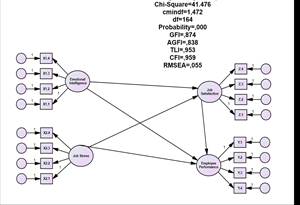
Based on the description above, an empirical model can be developed, as shown in Figure 1.

RESEARCH METHODE

The research method employed is a quantitative approach with the implementation of a questionnaire among employees in the Regional Secretariat of Pekalongan Regency, utilizing the Likert scale as a measurement tool. Data analysis is conducted using the SEM AMOS software to process the survey results [19]


The sample to be studied consists of 111 individuals using the Calvin formula, with a total population of 150 individuals. The sample size refers to the Slovin formula approach, as follows:     


n = N/1 + Ne2


Where:

n              :               Number of samples

N             :               Number of population

e      :       Percentage of allowance due to sampling error that    can still be tolerated


In this research, N  = 150 ; e  = 5 %, So, the sample size in this study is as follows (Table 1):             


n = (150/1 + 150 (0,05)2) = 111 Sample               

Table 1: The Sampling Distribution in Each Section

NoSection NamePopulationProportionSample
1.FORKOMPIM2525/150 x 11119
2.TATA PEMERINTAHAN1111/150 x 1118
3.HUKUM  9  9/150 x 1117
4.PEMBANGUNAN7 7/150 x 1115
5.PEREKONOMIAN 77/150 x 1115
6.KESRA1212/150 x 1119
7.ORGANISASI1414/150 x 11110
8.UMUM4445/150 x 11132
9.PENGADAAN BARANG/JASA2121/150 x 11116
 Amount150 111


Table 2: Operational Definition

Variable TypeOperational DefinitionIndicator
Emotional Intelligence (X1)

The non-cognitive skills, abilities, and competencies that influence employees in the Regional Secretariat of Pekalongan Regency in dealing with environmental demands and pressures.

1. Self - awareness

2. Self - regulation

3. Self - motivation

4. Empathy


Job Stress (X2)

The non-cognitive skills, abilities, and competencies that influence employees in the Regional Secretariat of Pekalongan Regency in facing environmental demands and pressures.

1. Psychological

2. Physiological

3. Behavioral

4. Organizational

Job Satisfaction (Z)

The sense of satisfaction held by employees in the Regional Secretariat of Pekalongan Regency for the achievements at the workplace, both in maintaining themselves with the surrounding environment and in achieving the goals of the institution/government.

1. Psychological Factors

2.Social Factors

3Physical Factors

4.Financial Factors

Employee Performance (Y)

A concept that refers to the level of achievement and effectiveness of an individual in carrying out their tasks and responsibilities in the environment of the Regional Secretariat of Pekalongan Regency.

Top of Form


1. Evaluation of contributions

2.Productivity

3.Quality of work results

4.Ability to achieve individual and organizational goals


Sampling is conducted using the proportional random sampling method, where the sample size is randomly selected and distributed across each section in the Regional Secretariat of Pekalongan Regency. This ensures that the selected samples represent the population characteristics according to the Table 2.


Structural Equation Model Analysis

The next step is the analysis of the Structural Equation Model (SEM). The results of the data processing for SEM analysis are shown in Table 2. The Structural Equation Modeling (SEM) is considered to have a full model fit, as evidenced by the feasibility of the test values as shown in the following Table 2. 


Table 2:   Index of Structural Equation Modeling Feasibility  Test     

NoGoodness of fit indexCut of valueAnalysis resultsEvaluate the model
1X2 – Chi-Square< 103,0199,345Fit
2Significancy Probability≥ 0,050,053Fit
3CMIN / DF≤ 2.001,345Fit
4CFI≥ 0,900,982Fit
5GFI≥ 0,900,944Fit
6AGFI≥ 0.900,909Fit
7TLI≥ 0.950,978Fit
8RMSEA≥ 0,080,025Fit

Source: Processed primary data,2023


Table 3: Results of SEM analysis calculations and hypothesis testing

RegressionWeights  EstimateStd EstimateC.RP
Emosional Intelligence Employee Performance,248,0693,160,003
Emosional Intelligence Job Satisfaction,256,0732,527,004

 Work StressTop of Form

  Employee Performance

,175,0812,926,002

 Work Stress                  Job Satisfaction

Top of Form


,245,0852,574,001
Job Satisfaction Employee Performance,130,0852,692,002

Source: Processed primary data, 2023


Table 2, which tests the hypothesis model, indicates that this model is consistent with the data used in the study, or consistent with the data used in the study according to the significance level (P) of the Chi-square model. (99,345), The TLI, CMIN, /DF, GFI, AGFI, and RMSEA indices are within the expected range. Therefore, hypothesis testing for the overall model indicates that the model fits the data or the data used in the study.

RESULTS AND DISCUSSION

The measurement results meet the criteria of feasibility. In addition, 5 hypotheses are tested based on the appropriate model. The regression coefficient values of the cause-and-effect relationship and the t-value can be observed in the CR (critical ratio) values in the CR (critical ratio) values in Table 3.

DISCUSSION

H1: Emotional Intelligence has a significant impact on employee performance. The parameter estimate is 0.248 with a critical ratio (CR) of 3.160, which is CR < 2.00 at a significance level of 0.05 (5%). This is also supported by a probability value of 0.053. Therefore, hypothesis 1 can be accepted. The results of this research align with those presented by (Ratmawati and Nugroho 2021) titled "The Influence of Emotional Intelligence on Employee Performance with Job Satisfaction and Work Stress as Intervening Variables: A Study on Credit Card Unit Employees of Bank X Regional Surabaya." This study examines the influence of emotional intelligence on employee performance, with a p-value less than 0.05. The original sample has a positive value, indicating that emotional intelligence significantly and positively affects job satisfaction and employee performance. Therefore, hypothesis H1 is supported. This means that for employees in the Secretariat of Pekalongan Regency to achieve optimal performance results, they should optimize self-awareness and self- regulation, which are indicators with the highest values in the study.

 

H2: Emotional Intelligence has a significantly positive effect on Job Satisfaction. The parameter estimate is 0.256 with a critical ratio (CR) of 2.527, which is CR > 2.00 at a significance level of 0.05 (5%). This is also supported by a probability value of 0.053. Thus, hypothesis 2 can be accepted. The results of this study align with those presented by (Supriyanto)[1] in the article titled "The Influence of Emotional Intelligence and Employee Creativity on Employee Performance with Job Satisfaction as an Intervening Variable: A Study on Generation Y Employees in the Regional Secretariat of Blora Regency." Blora Regency." Emotional awareness significantly influences job satisfaction.


H3: Work stress has a significantly positive effect on employee performance. The parameter estimate is 0.175 with a critical ratio (CR) of 2.926, which is CR > 2.00 at a significance level of 0.05 (5%). This is also supported by a probability value of 0.053. Therefore, hypothesis 3 is rejected. The results of this study differ from those presented by Hidayati et al. [9] in the article titled "Emotional Intelligence, Work Stress, and Employee Performance," The results of this study differ from those presented by Hidayati et al., [9] in the article titled "Emotional Intelligence, Work Stress, and Employee Performance," However, this study aligns with the one conducted by Jalagat [6], revealing that when assessing the level of job stress on employee performance, there is a significant relationship. A similar finding is also reinforced by Riyadi [7], stating that job stress has a significant relationship with employee performance in mineral and metal manufacturing companies in East Kalimantan.


H4: Work stress has a significantly positive effect on job satisfaction. The parameter is 0.245 with a critical ratio (CR) of 2.574, which is CR > 2.00 at a significance level of 0.05 (5%), also evidenced by the probability value of 0.053. Therefore, hypothesis 4 is accepted. The results of this study are similar to those presented by Ahsan et al. [8] In the study titled "A Study of Job Stress on Job Satisfaction among University Staff in Malaysia: Empirical Study," the research empirically examines the relationship between job stress and job satisfaction among university staff in Malaysia, indicates that with job satisfaction as the dependent variable and work stress as the independent variable, significant p-values were obtained (p<0.01) with an R Square of approximately 10%. This indicates that the higher the level of work stress, the lower the level of job satisfaction will be. Similarly, as work stress decreases, job satisfaction will increase. Employees should be able to manage work stress well, considering psychological, social, physical, and financial factors, in order to cope  with  their  job  effectively.


H5: Job Satisfaction has a significantly positive effect on Employee Performance. The parameter estimate is 0.130 with a critical ratio (CR) of 2.692, which is CR > 2.00 at a significance level of 0.05 (5%). This is also supported by a probability value of 0.053. Therefore, hypothesis 5 is accepted. The results of this study are in line with those presented by Котлер [24] in the article titled: "The Influence of Work Stress and Job Satisfaction on Employee Performance with Organizational Commitment as an intervening variable: A case study at the Regional Office of the Ministry of Religious Affairs in Riau Province." It states that job satisfaction is a positive and enjoyable emotional condition as a result of performance assessment. In other words, job satisfaction is an emotional attitude that brings happiness and love for the job. With employee job satisfaction, there will be an improvement in employee performance.

CONCLUSION

Based on the analysis of the relationship between emotional intelligence, work stress, job satisfaction, and employee performance, the following conclusions can be drawn: Firstly, Emotional Intelligence plays a crucial role in managing work stress, as the ability to recognize and regulate emotions contributes to reducing employees' stress levels. Secondly, work stress significantly affects job satisfaction, which in turn can impact employee performance. Thirdly, job satisfaction can also serve as an intervening variable that may moderate the impact of work stress on employee performance.

RECOMMENDATIONS

This study explains that for an organization to create a better work environment, fostering a sense of professionalism in each employee and enhancing overall performance to control emotions and reduce work stress, the following steps need to be taken:


  • Emotional Intelligence Development Organizations should pay special attention to the development of employees' emotional intelligence. Training and personal development programs can help enhance their abilities in managing emotions, increasing resilience to stress, and improving mental well-being.

  • Work Stress Management It is crucial for organizations to implement effective stress management strategies. This may include reviewing workload, allocating tasks more evenly, and creating a work environment that supports a balance between work and personal life.

  • Job Satisfaction Improvement

  • Initiatives to enhance job satisfaction should be a priority. This may involve improving internal communication, acknowledging achievements, and addressing working conditions. High job satisfaction can serve as a buffer against the negative

  • Integrated Performance Monitoring and Evaluation

  • Organizations need to adopt a performance monitoring system that includes the evaluation of emotional and psychological aspects. Integrating these dimensions into the performance evaluation process can provide a more holistic and accurate picture of employees' contributions.

LIMITATIONS OF THE STUDY

It is important to acknowledge that while this research provides valuable insights, these limitations need to be considered in interpreting the findings and serve as a basis for further research to broaden our understanding of the complexity of the relationship between Emotional Intelligence, work stress, job satisfaction, and employee performance.


Limitations of the Study on the Analysis of Emotional Intelligence, Work Stress on Job Satisfaction Impacting Employee Performance include:


  • Limitations of Generalization:  This research may have limitations in generalizing the results to a broader population. The collected data may be limited to a specific sample, such as a particular industry sector or age group, so caution is needed in generalizing these findings to a larger population

  • Methodology Limitations :   Data collection methods, such as surveys or interviews, have potential limitations.Subjective responses or self-report bias from respondents can influence the accuracy of the results. Furthermore, variability in the assessment of Emotional Intelligence and work stress may affect the research results

  • Contextual Aspects : The study may not consider all contextual factors that could potentially influence the relationship between the observed variables. Cultural differences, company policies, or changes in the work environment may be factors not fully covered in the study

  • Variability in Job Satisfaction: Job satisfaction can vary significantly among individuals. The research may not fully capture the diversity of factors contributing to the level of job satisfaction, such as individual needs, expectations, or other psychological factors

  • Time Lag Effect :       This research may not adequately capture changes over time. External factors, organizational changes, or life events of employees that can affect these variables may not be well recorded during the study period

  • Uncontrollable External Factors : There is a possibility of external factors beyond the control of the study, such as  economic changes or national policies, which can influence work stress and overall employee performanceTop of Form

  • Top of Form


Measurement of Emotional Intelligence : Methods of measuring Emotional Intelligence can vary, and some aspects of intelligence may not be fully covered. Inaccuracy or incompleteness of the measurement instrument can affect the validity of research findings

FUTURE RESEARCH

By designing a future research agenda based on the above article, future research can be recommended. Firstly, future research is expected to develop richer and more relevant insights into the complexity of the relationship between emotional intelligence, work stress, job satisfaction, and employee performance. Secondly, future research is expected to further examine how contextual factors such as organizational culture, work climate, and human resource management policies may moderate or influence the relationship between emotional intelligence, work stress, job satisfaction, and employee performance. Thirdly, in future research studies, it is necessary to conduct new research and ensure the validity of the model through the use of different scales and comparisons across sectors.

REFERENCE
  1. Supriyanto, Soni. 2023. ‘Innovation, Theory & Practice Management Journal PENGARUH PENGARUH EMOTIONAL INTELLIGENCE DAN KREATIVITAS PEGAWAI TERHADAP KINERJA PEGAWAI DENGAN KEPUASAN KERJA SEBAGAI VARIABEL INTERVENING Studi Pada Pegawai Generasi Y Di Sekretariat Daerah Kabupate Blor’. Jurnal Untagsmg.ac.id 2(1):87–104. doi: 10.56444/jitpm.v2i1.380.

  2. Setyaningrum, Rani, Hamidah N. Utami, and Ika Ruhana. 2016. ‘Studi Pada Karyawan PT . Jasa Raharja Cabang Jawa Timur’. Jurnal Administrasi Bisnis (JAB) 36(1):211–19.

  3. Bhoir, Bhagyshree M., and Sapna Suri. 2019. ‘Impact of Emotional Intelligence on Performance of Employees at Manufacturing Organizations’. International Journal of Recent Technology and Engineering 8(3):570–72. doi: 10.35940/ijrte.B1901.098319.

  4. Anon. 2018. INTERNATIONAL CONFERENCE ON GLOBAL EDUCATION VI Theme The Fourth Industrial Revolution: Redesigning Education 7 – 8.

  5. Sharfras Navas, M. A., and M. Vijayakumar. 2018. ‘Emotional Intelligence: A Review of Emotional Intelligence Effect on Organizational Commitment, Job Satisfaction and Job Stress’. International Journal of Advanced Scientific Research & Development (IJASRD) 5(6):1. doi: 10.26836/ijasrd/2018/v5/i6/50602.

  6. Jalagat, Revenio. 2017. ‘Determinants of Job Stress and Its Relationship on Employee Job Performance’. American Journal of Management Science and Engineering 2(1):1. doi: 10.11648/j.ajmse.20170201.11.

  7. Riyadi, Slamet. 2019. ‘The Influence of Job Satisfaction, Work Environment, Individual Characteristics and Compensation Toward Job Stress and Employee Performance’. International Review of Management and Marketing 9(3):93–99. doi: 10.32479/irmm.6920.

  8. Ahsan, Nilufar, Zaini Abdullah, David Yong Gun Fie, and Syed Shah Alam. 2009. ‘A Study of Job Stress on Job Satisfaction among University Staff in Malaysia: Empirical Study’. European Journal of Social Sciences 8(1):121–31.

  9. Hidayati, Reni, Yadi Purwanto, and Susatyo Yuwono. 2008. ‘Kecerdasan Emosi, Stres Kerja Dan Kinerja Karyawan’. Jurnal Psikologi 2(1):91–96.

  10. Raharjo, Adnan Agus. 2014. ‘Analisis Pengaruh Fitur Stres Kerja Pada Kepuasan Kerja … Adnan Agus Raharjo’. 5:61–79.

  11. Gofur, Abdul. 2018. ‘Pengaruh Stres Kerja Terhadap Kepuasan Kerja Pegawai’. Jurnal Riset Manajemen Dan Bisnis (JRMB) Fakultas Ekonomi UNIAT 3:295–304. doi: 10.36226/jrmb.v3is1.147.

  12. Berliana, Marthina, Nahar Siregar, and Huske Dwi Gustian. 2018. ‘The Model of Job Satisfaction and Employee Performance’. International Review of Management and Marketing 8(6):41–46.

  13. Yulianti Selan, Ana Risky, Henny A. Manafe, Simon Sia Niha, and Agapitus Hengki Kaluge. 2023. ‘Pengaruh Kecerdasan Emosional Dan Stres Kerja Melalui Kepuasan Kerja Sebagai Variabel Mediasi Terhadap Komitmen Organisasi (Suatu Kajian Studi Literatur Manajemen Sumberdaya Manusia)’. Jurnal Manajemen Pendidikan Dan Ilmu Sosial 4(1):149–61. doi: 10.38035/jmpis.v4i1.1414.

  14. Rizaldi, Arjuna. 2021. ‘Pengelolaan Kinerja Karyawan Melalui Kecerdasan Emosional Dan Stres Kerja’. Journal of Applied Business Administration 5(1):34–43. doi: 10.30871/jaba.v5i1.2033.

  15. Ilmu, Fakultas, Sosial Dan, and Ilmu Politik. 2021. ‘Roma Novrianti Nainggolan’.

  16. Kusuma Putri, Deandra Indah, Prayekti Prayekti, and Didik Subiyanto. 2023. ‘Peran Kecerdasan Emosional Dan Suasana Hati (Mood) Terhadap Kepuasan Kerja Dan Stres Kerja Di Badan Pengelolaan Keuangan Pendapatan Dan Aset Daerah Kabupaten Bantul’. Ekonomis: Journal of Economics and Business 7(1):300. doi: 10.33087/ekonomis.v7i1.713.

  17. Adha, Pradnya Paramitha. 2021. ‘Pengaruh Stres Kerja Dan Kecerdasan Emosional Terhadap Kepuasan Kerja Karyawan PT.X Saat Pandemi COVID-19’. Skripsi Universitas Islam Negeri Maulana Malik Ibrahim 155

  18. Ratmawati, Dwi, and Arfandi D. Nugroho. 2021. ‘Pengaruh Kecerdasan Emosional Terhadap Kinerja Karyawan Dengan Kepuasan Kerjadan Stres Kerja Sebagai Variabel Intervening (Studi Pada Karyawan Bagian Unit Kartu Kredit Bank X Regional Surabaya)’. 23(2):126–31.

  19. Sugiyarti, Gita, and Elia Ardyan. 2017. ‘Market Sensing Capability and Product Innovation Advantages in Emerging Markets: The Case of Market Entry Quality and Marketing Performance of Batik Industry in Indonesia’. DLSU Business and Economics Review 27(1):175–89.

  20. Argon, Bill, and Yuyuk Liana. 2020. ‘Kecerdasan Emosional Terhadap Komitmen’. Jurnal Akuntansi Dan Investasi 4(1):1–14.

  21. Badrianto, Yuan, and Muhamad Ekhsan. 2021. ‘Effect of Work Environment, Organizational Culture and Job Satisfaction on Employee Performance’. Economics & Business 6(48):74–83.

  22. Emosional, Pengaruh Kecerdasan, Stres Kerja Dan, and Karyawan C. V Metro. 2021. ‘Dukungan Organisasi Terhadap Kinerja’. 19(2):140–43.

  23. Munir, M., and R. I. Azam. 2017. ‘Emotional Intelligence and Employee Performance : An Intervention Based Experimental Study’. Journal of Business & Economics 9(2):1–19.

  24. Котлер, Филип. 2008. ‘No TitleМаркетинг По Котлеру’. 282.


License
CC BY-NC-ND
Creative Commons Attribution-NonCommercial-NoDerivatives 4.0 International License
Analysis Of Emotional Intelligence, Work Stress, Impact On Job Satisfaction Affecting Employee Performance "Case Study Of Employees In The Regional Secretariat Of Pekalongan District" © 2026 by Dinar Wulan Sari, Lucy Kristianasari, F. Ferry Susanto, Achmad Rofi Arifin, Gita Sugiyarti licensed under CC BY-NC-ND 4.0
All papers should be submitted electronically. All submitted manuscripts must be original work that is not under submission at another journal or under consideration for publication in another form, such as a monograph or chapter of a book. Authors of submitted papers are obligated not to submit their paper for publication elsewhere until an editorial decision is rendered on their submission. Further, authors of accepted papers are prohibited from publishing the results in other publications that appear before the paper is published in the Journal unless they receive approval for doing so from the Editor-In-Chief.
Himalayan Journal of Economics and Business Management open access articles are licensed under a Creative Commons Attribution-Share A like 4.0 International License. This license lets the audience to give appropriate credit, provide a link to the license, and indicate if changes were made and if they remix, transform, or build upon the material, they must distribute contributions under the same license as the original.
Advertisement
Recommended Articles
Research Article
Influence of Leadership on Poverty Reduction in the Devolved Government in Trans-Nzoia County, Kenya
...
Published: 30/06/2021
Download PDF
Research Article
The impact of organizational flexibility on improving institutional performance in Iraqi business organizations
Published: 22/01/2026
Download PDF
Research Article
Modelling Structure Job Quality, Job Design and Job Satisfaction
...
Published: 30/08/2022
Download PDF
Research Article
Accountability and Transparency of Village Fund Management in Lumajang District
...
Published: 28/12/2023
Download PDF
Chat on WhatsApp
Flowbite Logo
Najmal Complex,
Opposite Farwaniya,
Kuwait.
Email: kuwait@iarcon.org

Editorial Office:
J.L Bhavan, Near Radison Blu Hotel,
Jalukbari, Guwahati-India
Useful Links
Order Hard Copy
Privacy policy
Terms and Conditions
Refund Policy
Others
About Us
Team Members
Contact Us
Online Payments
Join as Editor
Join as Reviewer
Subscribe to our Newsletter
Follow us
MOST SEARCHED KEYWORDS
scientific journal
 | 
business journal
 | 
medical journals
 | 
Scientific Journals
 | 
Academic Publisher
 | 
Peer-reviewed Journals
 | 
Open Access Journals
 | 
Impact Factor
 | 
Indexing Services
 | 
Journal Citation Reports
 | 
Publication Process
 | 
Impact factor of journals
 | 
Finding reputable journals for publication
 | 
Submitting a manuscript for publication
 | 
Copyright and licensing of published papers
 | 
Writing an abstract for a research paper
 | 
Manuscript formatting guidelines
 | 
Promoting published research
 | 
Publication in high-impact journals
Copyright © iARCON Internaltional LLP . All Rights Reserved.