In a business environment, when companies want to enlarge their portfolio or expand their operation, merger and acquisition process could be one of the ways to put the perspective into reality. This acquisition approach was also chosen by PT. ELI when they want to expand their lubricant business operations in Indonesia for when in 2018, they acquired PT. IND.After the acquisition by PT. ELI, the cultural differences between the multinational and the local company, particularly in terms of safety, came to the fore for the leadership of PT.IND. They realized their key role as change agents who had to communicate this cultural change to the workers. Behavioral skills were important as leaders already had their own leadership styles, while Kouzes and Posner's Exemplary Leadership theory became the foundation for an effective leadership approach. Leaders were also directed to hone communication skills through Computer Based Training from the company intranet. From the employees' perspective, their interviews confirmed that the safety culture had changed after the acquisition and their leaders appeared more safety-conscious and concerned. However, they wanted consistency in the implementation of the safety culture as their biggest challenge was changing ingrained mindsets and habits. Their solutions included the development of a prioritized program that considers immediate needs and basic business processes to maintain the integration of the safety culture.
Acquisition is a common practice in a business environment especially when a company tries to either expand their business portfolio or stabilize their position in the market. Although common, acquisition should be considered carefully given that the effort to merge two companies is huge. This is because the process of acquisition itself can be considered complete when the acquirer has obtained control of the target company's assets and operation; upon completion, the acquirer and target company will need to integrate their businesses and cultures. According to [1] it takes nearly 10 years to completely transform an organizational culture. However, if an organization is committed to the change process, the organizational culture can be accomplished in 3-5 years. To accomplish the culture integration after an acquisition, both the acquirer and target company have to work together to achieve the objective.
Communication becomes a critical point as the target company’s management needs to bridge the culture shifting to their employee upon an acquisition while at the same time, they receive guidance from the acquirer about the new company culture, company regulations, and other procedures they have to assimilate. Nonetheless, establishing communication was also challenging during the pandemic period as the main method of communication was shifted to online. When COVID-19 struck in 2019, it brought disruption not only to how people lived but also to how the businesses ran. Since a pandemic like COVID-19 is an unprecedented situation, it has a big impact on the business players as they have to rearrange their strategy to align with the new regulations regarding the pandemic.
Essentially, when a multinational company acquires a culturally established local company, especially in the context of safety amid a pandemic, the challenge of cultural integration becomes more complex. Safety culture as an attitude by which an organization can improve its safety by instilling values in everyone in the organization [2].
In addition, to instill a new culture in an organization, there must be shared learning values through (1) survival, growth, and adaptation in its environment and (2) internal integration that allows people in the organization to adapt and learn [3]. The establishment of a strong safety culture is essential because employee well-being is as important as financial factors. This culture not only prevents accidents and injuries but also maintains and improves employee productivity. Leadership behavior plays a key role in shaping this culture, providing guidance, examples, and a strong influence in determining the values, beliefs, and norms the entire organization shares.
Building an effective safety culture, especially in the context of post-acquisition integration, requires an approach that uses organizational behavior, particularly leadership behavior. Management needs to provide clear direction and serve as an example in shaping the culture, especially in terms of safety. Leadership behavior plays a crucial role in shaping culture by influencing the values, beliefs, and norms that form the basis for all individuals in the organization. In the context of shaping safety culture, an approach focused on organizational behavior, especially leadership roles and behaviors, is important in the post-acquisition cultural integration process.
PT. IND, established on June 6, 1988, under PT. MPM, is one of the key players in the motorcycle lubricant industry in Indonesia. The acquisition by PT ELI, a multinational company, in June 2018 gives PT. ELI access to lubricant brands, production facilities with a capacity of 700,000 barrels per year in West Java, as well as a distribution network covering 40 dealers, 3,200 lubricant centers, and over 10,000 retailers in Indonesia. This strengthens PT. ELI's position in a rapidly growing market, especially with the growth of the lubricant industry in Indonesia estimated to reach 15% per year until 2026. While PT. IND focuses on motorcycle lubricants, PT. ELI has a portfolio of lubricants for automobiles, making this acquisition a comprehensive solution to meet the needs of the automotive lubricants market.
Following the acquisition in 2018, the company's integration process has been significantly challenged by the COVID-19 pandemic. The pandemic necessitated a change in the way of working, especially with the "work from home" directive from the Indonesian Government. The management of PT. IND, who came from the regional office in Singapore, faced great difficulties in implementing cultural integration due to cultural differences between the local company and the acquirer. Language was a big barrier, especially when switching from Bahasa Indonesia to English as the standard of business communication. Safety training and implementation in 2019 were hampered by language barriers and travel restrictions that made it difficult for managers from Singapore to provide direct support to the factory in West Java.
On the other hand, the complexity of safety culture integration lies in the job rotation system. Before the acquisition, there was no job rotation; people tended to stay in the same job role for years, so almost all PT. IND employees became experts in their jobs. This is also a weakness in safety culture integration because the more people are experts in a particular field, the more familiar they feel with the hazards; and the more familiar they feel with the hazards, the more likely they are to become complacent about a risk.
One of the new programs introduced was workplace safety surveillance which aims to improve hazard identification to create a safer working environment. However, in its implementation, the program failed due to delays in following up on action items from the previous month, which led to mistrust from employees and a lack of response to safety observations. Inconsistency in communication between supervisors, hazard owners, and observers was a major obstacle to the program's success. The safety manager also noted the lack of leadership from the region due to the pandemic, which resulted in inconsistent implementation of the safety culture. In addition, different strategies from SMEs in the Region created additional challenges for safety managers in maintaining consistency. Recognizing the lack of supervision and site visits, the SME made longer visits to evaluate the progress of safety culture implementation, emphasizing that close supervision from individuals who understand safety concepts is critical to the successful implementation of safety culture in the company.
Objectives of the study
The research objectives of this study are:
To determine the role of leadership behavior in influencing and accelerating the integration of safety culture
To identify challenges and barriers to the integration of safety culture in the company after the acquisition
To determine how to overcome the identified challenges and barriers to safety culture integration
Theoretical Review
Leadership Behavior: State that leadership is about behavior and not about personality so leadership can happen anywhere and anytime [4]. There are 5 exemplary leadership practices relevant to the research, namely First, leaders must find their voice by articulating clear guiding principles and values to influence the team. They need to earn trust before asking for followers. Second, inspirational leaders can harness the passion and dreams of the team in creating a motivating shared vision. Third, excellent leaders are ready to innovate and evolve by listening and taking opportunities in the process, regardless of success or failure. Fourth, they build strong teamwork, focusing on collaboration rather than individual performances. Fifth, leaders who care and show concern for their team's contributions can move them through difficult times with their spirits up. Success lies in the leader's ability to motivate, build collaboration, and support team growth by setting an example in daily actions.
Interpersonal Communication
Defines interpersonal communication as verbal and/or nonverbal interactions between two interdependent people that are a continuum in nature and involve choice-making, and can use various means of communication [5]. Mentions the following habits to build a highly effective personality, First, leaders must be proactive in taking necessary steps in response to change, such as the right approach to communicating cultural changes after an acquisition [6]. Second, having a clear vision and concrete actions to achieve goals, such as embedding a new safety culture in the post-acquisition company with measurable strategies and procedures. Third, setting priorities that match the company's goals to ensure focus on what matters. Fourth, practicing a 'win-win' approach with team members to create mutual success. Fifth, is the ability to listen and understand the team's point of view before making decisions. Sixth, leveraging synergies within the team to drive cultural change in line with shared goals. Finally, the principle of continuous learning enables leaders to build strong relationships and a dynamic work environment. These habits emphasize the importance of being responsive, purposeful, collaborative, and continuous learning in building effective leadership.
Safety Cultures
The establishment of a safety culture relies on a behavioral approach to integrate the key factors that influence the way people think and act; however, a safety culture does not only focus on individual behavior but must involve all lines of management [7]. Also mentioned three pillars of safety culture development that can be outlined. First, the importance of developing safety skills from the beginning for new workers to ensure a deep understanding of safety culture. Second, daily communication about safety culture is integrated into daily meetings and pre-work instructions to reinforce safety awareness. Thirdly, the collective assessment of safety culture, where discussions between teams foster a solid safety culture, enabling collective thinking and involvement in the implementation of the culture.
Asserts that an established corporate culture that is widely accepted by company members needs to be aligned with the establishment of a safety culture [8]. To achieve this, strategies such as strengthening existing safety programs, introducing safety models that leverage internal and external sources, and integrating safety programs into company strategy are key. When a safety program is immersed in the company's strategy, it sends a strong message to all company members about the importance of safety as a top priority.
The approach taken in this research is a qualitative method using a case study to obtain an in-depth analysis of the corporate culture after the acquisition. Data collection in this study will use primary data using direct interviews with PT. IND employees who worked before the acquisition period until now. The criteria for interview candidates are determined to obtain the most valid insights from employees who served the company before the cultural change. To obtain insights, structured interviews were chosen because the data collection method focuses on certain problems at PT. IND. The analysis approach used emphasized accurate transcription and the need for qualitative analysis. There are several transcription protocols applied, such as selective protocols that focus on relevant information in the interview and comprehensive protocols that ensure the suitability of information through reconfirmation.
The considerations made to categorize the informant population are:
They had sufficient exposure to PT. IND culture before the acquisition.
They still have a sufficient impact on the company as they are not in retirement.
They are the largest population in the company, so they can represent the organization.
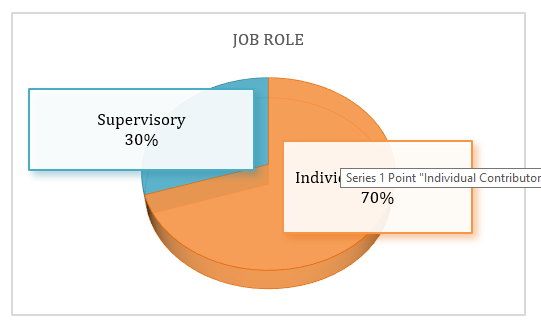
The following table and figure illustrate the demographic profile of the informants.
Leadership Behavior, Challenges, and Barriers to Safety Culture Integration
Significant changes in the company post-acquisition: The interviews showed that several informants with different ranges of work experience agreed that there were significant changes in the company culture after the acquisition process, especially in terms of safety, personnel competency requirements, and benefits. This change was particularly pronounced in safety policies, such as the use of protective equipment, which became stricter after the acquisition. The impact on corporate culture reflects the differences between local and multinational companies, affecting governance and the way companies operate. Informants highlighted the importance of the leadership role in articulating, socializing, and implementing this new culture by considering the characteristics and roles of individuals in the organization. Good interpersonal communication is also key in ensuring better acceptance and understanding of these changes among employees.
Table 1: Informants’ Demographic
| No | Service Year | Individual Contributor | Supervisory |
| 1 | 6 – 10 | 3 | 1 |
| 2 | 11 – 15 | 4 | 2 |
| Total | 7 | 3 |

Figure 1: Informants’ Service Year and Job Role
Table 2: Implementation of Five Exemplary Leadership
| No | Leadership Practice | Solution | Priority |
| 1 | Model The Way Find your voice Affirm shared value |
|
|
| 2 | Inspire a Shared Vision Envision the future Enlist other |
|
|
| 3 | Challenge the Process Search for opportunities Experiments and take risks |
|
|
| 4 | Enable Others to Act Foster collaboration Strengthen other |
|
|
| 5 | Encourage the Heart Recognize contributions Celebrate the values and victories |
|
|
Leadership behavior in the company after acquisition
The interviews showed that, after the acquisition process, the informants observed significant changes in leadership behavior at PT. IND, particularly regarding safety and management engagement. The majority of informants highlighted a shift from the previous lack of focus on safety to active involvement in the delivery of safety programs, such as monthly meetings and toolbox discussions. It appears that the leadership has adapted quickly to this change, showing that proactivity and open-mindedness are necessary in the face of organizational transformation. They also implemented a Care Management policy that encourages active involvement in health and care situations among employees, strengthening workplace relationships. Through example and encouragement, leaders guided workers to adopt the new corporate culture, more effective than an approach that simply dictated change to employees.
Leadership engagement in cultural integration
The informants emphasized the importance of leadership involvement in the post-acquisition integration of safety culture. They observed that management being actively involved in decision-making and setting an example to workers greatly influenced how the safety culture developed in the company. Management involvement not only helps ensure the implementation of rules and policies but also influences workers' perception of the importance of safety and the rules. Informants felt that leadership that is consistent in articulating the vision and goals of the safety culture sets a good example for workers, motivating them to follow and apply the principles in their daily work. Alignment and clarity from the top are crucial in fostering a strong and well-implemented safety culture throughout the organization.
Challenges and barriers to safety culture integration
The integration of safety culture at PT. IND after the acquisition faced several challenges stemming from various aspects. Informants highlighted changing habits that were difficult to change, especially for workers who had been with the company for a long time. Conflicts of interest between work speed and safety were also an obstacle, along with communication challenges that ensured a clear understanding of safety requirements. The need to transform old cultures into new habits and ensure uniform safety awareness among all workers was also a key focus. The lack of personnel to supervise high-risk activities and the importance of leadership commitment and example are also significant challenges. Management needs to focus on a proactive approach, patience, effective communication, and leading by example to build a strong safety culture and eliminate complacency when performing high-risk tasks.
Business Solutions
(Five) Exemplary Leadership Practices
Interpersonal communication: Effective communication, particularly in the context of leadership at PT. IND, is highly emphasized through various training platforms, such as computer-based training (CBT), which focuses on three key skills: self-awareness, trust, and patience. Leaders need to develop these competencies to communicate effectively with their subordinates, especially regarding safety culture. Active listening is also considered key in building an appropriate culture, where leaders not only talk but also give space for input from their subordinates to improve the implementation of a safety culture. In addition, leadership is responsible for building a high-performance culture, with clear objectives to ensure the team's smooth adaptation to the new culture.

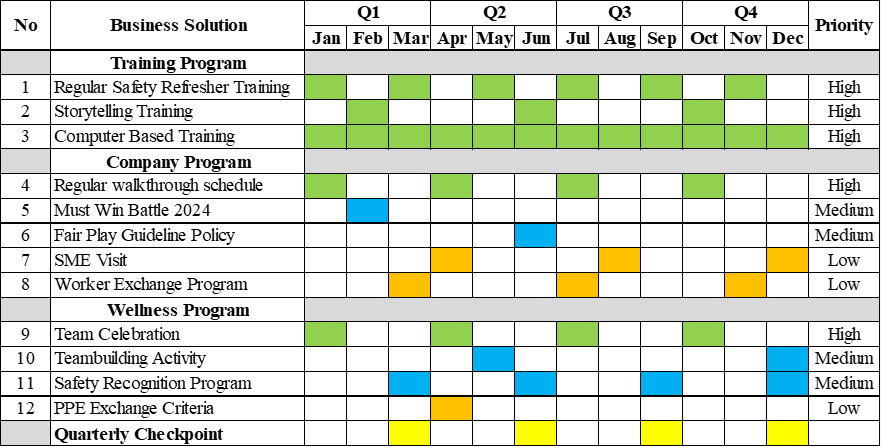
Figure 3: Implementation Plan
Implementation Plan & Justification
To provide clarity in the implementation plan, the business solution is divided into 3 (three) sections with the following program categories:
Training Program: The training program is the first category which contain both soft skill and hard skill to occupy both leadership and worker with certain competency to support safety culture implementation in particular and their literacy in general.
Company Program: The company program is part of the existing program in the company that could be utilized to foster the safety integration program. Some programs may be challenging as they need collaboration with another department.
Wellness Program: Wellness Program is a compilation of programs to increase employee engagement that hopefully could boost their work performance.
The color coding as depicted in Table 3 is used to ease the priority identification for the program implementation. Green is for high priority, blue is for medium priority and orange is for low priority. Mandatory activity such as quarterly checkpoint is distinguished using yellow color. The following point shall provide further elaboration on the prioritization.
In the company's activity plan, high, medium, and low priorities have been identified for implementation throughout the year. High-priority activities will begin in January with a focus on regular bi-monthly safety training, storytelling training, monthly CBT, and quarterly team celebrations to evaluate achievements and set future goals. Medium-priority activities, such as Must Win Battle 2024 and fair play policy, will be averaged throughout the year to minimize schedule conflicts. In addition, building weigh-in activities, safety recognition programs, and some other long-term programs are low priorities that require more thorough discussion and cooperation with other parties. These activities are scheduled at longer intervals, such as visits to SME every four months, worker exchange programs with a minimum duration of two years, and the creation of a PPE replacement matrix that requires formulation and updating in April.
The action plan is detailed by priority level, with each priority level having different schedules and activities. High-priority activities focus on safety, training, and regular team evaluations. Medium-priority activities are organized throughout the year to ensure conflict-free execution, while low-priority activities require in-depth discussions and more complex cooperation, with longer timeframes between each activity. The proposed timeline can be adjusted according to organizational readiness and business unit operations as per the company's needs and capabilities.
The results answer the research question regarding the influence of leadership on the integration of safety culture in the company after the acquisition. The research highlighted the importance of proactive leadership in understanding and implementing safety culture changes, modeling for the team, and ensuring effective communication to spread safety knowledge. The main challenge lies in changing workers' old behaviors and habits, while barriers are related to personnel limitations that may result in a lack of supervision. Here, the importance of leadership behaviors that build effective communication and personal engagement to overcome these challenges and barriers is emphasized.
Recommendations
From the results of interviews and business solutions, the recommendation for PT. IND will form a special task force to establish a competency roadmap containing high-priority business solutions, namely regular safety refresher training, storytelling training, computerbased training, regular walkthrough schedule, and team celebration.
Kotter, J. P. Leading change. Boston, MA: Harvard Business Press, pp., 1996.
Cooper, D. “Towards a model of safety culture.” Safety Science, vol. 36, no. 1, pp. 111–136, 2000.
Schein, E. H. Organizational culture and leadership (4th ed.). San Francisco, CA: Jossey-Bass, pp. ---, 2010.
Kouzes, J. M. and Posner, B. Z. The leadership challenge (4th ed.). San Francisco, CA: Jossey-Bass, pp. ---, 2007.
DeVito, J. A. The interpersonal communication book (14th ed.). London, UK: Pearson Education Limited, pp. ---, 2016.
Covey, S. R. The 7 habits of highly effective people. Utah: Stephen R. Covey Library of Congress Cataloging in Publication Data, pp. ---, 2004.
Guillaume, O. et al. “An industrial view on safety culture and safety models.” Retrieved from https://doi.org/ 10.1007 /978-3-319-95129-4_1, pp. ---, 2018.
Gilbert, C. “Safety models, safety cultures: What link?” Retrieved from https://doi.org/10.1007/978-3-319-951 29-4_2, pp. 2018.
Kouzes, J. M. and Posner, B. Z. The leadership challenge (4th ed.). San Francisco, CA: Jossey-Bass, pp. ---, 2007.
DeVito, J. A. The interpersonal communication book (14th ed.). London, UK: Pearson Education Limited, pp. ---, 2016.
Covey, S. R. The 7 habits of highly effective people. Utah: Stephen R. Covey Library of Congress Cataloging in Publication Data, pp. ---, 2004.
Guillaume, O. et al. “An industrial view on safety culture and safety models.” Retrieved from https://doi.org/ 10.1007 /978-3-319-95129-4_1, pp. ---, 2018.
Gilbert, C. “Safety models, safety cultures: What link?” Retrieved from https://doi.org/10.1007/978-3-319-951 29-4_2, pp. 2018.