Contents
Download PDF
pdf Download XML
1258 Views
123 Downloads
Share this article
Research Article | Volume 4 Issue 1 (Jan-June, 2023) | Pages 1 - 11
Determinants of Disclosure of Sustainability Report with Profitability Variables as Intervening Variables in Companies Listed In the Lq-45 Index
 ,
 ,
1
Master of Accounting, Postgraduate Program, Faculty of Economics and Business, University of Jember, Indonesia
Under a Creative Commons license
Open Access
Received
March 3, 2023
Revised
April 9, 2023
Accepted
May 19, 2023
Published
June 15, 2023
Abstract

This study aimed to examine the effect of institutional ownership, board of directors, audit committee, and company size on sustainability report disclosure with the intervening variable profitability. The population in this research is a company indexed LQ 45 in the period 2018 to 2022 with a total of 45 companies. The sampling technique used was purposive sampling. The samples obtained were 21 companies so a total of 105 units of analysis were obtained. The analysis technique used is descriptive statistical analysis and path analysis with IBM SPSS Statistic 23 software. This research shows that there is a positive influence between institutional ownership on disclosure of sustainability reports, institutional ownership on profitability, board of directors on sustainability report disclosure, board of directors on profitability, audit committee on sustainability report disclosure, audit committee on profitability, and profitability on sustainability report. Meanwhile, company size does not affect profitability and sustainability report disclosure.

Keywords
INTRODUCTION

Sustainable Development Goals (SDGs) as a global development agreement were ratified by world leaders officially on September 25, 2015, at the United Nations (UN) Headquarters. Approximately 193 heads of state attended, including Indonesian Vice President Jusuf Kalla who also endorsed the SDGs Agenda. Carrying the theme "Changing Our World: 2030 Agenda for Sustainable Development", the SDGs which contain 17 Goals and 169 Targets are a global action plan for the next 15 years (valid from 2016 to 2030), to end poverty, reduce inequality and protect the environment. SDGs apply to all countries (universal) so that all countries without exception developed countries have a moral obligation to achieve the SDGs Goals and Targets. The SDGs are a refinement of the MDGs,


One way for companies to show their contribution to the SDGs is by producing a sustainability report. A sustainability report is a report that contains information on the company's performance on economic, environmental, and social aspects which is carried out over one year. According to the Financial Services Authority (OJK), the preparation of this sustainability report also aims to communicate the company's commitment to running a sustainable business. Sustainability reports can also provide a broader and more open picture to all stakeholders regarding the sustainable development activities that have been carried out by the company. The number of sustainability report disclosures in Indonesia is still relatively low. As evidenced by the OJK, until March 2017, the number of companies listed on the IDX that had issued new sustainability reports was around 9%. Setyawan et al. [1] in his research also showed a low level of sustainability report disclosure, which can be seen from the average of the research object, which is 37.31%. In addition, Kusuma and Priantinah's research [2] also found low disclosure of sustainability reports, namely 33.20%. Company awareness to disclose voluntary reports such as sustainability reports is still lacking. According to Tobing et al. [3]. Another reason is that regulations governing sustainability reports in Indonesia only appeared in 2017 through POJK 51/POJK.03/2017. Company awareness to disclose voluntary reports such as sustainability reports is still lacking. According to Tobing et al. [3]. 


Company goals are an achievement that will be produced by a company. The company's targets are quantitative and the achievement of these targets is a measure by the success of the company's performance. As time passed, slowly the concept of corporate objectives is not only to achieve target numbers but also to fulfill environmental responsibility as a result of the company's operational activities. Participating in sustainable development is a major issue around the world for now. Not only in developed countries but also in developing countries which are struggling to prosper the economy, while the existing resources and environment decrease or shrink [4].


Discussing about the sustainability report, several things influence it. Research on disclosure of sustainability reports has been carried out by several researchers, research by Aliniar [5], Afsari et al. [6] and Nurleni et al. [7] stated that there is a positive relationship between institutional ownership variables and disclosure of sustainability reports. Meanwhile, Roviqoh and Khafid and Madani and Gayatri's research [8] reveal that institutional ownership does not affect sustainability reports. Justin and Suprajitno [9] show that the structure of the board of directors influences the disclosure of sustainability reports, while Hasanah et al. [10] state the opposite that the board of directors does not affect the disclosure of a sustainability report. Afsari et al. [6], Leksono, and Buallay and Aldhaen [11] that the audit committee influences the disclosure of sustainability reports. while the results of research conducted by Roviqoh and Khafid [12], Aliniar and Wahyuni ​​ [5], Hasanah et al. [10], and Tobing et al. [3] resulted in research that the size of a company's audit committee has no significant positive effect on the quality of sustainability report disclosure. Madani and Gayatri [8], Afsari et al. [6], Damayanti and Hadiningsih [13], Kelvin et al. and Tobing et al. [3] that company size influences the disclosure of Sustainability reports. Meanwhile, Roviqoh and Khafid [12], Aliniar and Wahyuni ​​[5], and Leksono told that company size does not affect the disclosure of Sustainability reports. Institutional ownership is considered a factor that can affect profitability [14] as well as research produced by Fitria et al. and Nurkin et al. [15]. However, Rofiqoh and Khafid [12] and Situmorang and Simanjuntak [16] show conflicting results that institutional ownership does not affect profitability. The board of directors is one of the factors that can affect profitability according to research conducted by Rumapea, Fitriyani [17], and Fitria et al. While the conflicting results were concluded by Situmorang and Simanjuntak [16] who stated that the size of the board of directors did not affect profitability. Roviqoh Research and Khafid [12] and Fitriyani [17] and Rumapea conclude that audit committees affect profitability. However, Suryanto and Refianto [14] concluded in their research that the audit committee does not affect company profitability. Company size can affect a company's ability to generate profit or profit (profitability) [18] and Roviqoh and Khafid [12] say the same thing. While the opposite result that there is no effect between company size on profitability is stated in the research of Aghnitama et al. [19]. Roviqoh and Khafid [12], Madani and Gayatri [8], Leksono, and Tobing [3] in their conclusions explain that profitability affects the disclosure of sustainability reports.


This research is interesting to do because of the research gap described above. Previous research used financial reports and Sustainability reports for the year where the OJK had not issued rules regarding sustainability reports through POJK 51/POJK.03/2017, while this research used financial reports after these rules were published. The population in this study are companies listed on the LQ-45 Index because it is a composite index of 45 issuers with high liquidity, in selecting issuers to be included in the LQ 45 index, the selection is carried out with several selection criteria [20].


Literature Review and Hypothesis Development

Agency Theory: Agency theory is a theory that explains the relationship that occurs between the management of the company as an agent and the owner of the company as the principal. The principal is the party that gives orders to other parties, namely agents, to carry out all activities on behalf of the principal [21] this theory concerns the relationship or contract between the principal and the agent. The principal is the power of a large number of shareholders, whose interest conflict with those of managers, as a result, the company shows the separation of ownership and control, by modeling the company as two rational individuals with conflicting interests. This conflict causes agents to act inconsistently with the interests of the principal, thus triggering agency costs [14]. As an agent, the manager of a company, if you want to get compensation according to the contract, the manager must optimize the profits of the principals.


Agency theory includes disclosure of sustainability reports that can minimize information asymmetry between agents and owners. Institutional ownership is the number of external institutions that have shares in the company. The size of institutional ownership can influence investor control over management to disclose a sustainability report. This is important as a form of company transparency over information which contains actions that have been taken to maintain the company's condition from an economic, environmental, and social perspective.


Legitimacy Theory

Legitimacy is an acknowledgment of the legality of something. Organizational legitimacy can be said as a potential benefit or source for the company to survive [22]. According to this theory, a company operates with permission from the community, where this permit can be withdrawn if the community judges that the company has not done the things that are required of it.


Republic of Indonesia Law number 40 of 2007 concerning Limited Liability Companies states that social and environmental responsibility is the company's commitment to participate in sustainable economic development to improve the quality of life and a beneficial environment, both for the company itself, the local community, and society in general. Setiawan et al. the problem with the disclosure of sustainability is how much data related to environmental, social, and corporate governance practices and impacts must be disclosed. A company must carry out company activities by established rules to get support from the wider community.


Stakeholder Theory

Stakeholder theory has undergone a change in definition over the past few years. Friedman [23] said that the main goal of the company is to maximize the prosperity of the owner. This shows that the definition of stakeholder initially only refers to the owner of the company. However, Friedman [23] broadens the definition of stakeholders to include more constituencies, including groups that are not profitable for the company. Damayanti and Hardiningsih [13] define stakeholders as parties who have an interest in the company and can influence company activities. The parties referred to as stakeholders are the community, employees, government, suppliers, capital markets, and others.


Institutional Ownership

Institutional ownership is the percentage of share ownership by institutions or institutions such as insurance companies, banks, investment companies, and other institutional owners. Theoretically, the higher the institutional ownership, the stronger the control over the company, the company's performance/value will increase if the company owner can control management behavior so that it acts by company goals [25]. Institutional ownership will encourage more optimal monitoring of management performance, especially in decision making


Audit Committee

According to Rule Number IX.1.5 in the Decree of the Chairman of BAPEPAM Number: Kep-643/BL/2012, ―Audit Committee is a committee established by and responsible to the Board of Commissioners in assisting the carrying out of the duties and functions of the Board of Commissioners. It was concluded that the Audit Committee is a committee formed by the Board of Commissioners which has the duties and responsibilities of assisting the Board of Commissioners in carrying out internal oversight, ensuring the effectiveness of internal auditors and external auditors, and strengthening auditor independence. In Article 1 paragraph (1) of OJK Regulation 55/2015, an audit committee is a committee formed by and is responsible to the board of commissioners in assisting in carrying out the duties and functions of the board of commissioners.


Company Size

Company size has an influence on the company in terms of the ability to bear the consequences of various situations that the company will face [26]. Large companies generally have large resources, so the companies need and can finance information for internal purposes as a whole. On the other hand, small companies require greater additional costs if the company wants their information to be disclosed comprehensively. Theoretically, large companies will not be free from pressure, and larger companies with operating activities and greater influence on society will probably have shareholders who pay attention to social programs made by the company so that disclosure of the company's Sustainability report will be wider.


Profitability

Profitability is the ability of a company to earn a profit (profit) in a certain period [27]. The company is claimed to be good if the company can obtain large profits according to the expectations of owners and investors. Profitability is a company's ability to generate profits [28]. The ultimate goal to be achieved by a company is maximum profit. Companies that get maximum profits can prosper as owners, and employees, and can improve product quality and make new investments [29].


The profitability ratio is one of the important indicators to assess the performance of a company. According to Sartono [30], profitability is the company's ability to earn profits from sales, total assets, and own capital. Thus, long-term investors will be very interested in this profitability analysis, for example, shareholders will see the benefits that will be received in the form of dividends.


Based on the Financial Services Authority Regulation [31] the audit committee acts independently in carrying out its duties and responsibilities. Audit committee members are appointed and dismissed by the board of commissioners. The audit committee consists of at least 3 (three) members from independent commissioners and parties from outside the securities company. The audit committee must be chaired by an independent commissioner who is also a member of the audit committee.


Disclosure of Sustainability Report

Sustainability reports have various definitions, according to Susanto and Tarigan [32], SR means reports that contain not only financial performance information but also non-financial information consisting of information on social and environmental activities that enable companies to grow sustainably (sustainable performance). Sustainability reports are also used by government institutions, for example from the Ministry of Environment to assess the company's performance towards the environment in every organizational disclosure. As is the case in Indonesia, regulations on CSR disclosure can be found in regulations issued by Bapepam and Law number 40/2007 concerning Limited Liability Companies.


Companies that are listed on the stock exchange should make disclosures that are open to the public (investors or potential investors). The problem with sustainability disclosure is how much data related to environmental, social, and corporate governance practices and impacts should be disclosed. According to data from OJK [33], sustainable disclosure in Indonesia is voluntary disclosure. In contrast to disclosures such as annual reports and financial reports which are mandatory for companies, especially companies with public status (listing on the stock exchange). Where the number of issuers is still smaller than non-public companies, only a few issuers on the IDX publish sustainability reporting [34].


The obligation to disclose sustainability reports is regulated more strictly in POJK No.51/POJK.03/2017 concerning the Implementation of Sustainable Finance for Financial Services Institutions, Issuers, and Public Companies. This POJK mentions the meaning of a sustainability report and sustainable finance. A sustainability report is a report announced to the public that contains the economic, financial, social, and environmental performance of an FSI, Issuer, and Public Company in running a sustainable business. Meanwhile, sustainable finance is comprehensive support for financial services to create sustainable economic growth by aligning economic, social, and environmental interests.


This POJK is one of the mechanisms to ensure that Sustainability Report reporting has a deterrent effect if it is not carried out by the company. Article 2 still in POJK No.51/POJK.03/2017 states that "LJK, issuers and public companies are required to implement sustainable finance in the business activities of LJK, issuers and public companies" meaning that sustainability reports can be implemented by companies and are something mandatory. Article 2 becomes one of the articles strengthening not only managing companies such as mining but banks also responsibility in disclosing sustainability reports.


Hypothesis

Institutional ownership is share ownership by the government, financial institutions, legal entity institutions, foreign institutions, transfer funds, and other institutions at the end of the year [14]. The institution is one of the shareholders in a company, where the composition of share ownership is determined by the percentage of share ownership [8]. Theoretically, the stronger the control within a company, which is influenced by the high institutional ownership [25]. According to agency theory [21], one way to reduce agency costs is to increase institutional ownership in the framework of monitoring managers. Corporate transparency from an environmental and social perspective must be maintained not only from an economic perspective, where the company's operational activities do not harm the environment [12]. Aliniar [5], Afsari et al. [6], and Nurleni et al. [7] concluded that there is an effect of institutional ownership on the disclosure of sustainability reports.


Institutional Ownership Affects the Disclosure of Sustainability Reports

Situmorang and Simanjuntak [16] argue that institutional ownership acts as a party that acts as a party that professionally monitors the development of investments invested by shareholders. Company owners can control or control the behavior of management in carrying out their duties so that the performance or value of the company will increase [25]. The greater the institutional investment, the investor will play a significant role in monitoring management performance. In Agency Theory, the ownership structure is considered capable of influencing company profitability [12], as a result, institutional ownership can affect profitability (Suryanto and Refianto, 2019) as well as research produced by Fitria et al. and Nurkin et al. [15].


Institutional Ownership Affects Profitability

The size of a larger board of directors has a wider range of resources and opportunities compared to a smaller board this is because the decisions of the board of directors will be better because there are many experienced board directors, so there are more board directors then the decision will be increasingly unaffected. The results of research by Justin and Suprajitno [9] show that the structure of the board of directors influences the disclosure of sustainability reports. Of the three variables studied (size of the board of directors, representation of female directors, and ownership of the board of directors), it is evident that the size of the board of directors has a positive effect on the disclosure of the Sustainability report [14]. shows that the board of directors influences the disclosure of the Sustainability report. Fitria et al. and Nurkin et al. [15] show that the board of directors affects the disclosure of the Sustainability report. Based on the description above, the hypothesis is formed as follows:


The Board of Directors Influences the Disclosure of the Sustainability Report

The board of directors can affect the effectiveness of monitoring activities [16]. Based on Agency Theory where more and more boards of directors in the company will provide a form of oversight that can minimize information asymmetry (Information Asymmetry). Information that allows fraud or errors in accounting procedures to occur will be minimized by having a board of directors. The company's performance will increase which is marked by increased company profitability. The board of directors is one of the factors that can affect profitability according to research conducted by Rumapea, Fitriyani [17], and Fitria et al. Based on the description above, the hypothesis is formed as follows:


The Board of Directors Affects Profitability

The audit committee is a committee appointed by the company as a liaison between the Board of directors and external audit, internal auditors, and independent members [5]. Roviqoh and Khafid [12] in taking on their responsibilities, the audit committee must coordinate. This communication is the duty of the audit committee in charge its duties to supervise management in reporting company performance results. Based on the Stakeholder Theory, information transparency made by company management can be maximized due to encouragement from the audit committee so that the information is following the needs of stakeholders. Sustainability reports are a form of the company's commitment to social issues and environmental issues to stakeholders [6]. This results in the establishment of good relations between the company and outsiders and the company's image will be good. In line with the conclusions of Afsari et al. [6], Leksono, and Buallay and Aldhaen [11] that the audit committee influences the disclosure of sustainability reports. Based on the description above, the following hypothesis is formed


The Audit Committee Influences the Disclosure of the Sustainability Report

Regular meetings are held by the audit committee to discuss problems that occur within the company [12]. Based on agency theory, this meeting is expected to reduce information asymmetry, which can become a problem. Problems that occur can be in the form of the possibility of inappropriate accounting procedures or even data manipulation. The more the number of the board of directors is in line with the increase in profitability. Research by Roviqoh and Khafid [12], Rumapea, and Fitriyani [17] show that the audit committee affects profitability. Based on the description above, the following hypothesis is formed


The Audit Committee Affects Profitability

Firm size has an influence on the company in terms of the ability to bear the consequences of various situations that will face by the company [26]. On the other hand, small companies require greater additional costs if the company wants their information to be disclosed comprehensively. So, it can be assumed that small companies face less political pressure compared to large companies. One of the levels of investor confidence is determined by the size of the company. Large companies have the consequence of getting more attention from the public as the company's influence on society and the environment [12]. Based on legitimacy theory, as the owner of resources that will later be used by a company, the company must obtain permission from the community in carrying out its operations. The size of the company will require it to carry out social and environmental activities. Madani and Gayatri [8], Afsari et al. [6], Damayanti and Hadiningsih [13], Kelvin et al. and Tobing et al. [3] state that company size influences the disclosure of sustainability reports. Based on the description above, the following hypothesis is formed: Kelvin et al. and Tobing et al. [3] state that company size affects Sustainability report disclosure. Based on the description above, the following hypothesis is formed: Kelvin et al. and Tobing et al. [3] state that company size affects Sustainability report disclosure. Based on the description above, the following hypothesis is formed:


Company Size Affects Sustainability Report Disclosure

The size of operational activities within the company can be reflected in the size of the company, large companies can produce on an economic scale, as a result, the products produced have low unit prices, this low unit price makes the company have high competitiveness in the market [12]. As a result, there is an increase in the company's sales, which in turn increases the company's profits. Thus, large-scale companies have more opportunities to increase their profitability. Based on stakeholder theory, increasing profitability is the responsibility of the company to meet the expectations of all stakeholders. So, company size can affect a company's ability to generate profit or profit (profitability) [18] and Roviqoh and Khafid [12] and say the same thing. Based on the description above, the following hypothesis is formed:


Firm Size Affects Profitability

The profitability ratio is an important indicator for assessing a company's performance, this ratio is used to assess a company's ability to make a profit. as well as provide a measure of the effectiveness of the management of a company [3]. Thus, long-term investors will be very interested in this profitability analysis, for example, shareholders will see the benefits that will be received in the form of dividends. Revealing the sustainability report and the size of a company's profitability is important. The ability of a company to earn more profit is a reference that the company can be said to be financially healthy [12]. Based on the theory of legitimacy stated that to create conditions that are acceptable to society and the environment, the company will try to meet the needs of stakeholders, including information needs that are manifested through the disclosure of sustainability reports. Roviqoh and Khafid [12], Madani and Gayatri [8], Leksono, and Tobing [3] in their conclusions explain that profitability affects the disclosure of sustainability reports. Based on the description above, the hypothesis is formed as follows: Leksono and Tobing [3] in their conclusions explain that profitability affects the disclosure of sustainability reports. Based on the description above, the hypothesis is formed as follows: Leksono and Tobing [3] in their conclusions explain that profitability affects the disclosure of sustainability reports. Based on the description above, the hypothesis is formed as follows:


 

  • Profitability affects the disclosure of sustainability reports          

MATERIALS AND METHODS

Researchers use quantitative research methods. Sugiyono [35] quantitative method can be interpreted as a research method based on the positivist philosophy, used to examine certain populations or samples, collect data using research instruments, and data analysis are quantitative/statistical. Using secondary data in the form of Annual Reports which are accessed through the IDX website and sustainability reports which are accessed through the related company websites. The reporting period used is the period from 2018 to 2022 Table 1 with consideration that regulations governing sustainability reports in Indonesia only appeared in 2017 through POJK 51/POJK.03/2017 where previously it was only voluntary. Using a purposive sampling technique for selecting samples from companies registered with LQ45. The criteria that the author uses are as follows:


Table 1: Research Sample Selection Criteria

No.Sample CriteriaAmount
1.The company is listed on the IDX indexed LQ 4545
2.Companies listed on the IDX that are inconsistent in the LQ45 index in the period 2018 – 2022.12
3.LQ45 companies that do not publish Annual Reports in 2018–20222
4.Companies that do not publish sustainability reports in 2018-202210
Number of sample companies21
The number of samples during the research year (2018–2022) (21*5)105

Source: Processed data, 2023

RESULTS

Descriptive statistics describe data as information that is clearer and easier to understand. This study uses descriptive statistics to determine the description of data that can be seen from the average (mean), maximum and minimum values ​​, and standard deviation of the research variables. The results of processing the descriptive statistical data of the research variables are shown in Table 2 below:


Based on the results of the analysis in Table 2, it can be seen that the Institutional Ownership variable shows an average value (mean) of 0.89. The lowest value of the Institutional Ownership variable is big0.51 in the ADHI company in 2019 this condition reflects the condition of the composition of ownership by the government of 51%, the rest is owned by the public with ownership of less than 5%. The highest value of 98% in the 2018 BBRI company with a composition of institutional ownership by the government of 56.75%, foreign institutions at 34.33%, and owned by insurance services, social security, cooperatives, mutual funds, Limited Liability Companies, and pension funds. The standard deviation is equal to 0.1276. This means that the standard deviation value is close to the mean (mean) and the smaller the size of the data spread.


Based on the results of the analysis in Table 2, it can be seen that for variables Board of Directors shows an average value (mean) of 8.50. Variable lowest value Board of Directors is big 3.00 on company INTP 2022 and the highest score13.00 at the BBRI 2022 company consisting of the Main Director, Deputy President Director, Director of Micro Business, Director of Small and Medium Business, Director of Consumer Business, Director of Finance, Director of Human Resources, Director of Network and Services, Director of Risk and Management, Director Wholesale and Institutional Business, as well as Director of Digital and Information Technology. The number of the board of directors is a reflection of the representation of management and shareholders and must meet al.l internal and external members of the company. The standard deviation is equal to 2.4499. This means that the standard deviation value is close to the mean (mean) and the smaller the size of the data spread.


Based on the results of the analysis in Table 2, it can be seen that for variables Audit Committee shows an average value (mean) of 4,26. The lowest variable of Audit Committees is 3 people in the ASCII 2022 company with a structure of one chairman and 2 members, this number is the minimum number that must be met by an audit committee. The highest score is 8 people in the 2020 BSDE company with a structure of 1 chairman and 7 members of the audit committee, if necessary in carrying out the daily duties of the audit committee can appoint audit committee staff or secretariat as needed. The standard deviation is equal to 1.2346. This means that the standard deviation value is close to the mean (mean) and the smaller the size of the data spread.


Based on the results of the analysis in Table 2, it can be seen that for variables Company Size shows an average value (mean) of 32.37. The lowest value of the company Size is 30.56 for the AKRA 2020 company, based on the financial reports issued by AKRA, this is in line with a decrease in revenue of 18.37% and the issuer's liabilities decreased by 28% as a result of a decrease in business payables originating from fuel supplies, this was influenced by pressures from world oil prices throughout 2020. The highest score is 35.23 in the 2022 BSDE company, based on the financial reports published in 2022 BSDE experienced a positive performance with an 81% profit growth followed by an increase in assets. After having slumped during the pandemic, the property sector has shown improvement, this sector has even played a role as one of the drivers of Indonesia's economic recovery in the post-pandemic period. The standard deviation is equal to 1.4990. This means that the standard deviation value is close to the mean (mean) and the smaller the size of the data spread. 


Based on the results of the analysis in Table 2, it can be seen that for variables Profitability shows an average value (mean) of 0.14. The lowest value of Profitability as big 0.01 in the ADHI 2020 company, based on the financial reports published by ADHI in 2020 it fell drastically by 96%, this decrease in revenue resulted in a significant decrease in profit. The Covid-19 pandemic is the main problem causing an increase in foreign currency exchange rates and a decrease in activity in the economic sector which causes projects/sales to experience temporary delays. The highest score is 0.61 at the 2019 GGRM company even though during the pandemic the net profit grew 40% compared to 2018. The majority of revenue came from sales of local cigarettes, especially the machine-rolled kretek type. Another factor contributing to net profit growth was the reduction in one of the main financing items, namely general administration expenses and selling expenses. The standard deviation is equal to 0.0999. This means that the standard deviation value is close to the mean (mean) and the smaller the size of the data spread.


Based on the results of the analysis in Table 2, it can be seen that for variables Disclosure of Sustainability Report shows, an average value (mean) of 0.19 The lowest value of variable Disclosure of Sustainability Report is 0.02 in the 2019 UNTR company with the consideration of researchers in 2019 UNTR is still a transitional period in reporting obligations and still lacks understanding of the standards used in disclosing sustainability reports. The highest score is 0.43 in the INTP 2022 company with the consideration of researchers in 2020 INTP fulfills reporting obligations and already understands the standards used in disclosing sustainability reports. The standard deviation is equal to 0.1037. This means that the standard deviation value is close to the mean (mean) and the smaller the size of the data spread.


Table 2: Statistical ResultsDescriptive

Research variableNMinMaxMeansStandard Deviation
Institutional Ownership (X1)1050.510.980.890.1276
Board of Directors (X2)1053.0013.008.502.4499
Audit Committee (X3)1053.008.004,261.2346
Company Size (X4)10530,5635,2332,371.4990
Profitability (Z)1050.010.610.140.0999
Disclosure of Sustainability Report (Y)1050.020.430.190.1037

Source: Processed data, 2023


Table 3: Normality Test Results

VariableKolmogorov Smirnov valueInformation
Unstandardized Residuals0.120Normal Distribution

Source: Processed data, 2023


Table 4: Multicollinearity Test Results

VariableCollinearity StatisticsInformation
ToleranceVIF
X10.7751,290multicollinearity does not occur
X20.4912.035multicollinearity does not occur
X30.5521,810multicollinearity does not occur
X40.7761,289multicollinearity does not occur
Z0.6331,581multicollinearity does not occur

Source: Processed data, 2023


Table 5: Glejser Test Results

VariableSigInformation
X10.701No Heteroscedasticity
X20.066No Heteroscedasticity
X30.424No Heteroscedasticity
X40.431No Heteroscedasticity
Z0.420No Heteroscedasticity

 Source: Processed data, 2023


Classic Assumption Test

Data Normality Test: The normality test aims to test whether, in the regression method, the confounding variables or residuals are normally distributed or not. The Kolmogorov-Smirnov test is a data normality test by comparing the distribution of the data to be tested for normality with the standard normal distribution. The normality test results are as follows:


Based on the test results in the Table 3, it can be seen that the probability or significance value of the variablestudygreater than 0.05. So, it can be stated that the data in this study are normally distributed


Multicollinearity Test

The purpose of this multicollinearity test is to test whether the regression model found a correlation between independent variables. The absence of a correlation between the independent variables reflects a good regression capital. The results of the multicollinearity test are as follows:


Based on the analysis results Collinearity Statistic swhich can be seen in Table 4, It is known that the model does not have multicollinearity. This is indicated by the VIF value <10 and tolerance >0.1.


Heteroscedasticity Test 

The heteroscedasticity test was carried out to find out whether in the regression model there is an inequality of variance from the residual of one observation to another. This test was carried out using the Glejser test. The results of the heteroscedasticity test are as follows:


Based on Table 5 it can be seen that the significance value of each variable is greater than 0.05, so from these results it can be seen that there is no heteroscedasticity of the equation being tested.


Autocorrelation Test

Autocorrelation testing aims to test whether in a linear regression model there is a correlation between confounding errors in period t and errors in the previous period (t-1) and can be finished using the Durbin Watson test (DW test). This method is used to measure level one autocorrelation (first order autocorrelation). The results of the autocorrelation test are as follows:


Based on Table 6 of the test results, it can be seen that the Durbin Watson value is 1.792 between the DU value of 1.761 and 4-DU of 2.239. It can be stated that the data in this study has no autocorrelation.


Table 6: Autocorrelation Test Results

DU valueDurbin Watson Values4-DU valueInformation
1,7611,7922,239There is no autocorrelation

Source: Processed data, 2023


Table 7: Variable Path Analysis Results

StandardizedSigαInformation
TrackBetas
X1 Z0.2180.0170.05Significant
X2 Z0.3340.0170.05Significant
X3 Z0.3010.0080.05Significant
X4 Z-0.1180.2780.05Not significant
X1 Y0.2380.0400.05Significant
X2 Y0.4130.0200.05Significant
X3 Y0.3380.0190.05Significant
X4 Y0.0200.8820.05Not significant
Z Y0.1740.0180.05Significant

Source: Processed data, 2023


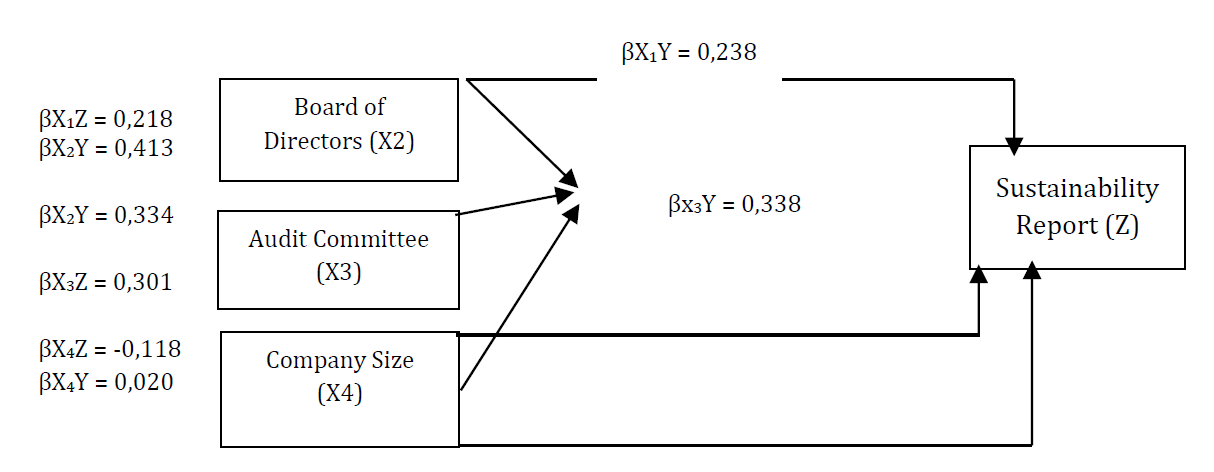
Figure 1: Path Analysis Model


Path Analysis (Path Analysis).

Path analysis is used to analyze the causal relationship between variables and test the hypothesis in this study mathematically and with the help of SPSS software. By using path analysis, it will later estimate the causal influence between variables and the position of each variable in the path, either directly or indirectly. If there is a path that is not significant then the trimming theory is applied. The results of path analysis are presented in the figure as follows:


Based on Table 7. To analyze the first path, it can be explained that Institutional Ownership X1 and Profitability Z have a significant effect. This can be seen by the significant value of 0.017 which is less than α = 0.05. The second line between the Board of Directors X2 with Profitability Z has a significant effect that is equal to 0.017 smaller than α = 0.05. The third line between the Audit Committee X3 with Profitability Z has a significant effect that is equal to 0.008 smaller than α = 0.05. The fourth line between Firm Size X4 with Profitability Z has a significant effect that is equal to 0.278 greater than α = 0.05.


Furthermore, the fifth line between Institutional Ownership X1 and Disclosure of Sustainability Reports Y has a significant effect that is equal to 0.040 smaller than α = 0.05. The sixth line between the Board of Directors X2 and with Disclosure of Sustainability Report Y has a significant effect of 0.020 which is smaller than α = 0.05. The seventh track between the Audit Committee X3 with Disclosure of Sustainability Report Y has a significant effect of 0.019 which is smaller than α = 0.05. The eighth line between Firm Size X4 with Disclosure of Sustainability Report Y has a significant effect of 0.882 which is greater than α = 0.05. The ninth line between Profitability Z with Disclosure of Sustainability Report Y has a significant effect that is equal to 0.018. The results of path analysis can be seen in the following Figure 1:

Information:


  • βX1Z: Path coefficient of direct influence Institutional Ownership (X1) to Profitability (Z)

  • βX2Z: Path coefficient of direct influence board of Directors (X2) to Profitability (Z)

  • βX3Z: Path coefficient of direct influence Audit Committee (X3) to Profitability (Z)

  • βX4Z: Path coefficient of direct influence company Size (X4) to Profitability (Z)

  • βX1Y: Path coefficient of direct influence institutional Ownership (X1) disclosure of Sustainability Report (Y)

  • βX2Y: Path coefficient of direct influence board of Directors(X2) to Skills Disclosure of Sustainability Report (Y)

  • βX3Y: Path coefficient of direct influence Audit Committee (X3) disclosure of Sustainability Report (Y)

  • βX4Y: Path coefficient of direct influence company Size (X4) to Skills Disclosure of Sustainability Report (Y)


Table 8: Test Results t

VariableSig
X1 Z0.017
X2 Z0.017
X3 Z0.008
X4 Z0.278
X1 Y0.040
X2 Y0.020
X3 Y0.019
X4 Y0.882
Z Y0.018

Source: Processed data, 2023


  • βZY: Path coefficient of direct influence profitability (Z) to Skills Disclosure of Sustainability Report (Y)


The path coefficient is calculated by making a structural equation, namely the regression equation which shows the relationship. The path analysis model in the equation is as follows:


Z = 0.218X1Z+0.334X2Z+0.301X3Z–0.118X4Z+e

(1)

Y = 0.238X1Y+0.413X2Y+0.338X3Y+0.020X4Y+0.174ZY +e

                (2)


Hypothesis Testing

T-test: The t-statistical test can be used to show how far the influence of one independent variable individually explains the dependent variable. The results of the t-test are as follows:


Based on Table 8, it can be seen that the influence of each independent variable on the dependent variable is as follows:


  • Institutional Ownership (X1) of the Profitability Variable (Z): The significance level α of the Institutional Ownership variable X1 is 0.017<0.05. This means that institutional ownership has a significant effect on profitability

  • Board of Directors (X2) to Profitability Variable (Z): The significance level α of the Board of Directors variable X2 is 0.017>0.05. This means that the Board of Directors has a significant effect on profitability

  • Audit Committee (X3) on Profitability Variable (Z): The significance level α of the Audit Committee variable X3 is 0.008<0.05. This means that the Audit Committee has a significant effect on Profitability

  • Company Size (X4) to Profitability Variable (Z): The significance level α of the variable Firm Size X4 is 0.278>0.05. This means that company size has no significant effect on profitability

  • Institutional Ownership (X1) of the Sustainability Report Disclosure Variable (Y): The significance level α of the Institutional Ownership variable X1 is 0.040<0.05. This means that Institutional Ownership has a significant effect on Sustainability Report Disclosure

  • Board of Directors (X2) on the Sustainability Report Disclosure Variable (Y): The significance level α of the Board of Directors variable X2 is 0.020>0.05. This means that the Board of Directors has a significant influence on the Sustainability Report Disclosure

  • Audit Committee (X3) on the Sustainability Report Disclosure Variable (Y): The significance level α of the Audit Committee variable X3 is 0.019<0.05. This means that the Audit Committee has a significant influence on Sustainability Report Disclosures

  • Company Size (X4) to the Sustainability Report Disclosure Variable (Y): The significance level α of the variable Firm Size X4 is 0.882>0.05. This means that company size has no significant effect on Sustainability Report Disclosures

  • Profitability (Z) on the Sustainability Report Disclosure Variable (Y): The significance level α of the Profitability variable Z is 0.018<0.05. This means that Profitability has a significant effect on Sustainability Report Disclosure

CONCLUSION

Based on the results of the analysis and discussion that the researcher has explained, it can be concluded as follows:


  • The results of the path test on the influence of Institutional Ownership on Sustainability Report Disclosures show a significant positive effect. This proves that high institutional ownership will increase Sustainability Report Disclosure

  • The results of the path test on the effect of Institutional Ownership in Profitability show a significant positive effect. This proves that high institutional ownership will increase profitability

  • The results of the path test on the influence of the Board of Directors in the Disclosure of the Sustainability Report show a significant positive effect. This proves that high institutional ownership will increase Sustainability Report Disclosure.

  • The results of the path test on the influence of the Board of Directors in the Disclosure of the Sustainability Report show a significant positive effect. This proves that high institutional ownership will increase Sustainability Report Disclosure.

  • The results of the path test on the influence of the Audit Committee in Profitability show a significant positive effect. This proves that a high Audit Committee will increase Profitability

  • The results of the path test on the influence of the Audit Committee in Profitability show a significant positive effect. This proves that a high Audit Committee will increase Profitability

  • The results of the path test on the effect of Company Size in Sustainability Report Disclosures show no significant effect. This proves that a high company size will not make changes to the Sustainability Report Disclosure

  • The results of the path test on the influence of Firm Size in Profitability show no significant effect. This proves that a high company size will not make a difference in profitability

  • The results of the path test on the influence of Profitability in the Disclosure of Sustainability Reports show a significant positive effect. This proves that high Profitability will increase Sustainability Report Disclosures


Limitations                                                                                                                                                         

This study has limitations that affect the results of the study. These limitations are:


  • This study has limitations on the use of all categories of companies, both financial and non-financial companies

  • The research period used included during the Covid-19 pandemic where almost all economic sectors were affected

  • The only variable for company size is total assets, while there are many ratios that can be used, such as market capitalization, total sales, and total employees


Suggestion


  • Future research is expected to be able to analyze by separating the categories of financial and non-financial companies

  • Future research is expected to be able to use the observation period when there is no impact of the Covid-19 pandemic which allows data to be obtained with a more accurate probability level

  • Further research is expected to using other ratios such as market capitalization, total sales, and total employees for company size variables

REFERENCE
  1. Setiawan K. et al. “The influence of profitability solvability and company size on disclosure of sustainability reports in banking companies listed on the Indonesia Stock Exchange and Malaysia Stock Exchange for the 2013–2017 period.” 2019, pp. 30–39.

  2. Kusuma A.W. and D. Priantinah. “The effect of disclosure of sustainability reports and company size on firm value with profitability as a moderating variable in companies joining filled and conventional period 2014–2016.” Nominal Journal, vol. 7, no. 2, 2018, pp. 91–105.

  3. Tobing R.A. et al. “The influence of financial performance company size and good corporate governance on disclosure of sustainability reports in manufacturing companies listed on the Indonesian Stock Exchange.” Indonesian Accounting and Business Review, vol. 3, no. 1, 2019, pp. 102–123.

  4. Mudiyanselage N.C. “Board involvement in corporate sustainability reporting: Evidence from Sri Lanka.” The International Journal of Business in Society, 2018.

  5. Aliniar D. and S. Wahyuni. “The influence of good corporate governance mechanisms and company size on the disclosure quality of sustainability reports in companies registered in BEI.” Komparteen, vol. 15, no. 1, 2017.

  6. Afsari R. et al. “The influence of leverage company size audit committee and institutional ownership on the extent of sustainability report disclosure.” E-Journal of Accounting, Ganesha University of Education, vol. 8, no. 2, 2017.

  7. Nurleni N. et al. “The influence of managerial and institutional ownership on disclosure of corporate social responsibility.” International Journal of Law and Management, 2018, doi:10.1108/IJLMA-03-2017-0078.

  8. Madani N.K. and Gayatri. “Profitability company size company age institutional ownership and disclosure of sustainability report.” E-Journal of Accounting, vol. 31, no. 4, 2021, pp. 822–835.

  9. Justin P. and P.T. Hadiprajitno. “The influence of the structure of the board of directors on the disclosure of the company’s sustainability report.” Diponegoro Journal of Accounting, vol. 8, no. 3, 2019, pp. 1–9.

  10. Hasanah N. et al. “The influence of corporate governance on disclosure of sustainability reports in companies in Indonesia.” Journal of Accounting and Finance Review, vol. 5, no. 1, 2015, pp. 711–720.

  11. Buallay A. and E. Alden. “The relationship between audit committee characteristics and the level of sustainability report disclosure.” Proceedings of the 17th Conference on E-Business E-Services and E-Society, 2018, pp. 1–5.

  12. Khafid D.I. “Profitability in mediating the effect of ownership.” Business and Economic Analysis Journal, vol. 1, no. 1, 2021, pp. 14–26.

  13. Damayanti A. and P. Hardiningsih. “Determinants of disclosure of sustainability reports.” Journal of Accounting and Tax, vol. 22, no. 1, 2021, pp. 1–16.

  14. Suryanto A. and Refianto. “Analysis of the implementation of good corporate governance on financial performance.” Bina Management Journal, vol. 8, no. 1, 2019, pp. 1–33.

  15. Nurkhin A. et al. “Relevance of ownership structure to the profitability and value of consumer goods companies.” Journal of Multiparadigm Accounting, vol. 8, no. 1, 2017, pp. 35–46.

  16. Situmorang C.V. and A. Simanjuntak. “The effect of corporate governance on the financial performance of banking companies listed on the Indonesian Stock Exchange.” Journal of Accounting and Business, 2019, pp. 160–169.

  17. Fitriyani Y. “Influence of the board of commissioners board of directors and audit committee on banking profitability on the IDX.” MEA Scientific Journal, vol. 5, no. 2, 2021, pp. 849–867.

  18. Giriyani N.L. and L.A. Diyani. “Effect of cash conversion cycle liquidity and firm size on profitability.” Profita: Scientific Communication of Accounting and Taxation, vol. 12, no. 1, 2019, pp. 130–143.

  19. Aghnitama R.D. et al. “The influence of company size on company profitability in the Investor33 index in BEI.” Journal of Accounting and Management, vol. 18, no. 2, 2021, pp. 1–11.

  20. Polakitan C.D. “Comparative analysis of LQ45 and non-LQ45 stock risks in several sub-sectors of companies listed on the Indonesia Stock Exchange.” Journal of Business and Management Research, vol. 3, no. 1, 2015, pp. 61–72.

  21. Jensen M.C. and W. Meckling. “Theory of the firm: Managerial behavior agency costs and ownership structure.” Journal of Financial Economics, vol. 3, 1976, pp. 305–360.

  22. Chariri and I. Ghozali. Accounting theory. Diponegoro University Publishing Agency, 2007.

  23. Friedman M. Capitalism and freedom. University of Chicago Press, 1962.

  24. National Committee on Governance Policy. General guidelines for corporate governance. 2006, www.governanceindonesia.or.id.

  25. Dervish H. “Corporate governance on company performance.” Journal of Finance and Banking, vol. 13, 2009, pp. 418–430.

  26. Andreas et al. “The effect of firm size media exposure and industry sensitivity to corporate social responsibility disclosure and its impact on investor reaction.” International Conference on Accounting Studies, 2015.

  27. Rejeki S. “The effect of family ownership good corporate governance practices and profitability on earnings management.” EMBA Journal, vol. 2, no. 1, 2015, pp. 1–15.

  28. Gunawan I.K. et al. “The effect of company size profitability and leverage on profit management in manufacturing companies listed on the Indonesia Stock Exchange.” E-Journal of Accounting, Ganesha University of Education, vol. 3, no. 1, 2015, pp. 103–127.

  29. Kasmir. Corporate financial management: Theory and practice. Rajagrafindo Persada, 2016.

  30. Sartono A. Financial management theory and applications. 4th ed., BPFE, 2012.

  31. Financial Services Authority. Financial services authority regulation number 51/POJK.03/2017 concerning implementation of sustainable finance. 2017.

  32. Susanto Y.K. and J. Tarigan. “Effect of sustainability report disclosure on company profitability.” Business Accounting Review, vol. 1, 2013.

  33. Financial Services Authority. Financial services authority regulation number 23/POJK.04/2016 concerning mutual funds. 2016.

  34. Fariz et al. “The influence of managerial ownership and financial distress on the integrity of financial statements.” Assets, vol. 7, no. 1, 2017, pp. 99–119.

  35. Sugiyono. Business research methods. 3rd ed., CV Alfabeta, 2017.

License
CC BY-NC-ND
Creative Commons Attribution-NonCommercial-NoDerivatives 4.0 International License
Determinants of Disclosure of Sustainability Report with Profitability Variables as Intervening Variables in Companies Listed In the Lq-45 Index © 2026 by Putri Zuhairo Aimma, Ririn Irmadariyani, Yosefa Sayekti licensed under CC BY-NC-ND 4.0
All papers should be submitted electronically. All submitted manuscripts must be original work that is not under submission at another journal or under consideration for publication in another form, such as a monograph or chapter of a book. Authors of submitted papers are obligated not to submit their paper for publication elsewhere until an editorial decision is rendered on their submission. Further, authors of accepted papers are prohibited from publishing the results in other publications that appear before the paper is published in the Journal unless they receive approval for doing so from the Editor-In-Chief.
Himalayan Journal of Economics and Business Management open access articles are licensed under a Creative Commons Attribution-Share A like 4.0 International License. This license lets the audience to give appropriate credit, provide a link to the license, and indicate if changes were made and if they remix, transform, or build upon the material, they must distribute contributions under the same license as the original.
Advertisement
Recommended Articles
Research Article
Influence of Leadership on Poverty Reduction in the Devolved Government in Trans-Nzoia County, Kenya
...
Published: 30/06/2021
Download PDF
Research Article
Modelling Structure Job Quality, Job Design and Job Satisfaction
...
Published: 30/08/2022
Download PDF
Research Article
National Approaches to Supply Chain Risk Management: A Comparative Analysis of Singapore and Vietnam with Policy Recommendations
Published: 27/01/2025
Download PDF
Research Article
Accountability and Transparency of Village Fund Management in Lumajang District
...
Published: 28/12/2023
Download PDF
Chat on WhatsApp
Flowbite Logo
Najmal Complex,
Opposite Farwaniya,
Kuwait.
Email: kuwait@iarcon.org

Editorial Office:
J.L Bhavan, Near Radison Blu Hotel,
Jalukbari, Guwahati-India
Useful Links
Order Hard Copy
Privacy policy
Terms and Conditions
Refund Policy
Others
About Us
Team Members
Contact Us
Online Payments
Join as Editor
Join as Reviewer
Subscribe to our Newsletter
Follow us
MOST SEARCHED KEYWORDS
scientific journal
 | 
business journal
 | 
medical journals
 | 
Scientific Journals
 | 
Academic Publisher
 | 
Peer-reviewed Journals
 | 
Open Access Journals
 | 
Impact Factor
 | 
Indexing Services
 | 
Journal Citation Reports
 | 
Publication Process
 | 
Impact factor of journals
 | 
Finding reputable journals for publication
 | 
Submitting a manuscript for publication
 | 
Copyright and licensing of published papers
 | 
Writing an abstract for a research paper
 | 
Manuscript formatting guidelines
 | 
Promoting published research
 | 
Publication in high-impact journals
Copyright © iARCON Internaltional LLP . All Rights Reserved.