Venture Capital (VC) has become an essential source of financing for startups and emerging businesses in Asia. As such, it has attracted significant attention from scholars who seek to understand the dynamics of VC in this region. This paper provides a comprehensive review of the existing literature on VC in Asia, spanning 7 years from 2015 to 2022. Using bibliometric analysis this study reveals that emergent research of VC in Asia has focused primarily on four themes: (1) VC in emerging economies, (2) Entrepreneurship and innovation, (3) VC and International Business and (4) Sustainable finance and environmental responsibility. While there has been a significant increase in VC research in recent years, this study identifies research gaps that offer promising avenues for future research in Asia, including fintech and crowdfunding, venture capital investment strategies, venture capital and IPOs and venture capital governance. This study contributes to the growing body of literature on VC in Asia region and provides a comprehensive overview of the key emergent research themes, trends and gaps in the field. It also suggests future research directions to help advance understanding of VC in the Asian context.
Keywords
Venture Capital
Asia
Entrepreneurship
Emerging Economies
Sustainable Finance
International Business
Bibliometric
INTRODUCTION
Cancino et al. [1] clarify that the expansion of venture capital (VC) academic research from 1990 to 2014 was greater than the growth of global science. In each of the years 1991, 1998, 2000 and 2008, venture capital research expanded by 5 to 10 percent and captured more than 20 percent of the market. This extension increases the number of highly cited works. In general, 2% of academic research has received more than 200 citations, with the almost all getting at least five.
Cumming et al. [2] Map global VC and Private Equity (PE) research between 2001 and 2021. In their study, they discuss the geographical concentration of VC research, noting that the United States has emerged as the most popular country for study among venture capital researchers, with 23.48 percent, surpassing other countries with less than 15 percent of the VC research population. Since venture capital is primarily correlated with the number of start-up companies, it is reasonable that the United States has more start-ups than other nations [3]. Even though many studies on the subject are still significantly biased toward the West, with America and Europe receiving most researchers' attention, the percentages of Asian and African nations have increased over time [2]. China is the most researched country in Asia, surpassing other western nations such as the United Kingdom and Germany by 12.61 percent (2017-2021). India and Japan, both of which are ranked in the top ten, are the other two Asian countries that are frequently studied. The trend indicates Asia has become one of the continents where venture capital research is conducted the most.
This being so, the objective of this study is to map and analyze academic literature published regarding VC in Asia. To address this objective, bibliometric analysis and systematic literature review on the VC regarding Asia region ranging between 2015-2022 are chosen. The 34 academic literatures are collected as data sample for this study. This academic literature is gathered from Scopus database with focused on journal article that presented in English language. As for methodology, quantitative approaches are used in bibliometric analysis for co-citations, bibliographic coupling and co-occurrence type of analysis. These bibliometric analysis are conducted using VOS viewer software.
This research will follow a structured format comprising the following sections: Introduction, Conceptual Framework, Methodology, Findings and Analysis, Discussion and Conclusion. Based on findings from this study, hopefully this study will contribute to the advancement of VC research, particularly in Asia region.
Conceptual Framework
In this section, the author will describe the structure of this study, beginning with the research objectives, the development of a search strategy for relevant databases and the bibliometric analysis technique that will be employed. In this part, we also describe the scope and constraints. As stated previously, the purpose of this study is to map and evaluate emerging research on venture capital in Asia. Within that work, bibliometric analysis is performed to attain this purpose. Bibliometric analysis is a scientific computer-assisted evaluation technique that can identify major authors or pieces of research, as well as their relationships, by examining all the publications pertinent to a given subject or field [4].
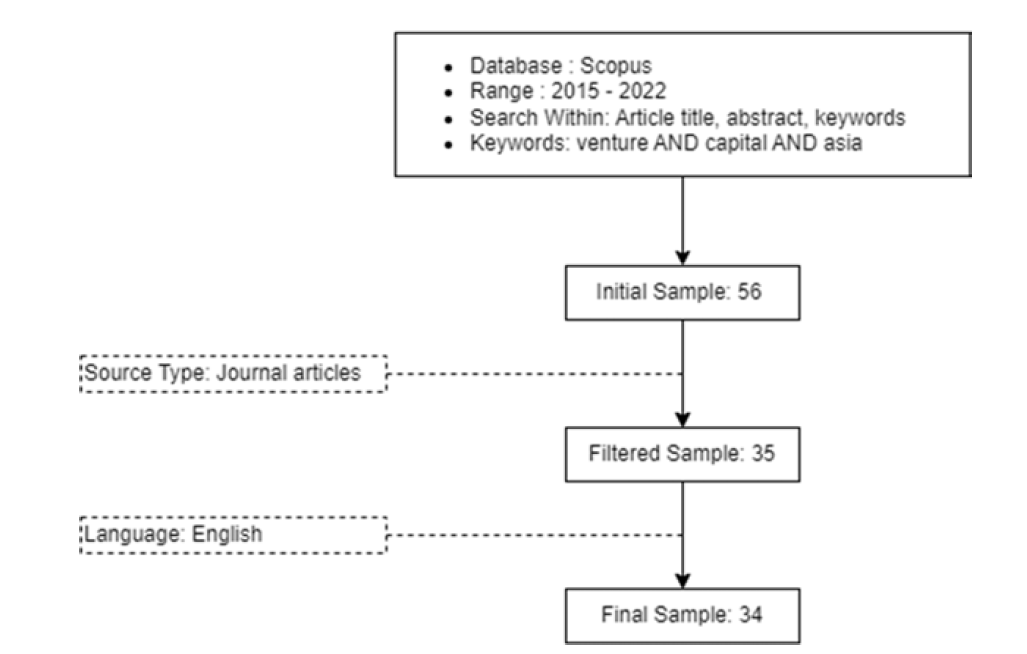
Scopus database information will serve as input for bibliometric analysis. The data spans 2015 through 2022 and includes the terms venture capital and Asia. The search begins inside the article's title, abstract and keywords based on these parameters. Figure 1 for information on the systematic search and filtering procedure. The outcome of this phase is 56 samples. This sample is then filtered with solely journal articles in mind, resulting in a 35 filtered sample. The author attempts to limit these 35 articles to those written in English exclusively. This study's final sample of 34 publications is given in Figure 1.
Figure 1: Systematic search and filter process
The 34 samples of articles are then subjected to bibliometric analysis. This paper examines the methodology utilized for bibliometric examination of co-occurrence, bibliographic coupling and co-citation. This approach, when combined with descriptive analysis, may produce a map of the most often discussed topics, the most productive and influential publication for VC research in Asia, the most referenced author and their country of origin. The subsequent section discusses the method's particulars.
RESEARCH METHODOLOGY
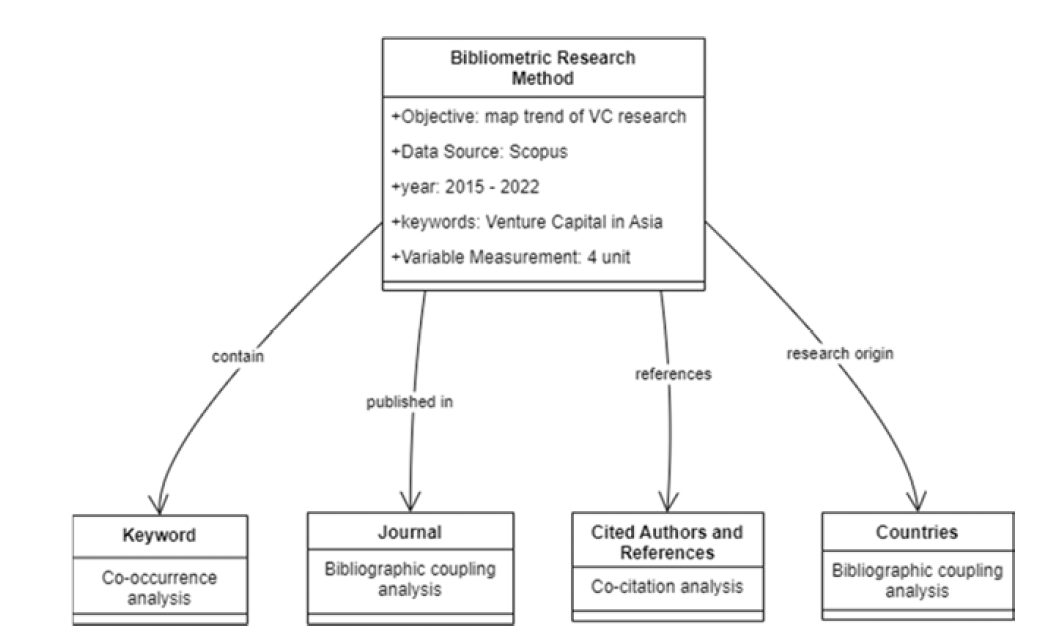
Following section will analyze the study's methodology in further detail. This study employs a quantitative approach that relies on bibliometric analysis. This methodology will offer four indications, including themes/keywords, journal, cited authors and references and article country of origin. These four indicators are derived from various bibliometric methodologies. The research framework for bibliometrics is presented in Figure 2.
Figure 2: Framework of Bibliometric Research Method
This research use VOS viewer software for bibliometric analysis. Co-occurrence is used to demonstrate which themes are addressed most frequently in VC research in Asia. According to Ding and Yang, co-occurrence may be used to explore present and potential future concerns in more depth. Bibliographic coupling is defined as the unit of coupling between two texts that share a single reference [5]. In this study, bibliographic coupling and descriptive statistics are utilized to determine the most prolific and influential journal for VC research in Asia and the country of origin for each article. Co-citation analysis, the final approach, is utilized to offer information on the most cited author and references in VC research in Asia. This study combines Bibliographic coupling and co-citation since it offers a greater scope of results for bibliometric analysis [6].
DATA RESULT AND ANALYSIS
Leading Journal in Venture Capital Research in Asia
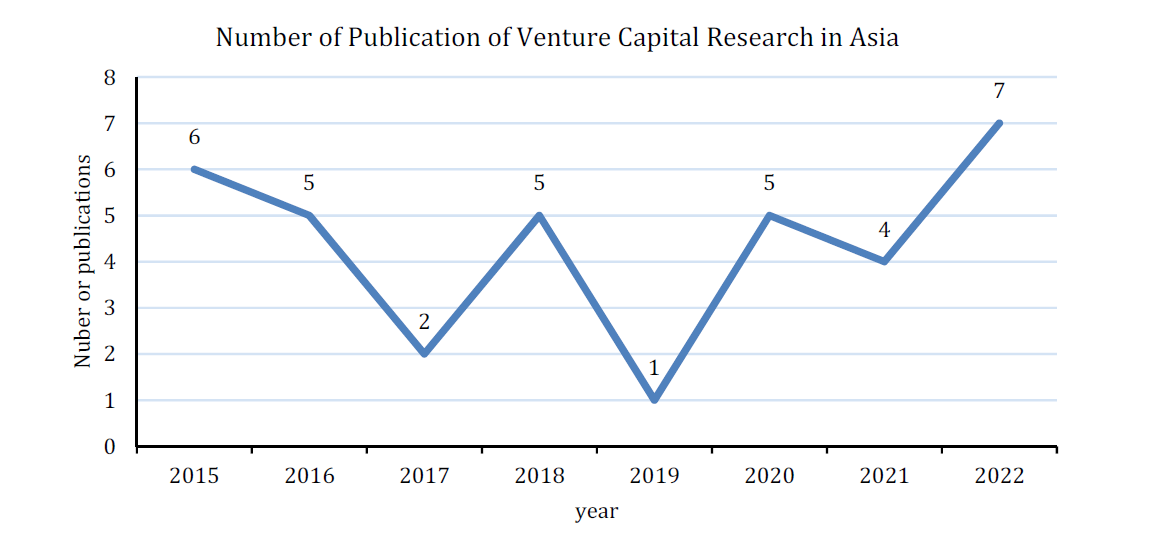
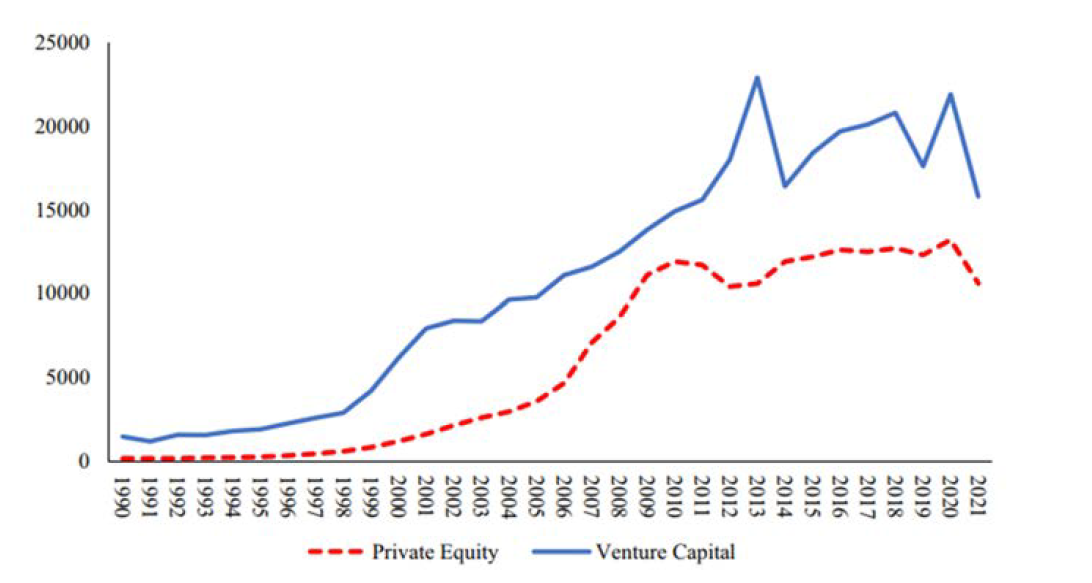
According to Cumming et al. [2] global mapping of venture capital research, the number of publications increased steadily until 2013 and then decreased significantly from 2014 to 2019. This graph illustrates a very same pattern in terms of topic Venture Capital in Asia, which begins to decline from 2015 to 2019 before rebounding in 2020 and reaching its high (relative to 2015) in 2022 (Figure 3). Since COVID 19 has become a pandemic that reduces productivity in nearly every country, including Asia, this trend of decline is likely to be influenced.
Figure 3: Trend number of publication VC research in Asia
This tendency also occurred in VC research worldwide, particularly from 2017 to 2019, as seen in Figure 2. Despite this tendency of decline, the quantity of documents relating to VC research continues to increase, especially in Asia. Cumming et al. [2] report that venture capital research in Asia increased between 2017 and 2021, which may explain why the number of publications in Asia after 2021 will be the highest compared to the preceding seven years (Figure 4).
Figure 4: Documents with the words “venture capital” and “private equity” found on Google Scholar [2]
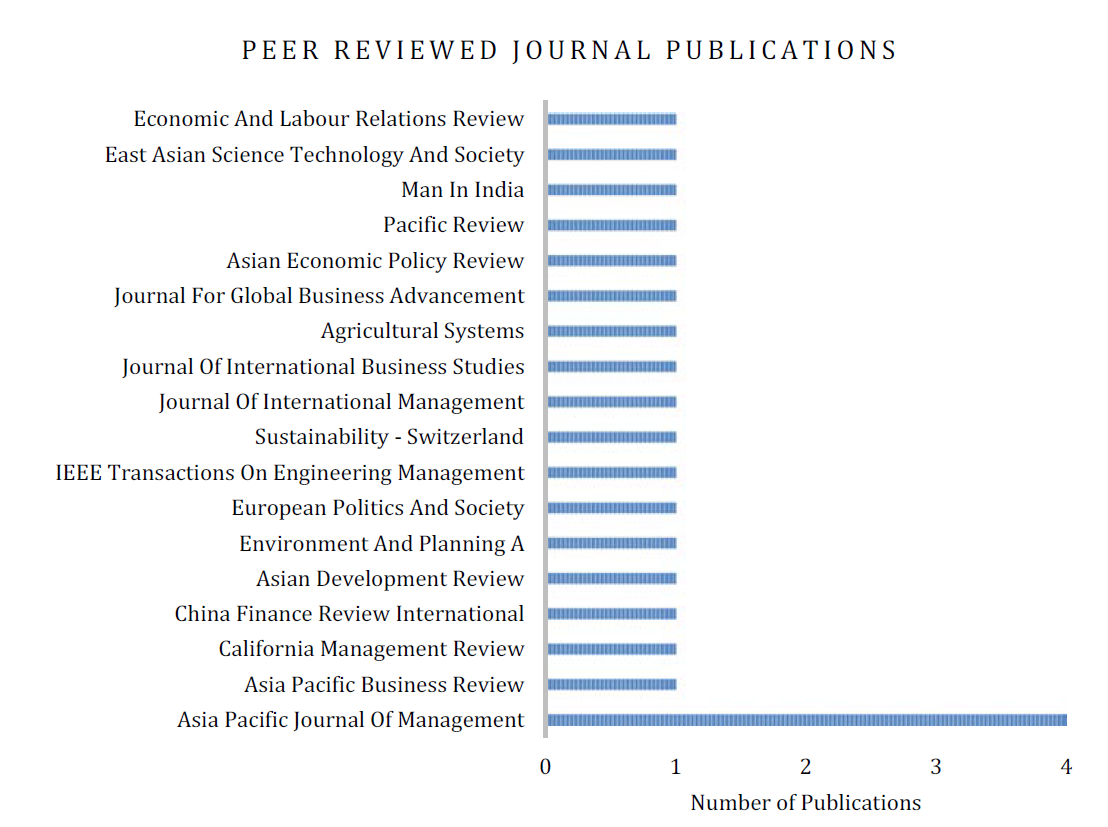
Asia Pacific Journal of Management is the most productive article that studies venture capital in Asia, with a total of four publications between 2015 and 2022, whereas the other journals only produced one journal each (Figure 5).
Figure 5: Research of Venture Capital in Asia based on publication source
Asia Pacific Journal of Management has 215 citations in 4 documents, making it the most cited journal overall. However, if we examine the most cited journal per document, Asia Pacific Business Review ranks highest with 102 citations per document, followed by California Management Review with 91 citations per document (Table 1).
Table 1: Research of VC in Asia - Journal Performance
Peer-Review Journal
Number of Publications
H Index
Quartile
SJR 2021
Total Citation
Asia Pacific Journal of Management
4
83
Q1
1.32
215
Asia Pacific Business Review
1
38
Q2
0.51
102
California Management Review
1
139
Q1
3.79
91
China Finance Review International
1
11
Q2
0.68
62
Asian Development Review
1
26
Q2
0.39
60
Environment And Planning A
1
139
Q1
1.67
51
European Politics and Society
1
27
Q1
0.55
41
IEEE Transactions on Engineering Management
1
97
Q1
0.88
36
Sustainability - Switzerland
1
109
Q1
0.66
36
Journal Of International Management
1
75
Q1
1.38
31
Journal Of International Business Studies
1
207
Q1
4.39
23
Agricultural Systems
1
118
Q1
1.55
22
Journal For Global Business Advancement
1
13
Q4
0.2
18
Asian Economic Policy Review
1
22
Q1
0.67
13
Pacific Review
1
51
Q1
0.64
10
Man In India
1
16
-
-
9
East Asian Science Technology and Society
1
17
Q2
0.37
3
Economic And Labour Relations Review
1
23
Q2
0.55
3
Business History
1
38
Q1
0.38
3
Applied Economics
1
91
Q2
0.56
3
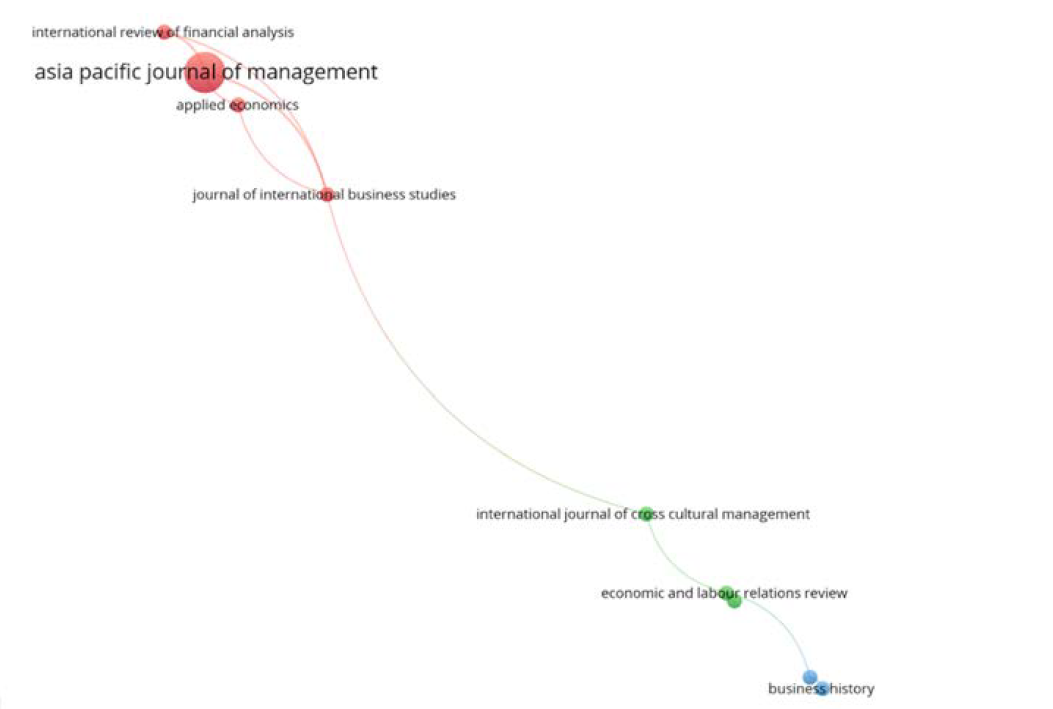
In addition to descriptive data, bibliographic coupling analysis is utilized to determine which journal is the most prolific. Judging on bibliographic coupling, the Asia-Pacific Journal of Management is the most prolific journal. It is determined by the diameter of the circle, as the larger the circle, the greater the number of published papers. Figure 6 depicts the bibliographic coupling analysis findings.
Figure 6: Bibliographic coupling-Source
Cited Author and References
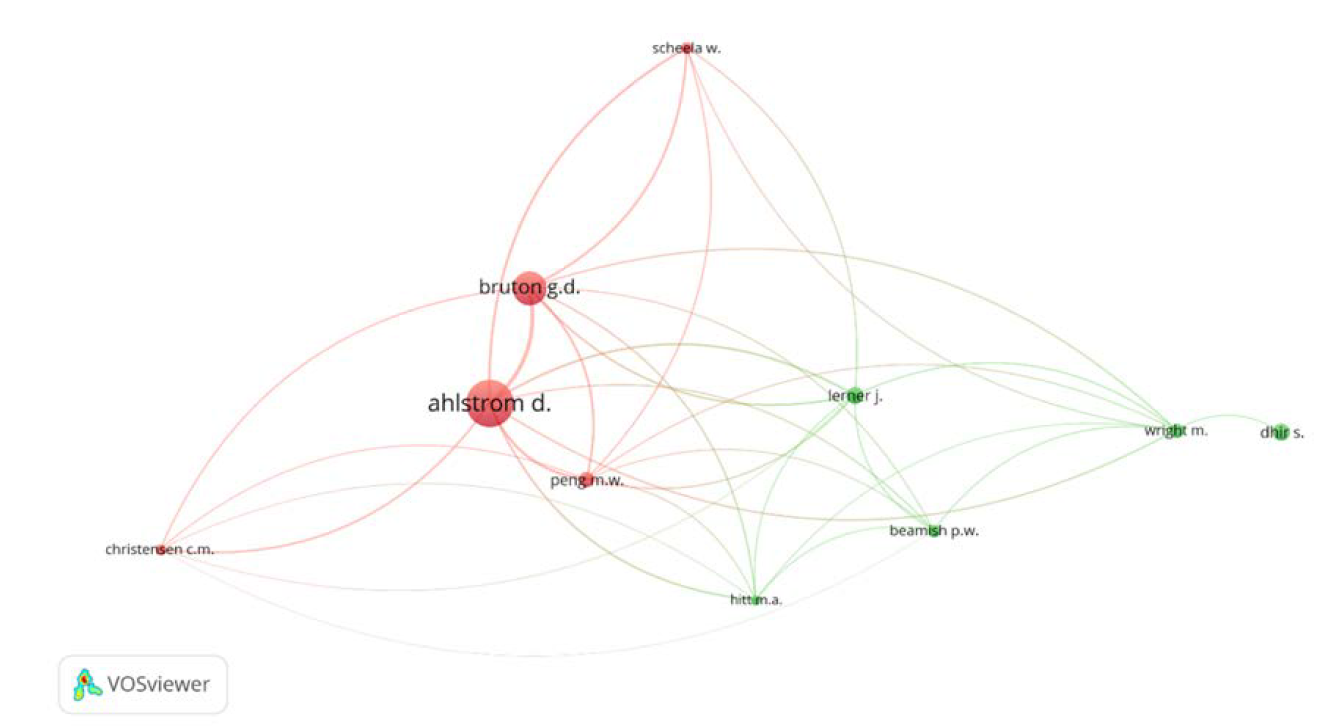
According to co-citation analysis, David Ahlstrom (ahlstrom d.) and Garry D. Bruton (bruton g.d.) are the most frequently cited authors in the Asia area for VC research. Ahlstrom d. and bruton g.d. have respectively been cited 77 and 49 times. No other author has received more than 20 citations and none have received more than 50 citations. The red connection between Ahlstrom d. and bruton g.d. indicates that they belong to the same cluster, indicating that they often have a same subject. Figure 7 illustrates the findings of the co-citation study.
Figure 7: Co-citation -Author
Country Origin
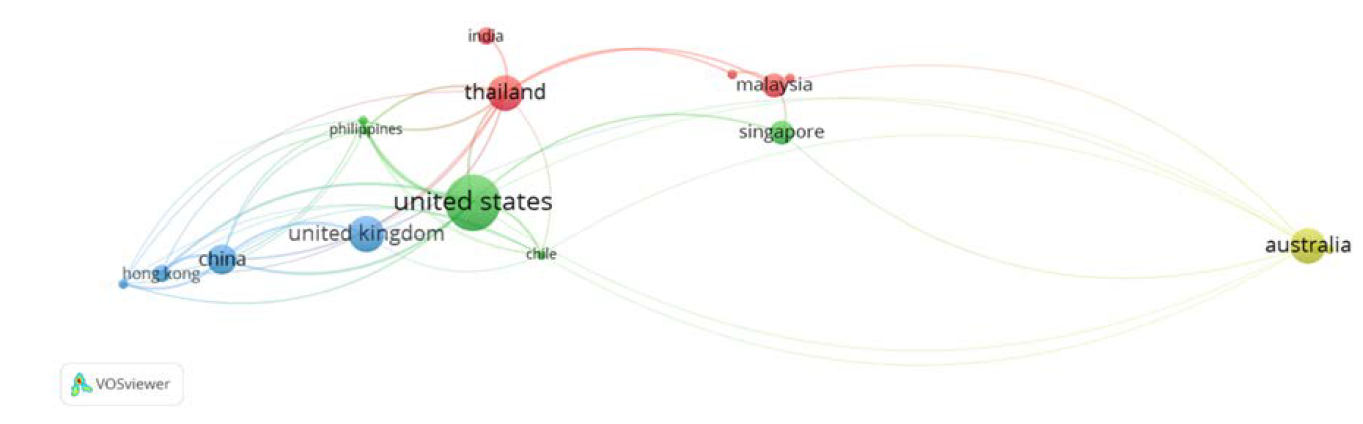
In order to create a map of VC research in Asia, country of origin is equally crucial information. The article's country of origin might be determined through bibliographic coupling. As a result, the United States is the only nation to have contributed almost six articles or more. The United Kingdom, Australia and Thailand, which are ranked second, have each published five articles. Thailand seems to be the only country in Asia to generate the greatest number of articles pertaining to emergent venture capital research in Asia. In comparison to Asian countries, non-Asian countries have conducted a greater amount of research on venture capital in the Asia-Pacific area. Figure 8 displays the bibliographic coupling results.
Figure 8: Bibliographic coupling-Countries
Theme Map of Venture Capital in Asia
In this part, the researcher will provide an overview of the topic of venture capital in Asia. It is undertaken to determine which themes are most frequently discussed in Asia and a co-occurrence analysis will be conducted to demonstrate the relationship between the themes. According to Ding and Yang, co-occurrence may be applied to explore present difficulties and potential future concerns in greater depth.
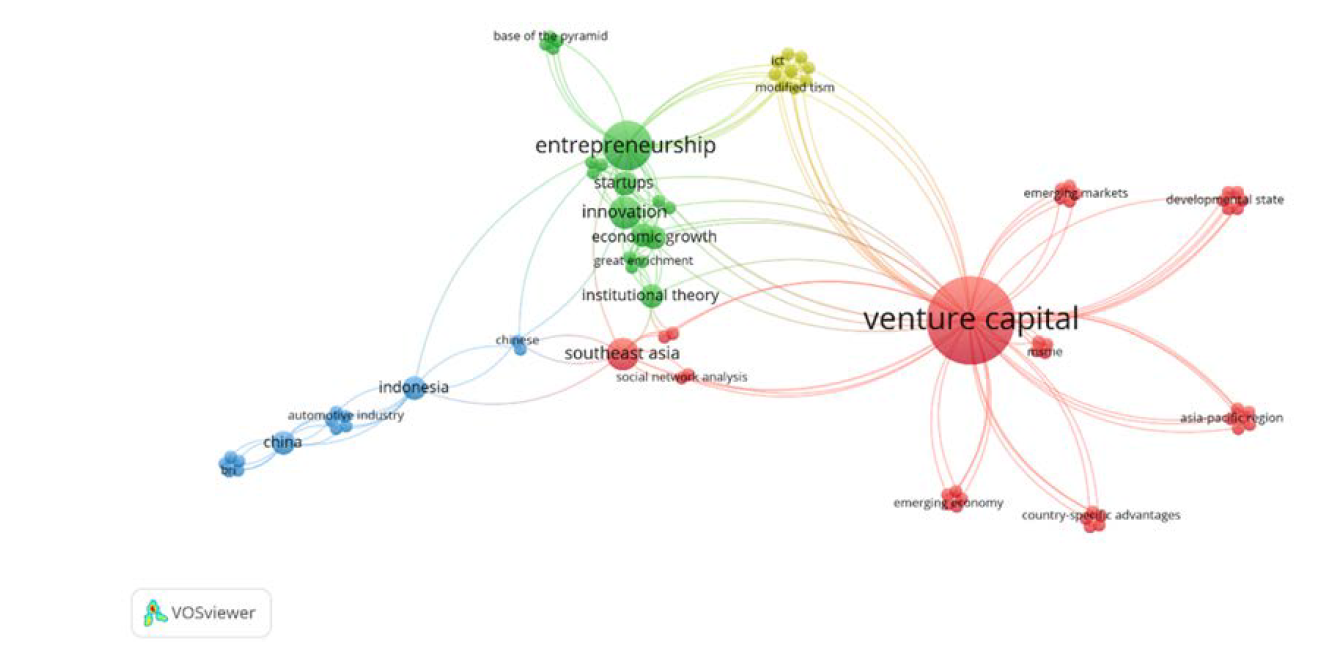
Through co-occurrence analysis, we may give an analysis of a subject that is most prevalent in Asia. First, we enter the entirety of the obtained journal data into the VOS viewer software. As stated in section 2, the data sample utilized for the co-occurrence analysis is comprised of 34 articles. The sample is then sent into the VOS viewer program for co-occurrence analysis. In this stage of data processing, the author organizes the lowest number of keywords, which is 1, resulting in 78 linked keywords, as shown in Figure 9.
Figure 9: Venture Capital subject co-occurrence analysis
Using co-occurrence analysis, a network based on the most connected themes is then formed after the key points are input and the connection strength of each topic with the others is calculated. Each subject is represented by a circle in the created network and each circle is associated with a certain colored cluster. The diameter of the circle depicts how frequently the topic occurs (e.g., the larger is the circle, the more frequent is the subject). The strength of the co-occurrence between the two topics is also indicated by the thickness of the line linking them (e.g., the thicker the line, the stronger the co-occurrence).
As a result of the co-occurrence analysis, four clusters of themes that are commonly mentioned in Venture Capital in Asia have been identified. Table 2 depicts the Cluster. From 2015 through 2022, these subjects are commonly studied in Asia.
Table 2: Cluster of emergent research theme
Cluster
Theme
Color
1
Venture Capital in Emerging Economies – Southeast Asia
Red
2
Entrepreneurship and Innovation
Green
3
Venture Capital and International Business
Blue
4
Sustainable Finance and Environmental Responsibility
Yellow
Venture Capital Themes
As a followed up from co-occurrence analysis in this section the researcher will elaborate on each cluster. There are 4 cluster as a result from co-occurrence analysis which is Venture Capital in Emerging Economies-Southeast Asia, Entrepreneurship and Innovation, Venture Capital and International Business and Sustainable Finance and Environmental Responsibility (Table 3).
Table 3: Emergent research theme elaboration of VC research in Asia
Theme
Publication
Titles
Journal
Cited
Venture Capital In Emerging Economies-Southeast Asia (Cluster 1)
Scheela et al. [7]
Formal and informal venture capital investing in emerging economies in Southeast Asia
Asia Pacific Journal of Management
29
Mingo et al. [8]
The interplay of national distances and regional networks: Private equity investments in emerging markets
Journal of International Business Studies
23
Van der Eng [9]
Chinese entrepreneurship in Indonesia: A business demography approach
Business History
3
Madi [10]
Private Equity and Venture Capital in China in the Aftermath of the Sino-American Trade Disputes
Global Journal of Emerging Market Economies
1
Aleenajitpong and Leemakdej [11]
Venture Capital Networks in Southeast Asia: Network characteristics and cohesive subgroups
International Review of Financial Analysis
1
Entrepreneurship and Innovation (Cluster 2)
Bruton et al. [13]
Entrepreneurship, poverty and Asia: Moving beyond subsistence entrepreneurship
Asia Pacific Journal of Management
110
Tomizawa et al. [14]
Economic growth, innovation, institutions and the Great Enrichment
Asia Pacific Journal of Management
72
Yin and Luo [15]
How do accelerators select startups? Shifting decision criteria across stages
IEEE Transactions on Engineering Management
37
Lee et al. [12]
Does Gender Matter in the Export Performance of International New Ventures? Mediation Effects of Firm-specific and Country-specific Advantages
Journal of International Management
31
Parameswar et al.
Factors that drive development of technological entrepreneurship in South Asia
Journal for Global Business Advancement
18
Machikita and Ueki
Measuring and Explaining Innovative Capability: Evidence from Southeast Asia
Asian Economic Policy Review
13
Pezeshkan et al. [16]
A neo-configurational institutional analysis of international venture capital attractiveness and performance: insights for Asia-Pacific
Asia Pacific Journal of Management
10
Dai et al. [17]
Late-stage venture capital and firm performance: evidence from small and medium-sized enterprises in China
Applied Economics
3
Venture Capital And International Business (Cluster 3)
Engel [18]
Global clusters of innovation: Lessons from Silicon Valley
California Management Review
92
Bassino et al. [19]
Do Japanese MNCs use expatriates to contain risk in Asian host countries?
Asia Pacific Business Review
9
Barnes [20]
Industry policy in Asia's demographic giants: China, India and Indonesia compared
Economic and Labour Relations Review
3
Sorensen and Nielsen [21]
Social capital as it pertains to international ventures in Asia: A comparative study of Theravada Buddhist Laos and Confucian China
International Journal of Cross Cultural Management
2
Paiva-Silva [22]
Understanding the Singaporean approach to state ownership: 'commercially viable strategic alignment' in historical perspective
Structural Change and Economic Dynamics
1
Hutchinson and Siew Yean [23]
The BRI in malaysia’s port sector: drivers of success and failure
Asian Affairs
1
Sustainable Finance And Environmental Responsibility (Cluster 4)
Sadiq et al. [24]
Does green finance matter for sustainable entrepreneurship and environmental corporate social responsibility during COVID-19?
China Finance Review International
63
Yoshino and Taghizadeh [25]
Combining environmental taxation, spill-over effects and community-based financing in development of renewable energy projects in Asia
Economics and Policy of Energy and the Environment
1
Aggarwal and Elembilassery [26]
Sustainable finance in emerging markets: A venture capital investment decision Dilemma
South Asian Journal of Business and Management Cases
1
Nagimova [27]
Islamic fintech: digitalization of global islamic finance
World Economy and International Relations
0
Venture Capital in Emerging Economies-Southeast Asia
This cluster theme focuses on venture capital investing in emerging markets, particularly in Asia. The papers in this cluster explore various aspects of venture capital, including the drivers of venture capital investment decisions, the impact of venture capital on firm performance and the role of expatriates in containing risk in Asian host countries.
Scheela et al. [7] "Formal and Informal Venture Capital Investing in SEA" explores the state of Venture Capital (VC) investment in Southeast Asia (SEA) and compares the formal and informal VC investment sectors in the region. This paper examines formal and informal VC investing in Southeast Asia, using a comparative analysis approach across three countries: Thailand, Philippines and Vietnam. This paper is based on a review of existing literature on the topic of VC investment in SEA and a qualitative analysis of the formal and informal VC investment sectors in the region. Scheela et al. [7] draws on case studies and interviews with VC investors and entrepreneurs to provide insights into the challenges and opportunities for VC investment in SEA.
A lack of local investment capital, restricted exit prospects and an immature startup ecosystem are cited as reasons for the absence of formal VC engagement in Southeast Asia. However, the author also observes the rise of informal venture capital activities in the region, including angel investors, family offices and corporate venture capital. The author claims that informal VC investors play a crucial role in the growth of the Southeast Asian startup ecosystem by giving seed capital and assistance to early-stage firms.
In addition, the study addresses the obstacles and potential for formal VC investors in Southeast Asia. The author emphasizes that formal VC investors have the ability to help the expansion of the startup ecosystem through the provision of bigger quantities of capital and expertise. Furthermore, they confront obstacles such as negotiating complicated regulatory regimes and locating acceptable investment opportunities.
Madi [10] studied Private Equity (PE) and VC in China in the aftermath of the Sino-American trade disputes. The study found that The study revealed that since trade tensions have begun to alter strategies related to future fundraising and capital allocation, the US-China trade war has increased new risks in an uncertain global environment. The "traditional paradigm" of globalization, in which the USA would buy low value-added Chinese items and China would utilize its capital account surplus to buy US assets, does not appear to be followed by the private equity industry's plans.
Furthermore, the move toward a more protectionist agenda signifies a long-term shift in global politics, with potential long-term ramifications for investors and businessmen alike. Due to this, private equity and venture capital allocation in China may be concentrated on the healthcare, consumer services, technology, media and telecommunications sectors despite the difficulties.
Aleenajitpong and Leemakdej [11] studied VC networks in Southeast Asia, with a focus on network characteristics and cohesive subgroups. The study observed 136 firm spread across the SEA region (Thailand, Indonesia, Malaysia, Philippines, Singapore and Vietnam) and total syndication deal 456 deal. The authors use social network analysis to analyze data from a survey of VC firms in Southeast Asia. The paper finds that VC networks in the region are highly connected, with strong ties between investors and entrepreneurs.
In contrast to China, Aleenajitpong and Leemakdej [11] discover that the VC network in Southeast Asia adheres to the small-world characteristic [12]. Singapore dominates the venture capital sector in ASEAN. Every nation in Southeast Asia relies on its ties to countries outside the region with more developed or established venture capital markets, such as Japan, China, the United States and Europe. While investing in Singaporean VC firms, the majority of foreign VC firms contact with low-networked VC firms as opposed to high-networked VC firms.
Entrepreneurship and Innovation
This cluster theme explores various aspects of entrepreneurship and innovation in Asia, including the impact of entrepreneurship on poverty reduction, the role of institutions in promoting innovation and the measurement and explanation of innovative capability in Southeast Asia.
Bruton et al. [13] studied entrepreneurship, poverty and Asia, with a focus on moving beyond subsistence entrepreneurship. The paper uses a qualitative research approach, drawing on existing literature on entrepreneurship, poverty and economic development in Asia. They argues that entrepreneurship can play an important role in reducing poverty in Asia but that policymakers should focus on promoting high-growth entrepreneurship rather than subsistence entrepreneurship. The authors suggest that this can be achieved through policies that encourage innovation, access to finance and education.
Bruton et al. [13] looks at what microlending is and isn't based on the study, as well as other strategies that academics and governments might use and continues by examining a different technique that economists have recommended as essential to promoting faster growth in areas of poverty. The informality of the business, a crucial primary institutional framework that defines entrepreneurship under circumstances of extreme poverty and on which management researchers have focused is also mentioned in this study.
Bruton et al. [13] conclude entrepreneurship is a fundamental engine of economic growth and can help in poverty reduction. They also argue that while institutional reform, property rights and financing are important for entrepreneurship, informal institutional change is also necessary for poverty reduction. They suggest that a new approach to economic development policy should focus on promoting growth entrepreneurship, which may have more promise and potential for poverty reduction in the knowledge-intensive era.
Tomizawa et al. [14] studied the relationship between economic growth, innovation, institutions and the Great Enrichment. The study argued that innovation is a key driver of economic growth and that institutions play a crucial role in promoting innovation. They summarize literature review that find Innovation that increases productivity, new business ventures and the development of new markets that enable consumption by a larger spectrum of customers lead to increased company and economic growth as well as higher living standards. The study also argued that VC can play a crucial role in funding innovative startups.
Tomizawa et al. [14] notes that geographic advantages, capital accumulation and trade expansion did not significantly contribute to economic growth. Instead, the author suggests that productive innovation, new venture creation and development were the main drivers of economic growth and that institutions play a crucial role in encouraging these activities.
Yin and Luo [15] studied how accelerators select startups, with a focus on shifting decision criteria across stages. They identify the selection procedure and latent factors, examine a special dataset of the genuine startup profiles that applied to the first seed accelerator in Southeast Asia and the accelerator's decisions.
The study examined the selection of startups by accelerator managers and discovered a small number of implicit choice criteria as well as a heuristic shifting of these criteria between the first screening and final selection stages. In the initial screening decisions, the study found eight crucial real-or-win criteria and in the final selection decisions, it identified four crucial win-or-worth criteria. The study also showed that while the end stage's crucial criteria are more explanatory of "selection" decisions, the first stage's critical criteria are more explanatory of "rejection" decisions.
Pezeshkan et al. [16] investigates why VC firms choose to invest in nations with weak institutions although previous studies suggested the contrary. The researchers have identified four institutional configurations that draw in foreign venture capital (IVC) investment using fuzzy-set qualitative comparative analysis (fsQCA).
Their findings revealed that there are four institutional configurations linked with IVC attractiveness and that none of the causal conditions are required. All configurations must have strong public governance and certain configurations also require advanced product markets and competition-friendly policies. IVC companies have excelled even in nations with extensive institutional weaknesses, indicating that they might uniquely contribute to the growth of new businesses in such environments.
Venture Capital and International Business
Bassino et al. [19] investigates the impact of host-country risk on the expatriation strategies of Japanese multinational firms in manufacturing industries in 13 host countries in Asia. According to the researcher, host-country risk is inversely connected with the level of expatriation and firm-specific variables, such as capital intensity, parent company ownership share in subsidiaries and venture age, account for the majority of the variation in the level of reliance on Japanese expatriates by subsidiaries. Contrary to other research, the authors discover that a critical firm-specific explanatory variable that positively correlates with the level of expatriation is the capital intensity of production. The study comes to the conclusion that Japanese multinational corporations use expatriates to reduce risk to parent investments in subsidiaries rather than to offset risk in the host country.
According to the study, the majority of the variation in how much a subsidiary depends on Japanese expatriates may be attributed to firm-specific criteria, such as capital intensity, ownership share and venture age. The study also shows a negative correlation between the level of expatriation and host-country risk. This shows that Japanese multinational corporations use expatriates to reduce risk to parent investments in subsidiaries rather than to offset risk in the host country. Senior management localization is a tactic to reduce national risk. The capital intensity of production of a subsidiary venture is a significant explanatory firm-specific variable that positively correlates with the degree of expatriation. These two variables are strongly connected with one another.
Paiva-Silva [22] discusses Singapore's approach to state ownership, which has resulted in a strong State-Owned Enterprise (SOE) sector that is aligned with governmental economic priorities and commercially viable. This approach has led to cautious privatization and the development of venture capital and entrepreneurship, both of which are governmental priorities.
In this paper Paiva-Silva [22] discover investments and SOEs Temasek continues to be successful and makes a large contribution to state finances, maintaining its key position in the Singaporean economy. Temasek, SOEs and other government-affiliated organizations have played crucial roles in the growth of Singapore's VC sector and private entrepreneurship, two major government priorities. Using its large financial resources, Temasek and SOEs have supported various governmental initiatives and made direct or indirect investments in some of Singapore's most prosperous high-growth businesses.
Engel [18] purpose of this paper is to investigate the potential for innovation and entrepreneurship to promote economic growth in diverse regions outside Silicon Valley. It outlines the essential traits, tendencies and connections that define Silicon Valley and investigates how they relate to various economic regions in Europe, Asia and Latin America. The study places a strong emphasis on how institutions like governments, colleges, big businesses and NGOs shape these communities. The study examines innovation communities in 11 countries and 13 distinct economic regions, looking at the role and behaviors of key players such as institutions, organizations, corporations and universities. The investigation identifies lessons, insights and strategies that may be useful for emerging innovation economies.
This study found that entrepreneurs in some ecosystems encounter significant institutional and societal barriers that have a significant impact on starting and expanding a business, whereas in others, the underlying conditions for entrepreneurship and innovation are favorable. All societies, meanwhile, have a strong tendency and push toward innovation and entrepreneurship and there is general agreement that innovative businesses and entrepreneurs have the ability to boost the economy and raise regional economic competitiveness.
Sustainable Finance and Environmental Responsibility
The first paper in this cluster is “Does green finance matter for sustainable entrepreneurship and environmental corporate social responsibility during COVID-19?” by Sadiq et al. [24], which examines the impact of green finance on sustainable entrepreneurship and environmental corporate social responsibility during the COVID-19 pandemic. The second paper is “Combining environmental taxation, spill-over effects and community-based financing in development of renewable energy projects in Asia” by Yoshino and Taghizadeh-Hesary [25], which proposes a model for combining environmental taxation, spill-over effects and community-based financing in the development of renewable energy projects in Asia. The last paper in this cluster is “Sustainable finance in emerging markets: A venture capital investment decision Dilemma” by Aggarwal and Elembilassery [26], which discusses the challenges of sustainable finance in emerging markets.
The focus of the paper is on the dilemma faced by SAIF Partners in evaluating an opportunity to invest in an Indian MSME lending enterprise as an impact investment [26]. The paper discusses the challenges of impact investing in emerging markets, particularly in India, where there is a lack of standardized tools for measuring impact investment returns and the uncertainty in regulatory provisions. This study provide examples of SAIF partner that invested in Alpha Capital.
The key finding of the paper is that impact investment is best catered by sustainable funds and not commercial funds and that there is a need for greater collaboration between the public and private sectors to support sustainable finance initiatives in emerging markets.
This paper aims to investigate green finance practices in Southeast Asia and how national and local governments, commercial banks and private corporations can incorporate green fund components into their post-COVID-19 strategies [24]. This paper finds a positive partnership between creativity and a sustainable world. It recommends that corporations uphold the principles of CSR by introducing environmentally friendly advanced technologies. Several programs have been established to expand businesses’ responsibilities to improve their confessions in sustainable growth.
This study explores the role of green finance in promoting sustainable entrepreneurship and environmental corporate social responsibility during the COVID-19 pandemic. The study was conducted in Malaysia and utilized a mixed-methods approach, including interviews with entrepreneurs, investors and policymakers. The results suggest that green finance has the potential to promote sustainable entrepreneurship and environmental corporate social responsibility during the pandemic. However, access to green finance remains a challenge, particularly for small and medium-sized enterprises (SMEs).
Sadiq et al. [24] find that CSR is crucial for social fairness, environmental sustainability and economic prosperity. For businesses to uphold the values of CSR in the development process, it is advised that they introduce innovative environmentally friendly technologies. For Firms to be motivated to implement CSR, increasing productivity and inventiveness are equally crucial. Lastly governments should work with businesses to develop environmentally friendly products and plans for ecological sustainability. Financial growth is vital for reducing environmental pollution.
DISCUSSION
As for discussion, this study compared this finding with Cumming et al. [2] research particularly regarding the emergent themes that mostly explored prominently by researcher. Cumming et al. [2] using bibliographic coupling to present emerging themes in VC research. They are using articles that were published between 2019-2021. The result is there are 7 major clusters that represent the major frontier of the field. The seven major cluster finding which is:
Venture capital and sustainable entrepreneurship
Fintech and crowdfunding
Venture capital investment strategies
Venture capital innovation
Entrepreneurial finance
Venture capital and IPOs
Drivers of venture capital funding decision
Despite there are many emergent research themes (7 cluster) but notable, there are connections between each theme, which makes sense since they all belong to the same field of study. In this way, a theme could be mentioned in passing while talking about another subject. So, the connected nature of research in the field should be considered when figuring out the details and trajectory of venture capital research. In order to answer the objective of this study which is to present map of emergent research of VC in Asia region, we do the comparison between Cumming et al. [2] theme with the finding of this study. We use systematic review to find similarity between each theme. The correlation of the possible theme is presented in Table 4.
Table 4: Correlation of emergent research themes
Cumming et al. [2]
Emergent research theme-this study
Remark
Venture capital and sustainable entrepreneurship,
Venture capital innovation
Entrepreneurial finance
Entrepreneurship and Innovation.
Sustainable Finance and Environmental Responsibility
Similar
Fintech and crowdfunding
---
No similarity
Venture capital investment strategies
---
No similarity
Venture capital and IPOs
---
No similarity
Drivers of venture capital funding decision
Venture Capital in Emerging Economies-Southeast Asia
Similar
---
Venture Capital and International Business
No similarity
In comparison with Cumming et al. [2], this study result reveal there is several similarities. This study resulting themes of entrepreneurship and innovation, sustainable finance and environmental sustainability that similar with Cumming et al. [2] themes: venture capital and sustainable entrepreneurship, venture capital innovation and entrepreneurial finance. The other result in this study is venture capital in emerging economies is considered no similarity (new theme) compared to the study conducted by Cumming et al. [2]. Venture Capital in Emerging Economies-Southeast Asia theme as discussed in previous section, mentions of factor that drives VC decision in SEA region. It is considered similar with drivers of venture capital funding decision [2].
This study theme Venture capital and International Business is considered no similarity with Cumming et al. [2] emergent research theme since it is mainly mentioned about corporate governance and international business. The other cluster theme fintech and crowdfunding, venture capital investment strategies and venture capital and IPOs have not been discussed yet in Asia’s emergent research.
Bruton et al. [28] examines how institutions, particularly those related to the regulatory environment and culture of East Asia, shape the venture capital industry and create differences from the venture capital industry in the West. They provide evidence suggesting that a range of institutional elements present in East Asia influence the actions of venture capitalists located in the region, despite similar training and norms as venture capitalists in the West. The nature of the normative institutional elements present in the East Asian region also can impact the implementation of some common venture capital activities.
In this study, the researchers rarely found the article of VC research in Asia that extend [28] paper. Only Paiva-Silva [22] that mention about understanding the Singaporean approach to state ownership which is related to study how institutions effect to VC activity in Asia. This could be interesting for future research since VC activity in Asia are different compared to West based on study [28].
CONCLUSION
Results show a steady increasing rate of VC research in Asia region during the past 7 years. The paperreports the 34 academic journals that permanently publish articles about VC research in Asia.The main contribution of this work is to develop a general overview of the VC research in Asia, which leads to the development of a future research agenda.
As mentioned above this study objective is to map and analyze academic literature of VC research in Asia. Bibliometric analyses are used to present research map such as the review of the most prominent subject, the most prominent journal, the most productive and influential authors and the countries origin of research articles. Asia pacific of journal and management become the most prolific journal with 4 articles and 215 total citations. In terms of the most influential authors that has been cited regarding VC research in Asia region are David Ahlstrom and Garry D. Bruton. They have been cited 77 and 49 respectively. As for articles country origin, United States become the only country that published above 5 articles. The second rank countries have published 5 articles which is United Kingdom, Australia and Thailand.
The most prominent subject regarding VC research in Asia region are presented in 4 cluster themes. The themes list is Venture Capital in Emerging Economies-Southeast Asia, Entrepreneurship and Innovation, Venture Capital and International Business and Sustainable Finance and Environmental Responsibility. These themes then compare with Cumming et al. [2] study to analyze the research gap. One of the emergent VC research gaps in Asia is, research on fintech and crowdfunding, venture capital investment strategies and IPOs (exit plan) are rarely found. It is interesting for future research because these three themes are considered important emergent research based on total citation in Cumming et al. [2] study.
The other major gaps is the lack of research on the influence of institutional factors on venture capital activity in Asia [28]. While there have been some studies on the role of government policies and regulations, there is a need for more research that examines the broader institutional context and its impact on venture capital activity.
REFERENCE
Cancino, C.A. et al. "A bibliometric analysis of venture capital research." Journal of Economics, Finance and Administrative Science, vol. 23, no. 45, 2018, pp. 182-195. https://doi.org/10.1108/JEFAS-01-2018-0016.
Cumming, D. et al. "Mapping the venture capital and private equity research: A bibliometric review and future research agenda." Small Business Economics, 2022. https://doi.org/ 10.1007/s11187-022-00684-9.
"Startup Ranking 2021. Ranking number of startups in the world per countries." Startup Ranking, https://www.start upranking.com/countries.
De Bellis, N. Bibliometrics and Citation Analysis: From the Science Citation Index to Cybermetrics. Scarecrow Press, 2009.
Kessler, M.M. An Experimental Study of Bibliographic Coupling between Technical Papers. Massachusetts Institute of Technology, Lincoln Laboratory, 1962.
Kleminski, R. et al. "Analysis of direct citation, co-citation and bibliographic coupling in scientific topic identification." Journal of Information Science, 2020.
Scheela, W. et al. "Formal and informal venture capital investing in emerging economies in Southeast Asia." Asia Pacific Journal of Management, vol. 32, no. 3, 2015, pp. 597-617.
Mingo, S., F. Morales, and L. Dau. "The interplay of national distances and regional networks: Private equity investments in emerging markets." Journal of International Business Studies, vol. 49, no. 3, 2018, pp. 371-386.
Van der Eng, P. "Chinese entrepreneurship in Indonesia: A business demography approach." Business History, vol. 55, no. 3, 2019, pp. 285-315.
Madi, M.A.C. "Private equity and venture capital in China in the aftermath of the Sino-American trade disputes." Global Journal of Emerging Market Economy, vol. 12, no. 1, 2020, pp. 69-79.
Aleenajitpong, N. and A. Leemakdej. "Venture capital networks in Southeast Asia: Network characteristics and cohesive subgroups." International Review of Financial Analysis, vol. 76, 2021.
Lee, I. et al. "Does gender matter in the export performance of international new ventures? Mediation effects of firm-specific and country-specific advantages." Journal of International Management, vol. 22, no. 4, 2016, pp. 365-379.
Bruton, G.D. et al. "Entrepreneurship, poverty, and Asia: Moving beyond subsistence entrepreneurship." Asia Pacific Journal of Management, vol. 32, no. 1, 2015, pp. 1-22.
Tomizawa, A. et al. "Economic growth, innovation, institutions, and the Great Enrichment." Asia Pacific Journal of Management, vol. 37, no. 1, 2020, pp. 7-31.
Yin, B. and J. Luo. "How do accelerators select startups? Shifting decision criteria across stages." IEEE Transactions on Engineering Management, vol. 65, no. 4, 2018, pp. 574-589.
Pezeshkan, A. et al. "A neo-configurational institutional analysis of international venture capital attractiveness and performance: Insights for Asia-Pacific." Asia Pacific Journal of Management, vol. 39, no. 2, 2022, pp. 365-393.
Dai, X., G. Chapman, and H. Shen. "Late-stage venture capital and firm performance: Evidence from small and medium-sized enterprises in China." Applied Economics, vol. 20, no. 4, 2018, pp. 297-315.
Engel, J.S. "Global clusters of innovation: Lessons from Silicon Valley." California Management Review, vol. 57, no. 2, 2015, pp. 36-65.
Bassino, J.P. et al. "Do Japanese MNCs use expatriates to contain risk in Asian host countries?" Asia Pacific Business Review, vol. 21, no. 3, 2015, pp. 383-402.
Barnes. 2017.
Sorensen, B., and B. Nielsen. "Social capital as it pertains to international ventures in Asia: A comparative study of Theravada Buddhist Laos and Confucian China." International Journal of Cross Cultural Management, vol. 18, no. 2, 2018, pp. 221-240.
Paiva-Silva, J. "Understanding the Singaporean approach to state ownership: 'Commercially viable strategic alignment' in historical perspective." Structural Change and Economic Dynamics, vol. 61, 2022, pp. 43-58.
Hutchinson, F., and T. Siew Yean. "The BRI in Malaysia's port sector: Drivers of success and failure." Asian Affairs, 2020.
Sadiq, M. et al. "Does green finance matter for sustainable entrepreneurship and environmental corporate social responsibility during COVID-19?" China Finance Review International, vol. 12, no. 2, 2022, pp. 317-333.
Yoshino, N. and F. Taghizadeh-Hesary. "Combining environmental taxation, spill-over effects and community-based financing in development of renewable energy projects in Asia." Energy Economics, vol. 92, 2020, 104858.
Aggarwal, D. and V. Elembilassery. "Sustainable finance in emerging markets: A venture capital investment decision dilemma." South Asian Journal of Business and Management Cases, 2018.
Nagimova. "Islamic fintech: Digitalization of global Islamic finance." World Economy and International Relations, 2022.
Bruton, G., D. Ahlstrom, and K. Yeh. "Understanding venture capital in East Asia: The impact of institutions on the industry today and tomorrow." Journal of World Business, vol. 39, no. 1, 2004, pp. 72-88.
License
Creative Commons Attribution-NonCommercial-NoDerivatives 4.0 International License
All papers should be submitted electronically. All submitted manuscripts must be original work that is not under submission at another journal or under consideration for publication in another form, such as a monograph or chapter of a book. Authors of submitted papers are obligated not to submit their paper for publication elsewhere until an editorial decision is rendered on their submission. Further, authors of accepted papers are prohibited from publishing the results in other publications that appear before the paper is published in the Journal unless they receive approval for doing so from the Editor-In-Chief.
Himalayan Journal of Economics and Business Management open access articles are licensed under a Creative Commons Attribution-Share A like 4.0 International License. This license lets the audience to give appropriate credit, provide a link to the license, and indicate if changes were made and if they remix, transform, or build upon the material, they must distribute contributions under the same license as the original.
Recommended Articles
Research Article
Influence of Leadership on Poverty Reduction in the Devolved Government in Trans-Nzoia County, Kenya
Kinisu Sifuna,
...
Peter Simotwo
Published: 30/06/2021
Download PDF
Cite
x
APA
Sifuna, K., Lwangale, D. W., Simotwo, P., Sifuna, K., Lwangale, D. W. & Simotwo, P. (2021). Influence of Leadership on Poverty Reduction in the Devolved Government in Trans-Nzoia County, Kenya. Himalayan Journal of Economics and Business Management, 2(1), None-None.
MLA
Sifuna, Kinisu, et al. "Influence of Leadership on Poverty Reduction in the Devolved Government in Trans-Nzoia County, Kenya." Himalayan Journal of Economics and Business Management 2.1 (2021): None-None.
Chicago
Sifuna, Kinisu, David W. Lwangale, Peter Simotwo, Kinisu Sifuna, David W. Lwangale and Peter Simotwo. "Influence of Leadership on Poverty Reduction in the Devolved Government in Trans-Nzoia County, Kenya." Himalayan Journal of Economics and Business Management 2, no. 1 (2021): None-None.
Harvard
Sifuna, K., Lwangale, D. W., Simotwo, P., Sifuna, K., Lwangale, D. W. and Simotwo, P. (2021) 'Influence of Leadership on Poverty Reduction in the Devolved Government in Trans-Nzoia County, Kenya' Himalayan Journal of Economics and Business Management 2(1), pp. None-None.
Vancouver
Sifuna K, Lwangale DW, Simotwo P, Sifuna K, Lwangale DW, Simotwo P. Influence of Leadership on Poverty Reduction in the Devolved Government in Trans-Nzoia County, Kenya. Himalayan Journal of Economics and Business Management. 2021 Jan;2(1):None-None.
Download PDF
Research Article
Modelling Structure Job Quality, Job Design and Job Satisfaction
Moch Nurhadi,
...
Avi Sunani
Published: 30/08/2022
Download PDF
Cite
x
APA
Nurhadi, M., Bisyri Effendi, M., Saiful Ulum, A. & Sunani, A. (2022). Modelling Structure Job Quality, Job Design and Job Satisfaction. Himalayan Journal of Economics and Business Management, 3(2), 1-4.
MLA
Nurhadi, Moch, et al. "Modelling Structure Job Quality, Job Design and Job Satisfaction." Himalayan Journal of Economics and Business Management 3.2 (2022): 1-4.
Chicago
Nurhadi, Moch, Moch Bisyri Effendi, Achmad Saiful Ulum and Avi Sunani. "Modelling Structure Job Quality, Job Design and Job Satisfaction." Himalayan Journal of Economics and Business Management 3, no. 2 (2022): 1-4.
Harvard
Nurhadi, M., Bisyri Effendi, M., Saiful Ulum, A. and Sunani, A. (2022) 'Modelling Structure Job Quality, Job Design and Job Satisfaction' Himalayan Journal of Economics and Business Management 3(2), pp. 1-4.
Vancouver
Nurhadi M, Bisyri Effendi M, Saiful Ulum A, Sunani A. Modelling Structure Job Quality, Job Design and Job Satisfaction. Himalayan Journal of Economics and Business Management. 2022 Jul;3(2):1-4.
Download PDF
Research Article
Accountability and Transparency of Village Fund Management in Lumajang District
Nurina Ayuningtiyas,
...
Muhammad Miqdad
Published: 28/12/2023
Download PDF
Cite
x
APA
Ayuningtiyas, N., Santosa Putra, H. & Miqdad, M. (2023). Accountability and Transparency of Village Fund Management in Lumajang District. Himalayan Journal of Economics and Business Management, 4(2), 1-4.
MLA
Ayuningtiyas, Nurina, Hendrawan Santosa Putra and Muhammad Miqdad. "Accountability and Transparency of Village Fund Management in Lumajang District." Himalayan Journal of Economics and Business Management 4.2 (2023): 1-4.
Chicago
Ayuningtiyas, Nurina, Hendrawan Santosa Putra and Muhammad Miqdad. "Accountability and Transparency of Village Fund Management in Lumajang District." Himalayan Journal of Economics and Business Management 4, no. 2 (2023): 1-4.
Harvard
Ayuningtiyas, N., Santosa Putra, H. and Miqdad, M. (2023) 'Accountability and Transparency of Village Fund Management in Lumajang District' Himalayan Journal of Economics and Business Management 4(2), pp. 1-4.
Vancouver
Ayuningtiyas N, Santosa Putra H, Miqdad M. Accountability and Transparency of Village Fund Management in Lumajang District. Himalayan Journal of Economics and Business Management. 2023 Jul;4(2):1-4.
Download PDF
Research Article
Proposed Digital Marketing Strategy to Enhance Engineering Consultancy Company Revenue
Alfarisy, K. A.,
Wandebori, H.
Published: 30/04/2024
Download PDF
Cite
x
APA
K. A., A. & H., W. (2024). Proposed Digital Marketing Strategy to Enhance Engineering Consultancy Company Revenue. Himalayan Journal of Economics and Business Management, 5(1), 1-18.
MLA
K. A., Alfarisy, and Wandebori, H.. "Proposed Digital Marketing Strategy to Enhance Engineering Consultancy Company Revenue." Himalayan Journal of Economics and Business Management 5.1 (2024): 1-18.
Chicago
K. A., Alfarisy, and Wandebori, H.. "Proposed Digital Marketing Strategy to Enhance Engineering Consultancy Company Revenue." Himalayan Journal of Economics and Business Management 5, no. 1 (2024): 1-18.
Harvard
K. A., A. and H., W. (2024) 'Proposed Digital Marketing Strategy to Enhance Engineering Consultancy Company Revenue' Himalayan Journal of Economics and Business Management 5(1), pp. 1-18.
Vancouver
K. A. A, H. W. Proposed Digital Marketing Strategy to Enhance Engineering Consultancy Company Revenue. Himalayan Journal of Economics and Business Management. 2024 Jan;5(1):1-18.
Haris, F. & Rahadi, R. A. (2023). Emergent Research of Venture Capital in Asia, a Bibliometric Review and Future Research Agenda. Himalayan Journal of Economics and Business Management, 4(2), 1-12.
MLA
Haris, Faldi and Raden A. Rahadi. "Emergent Research of Venture Capital in Asia, a Bibliometric Review and Future Research Agenda." Himalayan Journal of Economics and Business Management 4.2 (2023): 1-12.
Chicago
Haris, Faldi and Raden A. Rahadi. "Emergent Research of Venture Capital in Asia, a Bibliometric Review and Future Research Agenda." Himalayan Journal of Economics and Business Management 4, no. 2 (2023): 1-12.
Harvard
Haris, F. and Rahadi, R. A. (2023) 'Emergent Research of Venture Capital in Asia, a Bibliometric Review and Future Research Agenda' Himalayan Journal of Economics and Business Management 4(2), pp. 1-12.
Vancouver
Haris F, Rahadi RA. Emergent Research of Venture Capital in Asia, a Bibliometric Review and Future Research Agenda. Himalayan Journal of Economics and Business Management. 2023 Jul;4(2):1-12.



 Download PDF
 Download XML