Companies like P.T. Pegadaian, which distributes public financial loans in Indonesia, are attempting to gain an advantage in the market by undergoing digital transformation. This research highlighted the Digital marketing approach adopted and put into practice by P.T. Pegadaian. The data collection method of this study used a questionnaire with a total of 220 respondents from PT Pegadaian throughout Indonesia by purposive sampling techniques. The data were analyzed by Structural Equation Modeling (SEM) with the AMOS 24 application. This study showed that digital marketing positively and significantly affects brand loyalty. In addition, brand image has a positive and significant effect on brand loyalty and significantly mediates digital marketing.
The advancement of technology over the decade has caused a shift in marketing strategies toward self-expression, customer communication, marketing tools, and market intelligence for promotion [1] Digital media shapes and facilitates consumer behaviour in a variety of ways. Individuals, as well as businesses, have benefited from the expansion of the digitalization of the market that this century has brought about. Customers' evaluations and emotions before and immediately after using a product are reflected in the brand image of that Company [2] The consumer's evaluation of the brand will become more in-depth as a result of the favourable experience that the consumer has after consuming the product. The product includes P.T. Pegadaian, which has a strong brand image as a reliable state-owned corporation that assists in channelling business capital loans and offers a variety of products that can meet consumers' needs.
Several empirical studies, such as Susetyo, Nilowardono & Wulandari, Dananjaya & Rastini [3] and Sulibhavi & Shivashankar [2] showed that brand image has a positive and significant effect on consumer loyalty. According to Sangadji and Sopiah [4], the brand image can be positive or negative and depends on people's opinions, preferences, and points of view. Kotler and Armstrong [5] It is possible to claim that a brand's image is formed of brand names or symbols that have key aspects in the relationship that the Company has with its clients. Brand image is associated with extrinsic properties in a product or service, including the brand's efforts to complement customers' psychological or social needs.
P.T. Pegadaian adopted the “Driving Sustainability” policy in 2020 as the business's foundation to continue growing. Even during the Covid-19 pandemic, which caused economic and business conditions to slump, P.T. Pegadaian continues to implement sustainability strategies in its operational performance. It contrasts with most other businesses, which have implemented a strategy to survive in times of crisis. The Company focuses on developing new products and features to reach a wider range of customers. One of how it accomplishes this goal is by improving the quality and capacity of digital infrastructure and services, which are in increasing demand among the general public. P.T. Pegadaian seeks to optimize assets and capabilities to create opportunities to realize the Company's vision and mission, provide add value for all stakeholders, and contribute to triggering sustainability. Facing various challenges throughout 2021, P.T. Pegadaian focuses on core business innovation and strengthening digitalization to serve customers better. The operating profit that Pegadaian documented in 2021 reached IDR 20.64 trillion, while the net profit recorded by P.T. Pegadaian Pegadaian in 2021 reached IDR 2.43 trillion, representing an increase of 20.02 percent in comparison to the previous year's results. It is anticipated that P.T. Pegadaian's total assets will reach IDR 65.78 trillion by the time the year 2021 reaches to completion. P.T. Pegadaian has committed to becoming a firm built on digital technology and implementing "Digitalism," following changes in people's behaviours and lifestyles that necessitate efficient, rapid, and accurate services. Because of the disruption caused by changes in technology innovation, P.T. Pegadaian is encouraged to continue innovating to offer digital products and services to strengthen its competitiveness in the financial market. P.T. Pegadaian realizes that optimizing Information Technology (I.T.) can lead companies to achieve accelerated business growth and accommodate changes in the financial industry. Utilization of information technology includes digitizing business operations and increasing distribution channels for the firm to deliver the best service possible and reduce the number of operational risks it is exposed to.
Literature Review
The Effect of Digital Marketing and Brand Image: Afrina Yasmin et al. [6] illustrate that digital marketing attracts and allows customers to interact with certain brands in digital media. Traditional and digital marketing have distinct advantages and disadvantages in each component that contribute to the overall level of sales. The use of digital marketing has beneficial effects on product sales and helps businesses communicate more effectively with customers. The brand image contains consumer ideas and information about various brand features of products and products [7]. According to Hajli [8], the primary function of social media is not to facilitate conversations between customers but rather to impact customer trust and buy inclinations. Social media is defined as an efficient way to interact with current and potential customers for a business and develop a positive brand image [9-10].
H1: Digital Marketing has a significant effect on Brand Image
The Influence of Digital Marketing and Brand Royalty
Innovation features developed by P.T. Pegadaian offer convenience for consumers in transactions. The fact that there has been an increase in the number of satisfied consumers demonstrates that digital platforms can fulfil customers' needs and inspire them to remain loyal to a brand. In line with the research, Lisani & Indrawati [11] and Sidi found that digital marketing positively affects customer loyalty.
H2: Digital Marketing positively affects Brand Loyalt
The Effect of Brand Image on Brand Royalty
Consumer views regarding a brand's characteristics are the source of its image in the marketplace. According to Nisar and Whitehead [12]'s understanding of brand image, the whole consumer image obtained by a brand, including distinction from other brands, brand personality, and profit commitment, is considered to be the brand's overall brand image. According to Deliana in Aristana et al. [13], brand image is defined as the perceptions and beliefs made by the consumer, which are reflected in the associations that occur in the consumer's thoughts. The more it is embedded in the consumer's memory, the closer a brand will be to consumer choice. The concept of brand image refers to how brand names and other brand symbols work to recall information on their perceptions of brands and their associations with those companies from consumers' memories [14]. According to Keller [15], brand image is tested through three dimensions: strength, uniqueness, and preference.
H3: Brand Image has a significant effect on Brand Loyalty
Measurements
This study employed a causal research design since it focused on the effect of brand image in mediating digital marketing on brand loyalty. This study was carried out by P.T. Pegadaian, which is starting to put the digitization of everything from products to services to consumers into practice. Data were collected by questionnaire at a 5-point Likert scale (1 considered strongly disagree to 5 as alleged strongly agree). Digital Marketing was measured using eleven items adapted from Sufyan Habib, Nawaf N. Hamadneh, & Asif Hassan [16]. Then, Brand image is measured using items adapted from Keller [15]. Meanwhile, Brand Loyalty is measured using eight items adapted from Yuvaraj, & Indumathi [17].
Sampling and Data Collection
The number of samples collected and studied in this study was 220 respondents. The sample involved is a customer of P.T. Pegadaian from several cities in Indonesia, encompassing Bandung, Balikpapan, Jakarta, Makassar, Medan, Padang, Pontianak, Samarinda, Surabaya, and Yogyakarta. Through the use of an online questionnaire, the sampling site was communicated to all P.T. Pegadaian locations located in Indonesia.
Data Analysis
The data was analyzed by using Structural Equation Modeling (SEM) with the assistance of AMOS 24 . It is employed to analyze and evaluate measurement and structural models from the research constructs. The fit test model was assessed based on the goodness of fit index parameters such as chi square (χ2), CMIN/DF, Root Mean Square Error of Approximation (RMSEA), root mean squared residual (RMR), goodness of fit index (GFI), Tucker Lewis Index (TLI), Incremental Fit Index (IFI), Comparative Fit Index (CFI), Normed Fit Index (NFI). The validity evaluation will rely on the value of the standardized loading factor (SLF) whose value must be≥0.50 (Hair et al, 2014: 618), and the reliability construct will rely on the results of tabulation of construct reliability (C.R.) and average variance extracted (AVE) values. Furthermore, the SEM analysis analyzes structural models to assess the research hypotheses. The SEM analysis will display the t-test value on each coefficient. A hypothesis is considered to have a causal relationship if the t-test value≥t table (1.96) to a significant degree of α of 0.05.
Respondent Characteristics
This analysis outlines the characteristics of research respondents through descriptive data, namely gender, age, domicile, and occupation. The results of the distribution of the questionnaire to 220 respondents as customers of P.T. Pegadaian obtained data on the number of men (55%), aged 20-25 years (34.5%), domiciled in Jakarta (19%), and working in the private sector (31%):
Measurement and Structural Models
The results of goodness of fit, validity, and reliability tests can be described as follow:
Table 1: Characteristics of Respondents
| Category | Items | F | % |
| Gender | Man Woman Total | 121 99 220 | 55 45 100 |
| Age | 20-25 years 25-30 years 30-35 years over 35 years old Total | 76 61 32 51 220 | 34,5 27,7 14,5 23,2 100 |
| Residence | Bandung Balikpapan Jakarta Makassar Medan Padang Pontianak Samarinda Surabaya Yogyakarta Total | 21 16 42 19 22 24 31 11 22 12 220 | 10 7 19 9 10 11 14 5 10 5 100 |
| Occupation | Employees of SOEs Civil servants Private Self employed Students Total | 35 47 68 27 43 220 | 16 21 31 12 20 100 |
Table 2: Measurement Model Results
| Variable Items | SLF | AVE | CR | |
| Digital Marketing | Consumers can access product information and purchase items quickly. | 0,840 | 0,627 | 0,954 |
| Digital marketing media provides multiple opportunities to explore the latest product information. | 0,838 | |||
| I have constant 24 × 7 access to information on the Internet irrespective of week or time maybe. | 0,790 | |||
| Digital marketing is effective means of product communication and a good source of consumer education. | 0,804 | |||
| Digital marketing platforms provide quick and convenient service. | 0,773 | |||
| Digital marketing platforms help in the cocreation of product demands. | 0,792 | |||
| Digital marketing platform assures privacy. | 0,767 | |||
| Digital marketing helps consumers in making a comparison of products. | 0,772 | |||
| Digital marketing facilitates generating qualified leads. | 0,805 | |||
| Digital marketing enables quick resolution of product queries. | 0,767 | |||
| Digital marketing platforms have helped develop and manage better relationships between customers and Brands. | 0,759 | |||
| Brand Image | Products at affordable prices. | 0,765 | 0,594 | 0,873 |
| Attractive promotions for consumers. | 0,749 | |||
| Provide the best facilities and services for its costumers | 0,747 | |||
| Unique logo and design with features that set it apart from other Companies. | 0,785 | |||
| Unique service | 0,742 | |||
| Branding is easy to remember | 0,806 | |||
| Branding is easy to pronounce | 0,821 | |||
| Have a positive Impression | 0,734 | |||
| Attractive prices to offer. | 0,786 | |||
| Brand Loyalty | This brand is reliable. | 0,772 | ||
| This brand is durable. | 0,796 | |||
| This brand has features that distinguish it from competitor's brands. | 0,818 | 0,638 | 0,864 | |
| This product has high quality. | 0,804 | |||
| I am satisfied with the product offered by this brand. | 0,818 | |||
| This brand provides good value for money. | 0,817 | |||
| This brand is familiar. | 0,796 | |||
| I recommend this brand to others. | 0,771 | |||
Table 3: Goodness of Fit Index
| Goodness of Fit Index | Cut off Value | Results |
| CMIN/DF | ≤ 3.00 | 2.365 |
| RMSEA | ≤ 0.08 | 0.079 |
| RMR | ≥ 0.05 | 0.036 |
| IFI | ≥0.90 | 0.910 |
| CFI | ≥0.90 | 0.909 |
| TLI | ≥0.90 | 0.901 |
Table 4: Hypothesis Testing
| Parameters | Estimate | S.E. | C.R. | P | Description | ||
| Brand Image | <--- | Digital Marketing | 0,824 | 0,070 | 11,838 | *** | Accepted |
| Brand Loyalty | <--- | Brand Image | 0,610 | 0,093 | 6,530 | *** | Accepted |
| Brand Loyalty | <--- | Digital Marketing | 0,351 | 0,078 | 4,479 | *** | Accepted |

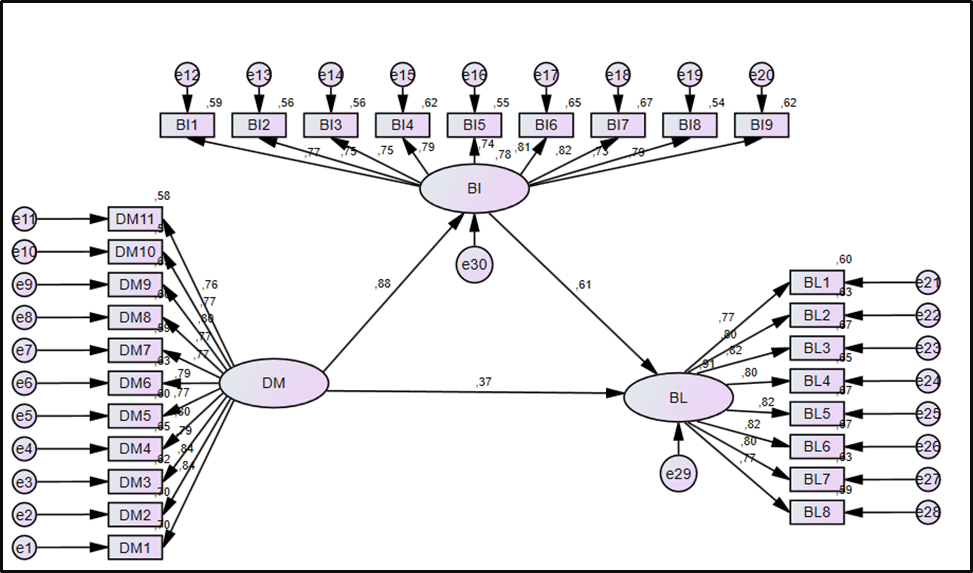
Figure 1: Full Model Structural Test
D.M (Digital Marketing), B.I (Brand Image), B.L (Brand Loyalty)
Table 5: Sobel Test - Significance of Mediation
| Parameters | Sobel test statistic | Two- tailed probability |
| Digital Marketing --> Brand Image --> Brand Loyalty | 5,72 | *** |
Table 2 is the result of the validity and reliability test of the overall model. The standardized loading factor (SLF) value of all indicator variables in the full model showed that the value is greater than 0.50. This means that all indicators are declared valid and are believed to be capable of measuring the construct of the full model being built. The reliability test results present corresponding results. All instruments are considered reliable and can measure constructs of the full model consistently. it revealed from the avariance extracted (AVE) value of the entire indicator instrument that obtained a value of greater than 0.50 and a construct reliability (C.R.) value that obtained a value greater than 0.70.
The results of Goodness of fit (GOF) measurements in Table 3 showed that six measurements are categorized into good. CMIN/DF values = 2.365 (≤3.00), RMSEA = 0.079 (≤0.08), and RMR = 0.036 (≤0.05) are declared fit. Likewise, the IFI = 0.910, CFI = 0.909, and TLI = 0.901 are all above 0.90, so it can be concluded that the model is fit and accepted.
Hypotheses Testing
The results of the causal relationship test between variables in this study are as follows.
Based on Table 4 revealed that there is an influence of digital marketing on the brand image, which is seen from the t-test value at 11,838, greater than the t-table value (1.96). Likewise, the p-value is less than 0.001; less than 0.05 (α = 0.05). Therefore, hypothesis 1 was accepted. For the second hypothesis, the t-test value is 6.530, and the p-value is less than 0.001. It implies that brand image positively and significantly affects brand loyalty. Moreover, hypothesis testing 3 revealed that the t-test value is at 4.479, and the p-value is less than 0.001. It indicated that digital marketing positively and significantly affects brand loyalty; therefore, the third hypothesis is accepted. The indirect influence of the mediation variables is presented in Table 5.
Digital marketing positively and significantly affects the brand image at P.T. Pegadaian Indonesia. The decision to utilize digitalization is carried out through technology and the Internet to make marketing more innovative in establishing a connection between firms and customers [18]. Innovation using digital marketing allows people to get information data quickly, effectively, and efficiently [19]. This study's results align with previous research, which stated that digital marketing could provide a positive brand image to the Company [17]. Digital marketing employed by PT Pegadaiaan aims to create, communicate, provide and exchange value offers for customers, clients, and partners. Digital marketing positively and significantly influences brand loyalty in PT Pegadaian. Companies can market their products on social media, advertisements, and other digital media, create promotional content facilities so that customers can see and continue to use them. The developmentthe of technology enables the Company to interact with existing customers and new customers. These factors all contribute to the fact that digital marketing activities have the potential to contribute to the formation of brand loyalty. Seo & Park and Afrina Yas min et.al [6] emphasized the importance of digital marketing to bring customers into the Company's digital ecosystem. The results of this study support previous researchers who claims that digital marketing has a positive and significant effect on brand loyalty [20-21]. PT Pegadaian can supply customers with pertinent information and lessen the amount of work they put in to find information through digital marketing.
Brand image has a positive and significant effect on brand loyalty. Customers are able to recognize their pertinent demands thanks to PT Pegadaian's brand image, and they can also understand effective processes for obtaining satisfaction through the brand [22]. With the brand image of PT Pegadaian gaining extremely special benefit and image can boost the progression of higher customer loyalty, have high-quality representation, and acquire a greater position in the market. The results of this study support the results of previous studies that stated that brand image has a positive and significant effect on brand loyalty [23-27]. The development of a good brand image will foster trust in the products offered by PT Pegadaian.
Lamberton et al. “A thematic exploration of digital, social media, and mobile marketing: Research evolution from 2000 to 2015 and an agenda for future inquiry.” Journal of Marketing, vol. 80, no. 6, 2016, pp. 146–172. DOT:10.1509/jm.15.0415.
Sulibhavi, and Shivashankar. “Brand image and trust on customers loyalty: A study on private label brands in Hubli-Dharwad conglomerate city of Karnataka.” International Journal of Engineering Research and Application, vol. 7, no. 9, part 6, Sept. 2017, pp. 01–10. www.ijera.com.
Dananjaya et al. “The role of brand image mediates the effect of product quality on customer loyalty.” E-Journal of Management Udayana University, vol. 7, no. 10, 2018, pp. 5258–5273. DOI:10.24843/EJMUN UD.2018.v07.i10.p03.
Sopiah, and Etta Mamang Sangadji. Salesmanship. Jakarta: PT Bumi Aksara, 2016.
Kotler et al. Marketing management and brand management. 15th ed., New Jersey: Pearson Prentice Hall, 2016.
Yasmin et al. “Effectiveness of digital marketing in the challenging age.” International Journal of Management Science and Business Administration, vol. 1, no. 5, 2015, pp. 69–80.
Lee, Hsiang Ming, Ching Chi Lee, and Wu Cou Chen. “Brand image strategy affects brand equity after M&A.” European Journal of Marketing, vol. 45, no. 7, 2011, pp. 1091–1111.
Hajli, M.N. “A study of the impact of social media on consumers.” International Journal of Market Research, vol. 56, no. 3, 2014, pp. 387–404. doi:10.2501/IJMR-2014-025.
Fortezza, F. and T. Pencarelli. “Potentialities of Web 2.0 and new challenges for destinations: Insights from Italy.” Anatolia, vol. 26, no. 4, 2015, pp. 563–573.
Halligan, B. and D. Shah. Inbound marketing: Get found using Google, social media, and blogs. New Jersey: John Wiley & Sons, 2009.
Lisani and Indrawati. “The effect of digital marketing mobile application on Gojek customer loyalty.” Journal of Science and Technology Research, vol. 5, no. 2, July 2020, pp. 254–258. https://doi.org/10.32528 /ipteks.v5i2.3665.
Nisar, Tahir M. and Caroline Whitehead. “Brand interactions and social media: Enhancing user loyalty through social networking sites.” Computers in Human Behavior, vol. 62, 2016, pp. 743–753. DOI:10.1016/j.chb.2016.04.042.
Aristana, I.K.G.A. et al. “The influence of brand image and brand trust on consumer loyalty (Case study on consumers of PT Citilink Indonesia branch office Denpasar).” Tourism Research Journal, vol. 6, 2022. https://doi.org/10.30647/trj.v6i1.129.
Tuten, et al. Solomon. Social media marketing. 2nd ed., London: SAGE Publications, 2015.
Keller, et al. Strategic brand management. 4th ed., Pearson Education Limited, 2013.
Habib, Sufyan et al. “The relationship between digital marketing, customer engagement, purchase intention via OTT platforms.” 2022.
Yuvaraj, S. and R. Indumathi. “Influence of digital marketing on brand building.” International Journal of Mechanical Engineering and Technology (IJMET), vol. 9, no. 7, 2018, pp. 235–243.
Manaf, P.A. et al. “E-satisfaction as a reflection of e-marketing and e-sequal in influencing e-loyalty on e-commerce.” International Journal of Engineering & Technology, vol. 7, no. 4, 2018, pp. 94–98. Doi:10.14 419/ijet.v7i4.44.26870.
Sumerta, I.K. et al. “Analysis of technology acceptance model (TAM) to use e-money in Bali Province.” International Journal of Advanced Trends in Computer Science and Engineering, vol. 8, no. 1.5, 2019, pp. 206–211. DOI:10.30534/ijatcse/20 19/3881.52019.
Erdoğmuş, İ.E. and M. Çiçek. “The impact of social media marketing on brand loyalty.” Procedia – Social and Behavioral Sciences, vol. 58, no. 5, 2012, pp. 1353–1360.
Ibrahim, B. and A. Aljarah. “Dataset of relationships among social media marketing activities, brand loyalty, revisit intention: Evidence from the hospitality industry in Northern Cyprus.” Data in Brief, vol. 21, 2018, pp. 1823–1828.
Hossain, M.S. et al. “Affirmative strategic association of brand image, brand loyalty and brand equity: A conclusive perceptual confirmation of the top management.” Academy of Strategic Management Journal, vol. 19, no. 2, 2020.
Kim, S. et al. “The effect of celebrity on brand awareness, perceived quality, brand image, brand loyalty, and destination attachment to a literary festival.” Journal of Destination Marketing & Management, vol. 9, 2018, pp. 320–329. doi:10.1016/j.jdmm.2018.03.006.
Lin, J., A. Lobo and C. Leckie. “Green brand benefits and their influence on brand loyalty.” Marketing Intelligence & Planning, vol. 35, no. 3, 2017, pp. 425–440. DOI: 10.1108/mip-09-2016-0174.
Iu, M.T. et al. “How CSR influences customer behavioural loyalty in the Chinese hotel industry.” Asia Pacific Journal of Marketing and Logistics, 2019. doi:10.1108/apjml-04-2018-0160.
Semadi, I.P. and M. Ariyanti. “The influence of brand experience, brand image and brand trust on brand loyalty of ABC-CASH.” Asian Journal of Management Sciences & Education, vol. 7, no. 3, 2018, pp. 12–23.
Tran, V.T. et al. “Brand equity in a tourism destination: A case study of domestic tourists in Hoi An city, Vietnam.” Tourism Review, 2019. DOI:10.1108/tr-08-2017-0130.