Unna-Thost Vs Vorner's Keratoderma - A Tough Nut to Crack
Kinnor Das
1
,
Bhaskar Gupta
2
,
Jyoti Kumari
1
1
Senior Resident, Department of Dermatology, Venereology and Leprosy, Silchar Medical College and Hospital, Ghungoor, Uttarkrishnapur Part 3, Silchar, Assam, 788014, India
2
professor And Head, Department of Dermatology, Venereology and Leprosy, Silchar Medical College and Hospital, Ghungoor, Uttarkrishnapur Part 3, Silchar, Assam, 788014, India
Palmoplantar Keratodermas (PPK) form a category of disorders typified by disproportionate epidermal thickening of the palms and soles. PPK may be inherited or acquired. The mutations in genes encoding different proteins involved in keratinization process are involved in the pathogenesis of inherited PPK. Majority of patients of inherited PPK manifest in infancy. Vorner's keratoderma and Unna-Thost keratoderma are two major types of non-transgradient diffuse palmo-planter keratoderma inherited as autosomal dominant trait. They are clinically similar but histologically there are minute differences. We are presenting here a case of mother and a child with thickening of palms and soles. The final diagnosis was made after the histopathological examination.
Keywords
Keratoderma
Keratinization
Transgradient
INTRODUCTION
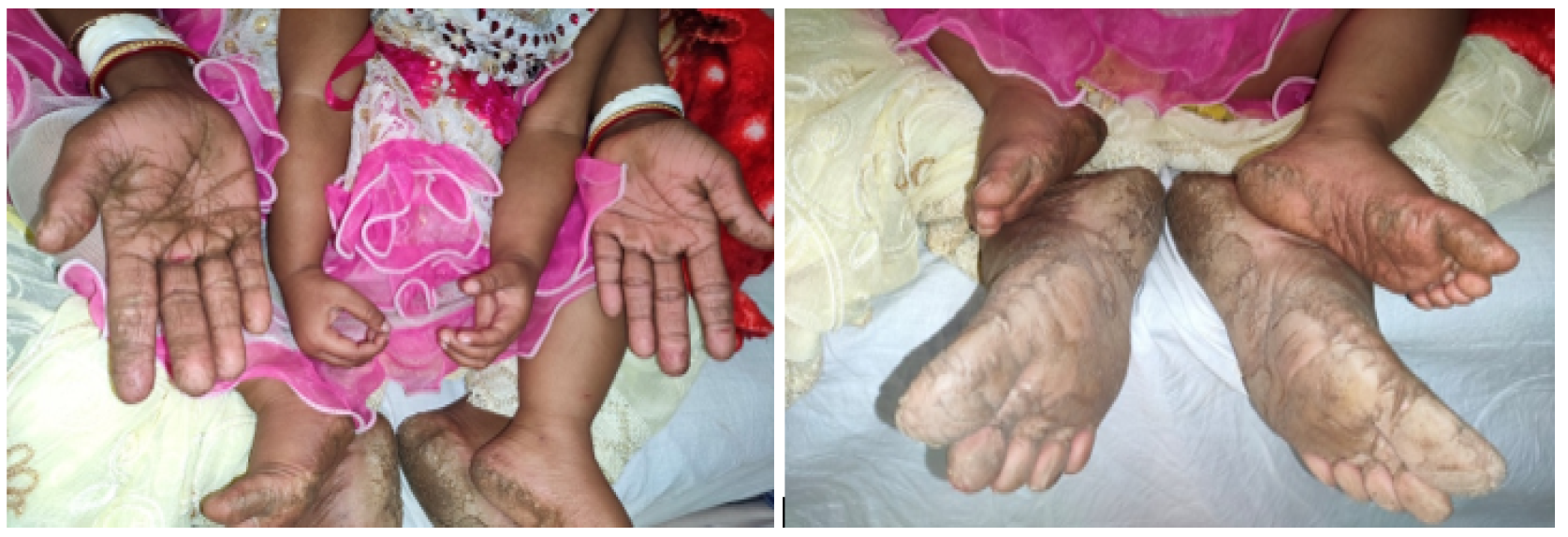
A 2 years 6 months old otherwise healthy female child was referred from the department of pediatrics for cracked feet and palms. She was accompanied by her mother and maternal grandmother who were our informant(s) as well. On cutaneous examination we found that there was diffuse thickening of palms and soles which was accompanied with deep fissuring. The fissures made walking difficult. The mother stated that, the girl had no abnormal dermatological manifestation at birth, the lesion started to evolve after infancy after one year of birth. After questioning and examining the mother we found out that she also had similar lesion since she was 2 years old and this was confirmed by her mother who also accompanied them to our Out-patient Department (OPD) and who was free of the disease. The lesion in both the mother and daughter was confined to both palms and soles with well demarcation at wrist and feet, sparing the dorsal surfaces of hand and feet (Figure 1).
Figure 1: The Lesion in both the Mother and Daughter was Confined to Both Palms and Soles with Well Demarcation at Wrist and Feet, Sparing the Dorsal Surfaces of Hand and Feet
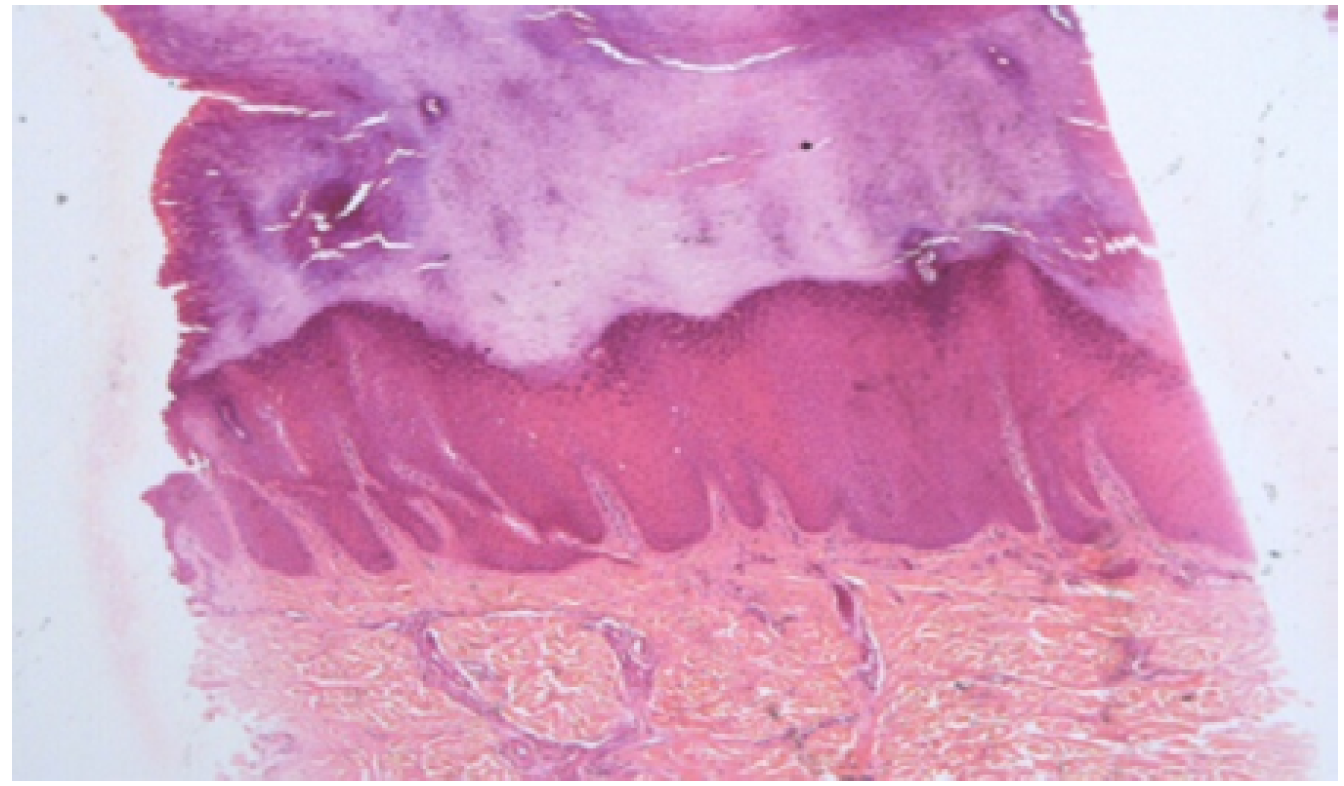
Oral mucosa, teeth and nails were not involved in both the mother and daughter. Histopathological examination of the biopsy taken from the sole of the patient revealed massive orthokeratotic hyperkeratosis, hypergranulosis and acanthosis without epidermolysis which was consistent with Unna-Thost disease (Figure 2).
Figure 2: Histopathological Examination of the Biopsy Taken from the Sole of the Patient Revealed Massive Orthokeratotic Hyperkeratosis, Hypergranulosis and Acanthosis without Epidermolysis which was Consistent with Unna-Thost Disease
After relevant blood investigations which was found to be within normal limits, we discharged the patient with topical emollient and a keratolytic agent (urea 40%). Following 2 weeks of regular treatment the patient came for review in our OPD and thereby we found that there was around 50% reduction in hyperkeratosis with healing of cracks and fissures.
Palmoplantar Keratodermas (PPK) form a category of disorders typified by disproportionate epidermal thickening of the palms and soles. PPK may be inherited or acquired [1]. On the basis of the underlying genetic defect and its phenotypic manifestation(s), inherited PPKs may be divided into:
Non-syndromic, isolated PPKs-which are characterized by a unique or predominant palmoplantar involvement
Complex PPKs-non-syndromic PPKs with additional distinctive cutaneous and adnexal manifestations, here named
Syndromic PPKs - in this type PPK is associated with specific extracutaneous manifestations [2,3]
The mutations in the genes which encodes for different proteins involved in keratinization process, like desmosomes, keratins, loricrin, gap junction proteins, cathepsin C and many others have been involved in the pathogenesis of PPK. Majority of patients of PPK manifests in infancy in isolation and in rest it is found in association with other abnormalities of nails, teeth, or other organs [4].
Vorner's keratoderma (epidermolytic keratoderma) and Unna-Thost keratoderma (non-epidermolytic) are two major types of non-transgradient diffuse palmo-planter keratoderma inherited as autosomal dominant trait. The disease present with hyperkeratosis of palms and soles in infancy which becomes evident by early childhood and persists throughout life. Unna first described a family with this peculiar syndrome in 1880. K1 and K9 mutation observed in Vorner's keratoderma and K1 and K2 mutation in Unna-Thost keratoderma. In both cases the onset is in the first few months of life and the pathological lesions are fully developed by the 3-4 years of age.
They usually present with even, thick, yellowish hyperkeratosis over palms and soles delineated by a sharp border at the dorsoventral margin on palms and soles [5,6]. Clinical features of Vorner's type of PPK are akin to Unna-Thost disease. Differentiation of Vorner’s keratoderma from Unna-Thost disease can be made histopathologically, with the finding of epidermolysis in the former [7].
The main objective of this case reporting is to highlight the two major type of autosomal dominant, non-transgradient palmo-planter keratoderma which look indistinguishable on clinical examination. The histopathological examination holds the key to differentiate between the two.
REFERENCES
Schiller, S. et al. “Palmoplantar keratoderma (PPK): Acquired and genetic causes of a not so rare disease.”JDDG: Journal der Deutschen Dermatologischen Gesellschaft, vol. 12, no. 9, September 2014, pp. 781–788.
Guerra, L. et al. “Hereditary palmoplantar keratodermas. part I: Non-syndromic palmoplantar keratodermas: classification, clinical and genetic features.” Journal of the European Academy of Dermatology and Venereology, vol. 32, no. 5, May 2018, pp. 704–719.
Guerra, L. et al. “Hereditary palmoplantar keratodermas. part Ii: Syndromic palmoplantar keratodermas—diagnostic algorithm and principles of therapy.” Journal of the European Academy of Dermatology and Venereology, vol. 32, no. 6, June 2018, pp. 899–925.
Dev, T. et al. “Hereditary palmoplantar keratoderma: A practical approach to the diagnosis.” Indian Dermatology Online Journal, vol. 10, no. 4, 2019, pp. 365.
Bhat, R. et al. “Unna thost syndrome: A case report.” International Journal of Contemporary Pediatrics, vol. 6, no. 4, June 2019, pp. 1767–1770.
Kuster, W. et al. “Epidermolytic palmoplantar keratoderma of vorner: Re-evaluation of vorner’s original family and identification of a novel keratin 9 mutation.” Archives of Dermatological Research, vol. 294, no. 6, June 2002, pp. 268–272.
Karadag, A. et al. “A family of Unna-Thost disease with one member showing findings of epidermolytic keratoderma.” Indian Journal of Dermatology, Venereology and Leprology, vol. 76, no. 1, January 2010, pp. 85–85.
License
Creative Commons Attribution-NonCommercial-NoDerivatives 4.0 International License
All papers should be submitted electronically. All submitted manuscripts must be original work that is not under submission at another journal or under consideration for publication in another form, such as a monograph or chapter of a book. Authors of submitted papers are obligated not to submit their paper for publication elsewhere until an editorial decision is rendered on their submission. Further, authors of accepted papers are prohibited from publishing the results in other publications that appear before the paper is published in the Journal unless they receive approval for doing so from the Editor-In-Chief.
Himalayan Journal of Medicine and Surgery open access articles are licensed under a Creative Commons Attribution-Share A like 4.0 International License. This license lets the audience to give appropriate credit, provide a link to the license, and indicate if changes were made and if they remix, transform, or build upon the material, they must distribute contributions under the same license as the original.
Recommended Articles
Research Article
Effect of Land Degradation on Livelihood
Kemalo Abdulmalik,
Isreal Zewide
Published: 04/01/2024
Download PDF
Cite
x
APA
Abdulmalik, K. & Zewide, I. (2024). Effect of Land Degradation on Livelihood. Himalayan Journal of Medicine and Surgery, 5(1), 1-4.
MLA
Abdulmalik, Kemalo and Isreal Zewide. "Effect of Land Degradation on Livelihood." Himalayan Journal of Medicine and Surgery 5.1 (2024): 1-4.
Chicago
Abdulmalik, Kemalo and Isreal Zewide. "Effect of Land Degradation on Livelihood." Himalayan Journal of Medicine and Surgery 5, no. 1 (2024): 1-4.
Harvard
Abdulmalik, K. and Zewide, I. (2024) 'Effect of Land Degradation on Livelihood' Himalayan Journal of Medicine and Surgery 5(1), pp. 1-4.
Vancouver
Abdulmalik K, Zewide I. Effect of Land Degradation on Livelihood. Himalayan Journal of Medicine and Surgery. 2024 Jan;5(1):1-4.
Download PDF
Research Article
Impact of Gut-Liver Axis: Hepatic Biochemical and Metabolic Changes Associated with Chronic Gastritis in Iraqi Patients with Helicobacter Pylori
Noor Zuhair Bakheet N. Z.
Published: 20/02/2026
Download PDF
Cite
x
APA
N. Z., N. Z. B. (2026). Impact of Gut-Liver Axis: Hepatic Biochemical and Metabolic Changes Associated with Chronic Gastritis in Iraqi Patients with Helicobacter Pylori. Himalayan Journal of Medicine and Surgery, 7(1), 1-4.
MLA
N. Z., Noor Z. B.. "Impact of Gut-Liver Axis: Hepatic Biochemical and Metabolic Changes Associated with Chronic Gastritis in Iraqi Patients with Helicobacter Pylori." Himalayan Journal of Medicine and Surgery 7.1 (2026): 1-4.
Chicago
N. Z., Noor Z. B.. "Impact of Gut-Liver Axis: Hepatic Biochemical and Metabolic Changes Associated with Chronic Gastritis in Iraqi Patients with Helicobacter Pylori." Himalayan Journal of Medicine and Surgery 7, no. 1 (2026): 1-4.
Harvard
N. Z., N. Z. B. (2026) 'Impact of Gut-Liver Axis: Hepatic Biochemical and Metabolic Changes Associated with Chronic Gastritis in Iraqi Patients with Helicobacter Pylori' Himalayan Journal of Medicine and Surgery 7(1), pp. 1-4.
Vancouver
N. Z. NZB. Impact of Gut-Liver Axis: Hepatic Biochemical and Metabolic Changes Associated with Chronic Gastritis in Iraqi Patients with Helicobacter Pylori. Himalayan Journal of Medicine and Surgery. 2026 Jan;7(1):1-4.
Download PDF
Research Article
Awareness and Practices among Professional Healthcare Workers towards COVID-19 in Iraq
Yasir H Motlaq,
...
Zainab T. N M. Almuhannah
Published: 30/03/2024
Download PDF
Cite
x
APA
H Motlaq, Y., A Aqebian, E. & N M. Almuhannah, Z. T. (2024). Awareness and Practices among Professional Healthcare Workers towards COVID-19 in Iraq. Himalayan Journal of Medicine and Surgery, 5(1), 1-9.
MLA
H Motlaq, Yasir, Esraa A Aqebian and Zainab T. N M. Almuhannah. "Awareness and Practices among Professional Healthcare Workers towards COVID-19 in Iraq." Himalayan Journal of Medicine and Surgery 5.1 (2024): 1-9.
Chicago
H Motlaq, Yasir, Esraa A Aqebian and Zainab T. N M. Almuhannah. "Awareness and Practices among Professional Healthcare Workers towards COVID-19 in Iraq." Himalayan Journal of Medicine and Surgery 5, no. 1 (2024): 1-9.
Harvard
H Motlaq, Y., A Aqebian, E. and N M. Almuhannah, Z. T. (2024) 'Awareness and Practices among Professional Healthcare Workers towards COVID-19 in Iraq' Himalayan Journal of Medicine and Surgery 5(1), pp. 1-9.
Vancouver
H Motlaq Y, A Aqebian E, N M. Almuhannah ZT. Awareness and Practices among Professional Healthcare Workers towards COVID-19 in Iraq. Himalayan Journal of Medicine and Surgery. 2024 Jan;5(1):1-9.
Download PDF
Research Article
Amniotic Fluid and Umbilical Cord Serum Erythropoietin as Biomarkers of Fetal Hypoxia in Term and Prolonged Pregnancies
Wasan Salih Mohammed,
Sarah F. Abdulqader
Published: 15/01/2026
Download PDF
Cite
x
APA
Mohammed, W. S. & Abdulqader, S. F. (2026). Amniotic Fluid and Umbilical Cord Serum Erythropoietin as Biomarkers of Fetal Hypoxia in Term and Prolonged Pregnancies. Himalayan Journal of Medicine and Surgery, 7(1), 1-6.
MLA
Mohammed, Wasan Salih and Sarah F. Abdulqader. "Amniotic Fluid and Umbilical Cord Serum Erythropoietin as Biomarkers of Fetal Hypoxia in Term and Prolonged Pregnancies." Himalayan Journal of Medicine and Surgery 7.1 (2026): 1-6.
Chicago
Mohammed, Wasan Salih and Sarah F. Abdulqader. "Amniotic Fluid and Umbilical Cord Serum Erythropoietin as Biomarkers of Fetal Hypoxia in Term and Prolonged Pregnancies." Himalayan Journal of Medicine and Surgery 7, no. 1 (2026): 1-6.
Harvard
Mohammed, W. S. and Abdulqader, S. F. (2026) 'Amniotic Fluid and Umbilical Cord Serum Erythropoietin as Biomarkers of Fetal Hypoxia in Term and Prolonged Pregnancies' Himalayan Journal of Medicine and Surgery 7(1), pp. 1-6.
Vancouver
Mohammed WS, Abdulqader SF. Amniotic Fluid and Umbilical Cord Serum Erythropoietin as Biomarkers of Fetal Hypoxia in Term and Prolonged Pregnancies. Himalayan Journal of Medicine and Surgery. 2026 Jan;7(1):1-6.
Das, K., Gupta, B. & Kumari, J. (2021). Unna-Thost Vs Vorner's Keratoderma - A Tough Nut to Crack. Himalayan Journal of Medicine and Surgery, 2(2), 1-2.
MLA
Das, Kinnor, Bhaskar Gupta and Jyoti Kumari. "Unna-Thost Vs Vorner's Keratoderma - A Tough Nut to Crack." Himalayan Journal of Medicine and Surgery 2.2 (2021): 1-2.
Chicago
Das, Kinnor, Bhaskar Gupta and Jyoti Kumari. "Unna-Thost Vs Vorner's Keratoderma - A Tough Nut to Crack." Himalayan Journal of Medicine and Surgery 2, no. 2 (2021): 1-2.
Harvard
Das, K., Gupta, B. and Kumari, J. (2021) 'Unna-Thost Vs Vorner's Keratoderma - A Tough Nut to Crack' Himalayan Journal of Medicine and Surgery 2(2), pp. 1-2.
Vancouver
Das K, Gupta B, Kumari J. Unna-Thost Vs Vorner's Keratoderma - A Tough Nut to Crack. Himalayan Journal of Medicine and Surgery. 2021 Jul;2(2):1-2.



 Download PDF
 Download XML