A Comparative Evaluation of Postoperative Airway Complications Using Ambu AuraGain in Trendelenburg and Reverse Trendelenburg Position in Patients Undergoing Laparoscopic Surgery
Poonam
1
,
Shelly
2
,
Mast Ram
3
1
Department of Anaesthesiology, Civil Hospital, Tauni Devi, Hamirpur H.P, India
2
Department of Anaesthesiology, Civil Hospital, Karsog, Mandi H.P, India
3
Department of General Surgery, Civil Hospital, Rajgarh, Sirmour H.P, India
The present study was done for comparative evaluation of Postoperative Airway Complications in Trendelenburg and Reverse Trendelenburg Position in patients undergoing Laparoscopic Surgery. Material and Methods: This was a prospective cohort study conducted in Department of Anaesthesia to determine the Postoperative Airway Complications in laparoscopic surgeries in Trendelenburg and Reverse Trendelenburg position. Group A included 16 patients with Trendelenburg position and Group B included 30 patients with Reverse Trendelenburg position. Results: The mean age of patients in Group A was 44.44±11.11 years whereas the mean age of patients in Group B was 45.50±11.78 years. ((p>0.05). Group A comprised of 2 (12.5%) males and 14 (87.5%) females whereas Group B comprised of 12 (40%) males and 18 (60%) females. (p>0.05). The mean BMI of patients in Group A was found to be 22.28±1.58 kg/m2 and mean BMI of patients in Group B was 22.57±2.54 kg/m2. (p>0.05). Group A comprised of 11 (68.8%) patients with ASA status I and 5 (31.2%) patients with ASA status II. On the other hand, Group B had 15 cases each with ASA status I and II. (p>0.05). The average duration of surgeries in Group A was 80-90 minutes whereas the average duration of surgeries in Group B was 70-80 minutes. Sore throat was reported in 5 (18.8%) patients in group A and 1 (6.7%) patient in group B. This was found to be statistically significant (p<0.05), higher in Group A. Only 1 patient reported with hoarseness in Group A and no patient reported with hoarseness in Group B. This was not found to be statistically significant (p>0.05). No patient reported with dysphonia in both the groups. Also, no patient reported with numbness of tongue in both the groups. Conclusion: We concluded that Postoperative airway complications like Sore throat and hoarseness was found more in patients operated in Trendelenburg Position as compared to patients operated in Reverse Trendelenburg Position while No patient reported with dysphonia and numbness of tongue in both the groups.
Keywords
Postoperative Airway Complications
Trendelenburg
Reverse Trendelenburg Position
Laparoscopic Surgery.
INTRODUCTION
In order to provide breathing, oxygenation and anaesthetic gas delivery during a respiratory arrest or during a surgical procedure carried out under general anaesthesia, a variety of devices known as supraglottic airway devices (SADs) are used [1]. Second generation supraglottic airway devices provide many advantages over endotracheal intubation. It includes reduced haemodynamic response, decreased anaesthetic requirement for airway tolerance and lesser pharyngolaryngeal morbidity 2-3].
The last ten years have seen the introduction of numerous novel supraglottic airway devices. There is a strong argument that it is time to stop using first generation supraglottic airway devices altogether and switch to second and third generation SAD, which have proven to be more effective than the conventional Laryngeal Mask Airway (LMA) and are more suited to advanced usage. A second-generation supraglottic airway device, the AMBU AURAGAIN laryngeal mask airway (Ambu A/S, Ballerup, Denmark) was introduced in June 2014. It is a single-use SAD that guarantees strong seal pressure. It has a larger airway tube, a biting block and an integrated gastric access [4].
Postoperative airway complications are common after general anaesthesia and it can cause a great deal of discomfort to the patients. Maintaining adequate cuff pressure is an important factor in the prevention of postoperative airway complications. Several postoperative complications such as cough, sore throat, hoarseness and blood-streaked expectorations are associated with excessive cuff pressure during laparoscopic surgery under general anaesthesia. But there is paucity of literature comparing clinical performance of Ambu AuraGain during laparoscopic surgeries under general anaesthesia. Hence, the present study was aimed to determine Postoperative Airway Complications in different positions in laparoscopic surgeries done using Ambu AuraGain.
Aim and Objectives
To determine Postoperative Airway Complications in laproscopic surgeries in Trendenlenburg and Reverse Trendenlenburg position with the use of Ambu AuraGain SGA.
MATERIALS AND METHODS
Study Design
Prospective cohort study
Study Site
Department of Anaesthesia, Dr RPGMC Kangra at Tanda
Study dur#ation
The study was conducted over the period of 18 months including data collection, data organization, presentation, analysis and interpretation from January, 2020 to June 2021.
Sample Size
Total of 46 patients were included which were categorized into two groups
In the first arm of study less number of patients participated than calculated sample size due to covid -19 pandemic containment restrictions. Further research is needed with adequate sample to rule out effect of chance if any from obtained results or power analysis to check adequacy of sample size.
Group A
Comprised of 16 patients who underwent Surgeries in Trendelenburg position including gynaecological surgeries like Diagnostic Laparoscopy for infertility and ectopic pregnancy, Laparoscopic cystectomy, TAP surgery for hernia and Laparoscopic appendicectomy.
Group B
Comprised of 30 patients who underwent surgeries in Reverse Trendelenburg position including Laparoscopic surgery for gall bladder disease, i.e., Laparoscopic cholecystectomy.
Inclusion Criteria
Patients (age 18 to 60 years) of either sex
Body Mass Index 18.5 to 30 kg/m2
American Society of Anesthesiologists physical status I or II
Undergoing elective laparoscopic surgery involving Trendelenburg and Reverse Trendelenburg position with an anticipated duration of 30-120 minutes will be included in the study
Exclusion Criteria
Obesity (Body Mass Index >30)
All the contraindications for supraglottic airway
Oropharyngeal diseases
If Laparoscopic surgery was converted into open surgery in any of cases
If in any case supraglottic airway had to be replaced by endotracheal tube
Limited mouth opening (inter-incisor gap <20 mm)
Patients at risk of aspiration (full stomach, previous upper gastrointestinal surgery, hiatus hernia)
Refusal to participate in the study
Methodology
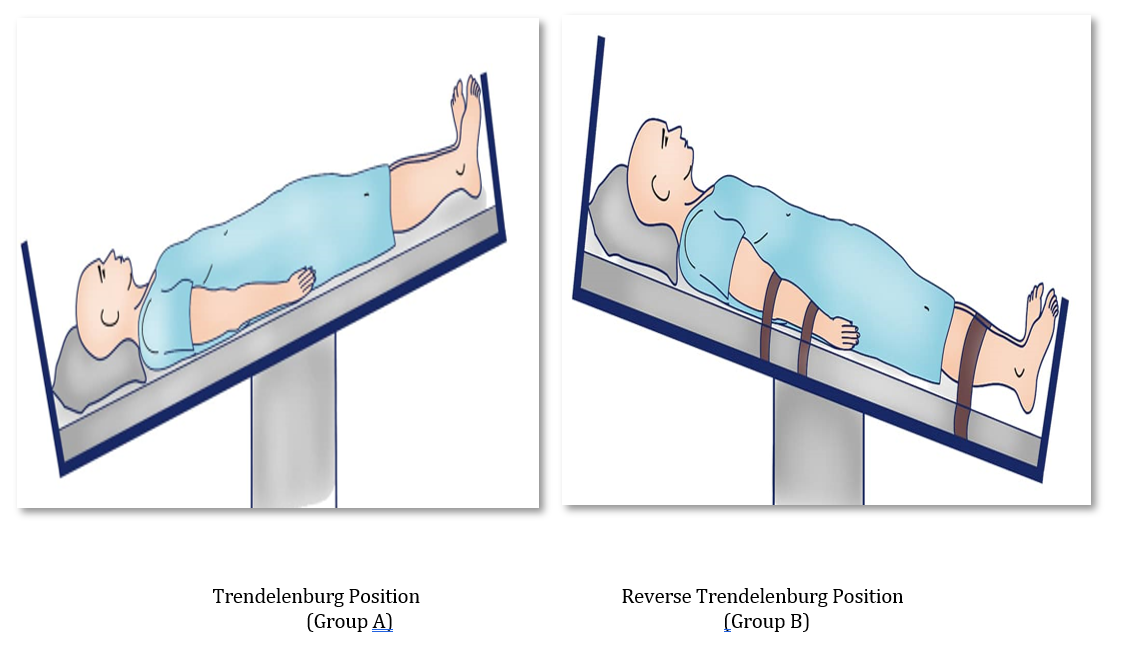
The study was commenced after obtaining Institutional Ethics Committee approval---dated 21-12-2019, NO-HFW- H DRPGMC/Ethics/2019/239. The patients were classified into Trendelenburg and Reverse Trendelenburg position depending upon the laparoscopic surgeries they were scheduled for:
Group A: Trendelenburg position (Head Down 20-300) n = 16
Group B: Reverse Trendelenburg position (Head Up 20-300), n = 30
In Group A
all patients were explained the procedure and written, well informed consent was taken. All patients were instructed to remain fasting for 8 hours prior to surgery and medicated night before surgery with Tablet Alprazolam 0.25 mg and Tablet Ranitidine 150 mg. In Operation Theater, intravascular fluid (Normal Saline) was started with 18G cannula. A multichannel monitor showing pulse rate, electrocardiogram, oxygen saturation, non-invasive blood pressure (NIBP) was connected and baseline readings were recorded.
All patients of group A were given Inj.glycopyrrolate 0.2 mg, Inj. midazolam 0.02 mg/kg and Inj. fentanyl 2 μg/kg IV. Pre-oxygenation was done for 3-5 minutes and induction was done with Inj. Propofol 2mg/kg IV in slow incremental dose till the loss of verbal command, eyelash reflex and ease of mask ventilation was noted. After confirming adequate mask ventilation Inj. Atracurium 0.5 mg/kg IV was administered to facilitate insertion of Ambu AuraGain.
Once the jaw relaxation was achieved, supraglottic device was inserted in supine position.
Size selection of Ambu AuraGain was done according to weight of the patients, SGA size 4 (weight 50-70 kg). For the lubrication, water based lubricating jelly was applied on the dorsum of the device. Initially, the handle (Shaft) was kept approximately parallel to the patient’s chest and then the device was pushed along the hard palate after. Its placement might require higher tangential force due to bulky and acute angle of the device. It was straightened like of classical LMA before insertion to avoid any complication.
Ambu AuraGain was inflated by recommended amount of air i.e., not more than 30 ml. If any leak around the Ambu AuraGain was found clinically, cuff was inflated with more air up to recommended limits. Adequate ventilation was confirmed by auscultation, chest movements and EtCO2 waveforms. The pilot balloon was attached to cuff manometer and cuff pressure was measured with cuff manometer, which further helped in getting an effective oropharyngeal seal and keep peak airway pressure and tidal volume within normal limits.
After the completion of procedure, when the patient showed initial sign of respiratory efforts, the neuromuscular block was reversed with Inj. neostigmine 0.05 mg/kg and Inj. glycopyrrolate 0.02 mg/kg. When extubation criteria was met the Ambu AuraGain was removed with the cuff deflated.
Post-operatively, the patients were assessed over 24 hours for sore throat (constant pain, independent of swallowing), hoarseness of voice, dysphonia (difficulty in or pain on speaking) and numbness of the tongue.
In Group B
Reverse Tredenlenburg position (head up 20-30o) all patients were monitored for same parameters at same time interval as in Group A.
Statistical Analysis
Statistical analyses were performed using IBM SPSS Statistics for Windows, Version 25.0. Armonk, NY: IBM Corp. Results on continuous measurements were presented on Mean±SD (Min-Max) & categorical as Frequency (Percentage). Inferential statistics like Chi-square test/Fischer Exact test, independent t test was applied. The significance of level adopted was 5%.
OBSERVATION AND RESULTS
The present study was conducted on 46 patients in Department of Anaesthesia, Dr RPGMC Kangra at Tanda, Himachal Pradesh to determine Postoperative Airway Complications in laparoscopic surgeries in Trendelenburg and Reverse Trendelenburg position with the use of Ambu AuraGain The patients were categorised into Trendelenburg and Reverse Trendelenburg position depending upon the laparoscopic surgeries they were scheduled for:
Group A: Trendelenburg position (n = 16)
Group B: Reverse Trendelenburg position (n = 30)
The mean age of patients in Group A was 44.44± 11.11 years whereas the mean age of patients in Group B was 45.50±11.78 years. The comparison of mean age of two groups was not found to be statistically significant (p>0.05). The mean BMI of patients in Group A was found to be 22.28±1.58 kg/m2 and mean BMI of patients in Group B was 22.57±2.54 kg/m2. Upon statistical analysis, this was not found to be significant (p>0.05).
Group A comprised of 2 (12.5%) males and 14 (87.5%) females whereas Group B comprised of 12 (40%) males and 18 (60%) females. The comparison of number of males and females between two groups was not found to be statistically significant (p>0.05). Group A comprised of 11 (68.8%) patients with ASA status I and 5 (31.2%) patients with ASA status II. On the other hand, Group B had 15 cases each with ASA status I and II. This was not found to be statistically significant (p>0.05).
Table 1: Comparison of Mean Age and BMI of Study Participants
Variables
Group A (N = 16)
Group B (N = 30)
p-value
Mean Age (Years)
44.44±11.11
45.50±11.78
0.768
Mean BMI (Kg/M2)
22.28±1.58
22.57±2.54
0.682
Table 2: Distribution of Study Participants according to Gender, ASA status and Duration of Surgery
Variables
Group A
Group B
p-value
Number
Percentage
Number
Percentage
Gender
Male
2
12.5
12
40
0.056
Female
14
87.5
18
60
ASA status
I
11
68.8
15
50
0.350
II
5
31.2
15
50
Duration of Surgery (Min)
70 Minutes
0
0
12
40
80 Minutes
4
25
13
43.3
90 Minutes
12
75
5
16.7
Total
16
100
30
100
Table 3: Distribution of Study Participants according to Postoperative airway complications
Variables
Group A
Group B
p-value
Number
Percentage
Number
Percentage
Sore Throat
No
11
68.75
29
96.7
0.007
Yes
5
31.25
1
3.33
Hoarseness
No
15
93.75
30
100
0.347
Yes
1
6.25
0
0
Dysphonia
No
16
100
30
100
NA
Yes
0
0
0
0
Numbness of Tongue
No
16
100
30
100
NA
Yes
0
0
0
0
Total
16
100
30
100
The average duration of surgeries in Group A was 80-90 minutes whereas the average duration of surgeries in Group B was 70-80 minutes.
Sore throat was reported in 5 (18.8%) patients in group A and 1 (6.7%) patients in group B. This was found to be statistically significant (p<0.05), higher in Group A. Only 1 patient reported with hoarseness in Group A and no patient reported with hoarseness in Group B. This was not found to be statistically significant (p>0.05). No patient reported with dysphonia in both the groups. Also, no patient reported with numbness of tongue in both the groups.
DISCUSSION
In this study, we evaluated and compared the Postoperative airway complications in Trendelenburg and Reverse Trendelenburg position. To the best of our knowledge, this is the first study to evaluate and compare Postoperative airway complications in two positions with the use of Ambu AuraGain.
Postoperative airway complications are common after general anaesthesia and it can cause a great deal of discomfort to the patients. Maintaining adequate cuff pressure is an important factor in the prevention of postoperative airway complications. Increased cuff pressure can cause significant decrease in blood flow of tracheal mucosa which can lead to postoperative airway complications like sore throat. Pneumoperitoneum and Trendelenburg position may increase airway pressure and cuff pressure, resulting in increased incidence of postoperative sore throat [5,6]. In the present study, sore throat was reported in Group A and Group B by 5 (18.8%) and 1 (6.7%) patient respectively. This was found to be statistically significant (p<0.05). Sore throat was reported more in Group A than Group B. In Trendelenburg position there is venous congestion which leads to airway edema, ultimately leading to higher chances of sore throat. Park S et al [7]. Concluded by their study that the incidences of laryngospasm, cough at removal, dysphagia or dysphonia and hoarseness are lower with SADs as compared to endotracheal tube. In our study, only 1 patient reported with hoarseness in Group A and no patient reported with hoarseness in Group B. This was not found to be statistically significant (p>0.05). None of our patients reported with dysphonia and numbness of tongue in any of the groups.
Limitations
The COVID-19 pandemic led to the decreased sample size of our study as there were less number of elective surgical procedures performed during this period. Studies with larger sample size are required to validate the findings of the present study.
CONCLUSION
We concluded that Postoperative airway complications like Sore throat and hoarseness was found more in patients operated in Trendelenburg Position as compared to patients operated in Reverse Trendelenburg Position while No patient reported with dysphonia and numbness of tongue in both the groups.
REFERENCE
Almeida, G., et al. "Supraglottic Airway Devices: A Review in a New Era of Airway Management." Journal of Anaesthesia and Clinical Research, vol. 7, no. 7, 2016, pp. 1-9.
Cook, T.M., et al. "The Proseal Laryngeal Mask Airway: A Review of the Literature." Canadian Journal of Anaesthesia, 2005, pp. 739-60.
Prys-Roberts, C., et al. "Studies of Anaesthesia in Relation to Hypertension. II: Hemodynamic Consequences of Induction and Endotracheal Intubation." British Journal of Anaesthesia, vol. 43, 1971, pp. 537-47.
Cook, T.M. and F.E. Kelly. "Time to Abandon the 'Vintage' Laryngeal Mask Airway and Adopt Second-Generation Supraglottic Airway Devices as First Choice." British Journal of Anaesthesia, vol. 115, no. 4, 2015, pp. 497-99.
Park, S.J., et al. "Endotracheal Cuff Pressure Change during Gynecological Laparoscopic Surgery: Effect on the Incidence of Postoperative Airway Complications." Anaesthesia and Pain Medicine, vol. 8, 2013, pp. 190-95.
Geng, G., et al. "The Effect of Endotracheal Tube Cuff Pressure Change during Gynecological Laparoscopic Surgery on Postoperative Sore Throat: A Control Study." Journal of Clinical Monitoring and Computing, vol. 29, no. 1, 2015, pp. 141-44.
Park, S., et al. "Comparison Between Supraglottic Airway Devices and Endotracheal Tubes in Patients Undergoing Laparoscopic Surgery: A Systematic Review and Meta-Analysis." Medicine, vol. 95, 2016, pp. 1-8.
License
Creative Commons Attribution-NonCommercial-NoDerivatives 4.0 International License
All papers should be submitted electronically. All submitted manuscripts must be original work that is not under submission at another journal or under consideration for publication in another form, such as a monograph or chapter of a book. Authors of submitted papers are obligated not to submit their paper for publication elsewhere until an editorial decision is rendered on their submission. Further, authors of accepted papers are prohibited from publishing the results in other publications that appear before the paper is published in the Journal unless they receive approval for doing so from the Editor-In-Chief.
Himalayan Journal of Applied Medical Sciences and Research open access articles are licensed under a Creative Commons Attribution-Share A like 4.0 International License. This license lets the audience to give appropriate credit, provide a link to the license, and indicate if changes were made and if they remix, transform, or build upon the material, they must distribute contributions under the same license as the original.
Recommended Articles
Research Article
Digital Implantology: Current Concepts, Clinical Applications, Limitations and Future Directions - A Narrative Review
Anukrity Chandra
Published: 30/07/2026
Download PDF
Cite
x
APA
Chandra, A. (2026). Digital Implantology: Current Concepts, Clinical Applications, Limitations and Future Directions - A Narrative Review. Himalayan Journal of Applied Medical Sciences and Research, 7(2), 1-7.
MLA
Chandra, Anukrity. "Digital Implantology: Current Concepts, Clinical Applications, Limitations and Future Directions - A Narrative Review." Himalayan Journal of Applied Medical Sciences and Research 7.2 (2026): 1-7.
Chicago
Chandra, Anukrity. "Digital Implantology: Current Concepts, Clinical Applications, Limitations and Future Directions - A Narrative Review." Himalayan Journal of Applied Medical Sciences and Research 7, no. 2 (2026): 1-7.
Harvard
Chandra, A. (2026) 'Digital Implantology: Current Concepts, Clinical Applications, Limitations and Future Directions - A Narrative Review' Himalayan Journal of Applied Medical Sciences and Research 7(2), pp. 1-7.
Vancouver
Chandra A. Digital Implantology: Current Concepts, Clinical Applications, Limitations and Future Directions - A Narrative Review. Himalayan Journal of Applied Medical Sciences and Research. 2026 Jul;7(2):1-7.
Download PDF
Research Article
Study of the Role of Serum Interleukin-6 in Inflammation among Pregnant Women with COVID-19
Aynar Talib Samad,
Yossra Saleh Khudhur
Published: 27/07/2021
Download PDF
Cite
x
APA
Talib Samad, A. & Khudhur, Y. S. (2021). Study of the Role of Serum Interleukin-6 in Inflammation among Pregnant Women with COVID-19. Himalayan Journal of Applied Medical Sciences and Research, 2(2), 1-6.
MLA
Talib Samad, Aynar and Yossra Saleh Khudhur. "Study of the Role of Serum Interleukin-6 in Inflammation among Pregnant Women with COVID-19." Himalayan Journal of Applied Medical Sciences and Research 2.2 (2021): 1-6.
Chicago
Talib Samad, Aynar and Yossra Saleh Khudhur. "Study of the Role of Serum Interleukin-6 in Inflammation among Pregnant Women with COVID-19." Himalayan Journal of Applied Medical Sciences and Research 2, no. 2 (2021): 1-6.
Harvard
Talib Samad, A. and Khudhur, Y. S. (2021) 'Study of the Role of Serum Interleukin-6 in Inflammation among Pregnant Women with COVID-19' Himalayan Journal of Applied Medical Sciences and Research 2(2), pp. 1-6.
Vancouver
Talib Samad A, Khudhur YS. Study of the Role of Serum Interleukin-6 in Inflammation among Pregnant Women with COVID-19. Himalayan Journal of Applied Medical Sciences and Research. 2021 Jul;2(2):1-6.
Download PDF
Research Article
Evalution CD11b, CD4, IL-17A and IL-23 as Biomarkers Immunological in Patients with Behçet’s Disease
Layla Saleh Abdul-Hassan,
...
Saeed hilal khudhair
Published: 13/07/2026
Download PDF
Cite
x
APA
Abdul-Hassan, L. S., Fadel, R. H. & khudhair, S. H. (2026). Evalution CD11b, CD4, IL-17A and IL-23 as Biomarkers Immunological in Patients with Behçet’s Disease. Himalayan Journal of Applied Medical Sciences and Research, 7(2), 1-7.
MLA
Abdul-Hassan, Layla S., Radhia H. Fadel and Saeed H. khudhair. "Evalution CD11b, CD4, IL-17A and IL-23 as Biomarkers Immunological in Patients with Behçet’s Disease." Himalayan Journal of Applied Medical Sciences and Research 7.2 (2026): 1-7.
Chicago
Abdul-Hassan, Layla S., Radhia H. Fadel and Saeed H. khudhair. "Evalution CD11b, CD4, IL-17A and IL-23 as Biomarkers Immunological in Patients with Behçet’s Disease." Himalayan Journal of Applied Medical Sciences and Research 7, no. 2 (2026): 1-7.
Harvard
Abdul-Hassan, L. S., Fadel, R. H. and khudhair, S. H. (2026) 'Evalution CD11b, CD4, IL-17A and IL-23 as Biomarkers Immunological in Patients with Behçet’s Disease' Himalayan Journal of Applied Medical Sciences and Research 7(2), pp. 1-7.
Vancouver
Abdul-Hassan LS, Fadel RH, khudhair SH. Evalution CD11b, CD4, IL-17A and IL-23 as Biomarkers Immunological in Patients with Behçet’s Disease. Himalayan Journal of Applied Medical Sciences and Research. 2026 Jul;7(2):1-7.
Download PDF
Research Article
Bones in Balance: Awareness of Rickets and Nutritional Deficiencies Among the Hamirpur Community
Vishal Dhatwalia,
Swati Chandel
Published: 10/12/2024
Download PDF
Cite
x
APA
Dhatwalia, V. & Chandel, S. (2024). Bones in Balance: Awareness of Rickets and Nutritional Deficiencies Among the Hamirpur Community. Himalayan Journal of Applied Medical Sciences and Research, 5(2), 1-5.
MLA
Dhatwalia, Vishal and Swati Chandel. "Bones in Balance: Awareness of Rickets and Nutritional Deficiencies Among the Hamirpur Community." Himalayan Journal of Applied Medical Sciences and Research 5.2 (2024): 1-5.
Chicago
Dhatwalia, Vishal and Swati Chandel. "Bones in Balance: Awareness of Rickets and Nutritional Deficiencies Among the Hamirpur Community." Himalayan Journal of Applied Medical Sciences and Research 5, no. 2 (2024): 1-5.
Harvard
Dhatwalia, V. and Chandel, S. (2024) 'Bones in Balance: Awareness of Rickets and Nutritional Deficiencies Among the Hamirpur Community' Himalayan Journal of Applied Medical Sciences and Research 5(2), pp. 1-5.
Vancouver
Dhatwalia V, Chandel S. Bones in Balance: Awareness of Rickets and Nutritional Deficiencies Among the Hamirpur Community. Himalayan Journal of Applied Medical Sciences and Research. 2024 Jul;5(2):1-5.
None, P., None, S. & Ram, M. (2022). A Comparative Evaluation of Postoperative Airway Complications Using Ambu AuraGain in Trendelenburg and Reverse Trendelenburg Position in Patients Undergoing Laparoscopic Surgery. Himalayan Journal of Applied Medical Sciences and Research, 3(2), 1-5.
MLA
None, Poonam, Shelly and Mast Ram. "A Comparative Evaluation of Postoperative Airway Complications Using Ambu AuraGain in Trendelenburg and Reverse Trendelenburg Position in Patients Undergoing Laparoscopic Surgery." Himalayan Journal of Applied Medical Sciences and Research 3.2 (2022): 1-5.
Chicago
None, Poonam, Shelly and Mast Ram. "A Comparative Evaluation of Postoperative Airway Complications Using Ambu AuraGain in Trendelenburg and Reverse Trendelenburg Position in Patients Undergoing Laparoscopic Surgery." Himalayan Journal of Applied Medical Sciences and Research 3, no. 2 (2022): 1-5.
Harvard
None, P., None, S. and Ram, M. (2022) 'A Comparative Evaluation of Postoperative Airway Complications Using Ambu AuraGain in Trendelenburg and Reverse Trendelenburg Position in Patients Undergoing Laparoscopic Surgery' Himalayan Journal of Applied Medical Sciences and Research 3(2), pp. 1-5.
Vancouver
Poonam P, Shelly S, Ram M. A Comparative Evaluation of Postoperative Airway Complications Using Ambu AuraGain in Trendelenburg and Reverse Trendelenburg Position in Patients Undergoing Laparoscopic Surgery. Himalayan Journal of Applied Medical Sciences and Research. 2022 Jul;3(2):1-5.



 Download PDF
 Download XML