Background: The initial clinical assessment of patients with Blunt trauma Abdomen (BTA) is often difficult and notably inaccurate. So, this study was done to determine the socio-Demographic and etiologic Profile of Blunt Trauma Abdomen patients in a tertiary care Hospital. Material & Methods: This Observational prospective study was conducted from July 2018 to December2019 and included all Blunt Trauma Abdomen (BTA) patients admitted in study period at advanced trauma center, PGIMER Chandigarh. Pattern, prevalence, non-operative versus operative management and outcome in term of mortality and morbidity were monitored. Results: Seventy-five patients admitted to ATC during study period were selected for the study. The most common age group affected was 16-30 years which constitute 42(56%) of total affected. Ninety two percent (n=69) of affected population were males whereas 8% (n=6) were females. Pain abdomen was the most common chief complaint (93.3%, n=70) in patients of blunt trauma abdomen followed by abdominal distension in 58.7% of patients (n=44). 81.3% patients had GCS of 15 and 14.6% of patients had GCS of 12 to 14. 3.99% patients had GCS of 9 to 10.Abdominal tenderness was the most common sign present in 76% (n=57) of cases followed by Rigidity (46.67%, n=35) .In the study, 22 patients had tachycardia and 20 had hypotension. Maximum BTA patients 26 (34.7%) had Abbreviated injury scale (AIS) score of 2& 3 each. Conclusion: Abdominal pain was the most common presenting symptom and abdominal tenderness was most common sign at presentation. Tachycardia and Hypotension was present in quarter of patients at presentation Maximum BTA patients had AIS score [2,3].
Blunt trauma includes direct blow, penetrating injury and deceleration force. Majority of blunt trauma abdomen cases are related to road traffic accidents and fall from height. Diagnosing and treatment of BTA remain a challenge as these types of injuries are also associated with other injuries to other organs such as brain, chest and musculoskeletal system. Abdominal injuries are one of the most common in poly-trauma patients requiring surgery in 25% cases [1-3].
Blunt trauma is dangerous because the clinical manifestations of the injury may be delayed for hours or days and internal damage is lethal. In open cases of abdominal trauma the clinical manifestations, diagnosis and management will be easier but closed cases of abdominal trauma offers a great challenge to the surgeon. Early detection of intra abdominal injuries can be challenging in some patients, particularly those with seemingly minor trauma or normal clinical examination [4]. The vital nature of organs contained within the abdomen makes evaluation and management a priority. Ultrasonography is considered as investigation of choice for early diagnostic investigations in patients with suspected blunt trauma abdomen whereas Focused Assessment with Sonography for Trauma (FAST) is considered investigation of choice in hemodynamically unstable patients. Some authors advocate an initial sonographic examination as primary diagnostic tool used as an extension of clinical examination in initial assessment of stable blunt trauma patients [5].
Other studies emphasize need for evaluation based on clinical criteria chest and pelvic radiography, laboratory results such as arterial base deficit or gross hematuria to determine the need of abdominal contrast enhanced computed tomography (CECT). Hollow viscus injury in BTA is evident from gas under diaphragm, free fluid in abdomen in absence of solid organ injury or contrast leak on CECT [6].
No study has been there from our institute regarding Clinical profile and severity of Blunt Trauma Abdomen injury. So, we conduct this study to determine the Clinical profile and severity of Blunt Trauma Abdomen patients in a tertiary care Hospital. Aims and objective to determine the Clinical profile and severity of Blunt Trauma Abdomen patients in a tertiary care Hospital.
Study design
Observational prospective study.
Study period
July 2018 to December2019.
Study population
FAST positive patients admitted in study period at ATC PGIMER Chandigarh, India were included in the study as per the inclusion and exclusion criteria. Informed understood written consent was taken from all the patients and approval from the institute’s ethical committee was obtained.
Sample size
Seventy five consecutive patients were recruited based on satisfying the inclusion and exclusion criteria. All the recruited patient's injuries were classified according to existing classification of organ injury. Pattern, prevalence, non-operative versus operative management and outcome in term of mortality and morbidity were monitored.
Eligibility
All consecutive patients with blunt trauma abdomen admitted during the time Frame of the study
Inclusion Criteria
Exclusion Criteria
Age <14 years as they are managed by department of pediatric surgery at PGIMER Chandigarh
Patients who refuse to give consent.
Patients having GCS score less than or equal to 4 on arrival
Material & Methods
Advance Trauma Center PGIMER Chandigarh is the major trauma center of India and it caters major population of Punjab, Haryana, Chandigarh, Himachal, Uttar Pradesh, Bihar, J&K, Rajasthan and act as referral center for the urban and rural hospitals within the region. It has a computerized registry into which trained data collectors have prospectively entered data on all injury admissions. Patients admitted for Blunt Trauma Abdomen were taken into study and categorized into:
Patients with hollow viscous perforation
Patients with solid organ injury
Patients with solid and hollow viscous organ injury along with other coexisting injuries
Patients were managed as per existing protocol of trauma guidelines of the institute and ATLS guidelines and outcome in term of morbidity mortality and length of hospital stay was monitored. Operative, non-operative management and its indications and outcomes were evaluated.
Clinical Course
Patients with blunt trauma abdomen were taken and their history was taken. Name, age, sex, residence, mode of injury, time of injury, time of arrival at ATC, brief history about antecedent incident was taken. Primary survey was done and GCS of patient and vitals such as pulse, blood pressure, respiration was noted. Airway, breathing, circulation was secured as per ATLS guidelines. Secondary survey was done, and detailed injuries were noted from head to toe.
After initial resuscitation patient underwent routine blood investigations such ABG, haemogram, blood biochemistry including electrolytes, renal function test and liver function test. Medico legal x-rays of skull with cervical spine, bilateral hip with pelvis, chest and abdominal X-ray was performed in addition injury specific x rays. FAST was done preliminary for BTA. In FAST positive patients CECT abdomen was performed and details of organ injured was noted. All the injuries noted clinically and by radiology were given an AIS and ISS score. Specific organ injuries were graded according to AAST grading of organ injuries.
Conservative or surgical management was done as per existing guidelines of institute. Conservative management includes BTA charting (hourly monitoring of pulse, blood pressure, respiration rate, urine output, abdominal girth, febrile status, 6hourly hemogram) transfusion of blood products, radiological interventions like percutaneous drainage or angio embolization, as guided by the clinical status of the patient, biochemical and radiological findings.
Surgical management for hollow viscus perforation and hemodynamically unstable solid organ injury includes exploratory laparotomy. Postoperatively, patient was monitored and managed according to clinical features, hemodynamic status with the help of biochemical and radiological investigations as indicated. Mortality and morbidity were notedData were summarized and expressed as frequency and percentages. All calculations were conducted with standard statistical programs (SPSS 8.01, SPSS, Inc, Chicago IL).
Observations and Results
Seventy-five patients admitted to Trauma center during study period were selected for the study based on inclusion and exclusion criteria. Following observations were made based on their admission and their stay and management
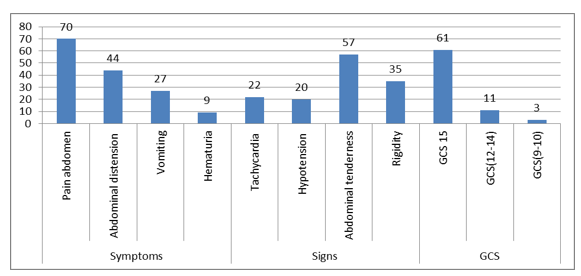
There were 75 patients who were included in this study belonged to the age group 16-75 years. The most common age group affected was 16-30 years which constitute 56% of total affected population. 61-75 years group constituted least affected group [Table 1]. Pain abdomen was the most common chief complaint (93.3%, n=70) in patients of blunt trauma abdomen followed by abdominal distension in 58.7% of patients (n=44). Vomiting was present in36% (n=27). Hematuria was present in 12% (n=9) of cases. At the time of admission, patient’s airway breathing, and circulation were assessed varied from 9 to 15. 81.3% patients had GCS of 15 and 14.6% of patients had GCS of 12 to 14. 3.99% patients had GCS of 9 to 10. [Table 2] Abdominal tenderness was the most common sign present in 76% (n=57) of cases followed by Rigidity (46.67%, n=35) and abdominal external injury was present in 26.6% (n=20) of cases (Table 2).
Table 1: Age distribution in blunt trauma abdomen patients
| Variables | Frequency | Percentage |
| Age group (in years) | ||
| 16-30 | 42 | 56.00 |
| 31-45 | 24 | 32.00 |
| 46-60 | 5 | 6.67 |
| 61-75 | 4 | 5.33 |
| Gender | ||
| Male | 69 | 92.00 |
| Female | 6 | 8.00 |
| Total | 75 | 100.00 |
Table 2: Signs and symptoms
Parameters | Frequency | Percentage | |
Symptoms
| Pain abdomen | 70 | 93.30% |
Abdominal distension | 44 | 58.7% | |
Vomiting | 27 | 36% | |
Hematuria | 9 | 12% | |
Signs | Tachycardia (pulse>100/ min) | 22 | 29% |
Hypotension (systolic BP < 90mm of hg) | 20 | 26.60% | |
Abdominal tenderness | 57 | 76.00% | |
Rigidity | 35 | 46.67% | |
GCS | GCS 15 | 61 | 81.33% |
GCS(12-14) | 11 | 14.66% | |
GCS(9-10) | 3 | 3.99% | |
Table 3: Severity assessment of injuries
| AIS SCALE | Frequency | Percentage |
| 1 | 8 | 10.7 |
| 2 | 26 | 34.7 |
| 3 | 26 | 34.7 |
| 4 | 14 | 18.0 |
| 5 | 0 | 0 |
| 6 | 0 | 0 |

Figure 2: Signs and symptoms
The pulse rate at presentation varied from 74-142/minute with an average of 91.9/minute. Of these, 22 patients had tachycardia (rate >100 beats/minute). The systolic BP of patients ranged from 58 to 128 mm of Hg. 26.6% (n=20) presented with systolic BP<90 mm of Hg. 6 patients (8%) stabilized using inotropes, 42.7% (n=32) using PRBC and 60% (n=45) using colloids (Table 2).
Assessment of severity of injuries was done on the basis of two scales: Injury Severity Score (ISS) and Abbreviated injury scale (AIS). The patients in study group had minimum ISS of 1 and maximum of 38. Corresponding Abbreviated injury scale (AIS) varied minimum 1 to maximum 4. Maximum BTA patients 26 (34.7%) had AIS score 2& 3 each followed by AIS score 2 in 14 (18%) and AIS score 1 in 8 (10.7%) patients (Table 3).
The initial clinical assessment of patients with blunt abdominal trauma is often very difficult.7 In our study, Pain abdomen was most consistent finding in all patients of blunt trauma abdomen in our study and was found in 93.3%. Abdominal distension was found in 58.7% and vomiting was present in 36% of cases. Abdominal tenderness was present in 76% of cases. Rigidity was present in 46.67% of cases and was associated with hem peritoneum and hollow viscus injury. There were 22 patients who had tachycardia at presentation, which when correlated with shock it was seen that 20 patients of these 22 were in shock i.e. with a systolic blood pressure less than 90 mm of Hg, out of which six patients required ionotropic support at admission after fluid and blood product resuscitation. When statistically analyzed the presence of shock on presentation was seen to be associated with ionotropic and blood product transfusion with a p value of <0.05. Similar to our study, Singh et al [8]. in a study over 110 patients found pain to be the most common symptom (100%) in blunt trauma abdomen. Tenderness was present in 95% of patients.
The injury scale such as AIS is known to be the predictor of mortality by many studies. Arumugam et al [9].showed mean AIS of 2.5+/-8 in the study. The abbreviated injury scale was measured for all the patients. The mean AIS was 2.61 with a range of 1-4.Maximum BTA patients 26 (34.7%) had AIS score 2& 3 each followed by AIS score 2 in 14 (18%) and AIS score 1 in 8 (10.7%) patients. (The mean ISS was 15.33 with a range of 1 -38 in this study group.
Abdominal pain was the most common presenting symptom and abdominal tenderness was most common sign at presentation. Maximum BTA Patients had GCS of 15 at the time of admission while remaining had it between 9-14. Hypotension (systolic BP of <90mmHg) was present in quarter of patients at presentation Maximum BTA patients had AIS score [2, 3].
Hemmila, M.R., and W.L. Wahl. “Management of Injured Patient.” Current Surgical Diagnosis and Treatment, edited by G.M. Doherty, McGraw Hill Medical, 2008, pp. 227–228.
Modi, K, et al. “A Profile Study of Death Due to Blunt Abdominal Trauma in BJ Medical College, Ahmedabad.” International Journal of Medical Toxicology and Legal Medicine, vol. 20, 2017, pp. 40–43.
Isenhour, J.L., and J. Marx. “Advances in Abdominal Trauma.” Emergency Medicine Clinics of North America, vol. 25, 2007, pp. 713–733.
George, M.J, et al. “Evaluation of Criteria and Outcome of Conservative Approach in Management of Blunt Trauma Abdomen.” MedPulse International Journal of Surgery, vol. 9, no. 2, Feb. 2019, pp. 1–2.
Bode, P.J., M.J. Edwards, M.C. Kruit, and A.B. Van Vugt. “Sonography in a Clinical Algorithm for Early Evaluation of 1671 Patients with Blunt Abdominal Trauma.” AJR, vol. 172, 1999, pp. 905–911.
Grieshop, N.A., et al. “Selective Use of Computed Tomography and Diagnostic Peritoneal Lavage in Blunt Abdominal Trauma.” Journal of Trauma and Acute Care Surgery, vol. 38, 1995, pp. 727–731.
Medscape. “What Are the Signs and Symptoms of Blunt Abdominal Trauma in an Alert Patient?” Medscape, https://www.medscape.com/answers/ 1980980-173117/what-are-the-signs-and-symptom-of-blunt-abdominal-trauma-in-an-alert-patient. Accessed 16 June 2021.
Singh, S.P., et al. “Pattern of Injury of Blunt Trauma Abdomen in Rural Population.” International Surgery Journal, vol. 3, 2016, pp. 497–500.
Arumugam, S., et al. “Frequency, Causes and Pattern of Abdominal Trauma: A 4-Year Descriptive Analysis.” Journal of Emergencies, Trauma, and Shock, vol. 8, 2015, pp. 193–198.