The research and study devote efforts to assess and know the Role of Vitamin 25-Hydroxy (D) In Promoting Health and Contributing to Iraqi Children; data on 70 children were collected from Karbala Health Directorate, Center Sector, Karbala, Iraq. The proportion was divided into two parts, 50 children, males, 20 children, women children. The children's ages ranged between 2 to 8 years, and through the statistical analysis program, the true value and the standard regression were identified to ages 5.3571 + 2.23954. The study was conducted in the period 3-4-2020 to 8-8-2020; in addition, in this article, we analyze the characteristics of vitamin D synthesis depending on the gender and age of patients.
Keywords
Cholecalciferol
Vitamin D
Ultraviolet rays Bone health
Vitamin D deficiency
INTRODUCTION
This substance is called "cholecalciferol." Most people know it as a sunshine vitamin: the body produces it in response to ultraviolet rays from the sun on the skin. Vitamin D is also found in fish, fish oil, egg yolks, dairy products and fortified cereals [1,2].
Vitamin D helps the body absorb calcium, strengthens bones, maintains muscle tone and stimulates the immune system [3].
The first signs of vitamin D deficiency are aches and pains in the bones or muscles. If not treated in time, vitamin deficiencies in the blood can increase the risk of death from cardiovascular disease, cancer, cognitive impairment in older children and severe asthma in children [4].
In addition, a vitamin D deficiency is dangerous if you have type 1 and type 2 diabetes, high blood pressure, glucose intolerance, or multiple sclerosis - in which case a deficiency can worsen the health condition [5].
Vitamin D deficiency can occur for several reasons. The most common are: The diet is low on products that contain vitamin D. This is especially true if the person is following a vegetarian diet, as most natural sources of vitamin D are of animal origin [6,7,8].
Not enough sunlight the body makes vitamin D when sunlight hits the skin. The risk of deficiency is greater if you often sit at home (and we have been isolated for a long time), live in northern latitudes (light up in late winter, dark early), or wear closed clothes or hats for religiousness. Causes or misuse means blocking ultraviolet rays from reaching the skin [9,10,11].
Obesity; Vitamin D is removed from the blood by fat cells, which reduces its release into the bloodstream. People with a BMI of 30 or higher often have low levels of vitamin D]12].
The most accurate way is to take a blood test for 25-hydroxy-vitamin D and the norm for healthy people is 20 ng/ml (Ng per milliliter) to 50 ng/ml. If the test shows 12 ng/ml or less, this is a severe vitamin D deficiency and needs treatment [13].
Vitamin D deficiency is always serious, but during an epidemic, it has become a potential factor in complicating the course of COVID-19. Many studies throughout the year concluded with the following results: Full intake of vitamin D can improve treatment outcomes for infected patients, Coronavirus and vitamin D can reduce the severity of the disease and the risk of complications and patients who have normal levels of vitamin D [14,15,16].
Table 1: Extra-skeletal effects of vitamin D [18,19]
system or disease
Vitamin D Effects
Skin
The risk of developing malignant tumors sharply increases the exposure of the skin to ultraviolet rays.
It affects the regeneration of hair follicles through its Vitamin D receptors
type 2 diabetes
Although vitamin D deficiency is common in obesity and types 2 diabetes, causation is poorly established.
There is no reason to recommend vitamin D for treatment
Or the prevention of obesity and diabetes
diabetic.
nephropathy
Vitamin D deficiency is a new risk factor
Kidney disease progression, but still
It has not been convincingly proven that
Able to extend the time before the start
End-stage renal failure.
This question remains open pending receipt
Controlled Clinical Results
Research
The body is less likely to encounter serious complications of the Coronavirus (for example, difficulty breathing and loss of consciousness) [17].
Experts of the International Endocrinological Society analyzed the evidence base on the extra-skeletal effects of vitamin D and the possibilities of its use for the prevention or treatment of diseases not associated with phosphorus-calcium or bone metabolism.
The systematized results of this analysis are presented in However; it should be noted that the evidence base underlying some conclusions and practical recommendations is limited to work with the use of relatively low doses of vitamin D, which has not always been sufficient to achieve blood levels of 25 (OH) D over 30 ng/ml.
Unlike 25(OH)D, the active form of vitamin D, 1,25(OH)2D, is not It is an indicator of vitamin D reserves, as it is of short duration Half-life (<4 hours) and tightly regulated by PTH, FGF23 depending on the content of calcium and phosphorous [23]. Serum 1.25(OH)2D Concentration The blood usually decreases until vitamin D deficiency is reached Critical values [3,19].
There is some disagreement among experts regarding Divide points that determine vitamin D deficiency and deficiency for the health of the skeletal system. In some cases, to evaluate the reference Interval analysis of vitamin D levels in healthy populations, Calculate the 95th percentile.
However, due to the high prevalence of Vitamin D deficiency, this method is much more unjustified proven analysis of bone tissue biopsies with level determination
Mineralization with an estimation of vitamin D content has Mineralization is not disturbed, but this technique cannot have mass Application due to its invasion. The definition of a level Parathyroid hormone allows to assess his vitamin D level Excessive secretion of parathyroid hormone is prevented [20] (Table 1).
MATERIALS AND METHODS
The study's empirical results were validated by collecting 80 healthy children from Karbala Health Directorate, Center Sector, Karbala, Iraq.
The percentage of children's ages was between 2 to 8 years old and by relying on statistical analysis, it was found that the mean value and the standard regression to the existing ages are 5+2.8, where the study was conducted in the period 3-4-2020 to 8-8-2020. Children who had problems in the musculoskeletal system, as this category was not included in the study. The division of patients was divided into two parts, 50 children, males and 20 children, women children.
Data collection was performed through the 24-hour feeding replication method. (daily) serum concentrations of 25(OH)D determined using a vitamin D ELISA kit and level were higher 75 nmol/L was used to determine the adequacy of vitamin D.
Statistical Analysis
Demographic information was collected and counted by specialists and then sent to the statistical analyst to make the necessary statistics, which were summed up in true value and standard regression in addition to accuracy and CHI-SQUARE and all the information was worked on through the use of the program SPSS 25-SOFT.
RESULTS
The data obtained indicate that the frequency of detection of both deficiencies and deficiencies and average concentrations depends on the patient's age. The rarest patients were detected with a concentration of 25(OH)D less than 65 ng/mL among children under two years of age - And it was in 5 children, the Vit D rate was more than 70 nanograms, but at the age of 3 years, the detection rate of patients with a blood concentration less than the minimum norm increased 2.5 times. The proportion of Vit D 5 children was more than 70 nanograms. The largest number of patients with the largest amount was identified, as they were from 6 to 8 years old, as shown in the Table 6.
DISCUSSION
Seventy children were selected from Karbala Health Directorate, Center Sector, Karbala, Iraq, where the study aimed to determine the role of Vitamin 25-Hydroxy (D) In Promoting Health and Contributing to Iraqi Children:
5.3571+ 2.23954
The results were referred in general to the evaluation of Vit D and high results were found more than 70 nanograms at the ages of 6 to 8 years and decreased at the age of 2 years.
Population studies on vitamin D status as one of the most important hormonal and mineral balance markers are receiving significant attention. The main conclusions of large-scale epidemiological and population studies are based, as a rule, on the results of measuring the concentration of the active form of calciferol - calcidiol (25 (OH) D) circulating in the blood. Calcidiol is one of the most important intermediate proteins that affect the concentration of calcium ions and tissues present in tissues, which are the main hormones that ensure homeostasis in the body.
Table 2: Disturbance of samples
age
Frequency
Percent
Valid Percent
Cumulative Percent
Valid
2.00
13
18.6
18.6
18.6
3.00
6
8.6
8.6
27.1
4.00
8
11.4
11.4
38.6
5.00
3
4.3
4.3
42.9
6.00
13
18.6
18.6
61.4
7.00
10
14.3
14.3
75.7
8.00
17
24.3
24.3
100.0
Total
70
100.0
100.0
Table 3:Descriptive Statistics depend on age
Descriptive Statistics
N
Minimum
Maximum
Mean
Std. Deviation
age
70
2.00
8.00
5.3571
2.23954
Valid N (listwise)
70
Table 4:Descriptive results depend on the value of Vit D
VITD
Frequency
Percent
Valid Percent
Cumulative Percent
Valid
44.00
2
2.9
2.9
2.9
45.00
2
2.9
2.9
5.7
46.00
1
1.4
1.4
7.1
48.00
1
1.4
1.4
8.6
49.00
2
2.9
2.9
11.4
50.00
6
8.6
8.6
20.0
51.00
1
1.4
1.4
21.4
53.00
1
1.4
1.4
22.9
55.00
4
5.7
5.7
28.6
57.00
6
8.6
8.6
37.1
58.00
3
4.3
4.3
41.4
63.00
3
4.3
4.3
45.7
65.00
1
1.4
1.4
47.1
66.00
7
10.0
10.0
57.1
70.00
2
2.9
2.9
60.0
76.00
2
2.9
2.9
62.9
77.00
6
8.6
8.6
71.4
79.00
6
8.6
8.6
80.0
80.00
8
11.4
11.4
91.4
81.00
3
4.3
4.3
95.7
83.00
2
2.9
2.9
98.6
87.00
1
1.4
1.4
100.0
Total
70
100.0
100.0
Table 5: Cross-tabulation of Vit D depends on age
age * VITD Cross tabulation
Count
VITD
44
45
46
48
49
50
51
53
55
57
58
63
65
66
70
76
77
79
80
81
83
87
Age
2
0
1
0
0
1
2
0
0
1
1
0
0
1
1
0
0
1
0
2
2
0
0
13
3
0
0
0
0
0
1
0
0
0
0
0
0
0
2
0
0
1
0
1
0
1
0
6
4
0
1
0
0
0
0
0
0
0
1
0
0
0
2
0
1
1
1
1
0
0
0
8
5
0
0
0
0
0
0
0
0
2
1
0
0
0
0
0
0
0
0
0
0
0
0
3
6
0
0
1
0
0
2
1
0
0
0
2
3
0
0
0
0
0
3
1
0
0
0
13
7.
1
0
0
0
0
0
0
1
0
1
1
0
0
2
0
1
1
1
1
0
0
0
10
8
1
0
0
1
1
1
0
0
1
2
0
0
0
0
2
0
2
1
2
1
1
1
17
Total
2
2
1
1
2
6
1
1
4
6
3
3
1
7
2
2
6
6
8
3
2
1
70
Table 6: Vitamin D status
S 25 OH
No
Status
Less than 50
14
reduction
Larger than 50 to 75
28
insufficiency
Larger or equal 75
28
adequacy
Previously, we analyzed the climatic and seasonal characteristics of the composition of vitamin D in the population of Russia and concluded (like other domestic and foreign researchers) that the blood level of 25 (OH) D does not depend on the geo-climatic location of the settlement in which the examined patients live, but it does exist. From the time of the year in which the survey is conducted. In this article, we analyze the characteristics of vitamin D formation depending on the sex and age of patients.
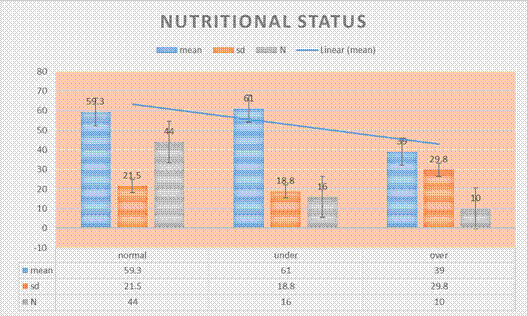
Figure 1: Nutritional status
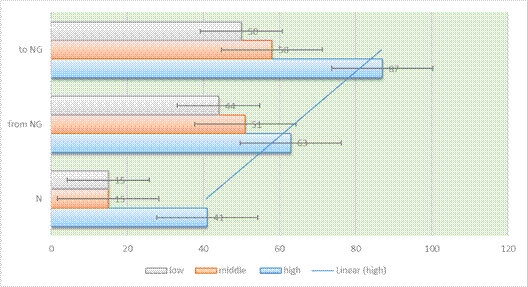
Figure 2: Assessment of socioeconomic status
Studies conducted in the Arkhangelsk region, where the insolation level is low, showed that the supply of vitamin D in different age groups is far from the same. Thus, 45% of children aged 0-3 years have a normal concentration of 25 (OH) D. In all other age groups (newborns, children 6-7 and 13-15 years old, students, mothers who have given birth to children), patients with normal levels were less likely to be enrolled: from 1% (adolescents 13-15 years) to 35% (mothers) [ten years]. When examining 171 one-month-old infants. Up to 3 years of age, mean values of 25(OH)D were 18.2±1.0 ng/mL. This is significantly lower than in our study, where infants were less than 12 months old. They have an average concentration of 25 (OH) D 60.45±2.1 ng/ml and children from 1 to 3 years old - 40.79±0.79 ng/ml.
CONCLUSION
Chronic vitamin D deficiency is fraught with serious health problems and significantly increases the risk of developing diabetes, psoriasis, arterial hypertension, bronchitis, lung and autoimmune diseases. With its deficiency, there is a violation of calcium metabolism and a decrease in its level in the blood.
Recommendations
To exclude the deterioration of health and the appearance of depression, it is worth adhering to simple recommendations:
It is necessary to pay special attention to the diet and eat fatty fish, cod liver and hard cheese.
Spend more time in the sun. And in the cold season, visit the solarium
Take calciferol supplements as needed, but only the doctor should decide whether to take vitamin D drugs after a detailed diagnosis, take anamnesis and pass certain tests.
Contact Vera Family Medicine Center to undergo a comprehensive diagnosis and prevent the development of many diseases from receiving competent medical care. Highly qualified doctors will take care of your health.
REFERENCES
Deluca, Hector F. and Margherita T. Cantorna. "Vitamin D: Its role and uses in immunology." The FASEB Journal, vol. 15, no. 14, 2001, pp. 2579–2585.
Hollis, B.W. "Comparison of commercially available 125I-based RIA methods for the determination of circulating 25-Hydroxyvitamin D." Clinical Chemistry, vol. 46, no. 10, 2000, pp. 1657–1661.
Omdahl, J.L., et al. "Hydroxylase enzymes of the vitamin D pathway: Expression, function and regulation." Annual Review of Nutrition, vol. 22, no. 1, 2002, pp. 139–166.
Horst, R.L., et al. "The isolation and identification of vitamin D2 and Vitamin D3 from Medicago Sativa (Alfalfa Plant)." Archives of Biochemistry and Biophysics, vol. 231, no. 1, 1984, pp. 67–71.
Armas, L.A., et al. "Vitamin D2 Is Much Less Effective Than Vitamin D3 in Humans." The Journal of Clinical Endocrinology & Metabolism, vol. 89, no. 11, 2004, pp. 5387–5391.
Karlson, P., et al. "IUPAC-IUB Joint Commission on Biochemical Nomenclature (JCBN): Nomenclature of Vitamin D-Recommendations 1981." European Journal of Biochemistry, 1982.
Iqbal, S.J. "Vitamin D Metabolism and the clinical aspects of measuring metabolites." Annals of Clinical Biochemistry, vol. 31, no. 2, 1994, pp. 109–124.
Holick, M.F. "The Use and interpretation of assays for Vitamin D and its metabolites." The Journal of Nutrition, vol. 120, suppl. 11, 1990, pp. 1464–1469.
Vogeser, M., et al. "Candidate reference method for the quantification of circulating 25-hydroxyvitamin D3 by liquid chromatography-tandem mass spectrometry." Clinical Chemistry, vol. 50, no. 8, 2004, pp. 1415–1417.
Trang, H.M., et al. "Evidence that vitamin D3 increases serum 25-Hydroxyvitamin D more efficiently than does vitamin D2." The American Journal of Clinical Nutrition, vol. 68, no. 4, 1998, pp. 854–858.
Coldwell, R.D., et al. "Gas chromatography-mass spectrometry and the measurement of vitamin D metabolites in human serum or plasma." Steroids, vol. 49, no. 1–3, 1987, pp. 155–196.
Eisman, J.A., et al. "Determination of 25-hydroxyvitamin D2 and 25-hydroxyvitamin D3 in human plasma using high-pressure liquid chromatography." Analytical Biochemistry, vol. 80, no. 1, 1977, pp. 298–305.
Gilbertson, T.J. and R.P. Stryd. "High-performance liquid chromatographic assay for 25-Hydroxyvitamin D3 in serum." Clinical Chemistry, vol. 23, no. 9, 1977, pp. 1700–1704.
Aksnes, L. "A simplified high-performance liquid chromatographic method for determining vitamin D3, 25-Hydroxyvitamin D2 and 25-Hydroxyvitamin D3 in human serum." Scandinavian Journal of Clinical and Laboratory Investigation, vol. 52, no. 3, 1992, pp. 177–182.
Turpeinen, U., et al. "Determination of 25-Hydroxyvitamin D in Serum by HPLC and Immunoassay." Clinical Chemistry, vol. 49, no. 9, 2003, pp. 1521–1524.
Sackrison, J.L., et al. "Develop a sensitive, automated, non-extracted, direct liaison immunoassay for 25 OH Vitamin D." Clinical Chemistry, vol. 48, no. 6, 2002, pp. A122–A123.
Glendenning, P., et al. "Issues of methodology, standardization and metabolite recognition for 25-Hydroxyvitamin D." Annals of Clinical Biochemistry, vol. 40, no. 5, 2003, pp. 546–551.
Ersfeld, D.L., et al. "Analytical and clinical validation of the 25 OH Vitamin D assay for the LIAISON® automated analyzer." Clinical Biochemistry, vol. 37, no. 10, 2004, pp. 867–874.
Antoniucci, D.M., et al. "Serum 25-Hydroxyvitamin D is unaffected by multiple freeze-thaw cycles." Clinical Chemistry, vol. 51, no. 1, 2005, pp. 258–261.
Binkley, N., et al. "Assay variation confounds the diagnosis of hypovitaminosis D: A call for standardization." The Journal of Clinical Endocrinology & Metabolism, vol. 89, no. 7, 2004, pp. 3152–3157.
License
Creative Commons Attribution-NonCommercial-NoDerivatives 4.0 International License
All papers should be submitted electronically. All submitted manuscripts must be original work that is not under submission at another journal or under consideration for publication in another form, such as a monograph or chapter of a book. Authors of submitted papers are obligated not to submit their paper for publication elsewhere until an editorial decision is rendered on their submission. Further, authors of accepted papers are prohibited from publishing the results in other publications that appear before the paper is published in the Journal unless they receive approval for doing so from the Editor-In-Chief.
Himalayan Journal of Applied Medical Sciences and Research open access articles are licensed under a Creative Commons Attribution-Share A like 4.0 International License. This license lets the audience to give appropriate credit, provide a link to the license, and indicate if changes were made and if they remix, transform, or build upon the material, they must distribute contributions under the same license as the original.
Recommended Articles
Research Article
Digital Implantology: Current Concepts, Clinical Applications, Limitations and Future Directions - A Narrative Review
Anukrity Chandra
Published: 30/07/2026
Download PDF
Cite
x
APA
Chandra, A. (2026). Digital Implantology: Current Concepts, Clinical Applications, Limitations and Future Directions - A Narrative Review. Himalayan Journal of Applied Medical Sciences and Research, 7(2), 1-7.
MLA
Chandra, Anukrity. "Digital Implantology: Current Concepts, Clinical Applications, Limitations and Future Directions - A Narrative Review." Himalayan Journal of Applied Medical Sciences and Research 7.2 (2026): 1-7.
Chicago
Chandra, Anukrity. "Digital Implantology: Current Concepts, Clinical Applications, Limitations and Future Directions - A Narrative Review." Himalayan Journal of Applied Medical Sciences and Research 7, no. 2 (2026): 1-7.
Harvard
Chandra, A. (2026) 'Digital Implantology: Current Concepts, Clinical Applications, Limitations and Future Directions - A Narrative Review' Himalayan Journal of Applied Medical Sciences and Research 7(2), pp. 1-7.
Vancouver
Chandra A. Digital Implantology: Current Concepts, Clinical Applications, Limitations and Future Directions - A Narrative Review. Himalayan Journal of Applied Medical Sciences and Research. 2026 Jul;7(2):1-7.
Download PDF
Research Article
Study of the Role of Serum Interleukin-6 in Inflammation among Pregnant Women with COVID-19
Aynar Talib Samad,
Yossra Saleh Khudhur
Published: 27/07/2021
Download PDF
Cite
x
APA
Talib Samad, A. & Khudhur, Y. S. (2021). Study of the Role of Serum Interleukin-6 in Inflammation among Pregnant Women with COVID-19. Himalayan Journal of Applied Medical Sciences and Research, 2(2), 1-6.
MLA
Talib Samad, Aynar and Yossra Saleh Khudhur. "Study of the Role of Serum Interleukin-6 in Inflammation among Pregnant Women with COVID-19." Himalayan Journal of Applied Medical Sciences and Research 2.2 (2021): 1-6.
Chicago
Talib Samad, Aynar and Yossra Saleh Khudhur. "Study of the Role of Serum Interleukin-6 in Inflammation among Pregnant Women with COVID-19." Himalayan Journal of Applied Medical Sciences and Research 2, no. 2 (2021): 1-6.
Harvard
Talib Samad, A. and Khudhur, Y. S. (2021) 'Study of the Role of Serum Interleukin-6 in Inflammation among Pregnant Women with COVID-19' Himalayan Journal of Applied Medical Sciences and Research 2(2), pp. 1-6.
Vancouver
Talib Samad A, Khudhur YS. Study of the Role of Serum Interleukin-6 in Inflammation among Pregnant Women with COVID-19. Himalayan Journal of Applied Medical Sciences and Research. 2021 Jul;2(2):1-6.
Download PDF
Research Article
Evalution CD11b, CD4, IL-17A and IL-23 as Biomarkers Immunological in Patients with Behçet’s Disease
Layla Saleh Abdul-Hassan,
...
Saeed hilal khudhair
Published: 13/07/2026
Download PDF
Cite
x
APA
Abdul-Hassan, L. S., Fadel, R. H. & khudhair, S. H. (2026). Evalution CD11b, CD4, IL-17A and IL-23 as Biomarkers Immunological in Patients with Behçet’s Disease. Himalayan Journal of Applied Medical Sciences and Research, 7(2), 1-7.
MLA
Abdul-Hassan, Layla S., Radhia H. Fadel and Saeed H. khudhair. "Evalution CD11b, CD4, IL-17A and IL-23 as Biomarkers Immunological in Patients with Behçet’s Disease." Himalayan Journal of Applied Medical Sciences and Research 7.2 (2026): 1-7.
Chicago
Abdul-Hassan, Layla S., Radhia H. Fadel and Saeed H. khudhair. "Evalution CD11b, CD4, IL-17A and IL-23 as Biomarkers Immunological in Patients with Behçet’s Disease." Himalayan Journal of Applied Medical Sciences and Research 7, no. 2 (2026): 1-7.
Harvard
Abdul-Hassan, L. S., Fadel, R. H. and khudhair, S. H. (2026) 'Evalution CD11b, CD4, IL-17A and IL-23 as Biomarkers Immunological in Patients with Behçet’s Disease' Himalayan Journal of Applied Medical Sciences and Research 7(2), pp. 1-7.
Vancouver
Abdul-Hassan LS, Fadel RH, khudhair SH. Evalution CD11b, CD4, IL-17A and IL-23 as Biomarkers Immunological in Patients with Behçet’s Disease. Himalayan Journal of Applied Medical Sciences and Research. 2026 Jul;7(2):1-7.
Download PDF
Research Article
Bones in Balance: Awareness of Rickets and Nutritional Deficiencies Among the Hamirpur Community
Vishal Dhatwalia,
Swati Chandel
Published: 10/12/2024
Download PDF
Cite
x
APA
Dhatwalia, V. & Chandel, S. (2024). Bones in Balance: Awareness of Rickets and Nutritional Deficiencies Among the Hamirpur Community. Himalayan Journal of Applied Medical Sciences and Research, 5(2), 1-5.
MLA
Dhatwalia, Vishal and Swati Chandel. "Bones in Balance: Awareness of Rickets and Nutritional Deficiencies Among the Hamirpur Community." Himalayan Journal of Applied Medical Sciences and Research 5.2 (2024): 1-5.
Chicago
Dhatwalia, Vishal and Swati Chandel. "Bones in Balance: Awareness of Rickets and Nutritional Deficiencies Among the Hamirpur Community." Himalayan Journal of Applied Medical Sciences and Research 5, no. 2 (2024): 1-5.
Harvard
Dhatwalia, V. and Chandel, S. (2024) 'Bones in Balance: Awareness of Rickets and Nutritional Deficiencies Among the Hamirpur Community' Himalayan Journal of Applied Medical Sciences and Research 5(2), pp. 1-5.
Vancouver
Dhatwalia V, Chandel S. Bones in Balance: Awareness of Rickets and Nutritional Deficiencies Among the Hamirpur Community. Himalayan Journal of Applied Medical Sciences and Research. 2024 Jul;5(2):1-5.
Ali Hasan Albakle, M., Riyadh Hashim Alhamadani, F. & Mohammed Ameen Zainy, D. (2021). Determining the Role of Vitamin 25-Hydroxy (D) in Promoting Health and Contributing to Iraqi Children. Himalayan Journal of Applied Medical Sciences and Research, 2(2), 1-5.
MLA
Ali Hasan Albakle, Manal, Fareed Riyadh Hashim Alhamadani and Dalal Mohammed Ameen Zainy. "Determining the Role of Vitamin 25-Hydroxy (D) in Promoting Health and Contributing to Iraqi Children." Himalayan Journal of Applied Medical Sciences and Research 2.2 (2021): 1-5.
Chicago
Ali Hasan Albakle, Manal, Fareed Riyadh Hashim Alhamadani and Dalal Mohammed Ameen Zainy. "Determining the Role of Vitamin 25-Hydroxy (D) in Promoting Health and Contributing to Iraqi Children." Himalayan Journal of Applied Medical Sciences and Research 2, no. 2 (2021): 1-5.
Harvard
Ali Hasan Albakle, M., Riyadh Hashim Alhamadani, F. and Mohammed Ameen Zainy, D. (2021) 'Determining the Role of Vitamin 25-Hydroxy (D) in Promoting Health and Contributing to Iraqi Children' Himalayan Journal of Applied Medical Sciences and Research 2(2), pp. 1-5.
Vancouver
Ali Hasan Albakle M, Riyadh Hashim Alhamadani F, Mohammed Ameen Zainy D. Determining the Role of Vitamin 25-Hydroxy (D) in Promoting Health and Contributing to Iraqi Children. Himalayan Journal of Applied Medical Sciences and Research. 2021 Jul;2(2):1-5.



 Download PDF
 Download XML