In this paper a combined exponential ratio- type estimator has been proposed for estimating population mean of characteristic under study. The expressions for bias and mean square error have been derived up to first order of approximation and found that the optimum mean square error of proposed estimator is equal to the mean square error of combined linear regression estimator. Efficiency of proposed estimator is compared theoretically with existing estimators and supported by numerical illustration.
Keywords
Simple random sampling
Ratio and regression-type estimator
Auxiliary information
Mean squared error
Efficiency.
INTRODUCTION
Use of auxiliary information at the estimation stage improves the efficiency of estimates of the population parameters of variable of interest. Conventional ratio, product, difference and linear regression estimators were introduced that utilize the information on auxiliary variable. The ratio estimator introduced by [1] is more efficient if the study variable Y is positively correlated with auxiliary variable X, while the product estimator introduced by [2] is more useful when the study variable Y is negatively correlated with auxiliary variable X. Linear regression estimator is useful when line of regression of Y on X is linear but does not pass through origin. Later on, various authors [3]-[12] introduced modified class of ratio and product type estimators. Such modified estimators are generally developed either using one or more unknown constants or introducing a convex linear combination of sample and population means of auxiliary characteristic with unknown weights. In both the cases, optimum choices of unknown constant were made by minimizing the mean square error of modified estimators so that they become more efficient than the conventional one. [13] Introduced exponential ratio-product type estimator and shown that both the estimators performed better than the conventional estimators. Later on, various authors [14]and [15] suggested exponential estimators in sampling theory. In this paper a combined exponential ratio type estimator has been suggested for estimating finite population mean of characteristic under study.
Notation
Consider a finite population of size N which is divided into k strata such that
∑_(i=1)^k▒N_h =N,
(h = 1, 2, 3, …, k) let us select sample of size n_hfrom hth stratum by SRSWOR such that ∑_(i=1)^k▒n_h =n . Let us further denote:
y ̅_st= ∑_(i=1)^k ▒〖W_h y ̅_h
stratified sample mean of per unit
y ̅_h=1/n_h ∑_(j=1)^(n_h)▒y ̅_hj
sample mean of hth stratum
Y ̅= ∑_(h=1)^k ▒ [W_h Y ̅_h]
the population mean;
Where, Y ̅_h= 1/N_h ∑_(j=1)^(N_h)▒Y ̅_hj and W_h= N_h/N
S_Yh^2=1/(N_h-1) ∑_(j=1)^(N_h)▒〖(Y ̅_hj-Y ̅_h)〗^2
The population mean square of hth stratum of characteristic under study.
S_Xh^2=1/(N_h-1) ∑_(j=1)^(N_h)▒〖(X ̅_hj-X ̅_h)〗^2
The population mean square of hth stratum of auxiliary variable.
The coefficient of variation of hth stratum of characteristic under study.
C_Xh= S_Xh/X ̅_h
The coefficient of variation of hth stratum of auxiliary variable.
ρ = S_XYh/(S_Xh S_Yh )
The Correlation coefficient between the value of auxiliary variable and value of characteristic under study.
Existing Estimators
Suggested exponential ratio-type and product –type estimators for population mean, respectively, as
and
(1)
The mean square error of are given as
(2)
(3)
Suggested an exponential estimator as
=
(4)
Exponential ratio-type and product –type estimators for population mean under stratified random sampling become:
=
(6)
=
(7)
The mean square error of are given as:
(8)
(9)
Proposed Estimator
Motivated from the work done by Gamze Ozel Kadilar (2016) and others, a combined exponential ratio-type estimator for population mean has been proposed as:
tp =
(10)
Bias And Mean Square Error (Mse) Of
To obtain the bias and mean square error, let us suppose
and (11)
E = E
E
(12)
Similarly, E &
Now,
(13)
The bias of the proposed estimator tto terms of ordercan be obtained by taking the expectation of (7) and substituting results obtained in (5) as
(14)
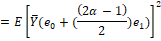
Now, squaring both sides of Eq. 7 and taking expectation and using results in Eq. 5, the MSE of the proposed estimator t to terms of order is obtained as:
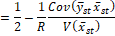
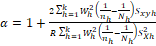
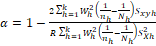
Optimum value of
Hence,
(16)
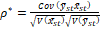
Where
Minimum MSE of by substituting the optimum value of
We have,
(17)
(18)
Where
That is the MSE of combined linear regression estimator. Hence for the optimum value of the proposed estimator t is equally efficient as the combined linear regression estimator.
Efficiency Comparison
In this section efficiency of the proposed estimator is compared with that of existing estimators and conditions are obtained under which the proposed estimator is more efficient.
MSE (
On simplification,
MSE (
Similarly on simplification, (20)
Empirical Study
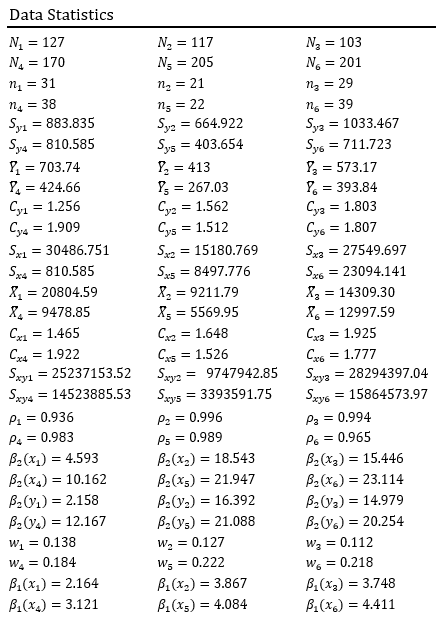
The efficiency of the proposed estimator has been compared with existing estimators considered in this paper. The Descriptions of the population is given as:
Estimators
MSE
PRE
Tp when α=0.1
1242.471
29.35391
Tp when α=0.2
987.838
36.9204
Tp when α=0.3
772.4812
47.21329
Tp when α=0.4
596.4004
61.1525
Tp when α=0.5
459.5957
79.35534
Tp when α=0.6
362.0671
100.731
Tp when α=0.7
303.8147
120.0448
Tp when α=0.8
284.8383
128.0424
Tp when α=0.9
305.138
119.5242
Tp min
47.4061
769.3394
85.2341
427.8965
750.1452
48.619
CONCLUSION
From above mentioned table it is found that the proposed estimator has greater relative efficiency than other existing estimator considered in this paper and also for optimum value of α the proposed estimator is equally efficient as combined linear regression estimator.
Thus, the proposed estimator can be recommended for estimating the population mean of variable of interest in survey sampling.
REFERENCE
Cochran, W.J. "The estimation of the yields of the cereals experiments by sampling for the ratio of grain to total produce." The Journal of Agricultural Science, vol. 30, 1940, pp. 262–275.
Murthy, M.N. "Product method of estimation." Sankhya, vol. 26, 1964, pp. 294–307.
Hartley, H.O. and A. Ross. "Unbiased ratio estimators." Nature, vol. 174, 1954, pp. 270–271.
Walsh, J.K. "Generalization of ratio estimator for population total." Sankhya, vol. 32A, 1970, pp. 99–106.
Ray, S.K. et al. "A note on ratio and product estimators." Annals of the Institute of Mathematical Statistics, vol. 31, 1979, pp. 141–144.
Srivenkataramana, T. and D.S. Tracy. "On ratio and product methods of estimation in sampling." Statistica Neerlandica, vol. 33, 1979, pp. 47–49.
Vos, J.W.E. "Mixing of direct ratio and product estimators." Statistica Neerlandica, vol. 34, 1980, pp. 209–218.
Ray, S.K. and A. Sahai. "Efficient families of ratio and product estimators." Biometrica, vol. 67, 1980, pp. 215–217.
Srivenkataramana, T. "A dual to ratio estimators in sample surveys." Biometrica, vol. 67, no. 1, 1980, pp. 199–204.
Singh, R.V.K. and B.K. Singh. "Study of a class of ratio type estimator under polynomial regression model." Proceeding of Mathematical Society, BHU, vol. 23, 2007.
Isaki, C.T. "Variance estimation using auxiliary information." Journal of the American Statistical Association, vol. 78, 1983, pp. 117–123.
Shah, D.N. and M.R. Gupta. "An efficiency comparison of dual, ratio and product estimators." Communication in Statistics: Theory and Methods, vol. 16, no. 3, 1987, pp. 1004–1012.
Bhal, S. and R.K. Tuteja. "Ratio and product type exponential estimator." Information and Optimization Sciences, vol. 12, 1991, pp. 159–163.
Upadhyaya, L.N. et al. "Improved ratio and product exponential type estimators." Journal of Statistical Theory and Practice, vol. 5, no. 2, 2011, pp. 285–302.
Solanki, R.S. et al. "An alternative estimator for estimating the finite population mean using auxiliary information in sample surveys." ISRN Probability and Statistics, 2012, doi:10.5402/2012/657682. Accessed 7 May 2025.
Kadilar, G.O. "A new exponential type estimator for the population mean in simple random sampling." Journal of Modern Applied Statistical Methods, vol. 15, no. 2, 2016, pp. 207–214.
None
None
None
None
None
License
Creative Commons Attribution-NonCommercial-NoDerivatives 4.0 International License
All papers should be submitted electronically. All submitted manuscripts must be original work that is not under submission at another journal or under consideration for publication in another form, such as a monograph or chapter of a book. Authors of submitted papers are obligated not to submit their paper for publication elsewhere until an editorial decision is rendered on their submission. Further, authors of accepted papers are prohibited from publishing the results in other publications that appear before the paper is published in the Journal unless they receive approval for doing so from the Editor-In-Chief.
Himalayan Journal of Applied Medical Sciences and Research open access articles are licensed under a Creative Commons Attribution-Share A like 4.0 International License. This license lets the audience to give appropriate credit, provide a link to the license, and indicate if changes were made and if they remix, transform, or build upon the material, they must distribute contributions under the same license as the original.
Recommended Articles
Research Article
Digital Implantology: Current Concepts, Clinical Applications, Limitations and Future Directions - A Narrative Review
Anukrity Chandra
Published: 30/07/2026
Download PDF
Cite
x
APA
Chandra, A. (2026). Digital Implantology: Current Concepts, Clinical Applications, Limitations and Future Directions - A Narrative Review. Himalayan Journal of Applied Medical Sciences and Research, 7(2), 1-7.
MLA
Chandra, Anukrity. "Digital Implantology: Current Concepts, Clinical Applications, Limitations and Future Directions - A Narrative Review." Himalayan Journal of Applied Medical Sciences and Research 7.2 (2026): 1-7.
Chicago
Chandra, Anukrity. "Digital Implantology: Current Concepts, Clinical Applications, Limitations and Future Directions - A Narrative Review." Himalayan Journal of Applied Medical Sciences and Research 7, no. 2 (2026): 1-7.
Harvard
Chandra, A. (2026) 'Digital Implantology: Current Concepts, Clinical Applications, Limitations and Future Directions - A Narrative Review' Himalayan Journal of Applied Medical Sciences and Research 7(2), pp. 1-7.
Vancouver
Chandra A. Digital Implantology: Current Concepts, Clinical Applications, Limitations and Future Directions - A Narrative Review. Himalayan Journal of Applied Medical Sciences and Research. 2026 Jul;7(2):1-7.
Download PDF
Research Article
Study of the Role of Serum Interleukin-6 in Inflammation among Pregnant Women with COVID-19
Aynar Talib Samad,
Yossra Saleh Khudhur
Published: 27/07/2021
Download PDF
Cite
x
APA
Talib Samad, A. & Khudhur, Y. S. (2021). Study of the Role of Serum Interleukin-6 in Inflammation among Pregnant Women with COVID-19. Himalayan Journal of Applied Medical Sciences and Research, 2(2), 1-6.
MLA
Talib Samad, Aynar and Yossra Saleh Khudhur. "Study of the Role of Serum Interleukin-6 in Inflammation among Pregnant Women with COVID-19." Himalayan Journal of Applied Medical Sciences and Research 2.2 (2021): 1-6.
Chicago
Talib Samad, Aynar and Yossra Saleh Khudhur. "Study of the Role of Serum Interleukin-6 in Inflammation among Pregnant Women with COVID-19." Himalayan Journal of Applied Medical Sciences and Research 2, no. 2 (2021): 1-6.
Harvard
Talib Samad, A. and Khudhur, Y. S. (2021) 'Study of the Role of Serum Interleukin-6 in Inflammation among Pregnant Women with COVID-19' Himalayan Journal of Applied Medical Sciences and Research 2(2), pp. 1-6.
Vancouver
Talib Samad A, Khudhur YS. Study of the Role of Serum Interleukin-6 in Inflammation among Pregnant Women with COVID-19. Himalayan Journal of Applied Medical Sciences and Research. 2021 Jul;2(2):1-6.
Download PDF
Research Article
Evalution CD11b, CD4, IL-17A and IL-23 as Biomarkers Immunological in Patients with Behçet’s Disease
Layla Saleh Abdul-Hassan,
...
Saeed hilal khudhair
Published: 13/07/2026
Download PDF
Cite
x
APA
Abdul-Hassan, L. S., Fadel, R. H. & khudhair, S. H. (2026). Evalution CD11b, CD4, IL-17A and IL-23 as Biomarkers Immunological in Patients with Behçet’s Disease. Himalayan Journal of Applied Medical Sciences and Research, 7(2), 1-7.
MLA
Abdul-Hassan, Layla S., Radhia H. Fadel and Saeed H. khudhair. "Evalution CD11b, CD4, IL-17A and IL-23 as Biomarkers Immunological in Patients with Behçet’s Disease." Himalayan Journal of Applied Medical Sciences and Research 7.2 (2026): 1-7.
Chicago
Abdul-Hassan, Layla S., Radhia H. Fadel and Saeed H. khudhair. "Evalution CD11b, CD4, IL-17A and IL-23 as Biomarkers Immunological in Patients with Behçet’s Disease." Himalayan Journal of Applied Medical Sciences and Research 7, no. 2 (2026): 1-7.
Harvard
Abdul-Hassan, L. S., Fadel, R. H. and khudhair, S. H. (2026) 'Evalution CD11b, CD4, IL-17A and IL-23 as Biomarkers Immunological in Patients with Behçet’s Disease' Himalayan Journal of Applied Medical Sciences and Research 7(2), pp. 1-7.
Vancouver
Abdul-Hassan LS, Fadel RH, khudhair SH. Evalution CD11b, CD4, IL-17A and IL-23 as Biomarkers Immunological in Patients with Behçet’s Disease. Himalayan Journal of Applied Medical Sciences and Research. 2026 Jul;7(2):1-7.
Download PDF
Research Article
Bones in Balance: Awareness of Rickets and Nutritional Deficiencies Among the Hamirpur Community
Vishal Dhatwalia,
Swati Chandel
Published: 10/12/2024
Download PDF
Cite
x
APA
Dhatwalia, V. & Chandel, S. (2024). Bones in Balance: Awareness of Rickets and Nutritional Deficiencies Among the Hamirpur Community. Himalayan Journal of Applied Medical Sciences and Research, 5(2), 1-5.
MLA
Dhatwalia, Vishal and Swati Chandel. "Bones in Balance: Awareness of Rickets and Nutritional Deficiencies Among the Hamirpur Community." Himalayan Journal of Applied Medical Sciences and Research 5.2 (2024): 1-5.
Chicago
Dhatwalia, Vishal and Swati Chandel. "Bones in Balance: Awareness of Rickets and Nutritional Deficiencies Among the Hamirpur Community." Himalayan Journal of Applied Medical Sciences and Research 5, no. 2 (2024): 1-5.
Harvard
Dhatwalia, V. and Chandel, S. (2024) 'Bones in Balance: Awareness of Rickets and Nutritional Deficiencies Among the Hamirpur Community' Himalayan Journal of Applied Medical Sciences and Research 5(2), pp. 1-5.
Vancouver
Dhatwalia V, Chandel S. Bones in Balance: Awareness of Rickets and Nutritional Deficiencies Among the Hamirpur Community. Himalayan Journal of Applied Medical Sciences and Research. 2024 Jul;5(2):1-5.
Abdullahi Sifawa, A. & Abdullahi, N. (2021). Combined Exponential Ratio –Type Estimator for Estimating Population Mean. Himalayan Journal of Applied Medical Sciences and Research, 2(2), 1-5.
MLA
Abdullahi Sifawa, Abdullahi and Nura Abdullahi. "Combined Exponential Ratio –Type Estimator for Estimating Population Mean." Himalayan Journal of Applied Medical Sciences and Research 2.2 (2021): 1-5.
Chicago
Abdullahi Sifawa, Abdullahi and Nura Abdullahi. "Combined Exponential Ratio –Type Estimator for Estimating Population Mean." Himalayan Journal of Applied Medical Sciences and Research 2, no. 2 (2021): 1-5.
Harvard
Abdullahi Sifawa, A. and Abdullahi, N. (2021) 'Combined Exponential Ratio –Type Estimator for Estimating Population Mean' Himalayan Journal of Applied Medical Sciences and Research 2(2), pp. 1-5.
Vancouver
Abdullahi Sifawa A, Abdullahi N. Combined Exponential Ratio –Type Estimator for Estimating Population Mean. Himalayan Journal of Applied Medical Sciences and Research. 2021 Jul;2(2):1-5.



 Download PDF
 Download XML




 Suggested exponential ratio-type and product –type estimators for population mean
 , respectively, as
 and
and 
 are given as

 Suggested an exponential estimator as
 =
= 
 Exponential ratio-type and product –type estimators for population mean
  under stratified random sampling become:
 =
= 
 =
= 
 are given as:



 and
and  (11)
(11) = E
= E 

 &
& 





 can be obtained by taking the expectation of (7) and substituting results obtained in (5) as
 is obtained as:









 (16)
(16)
 by substituting the optimum value of



 the proposed estimator t is equally efficient as the combined linear regression estimator.
 MSE (
MSE ( 

 MSE (
MSE ( 

 (20)
(20)