Contents
Download PDF
pdf Download XML
1362 Views
403 Downloads
Share this article
Research Article | Volume 2 Issue 2 (July-Dec, 2021) | Pages 1 - 3
Describing the Epidemiological Pattern of Musculoskeletal Injuries in Trans Himalayan Region
 ,
1
Department of Orthopedics, Dr Rajendra Prasad Government Medical College, Kangra, Himachal Pradesh, India
2
Department of Orthopedics, Indira Gandhi Medical College, Shimla, Himachal Pradesh, India
Under a Creative Commons license
Open Access
Received
Oct. 17, 2021
Revised
Nov. 27, 2021
Accepted
Dec. 12, 2021
Published
Dec. 31, 2021
Abstract

The Occupational Health and Safety Regulation defines musculoskeletal injury (MSI) defines musculoskeletal injury as a bodily lesion at the organic level, resulting from acute exposure to energy in amounts that exceed the threshold of physiological tolerance. The present study was designed with an aim to determine the pattern of musculoskeletal injuries presenting in district Kangra. Age group 45-60 years was most common age to suffer the traumatic musculoskeletal injuries. Outside home was the most commonplace for occurrence of injury. Road traffic accidents were the most common cause of injuries followed by fall from height.

Keywords
INTRODUCTION

Injuries are a growing public health problem, and affect all age groups [1]. The Occupational Health and Safety Regulation defines musculoskeletal injury (MSI) defines musculoskeletal injury as a bodily lesion at the organic level, resulting from acute exposure to energy (mechanical, thermal, electrical, chemical, or radiant) in amounts that exceed the threshold of physiological tolerance [2]. Injuries are a very broad group of afflictions, arising from many different activities, risk factors and can affect all organ system of the body. The external causes of injuries are categorized as unintentional or intentional [3]. Most traffic injuries, fire-related injuries, falls, drowning and poisonings are classified as unintentional injuries; injuries due to assaults, self-inflicted violence and war are classified as intentional injuries. Historically, the injury as a problem has been neglected, largely because injuries were viewed as accident or random events [4].


Most of the literature on injuries is from the west or from the urban areas of India. As the terrain and living conditions in Himachal Pradesh is different from other states of India the literature regarding these from different parts of India, cannot be the true reflection of the pattern of presentation in H.P. More over the concept of Trauma centers is being vigorously pursued by the Government of India. For proper and effective planning, one need to know the pattern of presentation of injuries in these trauma centers so that apart from orthopedic surgeons the requirement of other specialties and infrastructure can be projected accurately. 


Keeping these observations in consideration the present study was designed with an aim to determine the pattern of musculoskeletal injuries in district Kangra. This will help in further planning of the infrastructure and facilities to be provided to the injured patients.

MATERIALS AND METHODS

The study was carried out by taking the secondary data from the department of health and family welfare, district Kangra. It was a hospital based observational study conducted for a period of one year from the start of the study. The study population consisted of all the patients fulfilling inclusion criteria reporting to orthopedic department during the study period. All cases of musculoskeletal injuries reporting in the department on the day of the unit, in which post graduate had been allotted, was incorporated in the register. The detailed history of the study participant was taken from the patient after stabilizing the patient and if the patient was disoriented or was minor, the history was taken from the attendant accompanying the patient.


Statistical Analysis

Data was collected using a predesigned, semi-structured study tool. The data was entered and cleaned using MS Excel 2007. The qualitative results were expressed as frequencies and percentages along with 95% Confidence Interval, whereas the quantitative data was expressed as mean and its standard deviation


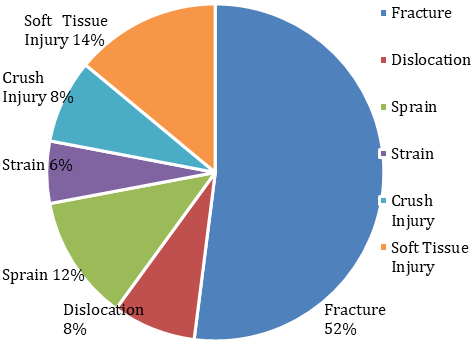
Figure 1:


Table1: Description of the nature and type of injury (N=1024)

Nature of InjuryFrequencyProportion
Fracture53252
Dislocation828
Sprain12312
Strain616
Crush Injury828
Soft Tissue Injury14314
Place of Injury
At Home14314
Outside Home88186
Mode of Injury at home14314%
Fall from stairs4129
Slipped on wet floor/level ground6948
Inadequate lighting1410
Domestic Violence1611
Others32
Mode of Injury outside home88186%
Fall from tree182
Fall from height19422
Fall while walking536
Fall while playing708
Road Side Accident47654
Blunt Force708
Injury in the upper extremity38938%
Injury in the lower extremity29729%
Injury to the Spine929%
Injury to the chest10210%
Dislocation Injury14314%
Radiological Investigations done
X-ray98396
Computed Tomography18418
Magnetic Resonance Imaging828
Ultrasonography515
None414
Treatment Given  
Surgical Treatment74873
Conservative Treatment27627
Average Duration of Stay in the hospital in days (Mean ± SD)

19.3 ± 4.73

Outcome
Cured94292
Debilitated777.5
Death50.5


RESULTS

The mean age of the study participants was 73.04 (SD=9.42) years. On assessing the nature of injury 532 study participants had suffered fractures of different parts of the body, 82 study participants were suffering from dislocation injuries, 123 study participants had sprain, 61 study participants had strain, 82 study participants suffered crush injury, whereas 143 study participants suffered from soft tissue injury. (Figure 1).


Out of 143 study participants who were injured at home, 41 study participants had a history of fall from stairs, 69 participants either slipped on wet floor or level ground, 14 suffered injuries at home due to inadequate lighting, 16 study participants were injured due to domestic violence whereas the rest were injured at home due to other causes.


Out of 881 study participants who were injured outside the home premises 18 gave a history of fall from tree, 194 study participants fell from height, 53 study participants had a history of fall while walking, 70 study participants fell while playing, 476 study participants were injured in roadside accident and 70 study participants were injured due to blunt force.


983 study participants required X-rays whereas 180 for study participants required computed tomography, 82 required magnetic resonance imaging while 51 study participants required ultrasonography as a part of their radiological investigations.


748 study participants out of 1024 study participants required surgical intervention while the rest 276 study participants required conservative treatment.


The average duration of stay in the hospital was 19.3 days (SD=4.73 days). Out of all the study participants 942 were cured, 77 were debilitated whereas 5 study participants had died (Table 1).


 

DISCUSSION

The majority of the study participants in our study were of the age group between 45-60 years (38%) followed by 61-70 years (37%). The reported mean age of injured patients varies from 26 years to 33 years across trauma centers across the globe [5,6]. It is mainly the result of substantial methodological heterogeneity while recruiting various age groups of injured patients.


The study on skeletal injuries following unintentional fall from height conducted in Delhi reported that the majority of the injuries (90%) were sustained in households and only 10% at places of work [59]. In another study conducted in North East India [58]. it was observed that most of the injuries occurred at home (41.26%) followed by road (39.8%). But other studies indirectly support the fact that road side accidents as most common cause of injury [7].


In our study most injuries were inflicted outside home (86%) while doing outdoor activities. This could be because most of injuries occur while being involved in outdoor activities related to work, study and other physical activities such as sports. Also, the fact people have to travel long distance to perform daily chores predisposing them to injuries outside home with difficult geographical terrain contributing to fall.


A study conducted in Delhi [8] discusses fall related injuries in detail. Study reported fall as the commonest mode of injury with slippery surface as the most common factor responsible for occurrence of fall (63.5%) at same levels. More common in the study was fall from ladder (42.8%) followed by fall from a building (21.5%) in case of fall from height. Study also reported road side accidents as significant cause of injury with injury being more common among two wheelers used by the victim (46.3%) and pedestrians (24.9%).


While in other studies Road traffic accidents were commonest cause of injury with varying incidence of 62%, 46.9% and 72% while fall was reported as mechanism of injury in 21.14% [9].


In our study road side accident was the commonest mechanism of injury (54%) followed by falls (14.6%), result not being similar to established study [61]. Fall from height contributed to 194 cases (22%). The geographical terrain of Himachal predisposes its population to injuries by fall. Injuries sustained while walking on narrow path, fall from trees while harvesting fodders, fall from stairs due to traditional housing could be the reason for this.

CONCLUSION

Age group 45-60 years was most common age to suffer the traumatic musculoskeletal injuries. Outside home was the most commonplace for occurrence of injury. Road traffic accidents were the most common cause of injuries followed by fall from height.


REFERENCE
  1. “Injuries and Violence”: The Facts. World Health Organization, 2010, http:// whqlibdoc. who. int/ publications/ 2010/ 9789241599375_eng.pdf. Accessed 12 Oct. 2021.

  2. WorkSafeBC. “Preventing musculoskeletal injury (MSI)”: A Guide for Employers and Joint Committees.

  3. Panda, P. et al. "Burden, Pattern, and Causes of Road Traffic Accidents in South India: Estimate of Years of Life Lost." CHRISMED Journal of Health Research, vol. 6, 2019, pp. 52–56.

  4. Karkee, R., and A.H. Lee. "Epidemiology of road traffic injuries in nepal, 2001–2013: systematic review and secondary data analysis." BMJ Open, vol. 6, no. 4, 2016, e010757, doi:10.1136/bmjopen-2015-010757.

  5. Heydari, S., A. et al. "Epidemiological characteristics of fatal traffic accidents in fars province, iran: a community-based survey." Public Health, vol. 127, 2013, pp. 704–709.

  6. Yadollahi, M. et al. "Types and causalities in dead patients due to traumatic injuries." Archives of Trauma Research, vol. 4, 2015, e26028.

  7. Bradley, C., and J. Harrison. Descriptive Epidemiology of Traumatic Fractures in Australia. “Injury Research and Statistics Series No. 17”, Australian Institute of Health and Welfare, 2004 (AIHW cat no. INJCAT 57).

  8. Epidemiology of Spinal Cord Injury in India. “Indian Spinal Injuries Centre, New Delhi”, 2010, http://www.indiaprwire.com. Accessed 20 Oct. 2021.

  9. Meena, R.K. et al "Pattern of Fractures and Dislocations in a Tertiary Hospital in North East India." International Journal of Epidemiology, vol. 11, 2013, pp. 13–15.

License
CC BY-NC-ND
Creative Commons Attribution-NonCommercial-NoDerivatives 4.0 International License
Describing the Epidemiological Pattern of Musculoskeletal Injuries in Trans Himalayan Region © 2026 by Abhinav Verma, Shashikant Sharma licensed under CC BY-NC-ND 4.0
All papers should be submitted electronically. All submitted manuscripts must be original work that is not under submission at another journal or under consideration for publication in another form, such as a monograph or chapter of a book. Authors of submitted papers are obligated not to submit their paper for publication elsewhere until an editorial decision is rendered on their submission. Further, authors of accepted papers are prohibited from publishing the results in other publications that appear before the paper is published in the Journal unless they receive approval for doing so from the Editor-In-Chief.
Himalayan Journal of Applied Medical Sciences and Research open access articles are licensed under a Creative Commons Attribution-Share A like 4.0 International License. This license lets the audience to give appropriate credit, provide a link to the license, and indicate if changes were made and if they remix, transform, or build upon the material, they must distribute contributions under the same license as the original.
Recommended Articles
Research Article
Digital Implantology: Current Concepts, Clinical Applications, Limitations and Future Directions - A Narrative Review
Published: 30/07/2026
Download PDF
Research Article
Study of the Role of Serum Interleukin-6 in Inflammation among Pregnant Women with COVID-19
Published: 27/07/2021
Download PDF
Research Article
Evalution CD11b, CD4, IL-17A and IL-23 as Biomarkers Immunological in Patients with Behçet’s Disease
...
Published: 13/07/2026
Download PDF
Research Article
Bones in Balance: Awareness of Rickets and Nutritional Deficiencies Among the Hamirpur Community
Published: 10/12/2024
Download PDF
Flowbite Logo
Najmal Complex,
Opposite Farwaniya,
Kuwait.
Email: support@himjournals.com

Useful Links
Order Hard Copy
Privacy policy
Terms and Conditions
Refund Policy
Others
About Us
Team Members
Contact Us
Online Payments
Join as Editor
Join as Reviewer
Subscribe to our Newsletter
Follow us
MOST SEARCHED KEYWORDS
scientific journal
 | 
business journal
 | 
medical journals
 | 
Scientific Journals
 | 
Academic Publisher
 | 
Peer-reviewed Journals
 | 
Open Access Journals
 | 
Impact Factor
 | 
Indexing Services
 | 
Journal Citation Reports
 | 
Publication Process
 | 
Impact factor of journals
 | 
Finding reputable journals for publication
 | 
Submitting a manuscript for publication
 | 
Copyright and licensing of published papers
 | 
Writing an abstract for a research paper
 | 
Manuscript formatting guidelines
 | 
Promoting published research
 | 
Publication in high-impact journals
Copyright © Himalayan Journals . All Rights Reserved.