Background: Sufficient sleep is essential in school children as it directly impacts mental and physical development. However, chronic sleep loss continues to increase in our country. This study was done to evaluate the sleep pattern among school going children of New Delhi. Methods: A cross-sectional study was performed in January to March 2022 among 400 students chosen using a simple random sampling procedure in New Delhi. Data was collected through school teachers based on their observation and analyzed using Epi info version 7. To predict the relationship between the Sleep pattern and its associated factors, a univariate analysis was done. At a p-value of 0.05 was taken as statistically significant. Results: Present study included 180 (45%) females and 220 (55%) males school children from New Delhi. Among them 243(60.8%) were ≤ 10 Years while 157(39.2%) were >10 years old. In the present study, 198(49.5%) school children had adequate sleep hours of 6-8 hours, 174(43.5%) had sleep hours of more than 8 hours and 28(7%) had sleep duration of less than 6 hours. 364(91%) school children had onset of sleep with in 30 minutes after going to bed while 36(9%) had after 30 min or more than that. 251(62.7%) school children didn’t have habit of watching Mobile/TV before sleeping while 149(37.3%) had this habit . In the present study there was no significant difference in Average duration of sleep per day on a weekday, Onset of sleep after going to bed and Habit of watching Mobile/TV before sleeping among male and female school children. In the present study the school children who were less than 10 years had significantly more adequate duration of sleep of 6-8 hours and had onset of sleep with in 30 minutes after going to bed and significantly less habit of watching Mobile/TV before sleeping as compared to children who were more than 10 years old. In the present study, 216(54%) school children rate their sleep quality to highest of 5, 135(33.8%) rate to 4, 41(10.3%) rate to
Sleep loss is one of the common plagues of modern societies. Inadequate sleep has been associated with a rainbow of physical and psychosocial health deficits, including impaired ability to concentrate and retain information, mood disorders, impaired motor skills, and poorer overall health and body’s natural defense mechanism [1].
Inadequate falling in sleep is characterized by sleep and wake difficulties resulting from “daily living activities that are inconsistent with the maintenance of quality sleep and normal daytime alertness”. These problems are common among adolescents and children [2-5].
The National Sleep Foundation Scientific Advisory Council recommends 9–11hours for school age children and 8–10 hours for teenagers. The common reasons can be advocated for the delayed sleeps are homework, hanging out with friends, late night television viewing, video games internet. Several other factors, like social and customs, cultural and climatic factors, appear to affect sleep duration in children. Over the past decades, sleep duration in children and adolescents showed a trend in decrease of 0.75 min nightly per year. It has been estimated that 15%–75% of school-aged children are not getting sufficient sleep [6-8].
In the light of increasing prevalence and negative consequences of insufficient sleep, there is paucity of literature regarding sleep habits and sleep hygiene among school going children in India. Thus the present study was done to evaluate the sleep pattern among school going children of New Delhi.
Objectives of the Study
To evaluate the sleep pattern among school going children of New Delhi
Research Approach: Descriptive
Research Design: Cross-sectional survey design
Study Area: New Delhi
Study Duration: Between January to March 2022
Study Population: Children aged between 5 to 18 years studying either in government and private schools
Sample Size: Assuming that 50% school children had adequate sleep pattern, 5% absolute error, 95% confidence level, and 5% non response rate, our minimum sample size came out to be 400
Inclusive Criteria: Students who were willing to participate in the study
Exclusion Criteria: Students who were not willing to participate in the study
Study Tool: A pre-test semi structured questionnaire containing questions regarding socio-demography and sleep pattern was created and utilized in the study after pilot testing
Validity of Tool: By the experts in this field
Data Collection: Data was collected and recorded by the school teachers
Data Analysis: Data was collected and entered in Microsoft excel spread sheet, cleaned for errors and analyzed with Epi Info V7 Software with appropriate statistical test in terms of frequencies, percentage, mean standard deviation etc. To predict the relationship between sleep pattern and its associated factors, a univariate analysis was done. At a p-value of 0.05 was taken as statistically significant
Ethical Considerations: Participants confidentiality and anonymity was maintained
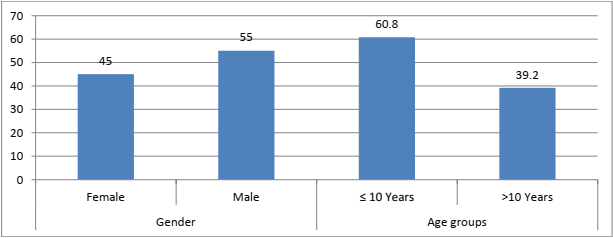
Present study was developed to evaluate the sleep pattern among school children of New Delhi. A total of 400 respondents including 180(45%) females and 220(55%) males school children from New Delhi were participated in the study. Among them 243(60.8%) were≤10 Years while 157(39.2%) were >10 years old. (Figure-1)
In the present study, 198(49.5%) school children had adequate sleep hours of 6-8 hours, 174(43.5%) had sleep hours of more than 8 hours and 28(7%) had sleep duration of less than 6 hours. 364(91%) school children had onset of sleep with in 30 minutes after going to bed while 36(9%) had after 30 min or more than that. 251(62.7%) school children didn’t have habit of watching Mobile/TV before sleeping while 149(37.3%) had this habit. (Table-1)
In the present study there was no significant difference in Average duration of sleep per day on a weekday, Onset of sleep after going to bed and Habit of watching Mobile/TV before sleeping among male and female school children. (Table-2)
In the present study the school children who were less than 10 years had significantly more adequate duration of sleep of 6-8 hours and had onset of sleep within 30 minutes after going to bed and significantly less habit of watching Mobile/TV before sleeping as compared to children who were more than 10 years old .(Table-3)
In the present study, 216(54%) school children rate their sleep quality to highest of 5, 135(33.8%) rate to 4, 41(10.3%) rate to 3 and 8(2%) school children rate the sleep quality to 2.
Table 1: Pattern of Screen Hours among Study Participants
Parameters | Frequency | Percent | |
Average duration of sleep per day on a weekday | < 6 hours | 28 | 7.0 |
6-8 hours | 198 | 49.5 | |
>8 hours | 174 | 43.5 | |
Onset of sleep after going to bed | <30 minutes | 364 | 91.0 |
≥ 30 minutes | 36 | 9.0 | |
Habit of watching Mobile/TV before sleeping | No | 251 | 62.7 |
yes | 149 | 37.3 | |
Table 2: Association of Pattern of Screen Hours with Gender
| Parameters | Gender | Total | p-value | |||
Female | Male | |||||
Average duration of sleep per day on a weekday | < 6 hours | Count | 12 | 16 | 28 | 0.965 |
% | 42.9% | 57.1% | 100.0% | |||
6-8 hours | Count | 90 | 108 | 198 | ||
% | 45.5% | 54.5% | 100.0% | |||
>8 hours | Count | 78 | 96 | 174 | ||
% | 44.8% | 55.2% | 100.0% | |||
Onset of sleep after going to bed | <30 minutes | Count | 162 | 202 | 364 | 0.599 |
% | 44.5% | 55.5% | 100.0% | |||
≥ 30 minutes | Count | 18 | 18 | 36 | ||
% | 50.0% | 50.0% | 100.0% | |||
Habit of watching Mobile/TV before sleeping | No | Count | 119 | 132 | 251 | 0.244 |
% | 47.4% | 52.6% | 100.0% | |||
Yes | Count | 61 | 88 | 149 | ||
% | 40.9% | 59.1% | 100.0% | |||
Total | Count | 180 | 220 | 400 |
| |
% | 45.0% | 55.0% | 100.0% | |||
Table 3: Association of Pattern of Screen Hours with Age Groups
Parameters | Age group | Total | p-value | |||
≤ 10 Years | >10 Years | |||||
Average duration of sleep per day on a weekday | < 6 hours | Count | 7 | 21 | 28 | 0.000 |
% | 25.0% | 75.0% | 100.0% | |||
6-8 hours | Count | 142 | 56 | 198 | ||
% | 71.7% | 28.3% | 100.0% | |||
>8 hours | Count | 94 | 80 | 174 | ||
% | 54.0% | 46.0% | 100.0% | |||
Onset of sleep after going to bed | <30 minutes | Count | 233 | 131 | 364 | 0.000 |
% | 64.0% | 36.0% | 100.0% | |||
≥ 30 minutes | Count | 10 | 26 | 36 | ||
% | 27.8% | 72.2% | 100.0% | |||
Habit of watching Mobile/TV before sleeping | No | Count | 185 | 66 | 251 | 0.000 |
% | 73.7% | 26.3% | 100.0% | |||
Yes | Count | 58 | 91 | 149 | ||
% | 38.9% | 61.1% | 100.0% | |||
Total | Count | 243 | 157 | 400 |
| |
% | 60.8% | 39.2% | 100.0% | |||
Table 4: Quality of Sleep among Study Participants
Parameters | Frequency | Percent | |
Rate your sleep quality from 1 to 5 | 2 | 8 | 2.0 |
3 | 41 | 10.3 | |
4 | 135 | 33.8 | |
5 | 216 | 54.0 | |
| Total | 400 | 100.0 |
Mean Score | 4.40± 0.752 | ||

Figure 1: Age and Gender Distribution of Study Participants
Sleep is a physiological process essential to humans and their normal functioning. Sleep habits and problems are also influenced by physical, mental, and environmental factors such as age, gender, lifestyle, emotional tension, and noise. Both the quantity and quality of sleep play an important role in an individual’s psychological and physical well-being [9].
In the present study, 198(49.5%) school children had adequate sleep hours of 6-8 hours, 174(43.5%) had sleep hours of more than 8 hours and 28(7%) had sleep duration of less than 6 hours. 364(91%) school children had onset of sleep with in 30 minutes after going to bed while 36(9%) had after 30 min or more than that. 251(62.7%) school children didn’t have habit of watching Mobile/TV before sleeping while 149(37.3%) had this habit .
In the study by, Apurva Mishra et al. [1], total sleep time during weekdays was 8.9(1.2) hours and 10.7 (1.1) hours during weekends. Another study by Henry Jeremy Lawson et al. [9], reported the mean duration of night sleep was 5.7±1.2 hours and 88(57.5%) students had sleep latency of 10-30 minutes Sleep quality was poor in 86(56.2%) .In the study by Ravi Gupta et al. [10], the mean total sleep time was 7.8 hr/day.
In the present study there was no significant difference in Average duration of sleep per day on a weekday, Onset of sleep after going to bed and Habit of watching Mobile/TV before sleeping among male and female school children. In the present study the school children who were less than 10 years had significantly more adequate duration of sleep of 6-8 hours and had onset of sleep with in 30 minutes after going to bed and significantly less habit of watching Mobile/TV before sleeping as compared to children who were more than 10 years old. Similarly, in the study by, Apurva Mishra et al. [1], Children in higher grades are sleep debt compared to younger ones. In the study by Ravi Gupta et al. [10], Adolescents of higher Grades had lesser total sleep time and progressed with higher Grade. This might be due to fact that school going adolescents in India also face the academic challenges and stress in higher grades.
In the present study, 216(54%) school children rate their sleep quality to highest of 5, 135(33.8%) rate to 4,
41(10.3%) rate to 3 and 8(2%) school children rate the sleep quality to 2. Study by Henry Jeremy Lawson et al. [9], reported the Sleep quality was poor in 56.2% students.
It has been observed from our study that there is a inadequate sleep duration in many school children which has to be addressed by creating awareness among the parents and the children regarding the importance of sleep.
The present study findings suggest that many school children in New Delhi were Irregular sleep habits specially who were more than 10 years old which may be due to academic commitments and stress in higher grades. Regular sleep studies could be conducted in the schools to implement effective interventions for the factors which might affect their sleep habits such as sleep hygiene, watching television, and use of the internet just before going to bed.
Mishra, A. et al. “Sleeping habits among school children and their effects on sleep pattern.” Journal of Caring Sciences, vol. 6, no. 4, December 2017, pp. 315–323.
Nixon, G.M. et al. “Short sleep duration in middle childhood: Risk factors and consequences.” Sleep, vol. 31, no. 1, January 2008, pp. 71–78.
Ng, E.P. et al. “Sleep duration, wake/sleep symptoms, and academic performance in Hong Kong secondary school children.” Sleep and Breathing, vol. 13, no. 4, November 2009, pp. 357–367. doi:10.1007/s11325-009-0255-5.
Noland, H. et al. “Adolescents’ sleep behaviors and perceptions of sleep.” Journal of School Health, vol. 79, no. 5, May 2009, pp. 224–230.
McKnight-Eily, L.R. et al. “Relationships between hours of sleep and health-risk behaviors in U.S. adolescent students.” Preventive Medicine, vol. 53, nos. 4–5, October 2011, pp. 271–273.
Johns, M.W. “A new method for measuring daytime sleepiness: The Epworth sleepiness scale.” Sleep, vol. 14, no. 6, November 1991, pp. 540–545.
Johnson, J.G. et al. “Association between television viewing and sleep problems during adolescence and early adulthood.” Archives of Pediatrics and Adolescent Medicine, vol. 158, no. 6, June 2004, pp. 562–568.
Petta, D. et al.. “Sleep habits in children aged 7–13 years.” Sleep Research, vol. 13, 1984, pp. 86–96.
Lawson, H.J. et al. “Evaluation of sleep patterns and self-reported academic performance among medical students at the University of Ghana School of Medicine and Dentistry.” Sleep Disorders, 11 June 2019, 2019, pp. 1–8.
Gupta, R. et al. “Sleep patterns of urban school-going adolescents.” Indian Pediatrics, vol. 45, no. 3, March 2008, pp. 183–189.