Contents
Download PDF
pdf Download XML
875 Views
489 Downloads
Share this article
Research Article | Volume 5 Issue 1 (Jan-June, 2024) | Pages 1 - 5
Intention to Leave Analysis of Management Trainee IT Graduates
 ,
1
School of Business and Management, Bandung Institute of Technology, Indonesia
Under a Creative Commons license
Open Access
Received
Oct. 4, 2023
Revised
Nov. 15, 2023
Accepted
Dec. 20, 2023
Published
Jan. 5, 2024
Abstract

The banking industry, previously recognized as a traditional sector, has evolved into a new stage within the digital era.The exponential growth of Information Technology (IT) has resulted in increased customer demands for financial services that are not only secure, but also seamless, simple to use, and unconstrained by location and time.Banks need to execute digital transformation to make essential enhancements to their business plans.To facilitate digital transformation, each company attempts to hire their most skilled digital professionals to support the company’s vision and mission by establishing Management Trainee IT program.The issue emerged when trainees completed their training program, resulting in the leaving of a lot of trained people who were prepared to become future leaders in the field of IT. The company has invested significant resources in cultivating digital talent from the ground up and equipping them for key leadership roles.However,once the service bond expires,trainees tend to leave from companies that have built in their expertise and experience since the beginning.The study draws on an explanatory sequentialmixedmethodscasestudyofoneoftheleadingdigitalBankinIndonesia.Theresearchfindingsindicate that job burnout and quiet quitting have a substantial influence on the intention to leave among graduates. According to the findings of the conducted data analysis, it is advised that the program implements regular project rotation, aspiration sessions, and mentorship in order to decrease the intention to leave of trainee graduates.

Keywords
INTRODUCTION

The Covid-19 pandemic from 2020 to 2022 led to the emergence of several groundbreaking innovations that enabled the transition of offline operations to online platforms. Every industry, including the banking sector, must undertake digital transformation in order to deliver innovations amidst fierce competition. Customer expectations for financial services are rising in association with the rapid growth of digital banking transactions. According to data Bank Indonesia [1], it shows a significant 31.83% year-on-year increase in digital banking transactions in May. The exponential expansion of digital transactions presents attractive prospects for businesses. It aligned with study conducted by Pluralsight's [2] where 85% of companies have intentions to initiate or participate in digital transformation projects.


Every bank strives to acquire top digital talents to support their digital transformations and align with the bank's fresh vision and goal in the digital era. The demand for digital skills has made them highly prized in the labor market, leading to increased expenditures for employee compensation. Jobstreet [3] reports that the IT has claimed the top place on Indonesia's list of highest pay, based on median income by considering industry and position level. Organizations will continue to face talent management as one of the most significant difficulties in the next decade [4]. This condition has caused the "talent for war" phenomenon [5] to remain relevant in modern times and much more intense than previously.


In order to avoid the challenge of hiring senior IT employees with high salaries, several banks chose to establish a Management Trainee IT program. This program aims to hire recent graduates with computer education backgrounds and provide them with comprehensive training in both technical and interpersonal abilities. The ultimate goal is to develop these individuals to become future leaders in the field of IT. Trainee program is characterized by an intensive hiring procedure and need substantial resources. However, a significant portion of the skilled individuals who successfully complete trainee programs choose to depart from the firm [6]. This condition will put the company at a disadvantage. In his study, Cole [7] identified various adverse consequences that arise when employees leave the company, including a reduction of knowledge and experience, the increased risk of sensitive information falling into the hands of competitors and the necessity of making substantial investments to recruit and train replacements.


In order to mitigate the long-term consequences of low retention among Management Trainee IT graduates, it is crucial to thoroughly examine the reasons that influence their intention to leave and provide recommendations for enhancing the Management Trainee IT program.


Literature Review

Talent management is an organization's comprehensive approach for developing a fully integrated and standardized high-performing workforce. Successful companies strategically develop, merge and actively execute initiatives that construct and maintain a top-performing staff, emphasizing the recruitment, development, placement and recognition of workers who perform in achieving objectives while maintaining stated principles [8]. Dawn and Biswas [9] defined talent management as a human resource strategy that aims to acquire, develop, deploy and retain skilled and promising workers inside an organization. Talent management strategies are employed globally in many businesses. However, their ability to effectively enhance organizational success depends on the alignment of both management and staff with talent management objectives and implementation. 


The term "talent" covers individuals who demonstrate outstanding abilities and are considered talented. An individual with outstanding abilities contributes significantly to the development of a business, have the capacity to excel as a leader and is likely to occupy crucial positions of responsibility [10]. Choosing highly talented employees is a crucial aspect of successful firms [11].


The management trainee program is a revolutionary graduate recruitment approach specifically developed to attract highly talented fresh graduates from top-tier colleges [12]. The Management Trainee program is implemented as a long-term strategy to identify and develop the leadership and managerial potential of graduates. This program aims to prepare these individuals to take position on critical roles in the organization [13]. To ensure effective administration of the company in the future, the organization recruited the most talented graduates from prestigious national and international colleges. These recruits through a 3-month for theoretical training program, followed by 6 to 12 months of practical on-the-job training. After this, they were actively rotated across every department of the company [14]. Organizations are likely to engage heavily in talent development activities as a result of adopting an internal development approach. This is to ensure that skilled personnel have the necessary abilities to effectively execute the business strategy [15].


Job burnout is characterized as a condition of extreme physical or mental exhaustion resulting from persons who lack the ability to effectively cope with job-related pressure, endure emotional conflict and suffer from long-term work-induced stress [16]. Schaufeli and Bakker [17] demonstrated that burnout acts as a complete mediator in the association between job demands and health problems, which in turn has a positive correlation with turnover intentions. Supporting this discovery, Xueyun et al. [18] highlighted that job burnout generated a substantial and favorable impact on employees' decision to quit their jobs.


Quiet Quitting concept went viral on social media after Zaid Khan, a 24-year-old engineer from New York with TikTok user @zaidleppelin, produced a video titled "On Quiet Quitting." The video has already watched over 3 million views in only two weeks. He defined quiet quitting as:


  • “…You are not outright quitting your job, but you’re quitting the idea of going above and beyond. You are still performing your duties, but you are no longer subscribing to the hustle culture mentality that work has to be your life. The reality is it is not and your worth as a person is not defined by your labor…” [19].


According to Ellis and Yang [20], individuals perceive the act of quitting to be significantly different. Quiet leaving is perceived by some individuals as a minimal effort approach to work, strictly adhering to the given instructions. Conversely, others view it as a reminder to avoid working excessively and reaching a state of burnout.


Intention to leave is simply referred to is the term used to describe an employee's intention to quit their current company [21]. According to Worku et al. [22], an employee's intention to leave refers to their planned departure from their current position soon. It serves as a proxy indicator for assessing turnover. These statements indicate that an employee's intention to leave is fundamentally their desire to leave from the company they are employed for. 


According to Gallup [23), at least 51% of employees in the Southeast Asian region, specifically in Indonesia, Cambodia, Laos, Malaysia, Myanmar, Philippines, Singapore, Thailand and Vietnam, express their intention to leave their current employer. Equal to the worldwide percentage of 51%. In order to maintain a longer stay of employees within the company compared to competitors, it is necessary to use talent retention approaches that effectively decrease their intention to leave [24].

MATERIALS AND METHODS

Research Method

The primary data is collected through a questionnaire survey and interviews conducted with Management Trainee IT graduates. Secondary data is acquired through a literature research and by studying human resource documentation that is relevant to the Management Trainee IT program. Explanatory sequential mixed method is done by researcher with quantitative data collection and analysis first, then followed with qualitative data collection and analysis.


The data collection for quantitative analysis is acquired by a questionnaire survey of Management Trainee IT graduates who have stayed in the company following the completion of their service bond. The quantitative data analysis using Partial Least Squares Structural Equation Modeling (PLS-SEM) as a statistical analysis method to examine sets of data collected from a survey consisting of questionnaire statements. PLS-SEM refers to a recently developed statistical approach in multivariate data analysis. It allows researchers to effectively model and estimate complex correlations among several dependent and independent variables simultaneously [25]. The objective is to conduct an empirical examination of the theory that has already been outlined in the conceptual framework, by constructing a structural model. The SmartPLS 4 software is utilized to do all the PLS-SEM analysis in this research. The SmartPLS graphical user interface enables the researcher to compute the PLS path model.


Data collection for qualitative analysis is acquired through interviews. An interview is conducted to obtain a more comprehensive explanation and comprehension of the data obtained from previous quantitative analysis. The researcher carried out semi-structured interviews with Management Trainee IT graduates who have completed their service bond and have chosen to stay in the company. Interviews were recorded using an audio recording device. Upon the completion of the interview procedure, the author proceeds with the transcription process to transform the interview into text format. Afterwards, the analysis will be performed by coding every transcript. The ATLAS.ti software is utilized for the purpose of coding and analyzing transcripts derived from interviews.

RESULTS AND DISCUSSION

PLS-SEM Model 

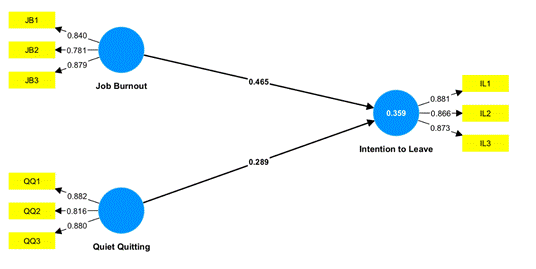
PLS-SEM analysis carried out in this research is Indicator Reliability, Internal Consistency Reliability, Convergent Validity, Discriminant Validity and Bootstrapping (Figure 1).


Indicator reliability is confirmed by the value of outer loadings. An indicator has high validity when loading factor is greater than equal 0.7 [25]. It represents how much of the variation in an item is explained by the construct and is described as the variance extracted from the item. Table 1 shows that all indicators used in this research have outer loading greater than 0.7, which means that all indicators used have high validity.


Internal consistency reliability is confirmed by the value of its Cronbach’s alpha. As stated by Hair et al. [25], Cronbach's alpha and the Composite reliability range from 0 to 1, with higher values demonstrating a greater level of reliability. Values within the range of 0.70 to 0.90 can be considered as satisfactory. Table 2 shows that all the constructs have Cronbach’s alpha range from 0.789 to 0.846 and Composite reliability range from 0.830 to 0.906, which means all the constructs in this research have high level of reliability.


Convergent validity is confirmed by the value of Average Variance Extracted (AVE). A score of 0.50 or greater for the Average variation Extracted (AVE) shows that, on average, the construct explains more than half of the variation of its indicators [25]. Table 3 shows that all the constructs have AVE range from 0.696 to 0.763, which means all the constructs in this research able to explains variation of its indicators.


Discriminant validity is confirmed by the value of Heterotrait-Monotrait Ratio (HTMT). Hanseler et al. propose a threshold value of 0.90 for path models that involve constructs that are highly comparable in terms of their conceptual form. An HTMT result above 0.90 indicates a lack in discriminant validity. Table 4 shows that all constructs have HTMT range from 0.249 to 0.605, which means all the constructs in this research are highly comparable.


Table 1: Indicator Reliability


Outer loadings

Outer Loading ≥ 0.7

IL1 <- Intention to Leave

0.881

Valid

IL2 <- Intention to Leave

0.866

Valid

IL3 <- Intention to Leave

0.873

Valid

JB1 <- Job Burnout

0.840

Valid

JB2 <- Job Burnout

0.781

Valid

JB3 <- Job Burnout

0.879

Valid

QQ1 <- Quiet Quitting

0.882

Valid

QQ2 <- Quiet Quitting

0.816

Valid

QQ3 <- Quiet Quitting

0.880

Valid


Table 2: Internal Consistency Reliability


Cronbach's alpha

Composite reliability (rho_a)

Composite reliability (rho_c)

Reliability

Intention to Leave

0.846

0.859

0.906

Valid

Job Burnout

0.789

0.830

0.873

Valid

Quiet Quitting

0.828

0.864

0.895

Valid


A diagram of a model

Description automatically generated

Figure 1: PLS-SEM Model


Table 3: Convergent Validity


Average variance extracted (AVE)

AVE >0.5

Intention to Leave

0.763

Valid

Job Burnout

0.696

Valid

Quiet Quitting

0.739

Valid


Table 4: Discriminant Validity


Heterotrait-monotrait ratio (HTMT)

HTMT < 0.90

Job Burnout <-> Intention to Leave

0.605

Valid

Quiet Quitting <-> Intention to Leave

0.444

Valid

Quiet Quitting <-> Job Burnout

0.249

Valid


Table 5: Bootstrapping


T statistics

p-values

Value <0.05

Job Burnout -> Intention to Leave

4.397

0.000

Significant

Quiet Quitting -> Intention to Leave

2.571

0.010

Significant


Bootstraping procedure is employed to ascertain the significance of the calculated path coefficient. As to the outcomes of Hair et al. [25], the path coefficient shows a statistically significant difference from zero, with a significance level of 5%. In order for the relationship under research to be considered significant, the t-value must exceed 1.96 and the p-value must be less than 0.05. The findings from the bootstrapping procedure indicate that both job burnout and quiet quitting have significant impact on the intention to leave a job, which can be seen from Table 5.


Interview Results

Regular Project Rotation

A significant proportion of trainees experience job burnout due to a high volume of tasks. However, certain individuals expressed experiencing job burnout due to less in the scope of challenges they encountered. Upon further investigation, the researcher discovered that trainees perceived an excessive number of tasks and routine in their work, likely associated with long-term placement only in one project. This phenomenon is actually associated with less challenges caused by trainees being on a project for an extended period of time. As a Management Trainee IT program graduate said:


  • “…Lately I've been feeling burnt out. Now it seems like it's mostly because of the repetition. I've been here from the beginning on one project. Maybe from me, I want to know what other projects are like, what they do. So it's like being rotated. It looks like it would be the same place but with a new atmosphere…”


Interview results indicate that regular project rotation is an often-suggested solution for addressing job burnout. It is also the largest gap in expectations experienced among trainee graduates. As a Management Trainee in IT, they expect to be regularly assigned to different projects. Implementing a regular project rotation system is crucial to mitigate intention to leave. As a Management Trainee IT program graduate emphasized:


  • “…It is better to do project rotation than lose one of your talents. Even though the abandoned project definitely feels like a loss of talent. But rather than losing talent in your own company, if we look at it from an organizational perspective, that's how it is. it is better to lose people on the project than to lose in the company….”


Aspiration Session

According to the interview results, aspiration is commonly stated as a recommended approach for overcoming quiet quitting. All respondents express the need for an aspiration session to get knowledge regarding current career paths, available prospects and to share their own professional objectives. As a Management Trainee IT program graduate said:


  • “…The first thing to know is what causes them to be quiet quitting, which can certainly be done by chatting or asking what their aspirations are. Maybe it's like a forum whose contents are like opportunities for project rotation. Because if I'm asked if I want to move, I don't know what projects are open, so they have to tell me first. Currently there are no forums that open it…”


The aspiration session was also commonly stated by trainees as a recommendation to the Management Trainee IT program to address the trainee graduates' intention to leave. As a Management Trainee IT program graduate emphasized:


  • “…Try to find out what each person's life goals are, ask for honest answers. So, if for example the goal is money, maybe they will leave because of the money. But if, for example, they want growth, but the company can't accommodate that because it can't be scanned or something like that according to the company, maybe they will also leave…”


Mentorship

Most of the interviewees suggested that to overcome job burnout, it is advisable to maintain regular communication with senior employees, cultivate a supportive work atmosphere and engage in regular project rotation. Furthermore, most of them suggested the importance of a supportive environment, together with motivating sessions, to address the tendency to quiet quitting. Mentorship can be established to facilitate both regular communication with senior employees and a supportive environment. Indeed, most trainee graduates 


are no longer doing mentoring. Only a few of them reported that they continue to receive regular mentoring, despite their shared awareness of the importance of mentorship. Most interviewees expressed a desire for mentorship to facilitate work-related discussions, while others sought mentoring to get insight into the future stages of the organization. Furthermore, the remaining individuals require guidance and support to access opportunities and maintain their focus. As Management Trainee IT program graduates said:


  • “…It's also a heavy work, but if there is support from environment, that will help...”

  • “…If don't have a mentor, it's like there's no one to open up to and in the end you come back to yourself. it will be more difficult because you have to be stuck in your daily work. But if there is a mentor, you can usually get insight and external motivation…

CONCLUSION

The investigation revealed a positive correlation between job burnout and quiet quitting with the intention to leave among Management Trainee IT graduates. Regular project rotation can effectively manage job burnout. A significant number of trainees experienced job burnout because of prolonged participation only in a project. The author also suggests organizing an annual aspiration session to address the phenomenon of quiet quitting. The trainee graduates require a designated time and location to acquire information regarding career advancement prospects and to communicate their thoughts and aspirations for their future careers. Furthermore, mentorship will provide assistance to trainees in their day-to-day tasks, helping them to overcome job burnout and quiet quitting.

REFERENCES
  1. Bank Indonesia. “Tinjauan kebijakan moneter juni 2023.” Retrieved June 30, 2023, from https://www.bi.go.id/id/publikasi/laporan/Documents/TKM-Juni-2023.pdf, 2023.

  2. Pluralsight. “State of upskilling: Navigating economic uncertainty.” Retrieved July 1, 2023, from https://www.pluralsight.com/resource-center/state-of-upskilling-2023, 2023.

  3. Jobstreet. “Salary report 2022: The essential guide to plan your hiring. Indonesia edition.” Retrieved July 1, 2023, from https://www.jobstreet.co.id/en/cms/employer/wp-content/themes/jobstreet-employer/assets/pdf/ID-SalaryReport-English-21stJan2022-final.pdf, 2022.

  4. McDonnell, A. “Still fighting the ‘war for talent’? bridging the science versus practice gap.” Journal of Business and Psychology, vol. 26, no. 2, 169-173, 2011.

  5. Chambers, E.G. et al. “The war for talent.” The McKinsey Quarterly, vol. 3, 44-57, 1998.

  6. Král, P., et al. “Why does talent leave organizations? talent retention of trainee program graduates.” Kidmore End: Academic Conferences International Limited, 2022.

  7. Cole, G. “Winning the talent war: how learning impacts on retention.” Development and Learning in Organizations, vol. 29, no. 3, 21-23, 2015.

  8. Berger, L.A. et al. “The talent management handbook.” 3rd Ed., McGraw-Hill Professional, 2017.

  9. Dawn, S.K., et al. “Talent management: designing strategies.” ASBM Journal of Management, vol. 6, no. 2, 41-51, 2013.

  10. Deters, J. “Analytics and intuition in the process of selecting talent.” De Gruyter. Retrieved from https://doi.org/10.1515/9783110980967-001, 2022.

  11. Church, A.H., et al. “How are top companies designing and managing their high-potential programs? A follow-up talent management benchmark study.” Consulting Psychology Journal: Practice and Research, vol. 67, no. 1, 17–47. Retrieved from https://doi.org/10.1037/cpb0000030, 2015.

  12. Cesário, F., et al. “A previous trainee experience: does it matter for retention of young graduates?” International Journal of Organizational Analysis, vol. 25, no. 2, 270-281, 2017.

  13. Gama, L.Z., et al. “The relationship between the graduate trainee programme and talent management in corporate organisations in eswatini.” SA Journal of Human Resource Management, vol. 18. Retrieved from https://doi.org/10.4102/sajhrm.v18i0.905, 2020.

  14. Ahmad, M.K. “Prospects and issues in human resource management: A case study.” London: Centre for Business & Economic Research, 2015.

  15. Garavan, T.N., et al. “Mapping talent development: definition, scope and architecture.” European Journal of Training and Development, vol. 36, no. 1, 5-24, 2012.

  16. Lu, M., et al. “Quiet quitting during COVID-19: the role of psychological empowerment.” Humanities & Social Sciences Communications, vol. 10, no. 1, 485. https://doi.org/10.1057/s41599-023-02012-2, 2023.

  17. Schaufeli, W.B., et al. “Job demands, job resources and their relationship with burnout and engagement: a multi-sample study.” Journal of Organizational Behavior, vol. 25, no. 3, 293–315. Retrieved from https://doi.org/10.1002/job.248, 2004.

  18. Xueyun, Z., et al. “Modelling the significance of organizational conditions on quiet quitting intention among gen Z workforce in an emerging economy.” Scientific Reports, vol. 13, no. 1, 15438. Retrieved from https://doi.org/10.1038/s41598-023-42591-3, 2023.

  19. Khan, Z. “On quiet quitting.” Retrieved September 20, 2023, https://www.tiktok.com/@zaidleppelin/video/7124414185282391342?is_copy_url=1&is_from_webapp=v1, 2022.

  20. Ellis, L., et al. “If your co-workers are ‘quiet quitting,’ here’s what that means.” The Wall Street Journal, August. Retrieved September 20, 2023, from https://www.wsj.com/articles/if-your-gen-z-co-workers-are-quiet-quitting-heres-what-that-means-11660260608, 2022.

  21. Cho, S., et al. “Employees’ intent to leave: a comparison of determinants of intent to leave versus intent to stay.” International Journal of Hospitality Management, vol. 28, no. 3, 374-381. Retrieved from https://doi.org/10.1016/j.ijhm.2008.10.007, 2009.

  22. Worku, N., et al. “Magnitude of intention to leave and associated factors among health workers working at primary hospitals of north gondar zone, northwest ethiopia: mixed methods.” BioMed Research International, vol. 2019, no. 9. Retrieved from https://doi.org/10.1155/2019/7092964, 2019.

  23. Gallup. “State of the global workplace 2023 report: the voice of the world’s employees.” Retrieved September 20, 2023, from https://www.gallup.com/workplace/349484/state-of-the-global-workplace.aspx, 2023.

  24. Dhanpat, N., et al. “Exploring employee retention and intention to leave within a call centre.” SA Journal of Human Resource Management, vol. 16. Retrieved from https://doi.org/10.4102/sajhrm.v16i0.905, 2018.

  25. Hair, J.F., et al. “A primer on partial least squares structural equation modeling (PLS-SEM).” 3rd Ed., Thousand Oaks, CA: Sage, 2022.
License
CC BY-NC-ND
Creative Commons Attribution-NonCommercial-NoDerivatives 4.0 International License
Intention to Leave Analysis of Management Trainee IT Graduates © 2026 by Citra Larasati, Achmad Ghazali licensed under CC BY-NC-ND 4.0
All papers should be submitted electronically. All submitted manuscripts must be original work that is not under submission at another journal or under consideration for publication in another form, such as a monograph or chapter of a book. Authors of submitted papers are obligated not to submit their paper for publication elsewhere until an editorial decision is rendered on their submission. Further, authors of accepted papers are prohibited from publishing the results in other publications that appear before the paper is published in the Journal unless they receive approval for doing so from the Editor-In-Chief.
Himalayan Journal of Economics and Business Management open access articles are licensed under a Creative Commons Attribution-Share A like 4.0 International License. This license lets the audience to give appropriate credit, provide a link to the license, and indicate if changes were made and if they remix, transform, or build upon the material, they must distribute contributions under the same license as the original.
Recommended Articles
Research Article
Influence of Leadership on Poverty Reduction in the Devolved Government in Trans-Nzoia County, Kenya
...
Published: 30/06/2021
Download PDF
Research Article
Modelling Structure Job Quality, Job Design and Job Satisfaction
...
Published: 30/08/2022
Download PDF
Research Article
The Constitutional and Legislative Basis for Considering the Taxable Capacity of Taxpayers in Iraqi Tax Legislation
Published: 05/05/2025
Download PDF
Research Article
Proposed Digital Marketing Strategy to Enhance Engineering Consultancy Company Revenue
Published: 30/04/2024
Download PDF
Flowbite Logo
Najmal Complex,
Opposite Farwaniya,
Kuwait.
Email: support@himjournals.com

Useful Links
Order Hard Copy
Privacy policy
Terms and Conditions
Refund Policy
Others
About Us
Team Members
Contact Us
Online Payments
Join as Editor
Join as Reviewer
Subscribe to our Newsletter
Follow us
MOST SEARCHED KEYWORDS
scientific journal
 | 
business journal
 | 
medical journals
 | 
Scientific Journals
 | 
Academic Publisher
 | 
Peer-reviewed Journals
 | 
Open Access Journals
 | 
Impact Factor
 | 
Indexing Services
 | 
Journal Citation Reports
 | 
Publication Process
 | 
Impact factor of journals
 | 
Finding reputable journals for publication
 | 
Submitting a manuscript for publication
 | 
Copyright and licensing of published papers
 | 
Writing an abstract for a research paper
 | 
Manuscript formatting guidelines
 | 
Promoting published research
 | 
Publication in high-impact journals
Copyright © Himalayan Journals . All Rights Reserved.