The Quality of Information Systems and their Impact on Improving Digital Management: An Exploratory Study of the Opinions of a Sample of Administrative Staff at Tikrit University
Anwar Ghazi Noaman
1
1
Department of Marketing Management, College of Administration and Economics, Tikrit University, Iraq
This study aims to determine the impact of information systems quality on improving digital management among administrative leaders at the University of Tikrit. This study employed a descriptive-analytical approach, utilizing a field method to collect data through a questionnaire. The University of Tikrit was selected as the study site and its administrative leaders, including deans, vice-deans, department heads and rapporteurs, were represented. The study sample consisted of 150 respondents and the questionnaire served as the primary data collection tool, utilizing a five-point Likert scale. The study yielded a set of conclusions, the most significant of which is that the quality of information systems has a positive impact on digital management among administrative leaders at the University of Tikrit. In light of the study's findings, the researcher recommends promoting the use of modern technologies in data analysis to enhance decision-making processes and digital management.
Keywords
Quality Information Systems
Digital Management
Tikrit University
INTRODUCTION
The rapid development of communications and information systems has prompted a re-examination of traditional management models and a shift toward electronic management. Electronic management offers numerous opportunities for the success, speed, transparency and efficiency of public services, enabling real-time interaction and transcending the boundaries of time and space. Digital management is one of the most significant achievements of modern science and technology. Advances in communications and innovations in advanced technologies have prompted governments worldwide to seriously consider leveraging the technological revolution to digitally complete tasks and provide services to citizens using computers and the internet. This has effectively addressed numerous issues, most notably the long queues at administrative offices. Consequently, digital management has emerged in response to the widespread use of computers in the road construction service industry, as well as the continued support provided by digital management and its sub-fields [1].
The quality of information systems plays a crucial role in digital management, having a significant impact not only on organizations and their employees, but also on society and its individuals. At the general economic level, it has its aspects and variables and has become a necessity for individuals and people. Therefore, we find that company managers and governments in various countries worldwide are interested in improving administrative efficiency. When preparing information systems, it is necessary to orient their content towards achieving administrative efficiency. The application of information system quality has an impact on the competitiveness of organizations in business [2].
Research Problem
Tikrit University implements high-quality information systems across its departments to enhance decision-making, improve employee efficiency and boost performance, ultimately improving management at Tikrit University and, in turn, positively impacting employee performance. Against this backdrop, this study aims to identify weaknesses in information system quality that may affect employee performance at Tikrit University. Therefore, this study attempts to answer the following questions.
The quality of information systems and their impact on improving digital management: An exploratory study of the opinions of a sample of administrative staff at Tikrit University.
Research Objectives
Based on the problem of the study and its importance, its objectives were formulated as follows:
Identify the level of quality of information systems at the University of Tikrit
Identify the level of administrative leaders at the University of Tikrit
Knowing the impact of information systems quality on enhancing digital management
The Importance of the Research
The significance of this study lies in the following:
This study explores information system quality, a critical topic with significant benefits for organizations; it also examines digital management, an outcome of organizational activities and work
To the best of the researchers' knowledge, there is limited research on the impact of Tikrit University's administrative staff and the quality of its information systems on digital management. Therefore, this study complements existing research on administrative libraries
This study examines the actual quality of Tikrit University's information systems and the current status of its administrative staff, identifying strengths and weaknesses in terms of quality and performance and offers recommendations to help university policymakers and decision-makers improve the quality of its information systems
Research Hypotheses
The researchers proposed the following hypotheses:
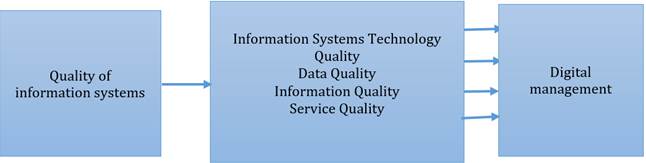
Main Significant Hypothesis: Information system quality has a statistically impact on the digital management of Tikrit University's administrative leaders (significance level: 0.05). This hypothesis is further divided into several sub-hypotheses:
First sub-hypothesis: System technical quality has a statistically significant impact (significance level: 0.05)
Second sub-hypothesis: Data quality has a statistically significant impact (significance level: 0.05)
Third sub-hypothesis: Information quality has a statistically significant impact (significance level: 0.05)
Fourth sub-hypothesis: Service quality has a statistically significant impact on the digital management of Tikrit University's administrative leaders (significance level: 0.05)
Study Model
Based on the research questions, objectives and significance, a hypothetical research model was developed to illustrate the impact of information system quality on digital management, as depicted in Figure 1.
Figure 1: Hypothetical Model of the Study
Research Limits
Space Constraints: The research subjects included administrative leaders at Tikrit University
Personnel Constraints: The research subjects included administrative leaders (dean, vice-dean, department heads and the department heads' record keepers)
Research Tools
After reviewing previous studies on the quality of information systems and digital management among administrative staff of Tikrit University, its results, the measures used therein and based on the research objectives and the purpose of collecting information and selecting the research hypotheses, the researcher developed a questionnaire to measure the quality of digital management information systems.
MATERIALS AND METHODS
This study adopted a descriptive analysis method, which included using a field method to collect data through questionnaires and conducting statistical analysis to test the validity of the research hypotheses, as well as presenting research literature and using references and existing materials to construct the theoretical background of the research topic.
Research Community
She served as one of the administrative heads of Tikrit University in Salahuddin Governorate, including (Dean, Vice-Dean, Department Head and Journalist).
Research Sample
The research sample of 150 respondents was reviewed by faculty members from the respondent universities, including deans, vice deans, department heads and rapporteurs, to assess their alignment with the study objectives (Table 1).
Table 1: Personal Characteristics of the Study Sample
Sequencing
Variables
Categories
Duplicate
Percentages
1
Gender
Male
80
54
Female
70
46
Total
150
100
2
Lifetime
20-30 years
50
33
30-40 years
43
29
40-50 years
34
23
More than 50 years
23
15
Total
150
100
3
Academic achievement
Doctor
70
46
Master
80
54
Total
150
100
4
Scientific Rank
Teacher
32
21
Assistant Professor
51
34
Professor
67
45
Total
150
100
Source: Preparing the researcher by relying on the highest computer outputs
Theoretical Framework
The Concept of Information Systems Quality: Quality is a set of characteristics and attributes that determine the extent to which a system meets the performance, effectiveness and efficiency standards expected by users. This quality encompasses the system's ability to achieve its stated objectives and to meet user needs and expectations appropriately and effectively [3]. Quality also refers to the system's ability to provide users with accurate, reliable and useful information, taking into account the economic value of this information and the technology used to develop it. Quality also encompasses adherence to industry and regulatory standards and requirements, ensuring that the system meets established and expected standards. Furthermore, quality reflects a focus on innovation and continuous improvement in the design, operation and maintenance of systems, thereby enhancing their adaptability to environmental changes and business needs [4].
Dimensions of Information Systems Quality
The dimensions of information systems quality consist of the following:
Information System Technology Quality
The quality of information system infrastructure performance encompasses the physical components, software and operational processes that achieve the system's objectives [5]. The quality of information system technology is determined by the performance of its components, including software, hardware, databases and operational processes. This quality involves conformance to the specifications and standards established at the time of design and includes specific indicators such as processing speed and portability. Connectivity also encompasses the availability of current applications, robustness, effective security systems, sufficient storage capacity and reliance on internet, intranet and extranet communications [6].
Data Quality
Data quality goes beyond accuracy, completeness and consistency. It is a critical process for identifying all aspects of data integrity and ensuring its accuracy and reliability. Because data is considered the raw material of information, its quality directly impacts the quality of the information it supports. Poor data quality can easily lead to errors in decisions based on that data. Therefore, ensuring data quality is crucial to any information system. High-quality data is accurate, complete, consistent, properly linked in chronological order and easy to understand and process, enabling the derivation of valuable insights. Timeliness, clear and consistent presentation, objectivity and relevance and data security are all crucial [7].
Information Quality
Research and models indicate that information quality is crucial to the success of information systems because information is a key output of the system [8]. Information quality encompasses temporal aspects, such as currency and novelty, as well as content aspects, including accuracy, authenticity, completeness and relevance. Additionally, it includes formal aspects, including clarity, organization and flexibility [6].
Quality of Service
In 2002, Delone and Mclean emphasized the importance of the QoS dimension for the success of information systems. In their second model, they focused on several dimensions and indicators to measure this dimension [7]:
Reliability, which refers to the degree of reliance on the information system
System user trust, which refers to whether the system provides the services users need
System user satisfaction, which refers to the user's ability to use the system effectively
User and management interest, which refers to their level of interest in the system
The Concept of Digital Management
"A new concept of administration based on electronic technology aims to apply it to administrative functions such as planning, organizing, controlling, directing and evaluating, making them more efficient, effective and high-quality. It is based on advanced information and communication technologies to develop the necessary tools and methods for the effective management of knowledge and intellectual capital and to stimulate innovative capabilities and targeted academic creativity. The information age is committed to providing better services to citizens, institutions and their clients by optimizing the use of existing information resources. By fully utilizing existing human, material and intellectual resources within a modern electronic framework, it is possible to maximize the use of time, energy and funds and achieve the desired goals and the required quality." (Mahmoud, 2010) As is clear from the previous definition, digital administration is based on a regenerative system that actively invests in administrative functions utilizing modern information and communication technologies, thereby facilitating the optimal allocation of qualified personnel at all administrative levels. This requires a quality of management that encourages employees to utilize their creativity to achieve established goals and differentiate themselves from the competition [9].
Practical Framework
Introduction
It includes data types and sources, research population, field research, measurement variables, original data collection methods and statistical hypothesis testing, among other elements.
Data Types and Sources
The data used to achieve research objectives can be categorized as follows:
Secondary Data: This is published data collected as part of other research and presented in books, academic journals, conferences and seminars
Primary Data: This is data obtained during field research
Search Tool
The primary research instrument (questionnaire) consisted of three parts:
Part I contained demographic data on study participants based on five variables: Gender, job title, educational background, academic expertise and professional experience. This data described the characteristics of the study participants
Part II contained a scale to assess the impact of information system quality on digital management
Part III contained a scale to assess the degree of digital management
Responses ranged from 1 to 5 on a five-point Likert scale, as Table 2 follows:
Table 2:Five-point Likert scale
Alternatives to Answer
Strongly agree
I agree
neutral
Disagree
Strongly disagree
Grade
(5)
(4)
(3)
(2)
(1)
The research instrument's questionnaire and final form consisted of 25 items on a five-point Likert scale.
In order to classify the degree of influence or relevance of the examined samples on the included paragraphs, the researchers used a scale of (0), calculated as follows: According to the five-point Likert scale, ranging from 1 to 5, this is equivalent to (0.80). This value is then added to the lowest value of the measurement, which becomes the correct value and determines the upper limit of the scale. Therefore, the results are shown in the Table 3.
Table 3: Answers to Questions and Their Significance
Category
Classification
Significance
From 4.2 – 5
Strongly agree
Very high grade
From 3.4 – Less than 4.2
I agree
High grade
From 2.6 – Less than 3.4
neutral
Medium Grade
From 1.8 – Less than 2.6
Disagree
Low score
Less than 1.8
Strongly disagree
Very low score
Source: Prepared by the researcher
The Validity and Consistency of the Study Tool
It was pointed out that the goal of honesty was to enable the instrument to reveal the phenomena and characteristics being studied in the research and that this was achieved after the original questionnaire was prepared for this purpose [10-15]. The researcher verified its ability to measure the purpose for which it was developed by presenting it in its original form (4) to the research investigators to determine the validity of the instrument used, its form and the extent to which the instrument paragraphs were able to measure the purpose for which it was developed and to refer to the comments and suggestions of the moderators. Necessary modifications were made based on the comments of the moderators and deletions and modifications were made as suggested, therefore, the instrument retains the integrity of its content (Table 4).
Table 4: Cronbach's Alpha Stability Coefficients for all Areas of Study and the Tool as a Whole
Figure
Variables
Number of Paragraphs
Stability Coefficient
1
Quality of Information Systems Technology
5
0.734
2
Data Quality
5
0.719
3
Quality of information
5
0.798
Quality of Service
5
0.746
4
Digital Management
10
0.766
The tool as a whole
30
0.787
Source: Prepared by the researcher based on the statistical program SPSS
Descriptive Statistics
Quality of Information Systems: Dimension (Quality of Information Systems Technology).
From Table 5, it can be seen that the average arithmetic mean of the dimension (technical quality of information systems) reaches (3.455) with a standard deviation of (1.108), because the declarative paragraph (the quality of information provided by information systems helps to improve communication and exchange in universities) has a high arithmetic mean of (3.525) with a standard deviation of (1.022). In contrast, the affirmative paragraph (easy and quick access to information helps to improve the performance of administrative staff) has an average arithmetic mean of 3.303 with a standard deviation of 1.02 [16].
Table 5: Shows the Arithmetic Mean and Standard Deviation of the Information Systems Technology Quality Dimension
Variables
Arithmetic Average
Standard deviation
Order
Level
University information systems help improve administrative performance
3.513
0.862
3
High
The quality of information systems contributes to more effective management decisions
3.413
1.027
4
medium
Easy and quick access to information helps improve executive performance
3.303
1.02
5
medium
The quality of information provided by the information system helps improve communication and exchange at the university
3.525
1.022
1
High
The quality of information systems has a positive impact on managers’ interactions with digital technologies
3.521
0.875
2
High
3.455
1.108
Source: Prepared by the researcher based on the statistical program SPSS
Data Quality
From Table 6, it can be seen that the dimension (data quality) has a high arithmetic mean of (3.633) and a standard deviation of (0.801), because the paragraph that states (the quality of existing data fully meets the needs of administrative personnel) has a high arithmetic mean, as it reaches (3.67) and a standard deviation of (0.885). In contrast, the paragraph that establishes (the quality of data directly affects the effectiveness of digital management of university administrative personnel) has a high arithmetic mean of (3.584) and a standard deviation of (0.801) [17].
Table 6: Shows the Arithmetic Mean and Standard Deviation of the Data Quality Dimension
Variables
Arithmetic Average
Standard deviation
Order
Level
The quality of existing data fully meets management needs.
3.67
0.885
1
High
The data provided by the information system is accurate and reliable.
3.657
0.782
2
High
The quality of existing data facilitates management decision-making.
3.65
0.806
3
High
The existing data accurately reflects the university's status, enabling administrators to conduct precise analyses.
3.603
0.701
4
High
Data quality has a direct impact on the effectiveness of digital management by university administrators.
3.584
0.801
5
High
3.633
0.801
Source: Prepared by the researcher based on the statistical program SPSS
Quality of information
As can be seen from Table 7, the dimension (information quality) has a high arithmetic mean of (3.748) and a standard deviation of (0.752), because the paragraph “university managers can easily and timely access data through information systems” has a high arithmetic mean of (4.1) and a standard deviation of (0.7). In contrast, the paragraph “the use of modern analytical technology in information systems helps to improve the digital management decisions of university administrative managers” has a high arithmetic mean of (3.577) and a standard deviation of (0.752) [18].
Table 7: Shows the Arithmetic Mean and Standard Deviation of the Dimensional Information Quality
Variables
Arithmetic mean
Standard deviation
Order
Level
University management can quickly and easily access data through the information system.
4.1
0.7
1
High
The information system helps improve digital management efficiency and effectively achieve university goals.
3.81
0.768
2
High
Data is securely recorded and stored in the university's information system.
3.653
0.688
3
High
The data analysis capabilities provided by the information system help improve forecasts for the university's future development.
3.601
0.761
4
High
The application of modern analytical techniques in the information system helps improve university management's digital management decisions.
3.577
0.854
5
High
3.748
0.752
Source: Prepared by the researcher based on the statistical program SPSS
Quality of Service
As can be seen from Table 8, the dimension (service quality) has a high arithmetic mean of (3.594) and a standard deviation of (0.786), because the paragraph “The service quality of Tikrit University helps to improve the management efficiency and effectiveness of administrative personnel” has a high arithmetic mean of (3.70) and a standard deviation of (0.657), while the paragraph “Improving the communication structure and information exchange between administrative departments helps to accelerate the process of digital transformation” has a high arithmetic mean of (3.501) and a standard deviation of (0.761).
Table 8: Shows the Arithmetic Mean and Standard Deviation of QoS Dimensions
Variables
Arithmetic mean
Standard deviation
Order
Level
The quality of Tikrit University's information systems services is excellent.
3.649
0.954
2
High
Service Quality at Tikrit University Contributes to Improving the Efficiency and Effectiveness of Administrative Leadership Management
3.70
0.657
1
High
Training and continuing education for managers in information systems applications will enhance the efficiency of Tikrit's digital administration.
3.542
0.577
4
High
Improving communication structures and information exchange across administrative departments will help accelerate the digital transformation process.
3.501
0.761
5
High
Providing additional financial and technical resources for the development of Tikrit University's digital administration infrastructure.
3.577
0.954
3
High
3.594
0.786
Source: Prepared by the researcher based on the statistical program SPSS
Digital Management
As can be seen from Table 9, the arithmetic mean of this axis (digital management) is relatively high, reaching (3.685) with a standard deviation of (0.843), because the arithmetic mean of the paragraph "The university's information system supports the digital needs of administrative personnel" is relatively high, reaching (3.837) with a standard deviation of (0.818). In contrast, the arithmetic mean of the paragraph "Investment in the development of information systems and information technology can effectively improve digital management and achieve the goals of the university" is relatively high, reaching 3.475 with a standard deviation of 1.145.
Table 9: Shows the Arithmetic Mean and Standard Deviation of the Digital Controls
Variables
Arithmetic mean
Standard deviation
Order
Level
The university's information systems support the digital needs of administration.
3.837
0.818
1
High
The quality of data available in the information systems helps improve digital management decisions.
3.8
0.726
2
High
Technical support provided to university management enhances their understanding and effective use of information systems.
3.77
0.86
3
High
The information systems provide useful reports and analyses that aid management decision-making.
3.805
0.802
4
High
The security and network protection of administrative information systems are ensured.
3.67
0.885
5
High
The information systems' ability to monitor performance and measure results helps the university achieve its goals and future vision.
3.657
0.782
6
High
The information systems enable improved digital management processes.
3.65
0.816
7
High
They facilitate integration across university administrative departments.
3.603
0.711
8
High
Investing in information systems and developing information technology helps improve digital management and achieve the university's goals.
3.585
0.831
9
High
The university's information systems support the digital needs of administration.
3.475
1.145
10
medium
3.685
0.843
Source: Prepared by the researcher based on the statistical program SPSS
Hypothesis Analysis
Main Hypothesis: The quality of information systems in digital management has a statistically significant effect at the significance level of (0.05).
Table 10 shows that the impact factor of information system quality on digital management is (0.556). The coefficient of determination and rate coefficient of determination both reach (0.626), indicating that information system quality explains (62.6%) of the variation in digital management and other factors explain (37.4%) of the variation. The F value reaches (12.648), the significance level is (0.000), which is less than (0.05) and the T test reaches (1.620), the significance level is (0.000), which is less than (0.05). Therefore, the researchers conclude that the hypothesis is accepted [19,20].
Table 10: Shows that the Quality of Digital Management Information Systems has declined
Variable
Digital Management
Quality of Information Systems
BETA
R2
Modified Determination Coefficient
F Test
T Test
0.556
0.626
0.622
12.648
1.620
Sig
0.000
0.000
Source: Prepared by the researcher based on the statistical program SPSS
First Sub-Hypothesis
The quality of system technology has a statistically significant impact on the digital management of administrative staff at the University of Tikrit, with a significance level of (0.05).
Table 11 shows that the impact factor of information system technology quality on digital management is 0.475, with coefficients of determination of 0.527 and 0.523, respectively. This indicates that information system technology quality explains 52.3% of the variance in digital management, while other factors account for 47.7% of the variance. The F value reaches 10.703, which is less than 0.05 at a significance level of 0.000. The T value reaches 1.512, which is less than 0.05 at a significance level of 0.000. Therefore, the researchers conclude that the hypothesis is acceptable.
Table 11: Is the Regression Analysis of Information System Technology Quality on Digital Management
Variable
Digital Management
Quality Information System Technology
BETA
R2
Modified Determination Coefficient
F Test
T Test
0.475
0.527
0.523
10.703
1.512
Sig
0.000
0.000
Source: Prepared by the researcher based on the statistical program SPSS
The Second Sub-Hypothesis
Data quality has a statistically significant impact on the digital management of administrative staff at the University of Tikrit at a significance level of 0.05.
Table 12 shows that the impact factor of data quality on digital management is (0.513), the determination coefficient reaches (0.662) and the rate determination coefficient reaches 0.661), indicating that data quality explains (66.2%) of the variation in digital management and other factors explain (33.8%) of the variation. The F value reaches (17.437), the significance level is (0.000), which is less than (0.05) and the T test reaches (1.552), the significance level is (0.000), which is less than (0.05). Therefore, the researchers concluded that the hypothesis is established.
Table 12: Shows the Regression of Data Quality and Digital Management
Variable
Digital Management
Data Quality
BETA
R2
Modified Determination Coefficient
F Test
T Test
0.513
0.662
0.661
17.437
1.552
Sig
0.000
0.000
Source: Prepared by the researcher based on the statistical program SPSS
The Third Sub-Hypothesis
The quality of digital management information of the administrative head of Tikrit University has a statistically significant impact at the significance level of (0.05).
Table 13 shows that the impact factor of information quality on digital management is (0.526), the determination coefficient reaches (0.635) and the rate determination coefficient reaches (0.633), indicating that information quality explains (63.3%) of the variation in digital management. Other factors explain (36.7%) of the variation. The F value reaches (13.373) and the significance level is (0.000), which is less than (0.05), indicating that the test T reaches (1.548) and the significance level is (0.000), which is less than (0.05). Therefore, the researchers concluded that the hypothesis is established.
Table 13: Shows the Decline in Information Quality in Digital Management
Variable
Digital Management
Quality of information
BETA
R2
Modified Determination Coefficient
F Test
T Test
0.526
0.635
0.633
13.373
1.548
Sig
0.000
0.000
Source: Prepared by the researcher based on the statistical program SPSS
The Fourth Sub-Hypothesis
Service quality has a statistically significant effect on digital management of administrative staff at the University of Tikrit, with a significance level of (0.05).
Table 14 shows that the impact factor of QoS on digital management is 0.548 and the coefficients of determination are 0.657 and 0.655, respectively. This indicates that service quality explains 65.7% of the variance in digital management, while other factors account for 34.3% of the variance. The F-value is 15.575, with a significance level of 0.000, which is less than 0.05. The T-test significance level is 1.765, with a p-value of 0.000, which is less than 0.05. Therefore, the researchers conclude that the hypothesis is supported.
CONCLUSION
The quality of information systems positively impacts digital management among Tikrit University administrators
The performance and quality levels of university information systems vary. Some aspects have potential for improvement, which could enhance overall performance and optimize management decision-making
The study indicates that universities have established effective communication systems to strengthen cross-departmental collaboration and successfully manage digital transformation
Some aspects of university information systems appear to be more advanced than others
There is a strong positive correlation between university information quality and quick and easy access to data through information systems
Recommendations
Improving the quality of university information is crucial to achieve its goals more effectively
Encouraging the use of modern technologies for data analysis to improve decision-making processes and digital management should be encouraged
Special attention should be paid to improving and developing information systems to ensure easy access to data and enhance management efficiency.
REFERENCES
Ahmed, H.H. The effect of the quality of accounting information system outputs on customer satisfaction in commercial banks. Master’s Thesis, Amman Arab University, Amman, Jordan, 2013.
Al-Mazad, N.Y. “Characteristics of management information systems and their impact on its success indicators.” Journal of Management and Economics, no. 90, 2012, pp. 220–241.
Al-Rashidi, M.M.M. The effect of using the goal management method on the performance of employees in Kuwait. Master’s Thesis, Middle East University, Kuwait, 2014.
Al-Basha, A.K.M. “Improving the quality standards of information systems in universities and raising the efficiency of decision-making.” Journal of Graduate Studies, no. 155, 2016, pp. 85–100.
Al-Rawaneh, A.O. The impact of the quality of human resources systems on the performance efficiency of employees. Master’s Thesis, Middle East University, Amman, Jordan, 2013.
Al-Barzanji, H.S. and H.J. Mahmoud. Information Technology and Systems in Contemporary Organizations. Baghdad: Abu al-Arabi Press, 2013.
Al-Bustan, A. et al.Educational Administration and Supervision: Theory and Practice Research. Kuwait: Al-Falah Publishing, 2003.
Al-Maqarji, A.H. et al.E-Management and Its Arab Applications Prospects. Institute of Public Administration, Kingdom of Saudi Arabia, 2005.
Najm, A.N. E-Knowledge Management and Strategic Functions Fields. Dar Al-Yazouri Scientific Publishing and Distribution, Jordan, 2009.
Jabas, K. The effectiveness of the performance appraisal system of employees in Algerian economic institutions. Master’s Thesis, University of Kasdi Merbah–Ouargla, Algeria, 2014.
Al-Hassaniya, S. Principles of management information systems. 2nd Edn., Amman: Al-Warraq Publishing and Distribution Establishment, 2002.
Dora, A.B. Human Performance Technology in Organizations. Arab Organization for Administrative Development, Cairo, Egypt, 2003.
Al-Sharif, O.A.A.H. et al.E-Management: An Introduction to Modern Educational Administration. Dar Al-Manahij for Publishing and Distribution, Amman, Jordan, 2013.
Hafez, M.A.F. Digital Resource Management. Dar El Fath for Artistic Binding, Alexandria, Egypt, 2008.
Abou El-Naga, M.A.A. Advanced Marketing. University Press, Alexandria, Egypt, 2008.
Al-Farawi, M.A.W. Total quality management. Dar Al-Yazouri for Publishing and Distribution, Amman, Jordan, 2005.
Ahmed, M.S. Digital Management. Dar Al-Masirah for Publishing, Distribution and Printing, Amman, Jordan, 2009.
Al-Wadi, M.H. and B.M. Al-Wadi. Electronic Knowledge and Its Contemporary Applications. Dar Al-Safa for Publishing and Distribution, Amman, Jordan, 2010.
Al-Qudwa, M. Digital Government and Contemporary Management. Osama Publishing and Distribution, Amman, Jordan, 2010.
Yassin, S.G. E-Management and Its Prospects for Arabic Applications. Institute of Public Administration, Kingdom of Saudi Arabia, 2005.
License
Creative Commons Attribution-NonCommercial-NoDerivatives 4.0 International License
All papers should be submitted electronically. All submitted manuscripts must be original work that is not under submission at another journal or under consideration for publication in another form, such as a monograph or chapter of a book. Authors of submitted papers are obligated not to submit their paper for publication elsewhere until an editorial decision is rendered on their submission. Further, authors of accepted papers are prohibited from publishing the results in other publications that appear before the paper is published in the Journal unless they receive approval for doing so from the Editor-In-Chief.
Himalayan Journal of Economics and Business Management open access articles are licensed under a Creative Commons Attribution-Share A like 4.0 International License. This license lets the audience to give appropriate credit, provide a link to the license, and indicate if changes were made and if they remix, transform, or build upon the material, they must distribute contributions under the same license as the original.
Recommended Articles
Research Article
Resonant leadership and its role in achieving organizational success: An Exploratory study of the opinions of a sample of employees of the Baghdad Municipality-Baghdad Water Department-Southern Reservoir
Muthana M. Saeed
Download PDF
Cite
x
APA
Saeed, M. M. (2026). Resonant leadership and its role in achieving organizational success: An Exploratory study of the opinions of a sample of employees of the Baghdad Municipality-Baghdad Water Department-Southern Reservoir. Himalayan Journal of Economics and Business Management, 7(2), 1-14.
MLA
Saeed, Muthana M.. "Resonant leadership and its role in achieving organizational success: An Exploratory study of the opinions of a sample of employees of the Baghdad Municipality-Baghdad Water Department-Southern Reservoir." Himalayan Journal of Economics and Business Management 7.2 (2026): 1-14.
Chicago
Saeed, Muthana M.. "Resonant leadership and its role in achieving organizational success: An Exploratory study of the opinions of a sample of employees of the Baghdad Municipality-Baghdad Water Department-Southern Reservoir." Himalayan Journal of Economics and Business Management 7, no. 2 (2026): 1-14.
Harvard
Saeed, M. M. (2026) 'Resonant leadership and its role in achieving organizational success: An Exploratory study of the opinions of a sample of employees of the Baghdad Municipality-Baghdad Water Department-Southern Reservoir' Himalayan Journal of Economics and Business Management 7(2), pp. 1-14.
Vancouver
Saeed MM. Resonant leadership and its role in achieving organizational success: An Exploratory study of the opinions of a sample of employees of the Baghdad Municipality-Baghdad Water Department-Southern Reservoir. Himalayan Journal of Economics and Business Management. 2026 Jul;7(2):1-14.
Download PDF
Research Article
Modelling Structure Job Quality, Job Design and Job Satisfaction
Moch Nurhadi,
...
Avi Sunani
Published: 30/08/2022
Download PDF
Cite
x
APA
Nurhadi, M., Bisyri Effendi, M., Saiful Ulum, A. & Sunani, A. (2022). Modelling Structure Job Quality, Job Design and Job Satisfaction. Himalayan Journal of Economics and Business Management, 3(2), 1-4.
MLA
Nurhadi, Moch, et al. "Modelling Structure Job Quality, Job Design and Job Satisfaction." Himalayan Journal of Economics and Business Management 3.2 (2022): 1-4.
Chicago
Nurhadi, Moch, Moch Bisyri Effendi, Achmad Saiful Ulum and Avi Sunani. "Modelling Structure Job Quality, Job Design and Job Satisfaction." Himalayan Journal of Economics and Business Management 3, no. 2 (2022): 1-4.
Harvard
Nurhadi, M., Bisyri Effendi, M., Saiful Ulum, A. and Sunani, A. (2022) 'Modelling Structure Job Quality, Job Design and Job Satisfaction' Himalayan Journal of Economics and Business Management 3(2), pp. 1-4.
Vancouver
Nurhadi M, Bisyri Effendi M, Saiful Ulum A, Sunani A. Modelling Structure Job Quality, Job Design and Job Satisfaction. Himalayan Journal of Economics and Business Management. 2022 Jul;3(2):1-4.
Download PDF
Research Article
Influence of Leadership on Poverty Reduction in the Devolved Government in Trans-Nzoia County, Kenya
Kinisu Sifuna,
...
Peter Simotwo
Published: 30/06/2021
Download PDF
Cite
x
APA
Sifuna, K., Lwangale, D. W., Simotwo, P., Sifuna, K., Lwangale, D. W. & Simotwo, P. (2021). Influence of Leadership on Poverty Reduction in the Devolved Government in Trans-Nzoia County, Kenya. Himalayan Journal of Economics and Business Management, 2(1), None-None.
MLA
Sifuna, Kinisu, et al. "Influence of Leadership on Poverty Reduction in the Devolved Government in Trans-Nzoia County, Kenya." Himalayan Journal of Economics and Business Management 2.1 (2021): None-None.
Chicago
Sifuna, Kinisu, David W. Lwangale, Peter Simotwo, Kinisu Sifuna, David W. Lwangale and Peter Simotwo. "Influence of Leadership on Poverty Reduction in the Devolved Government in Trans-Nzoia County, Kenya." Himalayan Journal of Economics and Business Management 2, no. 1 (2021): None-None.
Harvard
Sifuna, K., Lwangale, D. W., Simotwo, P., Sifuna, K., Lwangale, D. W. and Simotwo, P. (2021) 'Influence of Leadership on Poverty Reduction in the Devolved Government in Trans-Nzoia County, Kenya' Himalayan Journal of Economics and Business Management 2(1), pp. None-None.
Vancouver
Sifuna K, Lwangale DW, Simotwo P, Sifuna K, Lwangale DW, Simotwo P. Influence of Leadership on Poverty Reduction in the Devolved Government in Trans-Nzoia County, Kenya. Himalayan Journal of Economics and Business Management. 2021 Jan;2(1):None-None.
Download PDF
Research Article
Analysis Of the Influence of Leadership Style and Organizational Culture on Teacher Performance State Vocational School 4 Pontianak City
Yesti Rahmadani,
...
Ilzar Daud
Published: 07/08/2024
Download PDF
Cite
x
APA
Rahmadani, Y., Fauzan, R., Rosnani, T. & Daud, I. (2024). Analysis Of the Influence of Leadership Style and Organizational Culture on Teacher Performance State Vocational School 4 Pontianak City. Himalayan Journal of Economics and Business Management, 5(2), 1-10.
MLA
Rahmadani, Yesti, et al. "Analysis Of the Influence of Leadership Style and Organizational Culture on Teacher Performance State Vocational School 4 Pontianak City." Himalayan Journal of Economics and Business Management 5.2 (2024): 1-10.
Chicago
Rahmadani, Yesti, Rizky Fauzan, Titik Rosnani and Ilzar Daud. "Analysis Of the Influence of Leadership Style and Organizational Culture on Teacher Performance State Vocational School 4 Pontianak City." Himalayan Journal of Economics and Business Management 5, no. 2 (2024): 1-10.
Harvard
Rahmadani, Y., Fauzan, R., Rosnani, T. and Daud, I. (2024) 'Analysis Of the Influence of Leadership Style and Organizational Culture on Teacher Performance State Vocational School 4 Pontianak City' Himalayan Journal of Economics and Business Management 5(2), pp. 1-10.
Vancouver
Rahmadani Y, Fauzan R, Rosnani T, Daud I. Analysis Of the Influence of Leadership Style and Organizational Culture on Teacher Performance State Vocational School 4 Pontianak City. Himalayan Journal of Economics and Business Management. 2024 Apr;5(2):1-10.
Ghazi Noaman, A. (2025). The Quality of Information Systems and their Impact on Improving Digital Management: An Exploratory Study of the Opinions of a Sample of Administrative Staff at Tikrit University. Himalayan Journal of Economics and Business Management, 6(2), 1-8.
MLA
Ghazi Noaman, Anwar. "The Quality of Information Systems and their Impact on Improving Digital Management: An Exploratory Study of the Opinions of a Sample of Administrative Staff at Tikrit University." Himalayan Journal of Economics and Business Management 6.2 (2025): 1-8.
Chicago
Ghazi Noaman, Anwar. "The Quality of Information Systems and their Impact on Improving Digital Management: An Exploratory Study of the Opinions of a Sample of Administrative Staff at Tikrit University." Himalayan Journal of Economics and Business Management 6, no. 2 (2025): 1-8.
Harvard
Ghazi Noaman, A. (2025) 'The Quality of Information Systems and their Impact on Improving Digital Management: An Exploratory Study of the Opinions of a Sample of Administrative Staff at Tikrit University' Himalayan Journal of Economics and Business Management 6(2), pp. 1-8.
Vancouver
Ghazi Noaman A. The Quality of Information Systems and their Impact on Improving Digital Management: An Exploratory Study of the Opinions of a Sample of Administrative Staff at Tikrit University. Himalayan Journal of Economics and Business Management. 2025 Jul;6(2):1-8.



 Download PDF
 Download XML