Purpose: This paper would like to review the past studies related to the influence of corporate governance internal mechanism on a firm's stock return. Materials and Methods: This study uses systematic literature review to synthesize the relationship between corporate governance internal mechanism and the firm’s stock return. Results: Past researchers found several indices that can measure internal corporate governance mechanisms. The measurement is calculated based on variables such as board size, board compositions, board process, board structure, board characteristics, gender diversity and ownership concentration practice. Those indicators which contribute to a company's sustainable orientation, improved business performance and better stock return. Research Limitations or Implications: The terms of corporate governance and its underlying factors are very popular among researchers, but the comparison between different industries and different regions remains an interesting subject to be explored. Originality/Value: This article compiles various research about corporate governance from different industries and different parts of the world.
Keywords
Agency Problem
Board of Director
Conceptual Study
Corporate Governance Internal Mechanism
Listed Company
Performance
Stock Return
INTRODUCTION
Corporate Governance (CG) has been howling across financial economics researchers all over the world for the past 4 decades [1]. The topic become popular in Indonesia especially after the Asian Financial Crisis in 1997-1998 [2]. An effective corporate governance mechanism was defined as the way out to increasing shareholder wealth through aligning manager and shareholder interests in achieving the goals [3,4]. The goal of establishing good corporate governance in a company is maximising the shareholder’s wealth through minimising agency problems that occurs between shareholders and managers. Moreover, company with high level performance are applying superior company management system. The study of corporate governance itself focuses to either its effect on business performance or the variables that impact corporate governance mechanisms running in a firm [5]. Effectiveness of corporate governance mechanism in a company categorized as a crucial system to the financial and economic sectors in its entirety, moreover to emerging market firms [6-8].
Poor corporate governance can lead to poor stock return performance for a number of reasons. For instance, not good preforming corporate governance will cause colossal trouble starting from mismanagement of the company's financial and operational resources, presence of corruption, which then proceed to lower profits and a decline in the company's stock price or even stock crash. Researchers has studied that for governments of emerging market countries such as in Africa, the need for good corporate mechanism are essentials to tone down corrupt activities executed on the managerial levels of the company [9-13] Moreover, for instance, big cases like Worldcom, Tyco and Enron encountering sudden dramatic crash in it stock was due to the poor corporate governance [14]. In other words, bad performing corporate governance can result in lower returns for investors who hold the stock. Additionally, poor corporate governance can create an environment that is conducive to unethical behaviour, such as financial fraud, which can result in legal and regulatory penalties that harm the company's stock performance and reduce returns for investors. Furthermore, poor governance can erode investor confidence,
which can cause shareholders to sell their stock and drive the price down further, resulting in lower returns for those who continue to hold the stock.
On the other hand, excellent implementation of CG demonstrates the management commitment in lowering agency cost and increasing company’s value. which therefore draws lower cost of capital both domestically and internationally [11,15]. Furthermore, firms engaging in good mechanism of CG can reduce the foreignness liabilities, particularly if firms intend to relocate abroad or compete with enterprises in other developing nations [16]. Previous studies have stated that better internal mechanism in the corporate governance would enhance the firm’s financial performance. Thus, implementing and maintaining corporate governance are able to improve the financial indices and maximizing shareholder’s wealth, especially for publicly listed company.
The aim of this study is to make a contribution to the field of corporate governance literature in a few different ways. Firstly, it will examine and analyze the existing knowledge that pertains to corporate governance. Secondly, it will explore the various factors that affect the impact of corporate governance on stock returns across a range of existing works. By doing so, it aims to bring together and synthesize multiple research streams into a more comprehensive body of knowledge, highlighting the different methods, frameworks and models that are utilized in this field. The study will end by summarizing the most important findings and identifying any gaps in knowledge that require further investigation. Throughout the study, the term "manuscript" will be used to refer to the unit of analysis that is utilized in any examined study.
The review will only discuss variables or antecedents that impact stock returns and are related to corporate governance. The paper will start with a general review of corporate governance and its definition, followed by a section on research methodology. The study will then present the results of the analysis, followed by a number of conclusions, limitations and research recommendations.
Theoretical Background
Agency Theory: The term of Agency Theory is usually interrelated and considered as the main theory with corporate governance. The philosophy of agency is divisive. It is either a 'powerful' organizational theory, according to proponents. The agency relationship itself are explained as an arrangement where one or even more individuals (the principals) employ additional individual in order to provide a service as the represenative, but equipped with decision-making authority [17]. There is a good chance the agent won't always act in the principal's best interests when both parties in the relationship are utility maximizers [17]. The agency connection appears in the context of the managerial finance are between (1) shareholders and managers and (2) shareholders and creditors. The separation of ownership (principal or investor) and control (agent or manager) is the most essential aspect of the agency theory and this relationship will also cause both parties to experience positive monitoring and bonding cost [17,18]. Financial management’s one most essential point is firm’s purpose is to maximize shareholder’s wealth [19].
Agency Problems
Defined as problem arise when principal, who owns the business, is segregated as from agent, whose administers the business in the principal's best interests. Meanwhile, in reality, there is uncertainty whether agent manages company based on the shareholders/principal interest. Managers were chosen by share owners; due to that, managers are look forward to operate in accordance with shareholders' wishes; yet, disputes frequently arise during this process [18]. Companies in Indonesia uses a two-tier board management that separates the owner and management of the company. As a result, there is higher chance for conflict of interest to occur. There is vertical and horizontal agency problems that can happened. Asymmetric information, profit manipulation, excessive debt use and reluctance to pay dividends to shareholders are a few manifestations of the vertical agency problem that exists in Indonesia. Meanwhile, consolidated ownership (institutional shareholders) is the root source of horizontal agency issues in developing nations, including Indonesia. Therefore, implementing excellent corporate governance is one strategy to tackle the conflict of interest that occur to stop the management from acting opportunistically.
Stock Return
The profits from investing are referred to as a return. The stock market does not always guarantee investors a specific return. Dividends and capital gains are two stock return components that investors can use to their advantage. Expected return and realized return are another two different types of yield. Realized return calculated using historical data. This return is significant because it serves as a benchmark for future risk and returns calculations as well as one way to calculate the performance of the organization. The return that investors anticipate receiving in the future, notwithstanding uncertainty, is known as the expected return. The greater the projected return on an investment, the more the risk that the investor must bear (High risk-high return, low risk-low return).
Corporate Governance
Corporate governance is widely defined in many ways depending on the researchers [20]. Cardbury report defined corporate governance as the philosophy that leads and governs the firm in order to achieve a balance between the organization's strength and authority in giving accountability to its stakeholders [21]. Meanwhile Indonesian government defined it as a philosophy that underpins a procedure and firms’ management mechanism based on regulation and business ethics, according with Indonesian government.
Conflicts of interest brought on by the separation of ownership and control, which calls for oversight, are dealt with by corporate governance [20]. Political control is also one factors that intervene the corporate governance decision making progress [22-24]. Politicians with huge authority on company’s decision, often uses their opportunities over political goals that is rectifying market pitfals or enhancing community’s reputation at the expense of company’s performance [25-27]. The corporate governance model such as Anglo-Saxon, German and Japanese model are the framework that are popularly studied by researchers [28,29].
In order to maintain the integrity and long-term viability of a country's capital markets and corporations, as well as to ensure that company assets are used efficiently and productively for the benefit of investors and other stakeholders, it is crucial for company levels to be well-equipped and to recognize the importance of corporate governance. As a result, corporate governance is closely linked to the role of monitoring for corporate management to work effectively [30]. Internal expropriation can be curtailed, investors' best interests can be protected and effective operating performance and optimal business decisions can be ensured by corporate governance procedures [4].
The research study board composition, board process, ownership structures, board structure, board size, board characteristics and gender diversity as the components of internal corporate governance mechanism. An effective board process measured a company’s board activity [31]. Board process was indicated as the organization and management of the board, which must be done in purpose to obtain the board's objectives [32]. In agency theory, boards must be autonomous and efficient in regulating and supervising the activities of the top management [4,17]. In a study done towards non-financial institutions that registered in LQ-45 index had shown that board process has a negligible impact on stock returns [18]. The findings contradict, who found positive link among board process as a crucial corporate governance indicator and stock return [33].
Board Compositions and Stock Return
The stage of independence between a board's members and CEO of a company is known as board composition [34]. Driven by the desire to retain its reputation, board composition is seen as a representation of objective and competent control systems [4]. Research found that the board composition does have significantly beneficial and considerable impact on current and future operating performance [35]. Another research also has proven that the board composition does have significant relationship to the stock return [36]. But in contrast to the research Okon Akpan [37], the correlation of composition of the board to the company’s performance is found to be negative and insignificant. Earlier research has also found that there was no relation of board composition along with the company performance where it believes that the percentage of inside and outside executives has no pertinence to how the business performs [38]. Furthermore, study by Anwaar [39], explained that the company’s performance measured using profit margin and uncertain has strong and positive impact on stock return. In addition to that, it was found that quick ratios and return on equity has positive but insignificant influence to the stock return.
Board Process and Stock Return
In order to effectively monitor and oversee management's operations and to safeguard the interests of shareholders, boards must be independent and effective in their decision-making [4,17]. This process called board process. According to another study, board process relates to the healthy and occasionally frank debate of company issues and problems in order to reach and support choices. There is certain connection between the stock return and the board structure, which is a component of corporate governance. An effective board process measured a company’s board activity [31]. Board process was indicated as the organization and management of the board, which must be done in purpose to obtain the board's objectives [32]. In agency theory, boards must be autonomous and efficient in regulating and supervising the activities of top management [4, 17]. In a study done towards non-financial institutions that registered in LQ-45 index in Indonesian Stock Exchange had shown that the board process has a negligible impact on stock returns [18]. The findings contradict, who found a positive link between board process which was identified as a crucial corporate governance indicator and stock return [33].
Board Structure and Stock Return
The structure of the board is one of the key aspects of governance system which has tremendous influence on company performance thus its financial performance. Previous research has indicated that board structure can improve monitoring and accounting transparency in managerial level [40]. Measurement of board structure was identified to have positive but less substantial impact on stock performance [18]. This was supported by previous study done by Wijayanti et al. [41], that found the board structure has positive and significant influence to the investor confidence which higher confidence reflects future news is positive and stock prices are increasing. Rising prices, however, are correlated with both positive fundamentals, such as increases in industrial production and productivity and the underlying mood or attitude of investors. Thus, the increase in stock prices will provide capital gain for investors.
Board Size and Stock Return
Board size is defined as the total number of directors in the board [42]. Board size are studied to have strong negative influence on profitability, performance of the company and its shared returns [43] Larger number of the board will most likely to perform a poor monitoring function and thus any negative effects of high board sizes are likely to reflect problems with the board's advisory rather than monitoring function [44]. But in the other hand, study by Okon Akpan [37], has proven that board characteristics have positive and significant influence to company performance measured through turnover. Moreover, smaller boards have stronger positive relations compared to the larger board count.
Table 1: Previous Study
Author
Objective of the Paper
Methodology
Findings
1
Ludwig and Sassen [46]
Investigate which proxies of mechanisms for internal corporate governance that promote corporate sustainability.
Systematic review.
Board of directors have to be properly sized and organized with higher ratio of independency and more diverse in order to develop a sustainable viewpoint, improved social and environmental performance and shareholder communication and direction
To reduce short-term attention, ownership structures should avoid bulk holder ownership
2
Raithatha and Haldar [55]
Analyze the correlation between financial performance and internal corporate governance mechanisms.
Ordinary Least Squares (OLS) Method.
The improvement of corporate governance does improve the financial performance of a company. Specifically, the board’s quality.
Financial performance and company governance have a large and favorable correlation
3
Rostami et al. [58]
Examine how the 67 companies that are listed on the Tehran Stock Exchange are affected by corporate governance factors with regard to stock return and return on assets.
Multivariate Regression.
Ownership concentration, board independence, CEO duality, board tenure and return on assets all show a strong and significant influence
Meanwhile, there is a distinct and negative correlation between institutional ownership, board size and ROA
4
Koerniadi et al. [59]
Examine how corporate governance policies at firm level affect riskiness a firm's stock returns.
Panel data regressions.
Corporate governance as a whole has a detrimental effect on a firm's risk
Risk is significantly and adversely affected by board composition, shareholder rights and disclosure policy
5
DasGupta and Deb [60]
Study any potential relationships that occur between the "risk-return dilemma" and corporate governance of businesses in a multi-national, multi-cultural setting.
Multivariate and univariate analysis.
In terms of performance, firms below the median primarily display a negative (i.e., paradoxical) risk-return correlation, whereas firms above the median primarily display a normal or positive risk-return relationship. These results are consistent with various other studies, the majority of which focused on US markets
Companies with good corporate governance can influence the risk-return relationship to be more regular by balancing managerial and shareholder interests and minimizing the effects of rent-seeking manager behavior
6
Y. L. Hsu and Liao [61]
Examines the impact of COVID-19 on firm-level stock behaviors as well as if corporate governance has an impact on stock performance during a crisis.
Vector Auto Regressive Analysis
The result of COVID-19 on stock price volatility and trading volume can be mitigated through effective implementation of corporate governance (proxied by board structure and ownership structure), but stock returns may not be influenced
7
Aren et al., [62]
Investigate the factors that affect the corporate governance level of the companies trading on the Istanbul Stock Exchange.
Simple Regression.
Firm value and firm size are found to be the most vital determinant to corporate governance followed by corporate investor ratio
Vice versa, in order to increase firm value, the level of good corporate governance shall be higher
8
Haß et al. [63]
Explore how Chinese stock markets' information environment and corporate governance are related.
Univariate Analysis and Regression Analysis
More informed projections and larger analyst followings are frequently found in better-governed companies
Companies with better governance tend to be more timed with bad news than with positive news
9
Hegde et al. [56]
Investigate the relationship that occurs between stock market performance and the firm’s ownership concentrations.
Regression
There is insignificant relationship between abnormal stock returns and company with low level family shareholdings, but there come times where the relationship became significant and positive for companies with high level of family shareholdings
10
Shahid and Abbas [64]
Study how corporate governance, investor confidence and firm investment decisions are related in two different ways.
OLS Regression and GMM Panel Data Analysis
Good corporate governance procedures support the board members' oversight role and somewhat restrain the interests of shareholders, enabling effective decision-making
11
Bebchuk et al. [65]
Examine the relationship of abnormal returns to company’s governance strategies.
OLS Regression
Analysts were also more pleasantly surprised by the earnings releases of good-governance corporations than by those issued by poor-governance organizations
None of the literature-recommended factors for enhancing the Fama-French-Carhart four-factor model can explain the existence and subsequent absence of the governance-return association
12
Dumitrescu and Zakriya [66]
Analyze the evolution on the governance-return relationship.
Long-run event study
Firms with poor corporate governance tends to have higher uncertainty regarding the company’s future earning powers after the 2008 crisis
13
Peng et al. [67]
Examine the connection between the corporate governance, technological prowess and financial performance of Chinese listed tourism enterprises.
Panel Data Regression
Technical efficiency and financial performance have a positive linear relationship and this relationship serves as a mediator between board independence, ownership concentration and financial performance
There is found that ownership concentration and financial performance has positive and significant correlations
14
Chandra and Rusliati [68]
Determine the effect of financial leverage and liquidity affect stock return while using corporate governance as a moderating variable.
Panel Data Regression
The simultaneous impact of financial leverage and liquidity on stock return can be mitigated by the corporate is found to be positive but insignificant
15
Joseph Kwasi Agyemang and Barjoyai Bin Bardai [69]
Examine the impact of corporate governance on the relationship between accounting data and the stock market of companies listed on the Ghana Stock Exchange.
Panel Data Regression
Corporate governance proxied by board size increase the relationship between total asset turnover and stock market return
Corporate governance proxied by board size also strengthen the correlation of net tangible assets per share and stock return under fully modified and dynamic ordinary least squares
16
Tsafack and Guo [70]
Investigates the effects of substantial foreign shareholdings on a firm's corporate governance traits and institutional setting, as well as how foreign ownership affects a firm's performance.
Regressions
Number and size of significant foreign shareholdings are influenced by country-level institutional environments as well as governance features at the corporate level
An inverted U-shaped relationship between a firm's foreign ownership and its return on equity, return on assets and Tobin's q is also discovered
17
Uyar et al. [71]
The question of whether female and independent directors are a guarantee of financial stability in financial institutions is examined using board policies and duality, in which the Chief Executive Officer (CEO) also chairs the board of directors.
Two-Stage Least (2SLS) Regression Analysis
Board gender diversity promotes financial stability in financial organizations.
Investment Banking sector benefits from increased board independence in terms of financial stability
18
Bhatia and Gulati [72]
Review the influence of board governance on bank performances.
Meta-Analysis
Larger boards, a high proportion of outside members and female directors are all associated with better bank performance
The moderating factors significantly change how board governance and bank performance are correlated
19
Giroud and Mueller [73]
Investigates whether companies in non-competitive businesses gain more from sound governance than companies in competitive ones.
Panel Regression
Firms with poor governance perform worse operationally, generate lower equity returns and have lower firm values, but only in noncompetitive industries
20
Wijayanti et al. [74]
Examines the influence of investor confidence and efficiency of internal corporate governance processes.
Multiple Linear Regression Analysis
Two out the four attributes Board Structure and Board Composition or the effectiveness of internal corporate governance systems were favorably correlated with investors' confidence, but Board Process and Board Characteristics were adversely correlated
Table 1: Continue
In contrast, a meta-analysis study shows a connection of board size to company’s performance is favourable and draws on findings from a number of earlier cases from US companies in the study. These contradictory results imply, in a sense, that there can be benefits and drawbacks to larger boards [45]. Ludwig and Sassen, [46], studied that the number of the boards has to be properly arranged and organized and prioritizing the higher proportions of independencies and diverse educational background to collect various perspectives thus will increase its social and environmental performance.
Board Characteristics and Stock Return
The governance system of a firm is made up of a number of linked characteristics, all of which are important to provide high monitoring level [47]. Through past research, board characteristics has a positive and significant influence to the stock yield of a corporation and could be moderated by investor confidence[18]. Board characteristics are studied to have important aspects on the accounting reports of the company that are very vital to the firm due to act of monitoring done by the boards that will influence the either manipulation or honest reports [48,49]. Furthermore, boards’ expertise and proper incentives is proven to have influence on the ability of the boards in monitoring the company [50]. Meanwhile in the other side, [4], has study that the level of willingness and performance of the boards in monitoring the firm will mostly depends on their desire to attain specific management positions and its reputation concerns.
Gender Diversity and Stock Return
Gender diversity is the percentage level of woman who serves as the board members [42]. Board gender diversity can generally be considered as intrinsic components of board compositions. Female board members are studied to be more risk averse individuals [51], compared to male which leads to a more conservatives’ financial decisions. Female directors offer more knowledge and close scrutiny, are more engaged on corporate boards and are more likely to propose questions that male directors might not. As a result, having women on corporate boards increases their independence and efficiency. Research by Chen et al. [52], found that to have female directors increases the efficacy of the board in managing risks related to RandD expenditure, this is due to the risk averse character in female directors. In a study conducted by Bazel-Shoham et al. [53], concluded that gender diversity has positively and significant relationship to company performance.
Ownerships Concentration and Stock Return
Increased concentration of ownership of enterprises can boost the performance, but the impact of institutions and international participation is insignificant [54]. Study by Raithatha and Haldar [55], found that in an emerging economy, higher ownership concentrations would help company to expropriate minority shareholders which thus the alignment of interest would be easier and this will result in the better financial performance of the companies. Based a study by Hegde et al. [56], low levels of family shareholdings and abnormal stock yield have no correlation, whereas high levels of family stakes have an occasional positive and significant relationship. In India, family dominance often improves company success in markets with low competition and rapid growth. This result runs counter to the negative value effects of excessive ownership concentration and is in contrast to developed countries with lower growth rates and higher levels of product market competition.
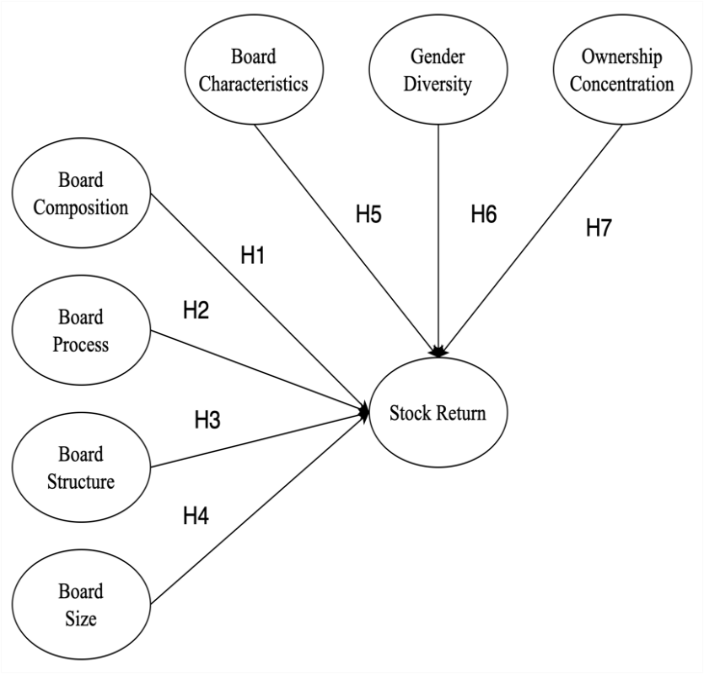
Figure 1: Conceptual Framework
Source: Author
Influence of Corporate Governance Internal Mechanism to the Stock Return
In the past, research has been conducted on the relationship between corporate governance and stock returns. A study that was previously published in various journals found that such a relationship exists. The following are the results of previous investigations that were gathered from selected journal articles.
MATERIALS AND METHODS
The main goal of a systematic literature review is to compile and evaluate the research that is currently being done on the topic of interest, producing objective findings that can be verified and replicated [57]. A systematic literature review is a comprehensive evaluation of research findings with the aim of grouping comparable works and assisting in the development of recommendations based on evidence for subject matter experts in the field of study [57]. This study uses 20 articles gathered from research article from reputable sources.
RESULTS
The researched variables have been identified from the literature review. Based on the initial review, stock return is affected by board composition, board process, board structure, board size and board characteristics. Furthermore, in this research two variables are added. The variables are gender diversity and ownership concentration. This addition due to inconsistent results on the additional variables. The conceptual framework is shown in Figure 1.
CONCLUSION
Study of internal corporate governance mechanism and role of corporate governance in the performance of businesses had always been a popular topic, as this problem has grown increasingly significant from around world in terms of current revelations and company financial crisis. After conducting a comprehensive and structured analysis of the relevant literature on the internal corporate governance mechanism and stock return, this systematic literature review has synthesized a conceptual framework. Corporate governance mechanism has various indexes that can be measured and each of this has different influence to the company. Variables that are found to have relationship with stock return are board composition, board process, board structure, board size, board characteristics, gender diversity and ownership concentration. The conceptual framework depicts the relationship between corporate governance factors and stock return. Understanding and implementing corporate governance is critical to determine its significancy to the stock return level in the future.
Ditta, A.S.A. and D. Setiawan. “Corporate governance in Indonesia: One-decade perspective.” Jurnal Keuangan dan Perbankan, vol. 23, no. 1, 2019. https://doi.org/10.26905/jkdp.v23i1.2182
Cadbury, A. Report of the Committee on the Financial Aspects of Corporate Governance. 1992.
Fama, E.F. and M.C. Jensen. “Separation of ownership and control.” The Journal of Law and Economics, vol. 26, no. 2, 1983, pp. 301–325. https://doi.org/10.1086/467037
Ararat, M. et al. “The effect of corporate governance on firm value and profitability: Time-series evidence from Turkey.” Emerging Markets Review, vol. 30, 2017, pp. 113–132. https://doi.org/10.1016/j.ememar.2016.10.001
Areneke, G. et al. “Transfer of corporate governance practices into weak emerging market environments by foreign institutional investors.” International Business Review, 2022, p. 101978. https://doi.org/10.1016/j.ibusrev.2022.101978
Brogi, M. and V. Lagasio. “Better safe than sorry: Bank corporate governance, risk-taking and performance.” Finance Research Letters, vol. 44, 2022, p. 102039. https://doi.org/10.1016/j.frl.2021.102039
Caselli, S. “Governance and strategy within the financial system: Tradition and innovation.” Journal of Management and Governance, vol. 14, no. 3, 2010, pp. 241–271. https://doi.org/10.1007/s10997-010-9149-y
Adegbite, E. et al. “The politics of shareholder activism in Nigeria.” Journal of Business Ethics, vol. 105, no. 3, 2012, pp. 389–402. https://doi.org/10.1007/s10551-011-0974-y
Agbim, K.C. “Effect of ethical leadership on corporate governance, performance and social responsibility: A study of selected deposit money banks in Benue state, Nigeria.” International Journal of Community Development and Management Studies, vol. 2, 2018, pp. 19–35. http://ijcdms.org/Volume02/v2p019-035Agbim4291.pdf
Areneke, G. and D. Kimani. “Value relevance of multinational directorship and cross-listing on MNES national governance disclosure practices in sub-saharan Africa: Evidence from Nigeria.” Journal of World Business, vol. 54, no. 4, 2019, pp. 285–306. https://doi.org/10.1016/j.jwb.2018.10.003
Aust, V. et al. “How does foreign direct investment contribute to sustainable development goals? Evidence from African Countries.” Journal of Cleaner Production, vol. 245, 2020, p. 118823. https://doi.org/10.1016/j.jclepro.2019.118823
Banks, E. Corporate Governance: Financial Responsibility, Controls and Ethics. n.d.
Ferreira, M.A. and P. Matos. “The colors of investors’ money: The role of institutional investors around the World.” Journal of Financial Economics, vol. 88, no. 3, 2008, pp. 499–533. https://doi.org/10.1016/j.jfineco.2007.07.003
Estélyi, K.S. and T.M. Nisar. “Diverse boards: Why do firms get foreign nationals on their boards?” Journal of Corporate Finance, vol. 39, 2016, pp. 174–192. https://doi.org/10.1016/j.jcorpfin.2016.02.006
Jensen, M.C. and W.H. Meckling. “Theory of the Firm: managerial behavior, agency costs and ownership structure.” Journal of Financial Economics, vol. 3, no. 4, 1976, pp. 305–360. https://doi.org/10.1016/0304-405X(76)90026-X
Narwastu, A. and R. Wijayanti. “The role of corporate governance and financial performance on company’s stock return (Study Case LQ-45 Period of 2010–2015).” Jurnal Ilmiah Mahasiswa Fakultas Ekonomi dan Bisnis, vol. 8, no. 2, 2020.
Dodd, E.M. et al. The Modern Corporation and Private Property.University of Pennsylvania Law Review and American Law Register, vol. 81, no. 6, 1933, p. 782. https://doi.org/10.2307/3308267
Ghafoor Awan, A. et al. “Problems of corporate governance in USA.” European Journal of Business and Innovation Research, vol. 2, no. 2, 2014. www.eajournals.org
Dedman, E. “The cadbury committee recommendations on corporate governance - A review of Compliance and Performance Impacts.” International Journal of Management Reviews, vol. 4, no. 4, 2002, pp. 335–352. https://doi.org/10.1111/1468-2370.00091.
Boubakri, N. et al. “Political connections and the cost of equity capital.” Journal of Corporate Finance, vol. 18, no. 3, 2012, pp. 541–559. https://doi.org/10.1016/j.jcorpfin.2012.02.005.
Chen, S. et al. “Government intervention and investment efficiency: evidence from China.” Journal of Corporate Finance, vol. 17, no. 2, 2011, pp. 259–271. https://doi.org/10.1016/j.jcorpfin.2010.08.004.
Boycko, M. et al. “A theory of privatisation.” The Economic Journal, vol. 106, no. 435, 1996, p. 309. https://doi.org/10.2307/2235248.
Shleifer, A. “State versus private ownership.” Journal of Economic Perspectives, vol. 12, no. 4, 1998, pp. 133–150. https://doi.org/10.1257/jep.12.4.133.
Shleifer, A. and Vishny, R.W. “Politicians and firms.” The Quarterly Journal of Economics, vol. 109, no. 4, 1994, pp. 995–1025. https://doi.org/10.2307/2118354.
Dore, R. “Deviant or different? Corporate governance in Japan and Germany.” Corporate Governance: An International Review, vol. 13, no. 3, 2005, pp. 437–446. https://doi.org/10.1111/j.1467-8683.2005.00438.x.
Gilson, R.J. and Roe, M.J. “Understanding the japanese keiretsu: Overlaps between corporate governance and industrial organization.” The Yale Law Journal, vol. 102, no. 4, 1993, p. 871. https://doi.org/10.2307/796835.
Sabbaghi, O. “Corporate governance in China: A review.” Corporate Governance: The International Journal of Business in Society, vol. 16, no. 5, 2016, pp. 866–882. https://doi.org/10.1108/CG-12-2015-0162.
Brick, I.E. and Chidambaran, N.K. “Board meetings, committee structure and firm value.” Journal of Corporate Finance, vol. 16, no. 4, 2010, pp. 533–553. https://doi.org/10.1016/j.jcorpfin.2010.06.003.
Sadat Sajadi, H. et al. “Evaluating the university’s governing board: A comprehensive review of its domains and indicators.” American Journal of Educational Research, vol. 2, no. 10, 2014, pp. 892–897. https://doi.org/10.12691/education-2-10-7.
Sangboonnak, R. and Prasertsri, W. An Analysis of Corporate Governance, Earnings Quality and Stock Returns of Listed Companies on the Stock Exchange of Thailand. Rajamangala University of Technology Thanyaburi, 2016.
Mandala, N. et al. “Gender diversity of boards, board composition and firm performance.” European Scientific Journal, ESJ, vol. 13, no. 34, 2017, p. 62. https://doi.org/10.19044/esj.2017.v13n34p62.
Müller, V.-O. “The impact of board composition on the financial performance of FTSE100 Constituents.” Procedia - Social and Behavioral Sciences, vol. 109, 2014, pp. 969–975. https://doi.org/10.1016/j.sbspro.2013.12.573.
Chiyachantana, C.N. et al. “Board composition, board diversity and stock performance.” International Journal of Business and Economics, vol. 6, no. 2, 2021.
Okon Akpan, E. “Board characteristics and company performance: evidence from Nigeria.” Journal of Finance and Accounting, vol. 2, no. 3, 2014, p. 81. https://doi.org/10.11648/j.jfa.20140203.17.
Bhagat, S. and Black, B. “Available on SSRN at business lawyer 921–963 (1999), Available at Journal of Corporation Law (Vol. 2).” SSRN. https://ssrn.com/abstract=1139191.
Anwaar, M. “Impact of firms’ performance on stock returns (Evidence from listed companies of FTSE-100 Index London, UK).” Global Journals Inc, vol. 16, 2016.
Leuz, C. et al. “Earnings management and investor protection: An international comparison.” Journal of Financial Economics, vol. 69, no. 3, 2003, pp. 505–527. https://doi.org/10.1016/S0304-405X(03)00121-1.
Wijayanti, R. et al. “The effect of quality of internal corporate governance mechanisms on investors’ confidence: Evidence among Indonesian sharia compliant companies.” International Journal of Economic Research, vol. 14, 2017a. http://www.serialsjournals.com.
Ballester, L. et al. “The role of internal corporate governance mechanisms on default risk: A systematic review for different institutional settings.” Research in International Business and Finance, vol. 54, 2020. https://doi.org/10.1016/j.ribaf.2020.101293.
Guest, P.M. “The impact of board size on firm performance: Evidence from the UK.” The European Journal of Finance, vol. 15, no. 4, 2009, pp. 385–404. https://doi.org/10.1080/13518470802466121.
Anderson, R.C. et al. “Board characteristics, accounting report integrity and the cost of debt.” Journal of Accounting and Economics, vol. 37, no. 3, 2004, pp. 315–342. https://doi.org/10.1016/j.jacceco.2004.01.004.
Dalton, D.R. et al. “Number of directors and financial performance: A meta-analysis.” Academy of Management Journal, vol. 42, no. 6, 1999, pp. 674–686. https://doi.org/10.2307/256988.
Ludwig, P. and Sassen, R. “Which internal corporate governance mechanisms drive corporate sustainability?” Journal of Environmental Management, vol. 301, 2022, 113780. https://doi.org/10.1016/j.jenvman.2021.113780.
Cerbioni, F. and Parbonetti, A. “Exploring the effects of corporate governance on intellectual capital disclosure: An analysis of european biotechnology companies.” European Accounting Review, vol. 16, no. 4, 2007, pp. 791–826. https://doi.org/10.1080/09638180701707011.
Carcello, J.V. and Neal, T.L. “Audit committee composition and auditor reporting.” The Accounting Review, vol. 75, no. 4, 2000, pp. 453–467. https://doi.org/10.2308/accr.2000.75.4.453.
Klein, A. “Audit committee, board of director characteristics and earnings management.” Journal of Accounting and Economics, 2002, pp. 375–400.
Bicksler, J.L. et al. “Corporate governance.” The Journal of Finance, vol. 51, no. 2, 1996, p. 774. https://doi.org/10.2307/2329384.
Vandegrift, D. and Brown, P. “gender differences in the use of high-variance strategies in tournament competition.” The Journal of Socio-Economics, vol. 34, no. 6, 2005, pp. 834–849. https://doi.org/10.1016/j.socec.2005.07.028.
Chen, S. et al. “Gender diversity in the boardroom and risk management: A case of RandD investment.” Journal of Business Ethics, vol. 136, no. 3, 2016, pp. 599–621. https://doi.org/10.1007/s10551-014-2528-6.
Rostami, S. et al. “The effect of corporate governance components on return on assets and stock return of companies listed in Tehran stock exchange.” Procedia Economics and Finance, vol. 36, 2016a, pp. 137–146. https://doi.org/10.1016/S2212-5671(16)30025-9.
Raithatha, M. and Haldar, A. “Are internal governance mechanisms efficient? The case of a developing economy.” IIMB Management Review, vol. 33, no. 3, 2021, pp. 191–204. https://doi.org/10.1016/j.iimb.2021.08.004.
Hegde, S. et al. “Ownership concentration and stock returns: evidence from family firms in India.” Pacific-Basin Finance Journal, vol. 61, 2020, 101330. https://doi.org/10.1016/j.pacfin.2020.101330.
Lame, G. “Systematic literature reviews: An introduction.” Proceedings of the Design Society: International Conference on Engineering Design, vol. 1, no. 1, 2019, pp. 1633–1642. https://doi.org/10.1017/dsi.2019.169.
Rostami, S. et al. “the effect of corporate governance components on return on assets and stock return of companies listed in Tehran stock exchange.” Procedia Economics and Finance, vol. 36, 2016b, pp. 137–146. https://doi.org/10.1016/s2212-5671(16)30025-9.
Koerniadi, H. et al. “Corporate governance and the variability of stock returns.” International Journal of Managerial Finance, vol. 10, no. 4, 2014, pp. 494–510. https://doi.org/10.1108/IJMF-08-2012-0090.
DasGupta, R. and Deb, S.G. “Role of corporate governance in moderating the risk-return paradox: cross country evidence.” Journal of Contemporary Accounting and Economics, 2022. https://doi.org/10.1016/j.jcae.2022.100313.
Hsu, Y.-L. and L.-K. Liao. “Corporate governance and stock performance: the case of covid-19 Crisis.” Journal of Accounting and Public Policy, 2021, 106920. https://doi.org/10.1016/j.jaccpubpol.2021.106920.
Aren, S. et al. “The Determinants and effects of corporate governance level: Evidence from Istanbul Stock Exchange.” Procedia - Social and Behavioral Sciences, vol. 150, 2014, pp. 1061–1070. https://doi.org/10.1016/j.sbspro.2014.09.118.
Haß, L.H. et al. “Corporate governance and the information environment: Evidence from Chinese stock markets.” International Review of Financial Analysis, vol. 36, 2014, pp. 106–119. https://doi.org/10.1016/j.irfa.2014.03.010.
Shahid, M.S. and M. Abbas. “Does corporate governance play any role in investor confidence, corporate investment decisions relationship? Evidence from Pakistan and India.” Journal of Economics and Business, 2019, 105. https://doi.org/10.1016/j.jeconbus.2019.03.003.
Bebchuk, L.A. et al. “Learning and the disappearing association between governance and returns.” Journal of Financial Economics, vol. 108, no. 2, 2013, pp. 323–348. https://doi.org/10.1016/j.jfineco.2012.10.004.
Peng, H. et al. “Corporate governance, technical efficiency and financial performance: Evidence from Chinese Listed tourism firms.” Journal of Hospitality and Tourism Management, vol. 48, 2021, pp. 163–173. https://doi.org/10.1016/j.jhtm.2021.06.005.
Chandra, A.L. and E. Rusliati. “financial leverage and liquidity on good corporate governance and stock return.” Jurnal Riset Akuntansi Kontemporer, vol. 11, no. 2, 2019, pp. 78–87. https://doi.org/10.23969/jrak.v11i2.3146.
Agyemang, Joseph Kwasi and Barjoyai Bin Bardai. “The mediating effect of corporate governance on the relationship between accounting information and stock market return of listed entities in Ghana.” Journal of Modern Accounting and Auditing, vol. 18, no. 2, 2022. https://doi.org/10.17265/1548-6583/2022.02.002.
Tsafack, G. and L. Guo. “Foreign shareholding, corporate governance and firm performance: Evidence from Chinese Companies.” Journal of Behavioral and Experimental Finance, vol. 31, 2021. https://doi.org/10.1016/j.jbef.2021.100516.
Uyar, A. et al. “Board structure and financial stability of financial firms: Do board policies and ceo duality matter?” Journal of International Accounting, Auditing and Taxation, vol. 47, 2022. https://doi.org/10.1016/j.intaccaudtax.2022.100474.
Bhatia, M. and R. Gulati. “Board Governance and Bank Performance: A Meta-Analysis.” Research in International Business and Finance, vol. 58, 2021. https://doi.org/10.1016/j.ribaf.2021.101425.
Giroud, X. and H.M. Mueller. “Corporate governance, product market competition and equity prices.” The Journal of Finance, vol. LXVI, no. 2, 2011.
Wijayanti, R. et al. “The effect of quality of internal corporate governance mechanisms on investors’ confidence: Evidence among Indonesian Sharia Compliant Companies.” International Journal of Economic Research, vol. 14, 2017b. http://www.serialsjournals.com.
License
Creative Commons Attribution-NonCommercial-NoDerivatives 4.0 International License
All papers should be submitted electronically. All submitted manuscripts must be original work that is not under submission at another journal or under consideration for publication in another form, such as a monograph or chapter of a book. Authors of submitted papers are obligated not to submit their paper for publication elsewhere until an editorial decision is rendered on their submission. Further, authors of accepted papers are prohibited from publishing the results in other publications that appear before the paper is published in the Journal unless they receive approval for doing so from the Editor-In-Chief.
Himalayan Journal of Economics and Business Management open access articles are licensed under a Creative Commons Attribution-Share A like 4.0 International License. This license lets the audience to give appropriate credit, provide a link to the license, and indicate if changes were made and if they remix, transform, or build upon the material, they must distribute contributions under the same license as the original.
Recommended Articles
Research Article
Influence of Leadership on Poverty Reduction in the Devolved Government in Trans-Nzoia County, Kenya
Kinisu Sifuna,
...
Peter Simotwo
Published: 30/06/2021
Download PDF
Cite
x
APA
Sifuna, K., Lwangale, D. W., Simotwo, P., Sifuna, K., Lwangale, D. W. & Simotwo, P. (2021). Influence of Leadership on Poverty Reduction in the Devolved Government in Trans-Nzoia County, Kenya. Himalayan Journal of Economics and Business Management, 2(1), None-None.
MLA
Sifuna, Kinisu, et al. "Influence of Leadership on Poverty Reduction in the Devolved Government in Trans-Nzoia County, Kenya." Himalayan Journal of Economics and Business Management 2.1 (2021): None-None.
Chicago
Sifuna, Kinisu, David W. Lwangale, Peter Simotwo, Kinisu Sifuna, David W. Lwangale and Peter Simotwo. "Influence of Leadership on Poverty Reduction in the Devolved Government in Trans-Nzoia County, Kenya." Himalayan Journal of Economics and Business Management 2, no. 1 (2021): None-None.
Harvard
Sifuna, K., Lwangale, D. W., Simotwo, P., Sifuna, K., Lwangale, D. W. and Simotwo, P. (2021) 'Influence of Leadership on Poverty Reduction in the Devolved Government in Trans-Nzoia County, Kenya' Himalayan Journal of Economics and Business Management 2(1), pp. None-None.
Vancouver
Sifuna K, Lwangale DW, Simotwo P, Sifuna K, Lwangale DW, Simotwo P. Influence of Leadership on Poverty Reduction in the Devolved Government in Trans-Nzoia County, Kenya. Himalayan Journal of Economics and Business Management. 2021 Jan;2(1):None-None.
Download PDF
Research Article
Modelling Structure Job Quality, Job Design and Job Satisfaction
Moch Nurhadi,
...
Avi Sunani
Published: 30/08/2022
Download PDF
Cite
x
APA
Nurhadi, M., Bisyri Effendi, M., Saiful Ulum, A. & Sunani, A. (2022). Modelling Structure Job Quality, Job Design and Job Satisfaction. Himalayan Journal of Economics and Business Management, 3(2), 1-4.
MLA
Nurhadi, Moch, et al. "Modelling Structure Job Quality, Job Design and Job Satisfaction." Himalayan Journal of Economics and Business Management 3.2 (2022): 1-4.
Chicago
Nurhadi, Moch, Moch Bisyri Effendi, Achmad Saiful Ulum and Avi Sunani. "Modelling Structure Job Quality, Job Design and Job Satisfaction." Himalayan Journal of Economics and Business Management 3, no. 2 (2022): 1-4.
Harvard
Nurhadi, M., Bisyri Effendi, M., Saiful Ulum, A. and Sunani, A. (2022) 'Modelling Structure Job Quality, Job Design and Job Satisfaction' Himalayan Journal of Economics and Business Management 3(2), pp. 1-4.
Vancouver
Nurhadi M, Bisyri Effendi M, Saiful Ulum A, Sunani A. Modelling Structure Job Quality, Job Design and Job Satisfaction. Himalayan Journal of Economics and Business Management. 2022 Jul;3(2):1-4.
Download PDF
Research Article
Proposed Digital Marketing Strategy to Enhance Engineering Consultancy Company Revenue
Alfarisy, K. A.,
Wandebori, H.
Published: 30/04/2024
Download PDF
Cite
x
APA
K. A., A. & H., W. (2024). Proposed Digital Marketing Strategy to Enhance Engineering Consultancy Company Revenue. Himalayan Journal of Economics and Business Management, 5(1), 1-18.
MLA
K. A., Alfarisy, and Wandebori, H.. "Proposed Digital Marketing Strategy to Enhance Engineering Consultancy Company Revenue." Himalayan Journal of Economics and Business Management 5.1 (2024): 1-18.
Chicago
K. A., Alfarisy, and Wandebori, H.. "Proposed Digital Marketing Strategy to Enhance Engineering Consultancy Company Revenue." Himalayan Journal of Economics and Business Management 5, no. 1 (2024): 1-18.
Harvard
K. A., A. and H., W. (2024) 'Proposed Digital Marketing Strategy to Enhance Engineering Consultancy Company Revenue' Himalayan Journal of Economics and Business Management 5(1), pp. 1-18.
Vancouver
K. A. A, H. W. Proposed Digital Marketing Strategy to Enhance Engineering Consultancy Company Revenue. Himalayan Journal of Economics and Business Management. 2024 Jan;5(1):1-18.
Download PDF
Research Article
The Constitutional and Legislative Basis for Considering the Taxable Capacity of Taxpayers in Iraqi Tax Legislation
Hussein Kamel Wadaa
Published: 05/05/2025
Download PDF
Cite
x
APA
Wadaa, H. K. (2025). The Constitutional and Legislative Basis for Considering the Taxable Capacity of Taxpayers in Iraqi Tax Legislation. Himalayan Journal of Economics and Business Management, 6(1), 1-10.
MLA
Wadaa, Hussein Kamel. "The Constitutional and Legislative Basis for Considering the Taxable Capacity of Taxpayers in Iraqi Tax Legislation." Himalayan Journal of Economics and Business Management 6.1 (2025): 1-10.
Chicago
Wadaa, Hussein Kamel. "The Constitutional and Legislative Basis for Considering the Taxable Capacity of Taxpayers in Iraqi Tax Legislation." Himalayan Journal of Economics and Business Management 6, no. 1 (2025): 1-10.
Harvard
Wadaa, H. K. (2025) 'The Constitutional and Legislative Basis for Considering the Taxable Capacity of Taxpayers in Iraqi Tax Legislation' Himalayan Journal of Economics and Business Management 6(1), pp. 1-10.
Vancouver
Wadaa HK. The Constitutional and Legislative Basis for Considering the Taxable Capacity of Taxpayers in Iraqi Tax Legislation. Himalayan Journal of Economics and Business Management. 2025 Jan;6(1):1-10.
Napitupulu, A. E. N. & Damayanti, S. M. (2023). The Effect of Corporate Governance Internal Mechanism to the Stock Return: A Literature Review. Himalayan Journal of Economics and Business Management, 4(1), 1-9.
MLA
Napitupulu, Anastasya E. N. and Sylviana M. Damayanti. "The Effect of Corporate Governance Internal Mechanism to the Stock Return: A Literature Review." Himalayan Journal of Economics and Business Management 4.1 (2023): 1-9.
Chicago
Napitupulu, Anastasya E. N. and Sylviana M. Damayanti. "The Effect of Corporate Governance Internal Mechanism to the Stock Return: A Literature Review." Himalayan Journal of Economics and Business Management 4, no. 1 (2023): 1-9.
Harvard
Napitupulu, A. E. N. and Damayanti, S. M. (2023) 'The Effect of Corporate Governance Internal Mechanism to the Stock Return: A Literature Review' Himalayan Journal of Economics and Business Management 4(1), pp. 1-9.
Vancouver
Napitupulu AEN, Damayanti SM. The Effect of Corporate Governance Internal Mechanism to the Stock Return: A Literature Review. Himalayan Journal of Economics and Business Management. 2023 Jan;4(1):1-9.



 Download PDF
 Download XML